



The owner of Parkwood Deli in Midland Park, New Jersey, Roger Schnorrbusch — known to his nearly 830,000 TikTok followers as “the deli guy” — has been serving sandwiches for over two decades. A viral personality due to his hyped-up, theatrical videos featuring him whipping up a chicken parmesan sandwich or an eggplant parm stacked with hot peppers, his videos rack up thousands of views, and customers come in from as far as California to grab a bite.
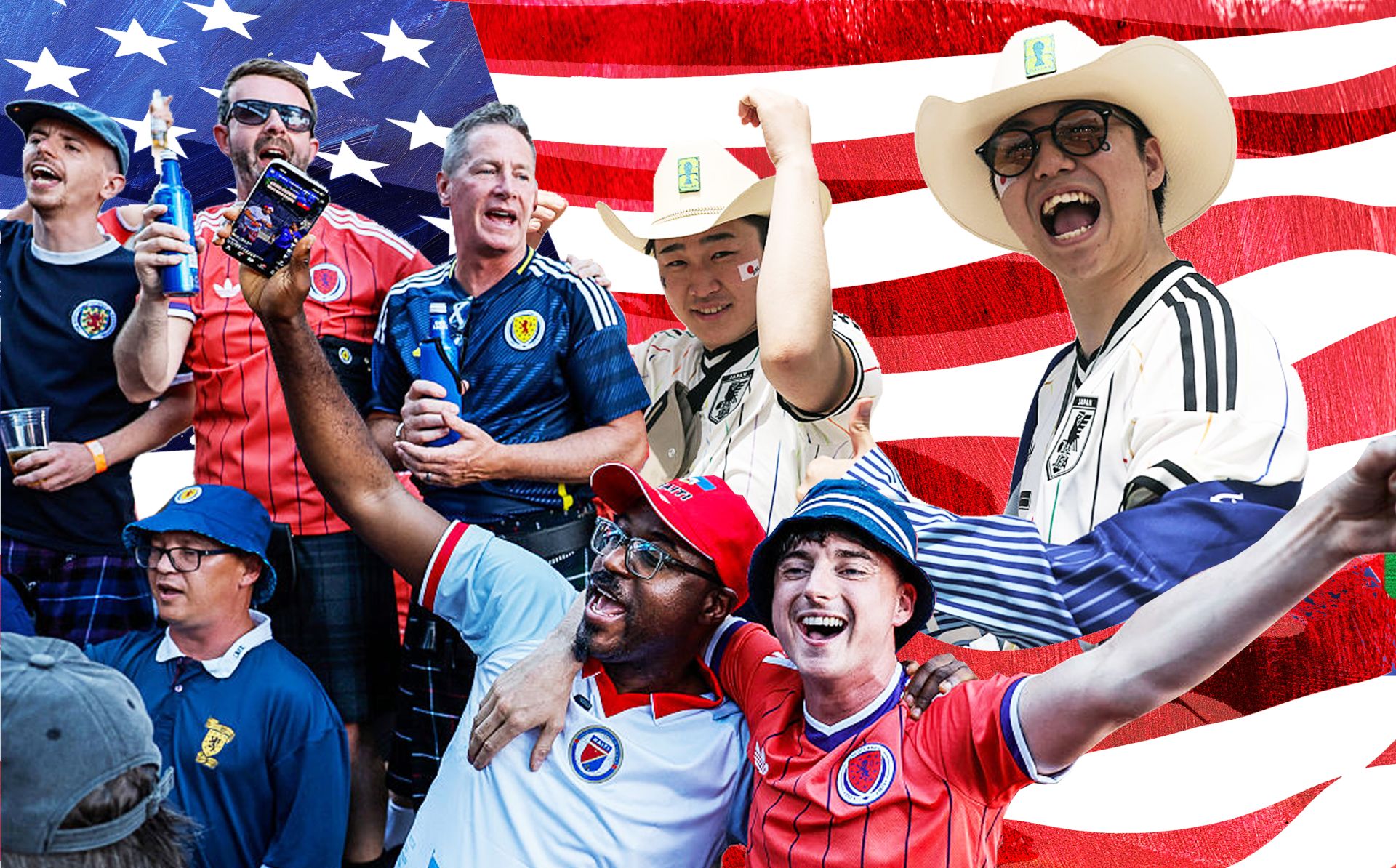
Last month, however, he started drawing a different kind of crowd, as soccer fans from countries such as Norway, Scotland and England began treating the deli as a pit stop en route to FIFA World Cup matches. As clips of their friendly banter began to get millions of views, Americans in the comments, genuinely moved, called it the “best PR the country has produced in years.” Others were reminded of “the America they grew up in,” seeing proof of a still warm and welcoming American hospitality.
Schnorrbusch’s own theory was less sentimental. He told the local news that visitors were amazed purely by scale, since a lot of countries just don’t make sandwiches that big. But, to many people, Schnorrbusch represented an America that was friendly, local, unbothered and generous by habit.
In the last few weeks, as fans from across Europe and other parts of the world traveled through the United States for the World Cup, following their teams from city to city, they discovered an America that tends not to make it into global news headlines, at least not in recent years. They met friendly strangers who offered rides to and from stadiums, discovered big portion sizes and free refills in American restaurants, and developed an unexpected fondness for ranch dressing, wanting to take it back home as a souvenir. (Sensing an opportunity, the food company Kraft Heinz, in true American fashion, released a “TSA-Compliant Ranch” kit after the Transportation Security Administration repeatedly reminded visitors that full-size bottles could not be carried through airport security.) They felt relief at the near ubiquity of air conditioning in the summer and came face to face with the largesse and abundance of suburban America as they ventured outside the tourist hotspots of New York City, Washington and Los Angeles.
As visitors marveled at America and their reactions went viral, Americans watched them marvel and, in turn, found themselves looking at their country differently, through that foreign prism — recognizing, even celebrating, everyday aspects of life here as uniquely American. This outsider’s gaze offered a version of America that stood in sharp contrast with the one both Americans and people around the world tend to encounter through doomscrolling and the relentless churn of the news cycle.
“This World Cup is significant in terms of how we view America. Not because it changes America but because it illuminates America,” the journalist and author Simon Kuper told our colleague Faisal Al Yafai in a recent episode of the New Lines podcast, The Lede. The World Cup “tells you that America is not just Trump,” Kuper said, noting that from Europe it’s easy to conclude that since Trump was elected twice on a xenophobic platform, it defines all of the United States. But traveling through the country and meeting people, one realizes that even Trump voters “really like the world, they really like having foreigners there,” Kuper said.
This gap between the reel and the real was perhaps best captured in an interview with Sebastian Kraus, a German soccer fan who became teary-eyed while speaking to NBC10 Boston. “I fall in love with this country and this was so emotional, I even cried in the stadium,” he said. Before making the trip, Kraus admitted he had been apprehensive, his perception shaped by news reports about mass shootings and concerns over public safety. But buoyed by the generosity of local Americans, he was bidding goodbye to the country with a heavy heart.
In a viral post on X, a London-based private equity associate weighed in on the phenomenon and wrote about his friends in Paris and London having a “distorted view” of the U.S. “They think only the top 1% lives well and everyone else is trapped in social collapse (guns, healthcare horror stories, obesity, politics, LA homelessness, NYC dysfunction),” he wrote. “Then they visit random suburbs in Texas, Florida or the Midwest and see middle-class families clearing $300k+/year with huge houses, multiple cars, space, AC, full restaurants, youth sports complexes and mass retail abundance.” This underscored an “uncomfortable reality,” he said, as many Europeans underestimate the material affluence enjoyed by the American middle and upper-middle class.
Countless moments over the last few weeks have captured this transatlantic love affair. European visitors have embraced the Texas convenience store and gas station chain Buc-ee’s, as well as other American chains such as Waffle House, Chick-fil-A and the Cheesecake Factory — treating them less like roadside pit stops (as many Americans experience them) and more like American cultural experiences.
Some have stumbled across American history during their travels. Shaun Alexander, a Scottish soccer fan and YouTuber documenting his journey across the country, devoted a video to Philadelphia’s Elfreth’s Alley, the nation’s oldest continuously inhabited residential street, dating back to 1703, pushing back on the idea that the United States has “no real history of its own.”
Bostonians fell in love with Scottish fans — the Tartan Army — who made headlines for charming locals with their spirited presence in pubs and drinking virtually all of the city’s beer. As one local remarked, since the Scots brought so much joy, New England should be renamed “New Scotland.”
The timing of these encounters was momentous, as the World Cup coincided with America’s celebration of its 250th anniversary. “Good America 250 vibes will not come from our political leaders,” Republican pollster and TV personality Kristen Soltis Anderson wrote on X. “They will come from massive fireworks displays, World Cup USMNT soccer victories, and European tourists discovering and openly embracing Bass Pro Shops.” A similar sentiment was echoed at a panel in Kansas City. “With respect to the politicians in the room, it’s beautiful to realize we don’t have to rely on politicians to be the face of America but for Americans to be the face of America,” said Geoff Freeman, president and CEO of the U.S. Travel Association.
An unlikely love story also played out in the city of Lawrence, Kansas, whose residents wholeheartedly embraced the Algerian national team. As videos of locals welcoming the squad, learning their chants and using land art to create the world’s largest Algerian flag went viral, it offered yet another reminder that one of the most memorable moments of the tournament unfolded far from the field.
This romance between Americans and foreign visitors also arrives after a tumultuous year marked by tariff wars with rivals and allies alike, global fallout from the Iran conflict, military-style Immigration and Customs Enforcement (ICE) operations in U.S. cities that left multiple people dead, a visible cooling in Europeans’ attitude to America, and domestic polling showing a sharp decline in Americans’ pride in their country. Perceptions of America are now almost entirely colored by the Trump presidency.
Several recent studies and surveys illustrate this. A YouGov poll in February showed that European opinion turned sharply negative toward the U.S. after the Greenland showdown, reaching its lowest point since the U.K.-based firm started tracking the sentiment in 2016. The number of Europeans “seeing America as either a friend and ally, or at least a friendly rival” also fell significantly since their last survey in 2023. Another poll in June by the European Council on Foreign Relations said that only 11% of Europeans across 15 countries viewed the United States as an ally, a historic low (and down from 16% half a year ago and 22% in November 2024).
And Americans themselves are deeply divided on almost every measure of national feeling. A poll released in June by the Public Religion Research Institute, “Competing Visions of America at 250: Politics, Religion, and American Identity,” found that only 24% of Americans see their country as a good moral example for the world and a mere 18% are happy with the way democracy is working in America today. (The survey was conducted among a representative sample of 5,469 adults living in all 50 states.) A June survey from the Emerson College Polling Center found that more Americans (41%) are pessimistic about the country’s future in 2026 than in 1976 (15%), when the Roper Organization conducted a similar survey.
There’s a long history of foreigners coming to America and observing dynamics that Americans don’t see, or don’t see in quite the same way. One of the most influential books in the history of American political thought is “Democracy in America” by the French writer Alexis de Tocqueville, published in two volumes in 1835 and 1840. Tocqueville traveled throughout the young nation over nine and a half months, observing various aspects of the American experiment and talking to a wide range of people, from politicians to ordinary citizens. As one commentator put it, Tocqueville “wound up explaining this country better than anyone before or since.”
In her fascinating book “Democracy and the Foreigner,” the Canadian political theorist Bonnie Honig argues that democracies in fact depend on outsiders for their very legitimacy. Immigrants choose to come to the U.S., for example. And when they raise their hands to take the pledge of citizenship, they formally enact the consent upon which our political system depends. Native-born Americans, by contrast, don’t choose to be American and never engage in these rituals of citizenship. It’s not just the considerable economic and material contributions immigrants make, Honig argues — they play a vital symbolic role for the very lifeblood of democracy.
As immigrants often discuss, native-born Americans take a lot of things for granted — not just their affluence and comfort, but their relative political freedoms and rights. People from many parts of the world don’t have the luxury of such presumptions. They know from their own experience what it’s like not to have these things. Immigrants and refugees who have fled repression and authoritarianism have a lot to teach people who have never experienced those horrors. Another political theorist (and New Lines contributor), Paul Apostolidis, makes this case poignantly in his book “Breaks in the Chain: What Immigrant Workers Can Teach America About Democracy.”
The World Cup comes to an end this weekend, and foreign fans will go back to their countries, but they will take their experiences of America — captured in those viral videos — with them. And they will leave those experiences here, with the Americans they met and talked to and drank with. They will also leave their impressions of America and of Americans, which allowed Americans to see themselves and their country reflected back to them. Perhaps Americans will have learned things about their own country through that encounter, things that only outsiders can see.
Become a member today to receive access to all our paywalled essays and the best of New Lines delivered to your inbox through our newsletters.