


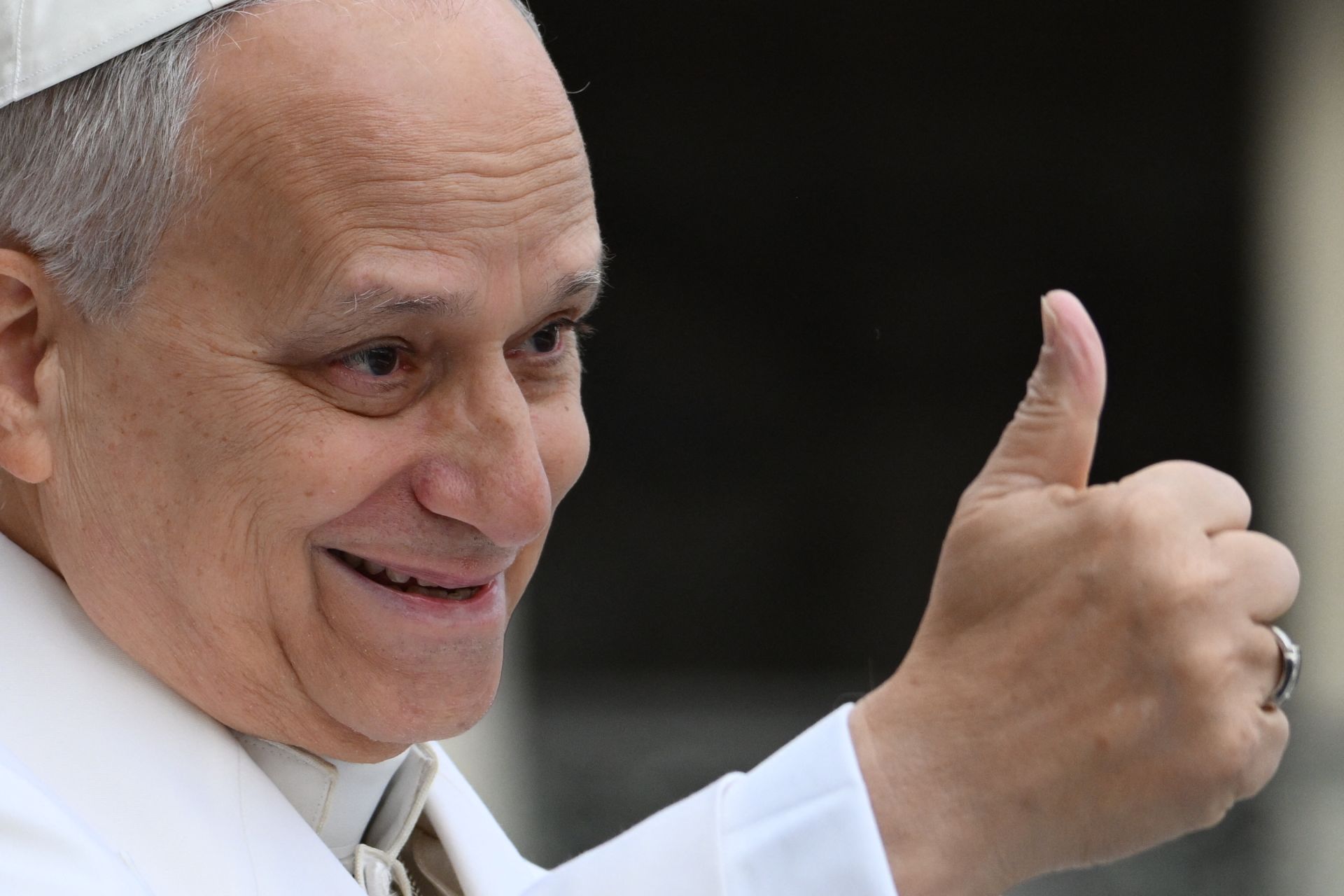
There is a moment in Rome, crossing the Ponte Sant’Angelo among Bernini’s angels, with the Tiber opening wide below, the Castel Sant’Angelo rising ahead and the dome of St. Peter’s glimpsed to the left in the distance, when the city stops being secular and begins to become sacred. These two cities — the secular and the sacred — have recently united around the figure of the pope in response to an unprecedented incident. For the first time, a sitting U.S. president publicly questioned the legitimacy of a pope’s election. And Pope Leo XIV refuses to back down from confronting him.
The conflict between perhaps the two most famous Americans on the planet has no historical precedent, not least because Leo XIV is the first American pope.
“It is an event that evokes the historical clashes between the papacy and the empire,” Giovanni Maria Vian, historian and former editor of L’Osservatore Romano, the Holy See’s daily newspaper, told New Lines. He described the confrontation between the pope and the U.S. president as “unprecedented,” adding that it “speaks volumes about the moment we are living through,” referring to the end of the world order that was created after World War II.
Half a year ago, shortly before the first anniversary of Leo’s papacy, a senior Vatican diplomat was summoned to the Pentagon. This was not a courtesy call. Some sources inside the Holy See described the meeting as a confrontation: U.S. defense officials allegedly warned that Washington had the military power to act as it pleased and that the church had better take its side.
That meeting marked the beginning of a rupture without precedent in the modern era. President Donald Trump has since questioned the legitimacy of the pope’s election, posted an AI-generated image of himself as Jesus, and declared he is “not a fan of Pope Leo.” Leo, for his part, has said he has “no fear of the Trump administration” and has continued to speak out.
A mural a few steps from Piazza Navona sums up the Leo XIV factor. TVBoy, an Italian neo-pop street artist, has portrayed the Chicago-born pope as smiling, the U.S. flag behind him, wearing a red cassock with the number 14 printed on his chest. In the mural, Leo holds a basketball emblazoned with the words “Chicago … Pope.” For Romans, and for Europeans in general, the American to love is not Donald J. Trump but Robert Francis Prevost, as the pope was christened. Italians look to Leo, the first American pontiff and only the second native English speaker, as an icon standing against a mad, warmongering U.S. president that even Italy’s conservative nationalists cannot bring themselves to like. He is perceived as a figure in continuity with Pope Francis’ pastoral vision, but with a different personal history.
The pope wants to highlight violations of international law and the dismantling of multilateralism and international institutions, acts which from his perspective are harmful to all of humanity, not just the U.S. When Trump threatened to make an entire civilization — the Persian one — disappear, implying that he would use weapons of mass destruction against Iran, Leo was at Castel Gandolfo, the papal summer residence just outside Rome. He called a press conference and delivered a statement, in which he called Trump’s threat “unacceptable” and described it as “a moral question.” He invited people to pray, but he also told his followers in the U.S. that they should tell their members of Congress “that we do not want war, we want peace.” He added: “We are a people who love peace, and there is so much need for peace in the world.”
Leo’s call was a political act, delivered six months before the midterm elections. Trump cannot afford to lose Catholic supporters, the majority of whom voted for him. And so the U.S. president went on the attack.
But this incident was only the spark that ignited a confrontation rooted in fundamentally opposing worldviews. On July 4, U.S. Independence Day, the pope will travel to Lampedusa, the island in the south of Italy that is a primary transit point for migrants from the Middle East and Africa, in a stark symbolic statement on MAGA’s anti-immigrant rhetoric and Trump’s harsh deportation policies.
Borgo Pio, the medieval street that has existed since religious pilgrims arrived on foot from across Europe, is full of rosary shops, bars, priests lining up for coffee, tourists and the faithful, all mingling. It is a place that feels far away from a U.S. president who cosplays as the pope in AI-generated images. Yet despite the overwhelming presence of tourist consumerism, one senses that this center of global Catholicism is experiencing a historical moment as its moral authority is challenged from Washington.
In a bookshop, prominently displayed, are Leo’s early writings; he is an Augustinian, who exalts the values of community. Stepping outside, St. Peter’s Square appears, with Bernini’s colonnade embracing the world and seeming to welcome even Secretary of State Marco Rubio, who came to Rome not so much as a representative of the U.S. government but as a candidate for the post-Trump era. Rubio knows his run for the White House is lost without the decisive vote of American Catholics, who have not taken kindly to Trump directing a string of insults at the pontiff. Many newspapers used the word “thaw” in describing Rubio’s meeting with Leo. But according to the Holy See’s official communique, the meeting was “frank,” which is a diplomatic adjective meaning direct, without circumlocution, and with differences in views that remain.
Antonio Spadaro is undersecretary of the Vatican Dicastery for Culture and Education, a figure representing continuity between the pontificates of Francis and Leo. He is a Jesuit, refined in culture but frank and sharp in his style of communication — as he demonstrated during a conversation with New Lines. Describing the pope’s position as “clear and direct,” Spadaro noted that while “Leo has never attacked Trump personally… [he] felt personally targeted because the American pope dared to engage with the internal dynamics of the U.S. administration. But when political power turns against a moral voice that speaks of peace — whatever Vice President Vance, himself a Catholic, may say — it means the president is powerless. He cannot bring the pope onto the terrain he dominates with the language of force.”
Sources inside the Roman Curia who do not want to be named told New Lines that for now the Vatican refuses to descend to Trump’s level and has instructed that his name be mentioned as little as possible in official communications and Vatican media. The pope does not take theology lessons from anyone; he advised Rubio to exercise “prudence” on Cuba, whose exhausted population could suffer further in the event of military intervention.
But how is the Vatican experiencing this moment of pressure from the White House? “Francis too was often criticized and misunderstood,” Spadaro said, “because he did not want to replace power but to challenge the logic of those who manage it. Today that logic is being contested not only by American Catholics but also by a portion of Trump’s own MAGA supporters.”
Spadaro continued: “The pope is very precise: He has spoken of idolatry of the self and of money, of the delusion of omnipotence. Yet our own vision risks being distorted: The United States at times appears ‘externally directed’, with an evident role played by Israel in the ongoing conflict. That said, the pope is not addressing just one country — there is a situation of chaos and a lack of strategy, even military strategy, that is deeply troubling. But the Holy See will keep dialogue and diplomatic conversation open, alongside clarity of position. Vatican diplomacy sews; it does not cut.”
Pietro Benassi, a veteran Italian ambassador and diplomat, told New Lines: “It is difficult to predict the medium-term effects of this exchange between Washington and the Holy See. Leo maintained a measured but firm style within a controversy that was itself the product of Trump’s provocation. Rubio’s subsequent visit to Rome would appear to have defused the tension. I would not rule out that the immediate solidarity of the Catholic world — including its American component — advised Donald Trump to quickly lower his tone.”
The relationship between the U.S. and the Holy See is at its lowest point since it was formalized in 1984. But what Trump does not seem to understand is that his outbursts are proving remarkably helpful in achieving one of the key objectives that led to Leo’s election. The new pope after Francis was expected to have two priorities: to prevent a world war and to reunite the Catholic community. Leo was elected in part to calm the disputes between conservative U.S. cardinals and the Vatican. It is no coincidence that his election came above all at the behest of American cardinals anxious to restore Vatican finances.
From 1922, a moment of crisis without precedent, when the Vatican’s coffers were found completely empty, until very recently, the Church of Rome benefited from a continuous flow of U.S. dollars. Encrypted cables in the Vatican Apostolic Archive reveal that without U.S. dollars in 1922, the conclave could not have been held. During the final years of Francis’ reign, that flow of money slowed as he lost support among the conservative American episcopate, which was not aligned with his vision. Catholic billionaire donors were giving less to Rome, while many Catholics in recent years converted to evangelical Christianity, pulled by a movement that is increasingly radicalized and politically aligned with Trump’s MAGA base.
Pope Leo has become the meeting point between the more conservative and the more progressive wings. Marco Politi, the doyen of Vatican journalism in Italy and author of books on the church and on Pope Francis translated worldwide, confirmed to New Lines that “Leo’s good relationship with the American bishops and his attention to doctrinal correctness should have positive effects on the attitude of donors.”
Unwittingly, then, Trump’s insults are helping Leo to effect reconciliation within the deeply fractured American Catholic Church. “Leo has stimulated the cohesion of the American episcopate in defending the human dignity of migrants, also because a very large number of the faithful are of Hispanic origin,” Politi told New Lines. “At the same time, he has been absolutely clear in rejecting the abuse of religion for political ends — an attack on MAGA ideology and evangelical fundamentalism.” Politi noted that Leo had surprised people with his powerful media presence, particularly when he took the unusual step of appealing “directly to the people to pressure their governments to stop a war he has called useless.”
Since the day Trump accused Leo of being “terrible for foreign policy,” America’s bishops have rallied around Leo in ways they never did with Francis. Even Bishop Robert Barron of Winona-Rochester, one of the most pro-Trump American bishops, said that “Trump owes the pope an apology.”
Europe’s political leaders have been critical of Trump, too. Italy’s Prime Minister Giorgia Meloni, Trump’s closest European ally, called the president’s criticism of the pope “unacceptable,” thus opening a public rift; in return, Trump publicly dropped her. Italy finds itself in the paradoxical position of being both Trump’s ally and the pope’s homeland, in that Vatican City is an enclave within Italian territory.
“Italy, faced with Trump’s outbursts, could only stand solidly on the side of the pontiff,” Benassi said. “The Italian government could not conceal a certain embarrassment in the face of the verbal attacks on the pope.” Nonetheless, Benassi added, Meloni, despite her ideological closeness to MAGA, had no choice but to describe Trump’s criticism of the pope as unacceptable, while the president’s approval rating with Italians was declining sharply.
Meanwhile, with a single move Leo has broadened his own support, reunited the American church, and increased the degree of cohesion of the church internationally, particularly in the Global South. A relaunching of the Holy See as an interlocutor on the international stage, as a point of reference for a world that looks toward peace, drawing the respect of states not entangled in war. The pope, after all, spent nearly 20 years in Peru, which is why he has described himself as a “Latin Yankee.” According to the Trump worldview, Latinos are potential criminals to be deported, while for Latin Americans, Yankees are colonialist aggressors. This pope has merged the two identities, and that alone makes him an anti-Trump symbol.
“He has united the faithful worldwide because he is the first truly global pope,” said Vian, the historian.
Arriving before Santa Maria Maggiore, as Rome’s oblique light falls on the cobblestones and the city prepares to settle into dusk, one encounters the faithful visiting the tomb of Pope Francis, who is still deeply loved here in Italy and across the world. A single thread connects Francis to Leo. From Rome, the message is clear: The pope has no desire to stand in the middle of the political arena. But he will fight like a lion against every form of war.
Become a member today to receive access to all our paywalled essays and the best of New Lines delivered to your inbox through our newsletters.