


… There, in her head of ebony,
there was no real need for the historian’s
remorse, nor for literature’s. Why not see Helen
as the sun saw her, with no Homeric shadow,
swinging her plastic sandals on that beach alone,
as fresh as the sea-wind? …
Chapter LIV, “Omeros” by Derek Walcott
In the Hindu Kush highlands where I was born, there is no word for beggar. The itinerant mendicants who walk the valley are called “mustafer,” which is Khowar for “traveler.” If one turns up at your door, you offer them food and shelter. The travelers rarely tax your generosity. The same courtesy is extended to any stranger, regardless of standing. The Pashtuns of Pakistan and Afghanistan also have the same tradition. Every Pashtun household with means has a “hujra,” usually a large room where any guest — known or unknown — is offered hospitality. The guests in turn honor the tradition by offering hospitality to others, who may be strangers to them. The tradition is sustained by paying it forward.
Ancient Greeks would recognize this tradition. They called it “xenia.” The word is derived from “xenos,” the Greek word for “stranger.” Hospitality to strangers was understood as both a moral obligation and service to the gods. Zeus and Athena were believed to be protectors of strangers. The tradition obliged the host to provide hospitality and the guest to show courtesy and not to abuse the host’s generosity. The tradition was sustained by the same combination of reciprocity and paying forward.
Such traditions have all but disappeared from the West. There are individual acts of generosity, but nothing that is sustained by a shared code. Indeed, over the past decade, the stranger has become a subject of hostility and derision — and not just for the far right. Before his defenestration, former U.K. Prime Minister Keir Starmer had mined xenophobia for political gain by lamenting Britain’s decline into an “island of strangers.” The word “xenophobia” is derived from the same root as “xenia.”
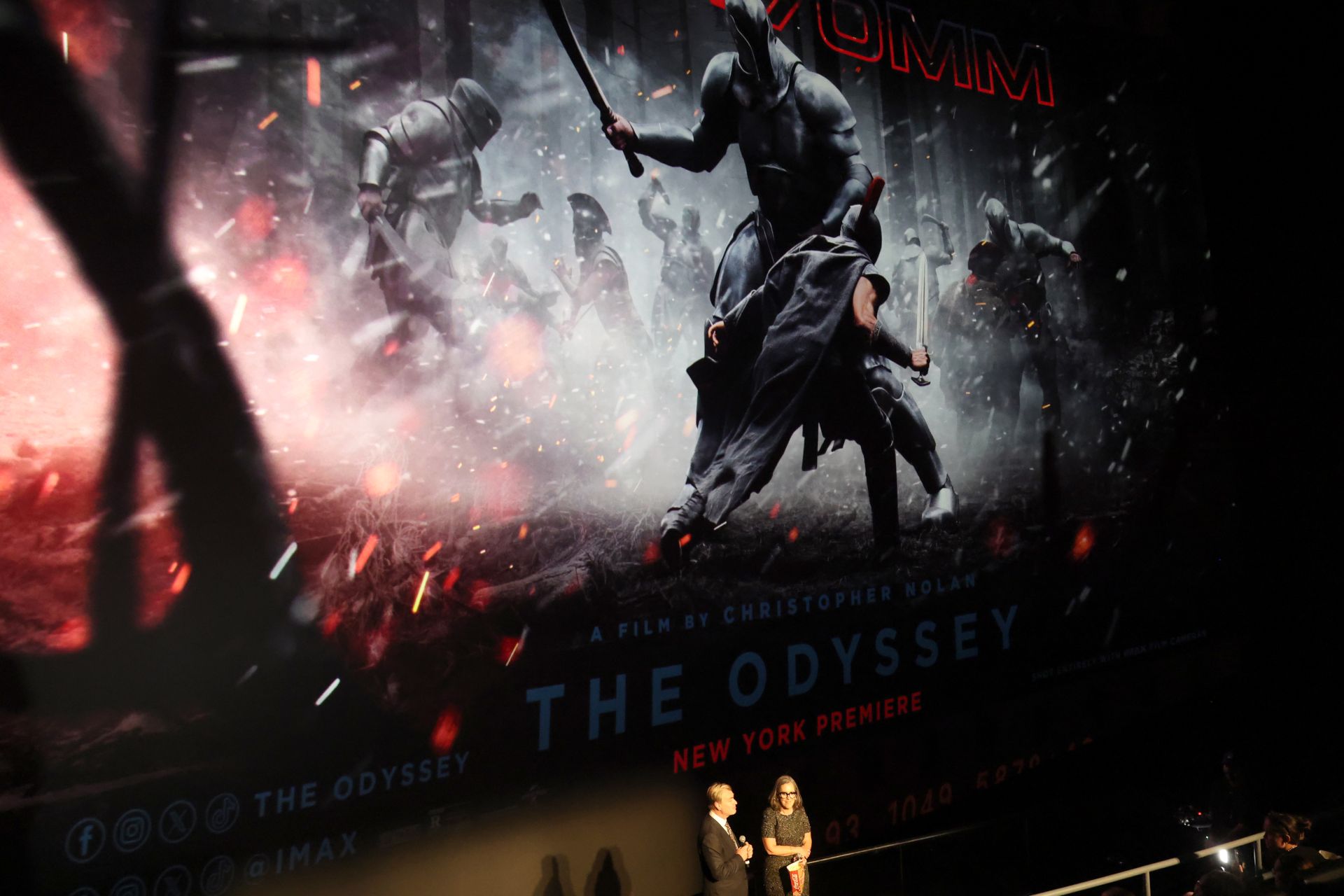
In adapting Homer’s epic “The Odyssey,” Christopher Nolan has chosen to use xenia as the moral pivot of the story. Except that Nolan broadens it into what he calls “Zeus’ law,” which he equates to the golden rule: Treat others as you’d have them treat you. In doing so, he makes the principle universal, accessible to more than an exclusive club of classicists, while also making the epic’s final irruption of violence less incomprehensible to a modern audience. Ancient Greek traditions of hospitality may not be familiar to the average cinemagoer, but everyone understands fairness.
Within the confines of Homer’s well-known tale, Nolan inserts an anti-war subtext. Odysseus, the hero, goes to war reluctantly. In a tender moment with his wife Penelope, queen of Ithaca, he confesses his misgivings. This is not a war to restore lost honor; it is a war to secure trade routes. Nolan’s Agamemnon is a menacing figure. While literalists debate whether Agamemnon’s helmet and armor are historically accurate, Nolan focuses on their effect. In the few scenes in which he appears, Agamemnon dominates the screen with power and dark authority. This is entirely due to the costume design and camera work, since the actor behind the helmet is Benny Safdie, a nerdy figure last seen in Nolan’s “Oppenheimer” playing the scientist Edward Teller. Agamemnon is a foil for Odysseus. Agamemnon is willing to pay any price for victory, including the blood of his own kin. He sacrificed his daughter Iphigenia to the gods in return for favorable winds for his fleet. He achieves martial glory. But on his triumphant return, he is killed by his wife Clytemnestra. Odysseus, on the other hand, might have been enchanted by nymphs and seduced by a sorceress but never stops pining for home, and in the end spurns the immortality promised by Calypso to be with his aging wife.
Nolan does not tell us that Calypso is a goddess. Instead, borrowing from another part of Homer’s tale, Nolan has Odysseus marooned on an island, living with Calypso in uneasy oblivion because she has been feeding him the lotus flower to suppress his memories. Nolan treats the gods as we would understand them. His characters believe in them, but the gods don’t walk among people. We hear of Zeus’ law, but we don’t see Zeus enforcing it. The gods may or may not be behind the natural forces that beset Odysseus’ journey, but he and his comrades believe they are. Calypso is just a beautiful woman with a powerful narcotic. And Athena, the only goddess who appears in human form (played by Zendaya), may just be the traumatic memory of a Trojan woman who was beheaded at the same time as the head of Athena’s statue was toppled during the sack of Troy. Odysseus’ memory is haunted by the two fused into one.
If images and words are the soul of screenwriting, its vitality comes from economy. In adaptations, pages of text are condensed into pithy lines so that the narrative is driven mainly by visuals. Side characters are fused into composites to give the story density and to ensure that an excessive fidelity to detail does not overwhelm the central theme. When Nolan adapted “Oppenheimer” from Kai Bird and Martin Sherwin’s Pulitzer Prize-winning book “American Prometheus: The Triumph and Tragedy of J. Robert Oppenheimer” (2005), he was able to tell the story without omitting any important incident or character. In “The Odyssey,” too, he has been able to retain an impressive amount of the original story. But, unusually for Nolan, who is known for his experiments with chronology and nonlinear narratives, he simplifies Homer’s storytelling devices, which include multiple narrators, stories within stories and jumps in both time and space.
In all the talk of meaning and fidelity, it’s easy to overlook the film’s technical achievements. It is the first feature film to be shot entirely on IMAX. IMAX cameras are large and loud and make it impossible to shoot dialogue. But Nolan had an enclosure built that muffles the noise enough to allow the filming of intimate conversations. The film’s sound design is meticulous. You experience every clap of thunder, every gust of wind and every one of the cyclops Polyphemus’ anguished screams viscerally. The film eschews CGI for physical effects, using animatronics, puppetry and other camera tricks to achieve its realism, even with such surreal subjects as a raging cyclops, a sorceress turning men into pigs, or the doomed Ithacans being ambushed by the giant Lystragoneans. The cinematography is deserving of every accolade for the underworld sequence alone, which simultaneously enchants and terrifies. The visuals resonate with allusions to the Spanish painter Francisco Goya, the French Symbolist Odilon Redon, the Russian filmmaker Andrei Tarkovsky, classic Hollywood and even “Star Wars.”
But if there is one production element that surpasses all else, it’s the score by Swedish prodigy Ludwig Göransson (who has already won three Oscars for his original scores, including for “Oppenheimer” and “Sinners”). Instead of an orchestra, Göransson uses Bronze Age instrumentation, including gongs, lyres and aulos, to create haunting accompaniments for the scenes. His sirens theme has already gone viral on TikTok and Instagram. But the most poignant moment comes when, in fidelity to Homer’s text, Odysseus strings his bow and plucks it, and it resonates like a lyre.
All these creative choices add up to what is easily the best adaptation of “The Odyssey” so far. The film is a cinematic marvel with standout performances from Samantha Morton as Circe, Robert Pattinson as Antinous, and John Leguizamo as Eumaeus. The film is not flawless: For a story based on the most enduring work of poetry, it has few memorable lines. Yet it succeeds both as entertaining spectacle and food for thought. Two years after he made a summer blockbuster out of a film about the belated misgivings of a scientist who oversaw the building of the atomic bomb, Christopher Nolan has made a summer blockbuster out of a 2,700-year-old epic about a man struggling to get home from war. He has also renewed interest in the book, with thousands of copies flying off the shelves.
And yet. Long before the film hit theaters, it also generated adverse reactions. At least one of these is justified. It appears the scenes with Calypso are filmed in Dakhla, part of Morocco-occupied Western Sahara. Given the film’s subject matter, its themes of exile and dispossession, this is a blemish on an otherwise stellar creation. Whether the filming in Dakhla brought any benefits to the local community or not, we do know that the Moroccan authorities milked it for publicity, with ministers putting photos of their visits to the set on the government’s official Instagram. Nolan can make amends by supporting or creating opportunities for Sahrawi artists and filmmakers.
But this is not the criticism that has dominated media coverage. A right-wing backlash brewed as soon as the cast for the film was announced. There were howls of protest at the casting of the Black actress Lupita Nyong’o as Helen and the trans man Elliot Page as the Greek foot soldier Sinon. The casting of John Leguizamo, Himesh Patel and William Yun Lee also drew ire. “Chris Nolan is pissing on Homer’s grave,” Elon Musk tweeted before denouncing the director as an “anti-White racist.” The film was not “historically accurate,” many complained. Not like “Troy” (2004), in which the blond and blue-eyed Brad Pitt played Achilles, and Helen was played by the ravishingly Teutonic Diane Kruger. Of course, both Achilles and Helen are figures from myth, not history. Achilles was the son of the Greek king Peleus and the sea goddess Thetis; Helen was born when the god Zeus, disguised as a swan, raped the Spartan queen Leda. Questions were also raised about the choice to make the ancient Greeks speak in American English. Perhaps those posing them would have preferred to see actors speaking in Greek-accented English, as Russian characters in Hollywood films are made to speak Russian-accented English. Or perhaps Odysseus should have spoken as all monarchs ought to: in the voice of King Charles as imagined by “The Crown.”
If for the right, the film’s alleged “wokeness” is a transgression, the left is still assembling reasons for its antipathy and has yet to find a coherent one. In a strangely crotchety review for the London Review of Books, the classicist Emily Wilson declared the film lacking in “psychological, emotional, political and ethical depth,” calling its narrative structure “gimmicky” and its writing “abysmal.” She finds Nolan’s “point about the contemporary Anglophone world: that the lies and xenophobia of the war on terror and Brexit began a cultural decline that is now destroying the values ‘we’ hold most dear” to be “relentlessly didactic.” In a follow-up for The Atlantic, she charges that the film “contains far more pontificating about values and civilizational decline, but much less coherence and less heart,” that it “focuses primarily on the perspective of the guilty, traumatized warrior rather than that of his victims” and that it uses “massacres as spectacle.” Elsewhere, she has also complained that the scenes with Odysseus’ ailing dog Argos, “catered towards modern sentimentality.”
In her zeal to impale the filmmaker, Wilson has emptied her quiver at Homer himself. Since, besides the introspection about contemporary belligerence and xenophobia, which she finds “relentlessly didactic,” all the things she faults Nolan with are features of Homer’s original — its disjointed narrative, capricious fates, moral inconsistencies, spectacular violence. As for the film’s lack of “depth” and “heart,” that’s a subjective judgment — as subjective as her faulting Nolan for failing to give his wooden horse wheels.
But if for Wilson the film was too didactically anti-war, for another left-wing writer it was only ostensibly so, since it didn’t show enough violence and excluded the part where Odysseus’ son Telemachus murders the 12 slave women who had lain with the suitors. Had Nolan included all those details, it is unclear how it would have served the story, except as a condemnation of the mythical Odysseus and ancient Greek customs. Have these critics considered that Nolan’s intention might be to extract the universals out of the story instead of getting lost in the particulars?
Nolan is making a shrewd choice. Since the birth of the medium, cinematic physics has been the subject of much derision. One virtue of modern auteurs like Nolan, Denis Villeneuve, Alejandro González Iñárritu and Alfonso Cuarón is that they take the physics of action seriously. They put kinetic elements to maximum effect: You feel the weight of punches, you experience the force of wind. Odysseus’ fight with the suitors is painstakingly choreographed, but there were 108 of them and no single man can fight that many. In Homer, Odysseus is aided by deus ex machina — the goddess Athena herself comes to his aid. Nolan instead makes the fight intense, but it does not end with 108 suitors dead along with their 12 consorts. The fight ends once the remaining suitors submit. Unlike in Homer, Odysseus accepts their surrender.
The right’s animus toward a film that condemns war and extols xenia is understandable; but the left’s hostility makes less sense. In the culture war, Nolan is very much an evangelist for the values they claim to espouse. What, then, explains this impulse to spurn the win and go on the attack?
The answer, alas, is nothing profound. It is the banality of ego — a need for attention. If everyone is enjoying this thing, how can I set myself apart and feel superior? By making subjective claims that are unfalsifiable. For right-wingers, Nolan’s Odysseus is too emasculated and the narrative too feminized, with the sorceress Circe literally saying that by turning men into pigs, she is unmasking them. But for left-wingers the film’s protagonist is too much of an action hero, its women too superficial, its commentary on war no more than a Rambo-like unburdening of a guilty conscience. In a put-down much relished by the film’s detractors, Emily Wilson calls it a mere “audiovisual spectacle.” What else does one go to the cinema for if not an audiovisual spectacle? If people are filling up theaters and exiting to the nearest bookstore, shouldn’t that count as a win?
Wilson’s attack on Nolan has now gained more traction than Elon Musk’s. She concludes her vituperation with a backhanded compliment and a derisive reference to Nolan’s education and alma mater. “Nolan, who studied English at University College London – where students still study The Odyssey as a first year ‘foundational text’ – is doing his best to get the general public reading again, and I am grateful.” If her intention was to leave us in awe of her Yale and Oxford education, this had the opposite effect. These are the flailings of an insecure pedant who resents her ring-fenced patch being opened to the public by a common interloper.
As with “Oppenheimer,” Nolan’s “The Odyssey” is a commentary on the present. Nolan used Robert J. Oppenheimer as a vessel for concerns about the destructive potential of technology. He magnified Oppenheimer’s regrets. The film’s best line — its last line — is Nolan’s own. Oppenheimer (played by Cillian Murphy) recalls to Albert Einstein an earlier conversation in which he had shared his fear that a mistake in the building of the atomic bomb could “destroy the entire world.”
“I remember it well,” Einstein replies. “What of it?”
“I believe we did,” says Oppenheimer, before the camera closes in on his haunted face and the scene cuts to an apocalyptic sequence of nuclear missiles ascending through the clouds.
“The Odyssey” is likewise a commentary on a world where rules have collapsed and might makes right. Every adaptation is an interpretation, and Nolan’s gives Odysseus regrets that are only implied in the original. (The preoccupation with xenos is in such contrast to “The Iliad,” where the abiding obsession is “kleos” — glory — that scholars believe the two epics had different authors). But Nolan’s interpretation is not entirely without warrant. Nolan transposes to Odysseus the regrets of Achilles, the Iliad’s hero, who achieved glory on the battlefield by slaying Troy’s greatest defender, Hector. But Achilles fell during the sack of Troy, and when Odysseus meets him in the underworld, the hero says he would happily trade his glorious death for life as a lowly servant. Nolan does not overload his narrative with this conversation, but he invests Odysseus with his regrets and the sorrow of war. His Odysseus is more reflective than Homer’s.
An original motif that Nolan inserts in his adaptation is the fear of the “people from the sea.” Ithacans don’t know if the sea people are real, but they live in fear of them. The sea people are like the feared outsiders in Constantin Cavafy’s famous poem “Waiting for the Barbarians” — the external threat that states use to excuse internal dysfunction. While Odysseus was sacking foreign cities, dangers were brewing at home. The cities that Odysseus plundered were also home to someone. Nolan uses this as a metaphor for Penelope’s final epiphany: “You are the people from the sea!” It is the same epiphany that Marlow has in Joseph Conrad’s “Heart of Darkness” as he sits on a boat on the Thames relating a story of colonial savagery in Africa, “the dark continent.” Britain, too, “has been one of the dark places of the earth,” he says. In her majestic “Voices,” the late Polish poet Wisława Szymborska had the poem’s Roman narrator justify imperial conquest through fear, which shifts from one external enemy to another: “I feel threatened by every new horizon,” he says. “That’s how I see the problem.” “Onward!” his interlocutor replies. “Somewhere out there surely the world must have an end.” Blind to such insights, the literal-minded Emily Wilson confuses the “sea people” metaphor for a statement about history and writes a supercilious passage on Nolan’s use of the device.
The virtues of Nolan’s “Odyssey” are beyond question. The film is a tightly plotted, finely acted, technically seamless visual feast. Nolan’s place in the cinematic pantheon is secure. He has drawn millions to theaters while also tackling profound existential questions. The film’s greatest merit is in reclaiming the classics from chauvinists and returning Homer to the world. (Ironically, criticisms about “cultural appropriation” and lack of Greek representation have come mainly from the conservative historian Victor Davis Hanson, a handful of left-wingers, and the Greek far-right party Niki. The film has been warmly received in Greece.)
For centuries, the classics have been seen by racial supremacists and imperialists in the West as their cultural inheritance. They see themselves as inheritors of Greek and Roman tradition. From British imperialists to American revolutionaries, explicit nods to these traditions in language, dress and architecture were common. The traditions were varied enough to justify both democratic and authoritarian impulses. If Athenian democracy or the Roman Republic were too effete for your taste, there were always Sparta and the Roman Empire. In 2023, Florida’s Gov. Ron DeSantis burnished his “antiwoke” credentials by formalizing “classical education” in the state, with a healthy diet of ancient Greek texts. At recent far-right marches across Europe, the Spartan helmet has been a frequent sight, as a symbol of masculine, martial culture.
But here’s the irony: Nolan has to recast xenia as the universal golden rule because the concept is alien to those who paint themselves as inheritors of Greek tradition. By contrast, every Pashtun, Chitrali, Persian, Tajik, Turk and Arab practices xenia. They just know it as “mehmaan-nawazi,” “melmastiya,” “misafirperverlik” or “diyafa.” If the Spartan helmet signifies a connection to ancient Greek tradition, then the Afghan asylum-seeker has more right to it than the people rioting to keep him out. If civilization is to be defined by geography, then the East, where ancient Greek codes of hospitality and reciprocity persist, has better preserved Homer’s spirit than the West. But Nolan is not interested in such exclusivity: His Homer belongs to the world and his film is an explicit rejection of xenophobia.
Become a member today to receive access to all our paywalled essays and the best of New Lines delivered to your inbox through our newsletters.