


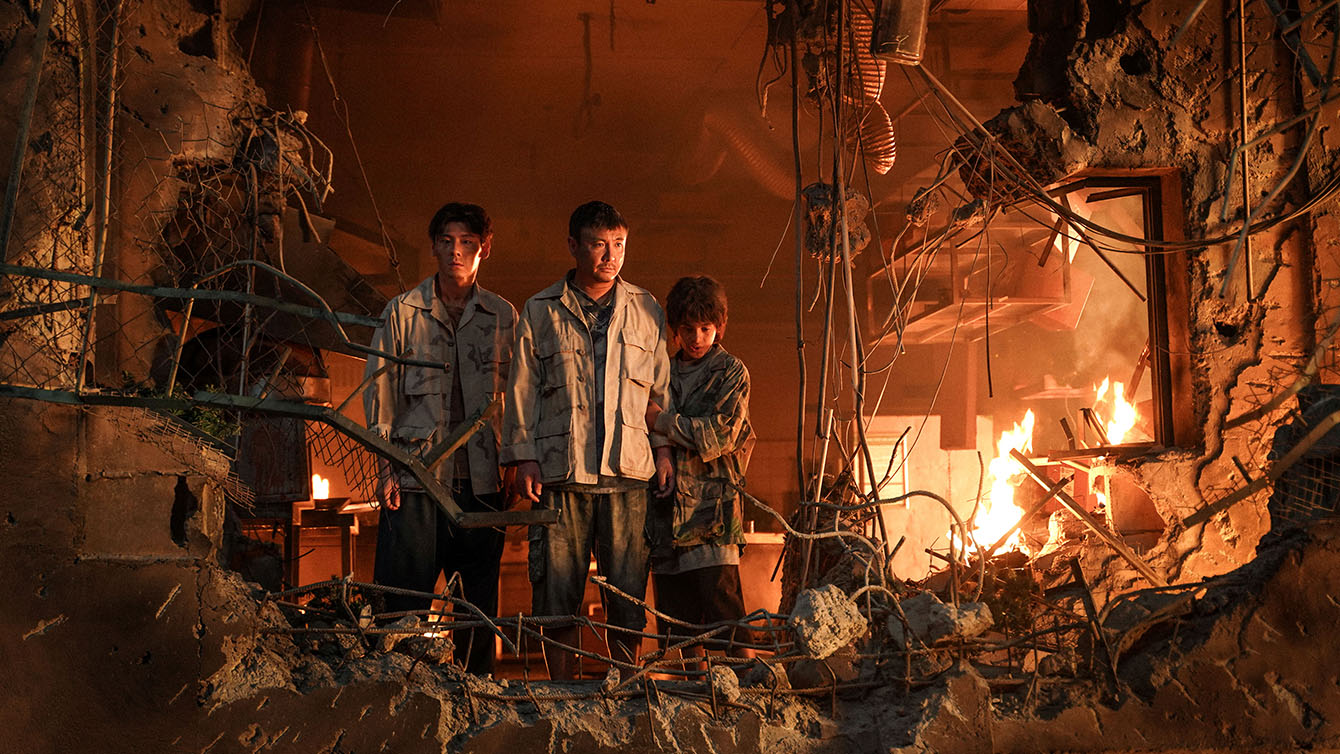
When a bedraggled man leaves home for a new start in the Middle East, he faces a rough introduction to an unnamed — but unmistakably Arab — country. A rude taxi driver yells at him in Arabic; he responds ineffectually in his own language. So far, so familiar to U.S. audiences. But this is early in Wen Muye’s movie “Once Upon a Time in the Middle East,” China’s 2026 entry for Best International Feature Film at the Academy Awards, which topped box office charts for more than a month after its domestic release. After this jarring start in the Middle East, the film settles into familiar visual language with a barrage of tropes drawn from Hollywood’s conception of the region.
Early shots show a TV broadcast where a Saddam Hussein look-alike inveighs against U.S. attempts to link his country to the 9/11 attacks, a quick glimpse of a peregrine falcon, a dusty street market selling colorful backpacks (which we later see used in a suicide bombing by child soldiers), clapping Arab children, a minaret and a highway barely obscuring mothballed tanks and helicopters from view.
But this familiar set-up belies the complexity of what’s to come in this story of two heroic Chinese cooks in the Middle East struggling their way through the aftermath of an American invasion. In some ways a close relative of the countless American films about U.S. emigres escaping violence in a strange foreign country, “Once Upon a Time in the Middle East” takes stock figures — an Arab who’s lived in and grown to love the hero’s land (in this case not America, but China), a local boy adopted by a transplant who’s moved to find work in a new country, a slick expat fixer with a heart of gold — and plays them against genre expectations in ways that reflect the anxieties and aspirations of an age of global Chinese soft power. The film evolves beyond the worldview of both its American predecessors and other popular Chinese movies that have gained international attention, at once portraying Chinese expats as facilitators of peace and genuine intercultural understanding while hinting at a more objectionable, paternalistic side to China’s engagement with the world.
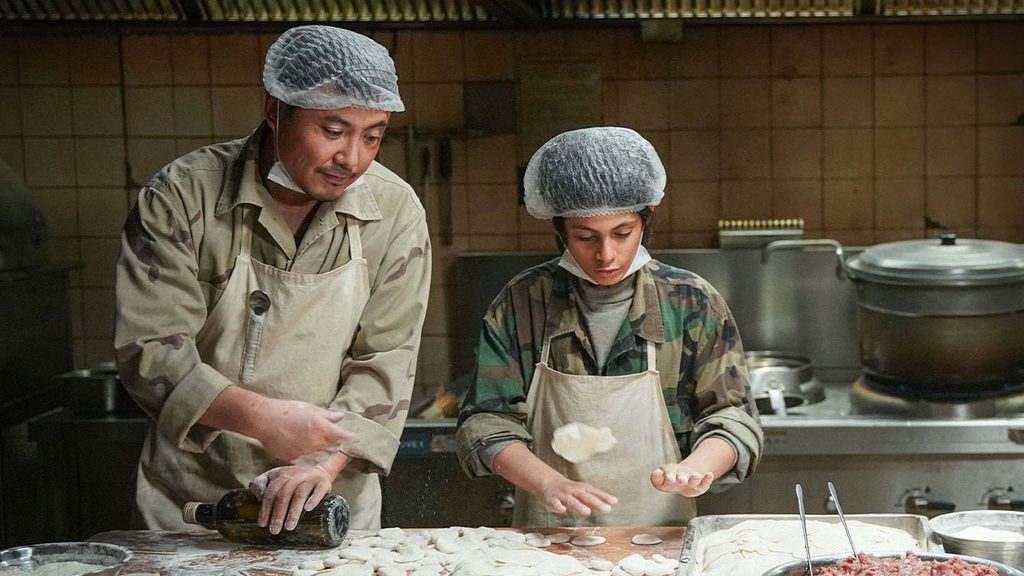
Our hero, Xu Fu, is a chef who takes a job in the Middle East hoping to solve his financial problems at home. His view of his new host country should feel recognizable to many viewers, especially for those familiar with the language of American and Chinese film: The movie works by subverting our expectations, introducing us to familiar scenes and stock characters before using them in novel ways. We’re not told what country the movie takes place in, though the American invasion clearly implies Iraq. Specific locations in the film are fictional, with stereotypical names that sound, in Mandarin or English transliteration, like they belong to places somewhere outside of East Asia or the Western world. The Chinese restaurant our protagonists work at is in the city of “Bahata” (quite close to the Chinese name for “Baghdad”: “Bageda”); American soldiers torture inmates at an Abu Ghraib-like compound called “Alifah Prison”; militants set up camp in a place called Khubazabad. All of these names are not too far from, say, the “Islamic Republic of Kamistan” from the TV show “24.”
Like Xu, other characters are also introduced as familiar archetypes. When he arrives at his new workplace, a Chinese joint called the Loong Restaurant, Xu meets its likeable frontman, Ma Junsheng. Ma plays the role of foreign guide through the Middle East: A voiceover introduces him as having worked a number of odd jobs in the region — mining coal in Jordan (what coal?), leading tours in Saudi Arabia, hauling bags in Dubai — before settling in as the restaurant’s manager; we soon see him calming down cantankerous local customers and marshaling line cooks in a fluid mixture of English, Mandarin and Arabic.
The Arab characters in the film are also introduced within a net of genre conventions. Zaid, a civil servant and the Loong Restaurant’s owner, starts off as a Chinese version of the American “good Arab.” Instead of having acquired a taste for freedom in Amreeka, he developed a palate for Chinese cuisine during his three years working in China. Zaid is slick; in what we might think of as a parallel to China’s actual relationship to Middle Eastern allies, he helps the film’s Chinese characters profit from the region’s chaos while keeping them out of the line of fire. When the Americans invade, Zaid takes advantage of his official position and the Loong Restaurant’s location on the edge of the U.S. military’s “Safety Zone” (conspicuously colored green on his map) to ensure it gets water and power even as the British Embassy goes without.
Zaid is not the film’s only “good Arab,” or even its most prototypical. That honor goes to Saif, a war orphan who Xu takes in as an apprentice and adoptive son. Saif quickly picks up quite a bit of Mandarin, and he spends much of the film choosing between the kind, peace-loving ways of his Chinese adoptive family and the aggressive recruiting efforts of a local Islamic militant group (to our relief, but not surprise, he decides to do the right thing). Of course, the “good Arab” can only exist in contrast to a “bad Arab.” The film’s third important Arab, Ali, is perhaps its most uncomplicated stock character, a victim of American military torture who turns out to also be a scheming militant straight out of “Homeland.”
Notably, not all of these distinctions last. Zaid, a former Baathist, gets radicalized and drawn into a deadly cycle of reprisal against the Americans. This is where the film starts to deviate from our expectations, despite its continued reliance on hackneyed tropes. The movie’s interest in violence, and the people who commit it on either side of a conflict, leads us toward its ultimate worldview, in which Chinese characters try to promote peace and commerce amid a harrowing environment of conflict between foreigners.
“Fuck me, an ABC [American-Born Chinese],” says Ma, about a third of the way through the film. By this time, the Loong Restaurant is well-established, with Zaid’s help. Saif is serving as a sous chef in the restaurant. Late at night, a few American soldiers barge in, led by a Chinese American named Tony Wang, who speaks halting Mandarin in an American accent and is boisterously, aggressively proud of his affiliation with the U.S. military.
The presence of an ABC GI puts the Chinese characters in an awkward spot. They don’t exactly know what to do with Tony, who is both recognizably “Chinese” — he banters with Xu and Ma in Mandarin, Xu calls him their “countryman,” and Xu’s mother recognizes him as a “Chinese boy” over a video call — as well as a consummate American, totally inured to the violent norms of the military in which he serves. Xu and Ma eventually split the difference, getting into business with Tony while trying to talk him out of his way of thinking.
We might be inclined to see this plot involving Tony as rote anti-Americanism or an idiosyncratic byproduct of intra-Chinese tensions between the global Sinitic diaspora and the citizens of an increasingly ascendant PRC. Certainly, other Chinese films, like 2017’s “Wolf Warrior 2” — another Chinese entry to the Academy Awards — have relished in their depictions of American military veterans as arrogant and rapacious. But instead, the film uses Tony’s story to articulate an account of Chinese interaction with the world that underpins its entire worldview. (This is not to say the film shies away from some light mockery of Chinese Americans; one of the film’s funnier gags involves Zaid and Xu bonding over their hatred of Americanized Chinese fusion dishes like General Tso’s chicken; later, as an inmate worker in an American prison, Xu is forced to cook these dishes for U.S. military officers.)
After Tony’s untimely death, American soldiers raid the Loong Restaurant; during the raid, filmed menacingly in first person in the green tones of a night vision camera, we see Saif scream in Mandarin that he’s Chinese. A bit later, we get some posthumous settlement of Tony’s identity: One of his fellow soldiers tells Xu and Ma that Tony went home wrapped in an American flag. In a certain way, the film seems to be implying that Saif is more Chinese than Tony. Tony, a Chinese body in an American uniform, ultimately gets caught up in the warlike, brutish, foreign way of doing things; he is draped unambiguously in the Stars and Stripes only when he dies in service of a pointless war. Saif, on the other hand, may not be Xu and Ma’s ethnic “countryman,” but he is, as he says, “Chinese”: He embraces a type of nonviolence and commitment to benevolent cultural exchange that the film suggests is characteristic of a Chinese attitude toward the rest of the world.
Early on in the film, as the restaurant starts taking off, Xu explains over the phone to his mother that the war does not really concern him. After all, he says, it’s just “foreigners fighting foreigners.” We see other characters reiterate this later on. When the U.S. military captures Xu, Ma and Saif following a car bombing, Xu and Ma insist that the war has nothing to do with them. But of course, it does: The attack, pulled off by a radicalized Zaid, kills Tony, the Chinese expats’ only possible character witness before the Americans. “Your partner was the perpetrator; your friend was the victim — you really think you’ve got nothing to do with this war?” their American interrogator asks.
Still, the film never fully abandons this perspective. We are led to believe, in so many ways, that the conflict portrayed really is just foreigners fighting foreigners in an endless cycle of tragic violence that happens to wrap up some good Chinese guys. This might reflect a general view, especially popular among China’s political elites, that opposes China becoming mired in foreign problems even as the country takes on a more prominent global role. As the scholar Patricia M. Kim observes, the Chinese state has typically sought “global reach without entanglement, partnerships without binding obligations, and great-power status without the burdens of leadership.” It makes sense that “Once Upon a Time in the Middle East” would see foreign conflicts as a preexisting problem that unfairly ensnares its Chinese characters, even as the film takes a largely positive attitude toward the international friendships and bonds these characters form.
The film’s narrative language echoes this account of violence in the Middle East as an intractable vicious circle. None of the violence between foreigners is portrayed as totally unjustified: Saif wants to kill the American soldiers who torture and imprison his adopted family. Zaid only joins the insurgency after his family is murdered by U.S.-backed militants. Tony explains that his knee-jerk prejudice and violence toward the locals came out of seeing his best friend get killed by a child soldier.
This gives us a sense of the movie’s broader politics, which are evidently anti-war, but not in a familiar way. The film, like the increasingly globally engaged China from which it came, is not particularly interested in assigning blame in foreign conflicts, and it in fact accepts premises that other movies critical of American wars might not. The war on terror hangs over the plot, but the film itself does not treat the American interest in terrorism as an imperialist pretext. If anything, the threats to American lives are treated as very real, and the U.S. military is depicted as only somewhat overzealous in its efforts to deter and avoid them.
This is no surprise for a film coming from a country which has eagerly prosecuted its own domestic “war on terror” against Chinese Muslims. The film’s treatment of the Americans does, however, unintentionally reveal some of the contradictions in the distinctively Chinese worldview it’s presenting. Most notably, at various points, Chinese characters complain that the American military is lawlessly detaining people, something we are meant to see as another sign of foreign barbarity. But the attitudes that the Chinese protagonists promote — particularly the need to educate foreign (often Muslim) characters away from their own violent traditions — have undergirded China’s own campaign of arbitrary detentions and detainee mistreatment that resembles the American one depicted in the film.
Thus, contrary to expectations that the cultural products of a rising China might be aligned in a more clearly anti-American direction, the film is better read as a reflection of the worldview of another kind of major power. China is presented less as an anti-imperialist force than as an influential country that views both American militarism and attacks by Middle Eastern militants as meaningful, and perhaps equivalent, disruptions to the smooth carrying on of Chinese affairs. This particular approach means that Xu and Ma regularly accept each side’s characterizations of the other, and the film strongly suggests that they are correct to do so — the Americans really are mostly brutish thugs, and a lot of the Arabs really are militants. One memorable scene depicts an attack on a U.S. base by militants disguised as American soldiers, making literal what was previously barely concealed subtext: that the factions in the movie’s war are two sides of the same coin.
The only characters who regularly break this cycle of bloodthirsty reprisals are the Chinese ones, who serve throughout the film as the lone voices of reason. We are meant to see events from the moral perspective of Xu and Ma, who consistently talk down other characters from acts of violence and are even capable of acting sympathetically toward stock villains like Ali the militant and a U.S. soldier whose job it is to torture inmates. The Chinese characters are depicted consistently as the moral core of the film, in contrast to everyone else: Whether it’s Americans like Tony or Arabs like Saif, none of the foreigners can break out of their need to fight and take revenge upon one another without the guidance of the sometimes reluctant, but always well-intentioned Chinese. Foreigners who accept this guidance, like Saif, are put on a better path; those who don’t, like Tony or Zaid, inevitably meet tragic ends.
A metaphor near the end of the film brings this worldview into the foreground. In the movie’s closing minutes, Zaid tastes Xu’s cooking for the last time and remarks that the food is still off: Xu, Zaid says, still doesn’t have a grasp of the local flavors. We are then shown a brief flashback of Zaid refusing Xu’s food at his family’s funeral, right before he’s pulled back into the war against the Americans. Later, we find out that the Chinese stew criticized by Zaid has become a staple at the reopened Loong Restaurant, where Arab cooks still make it to the delight of their customers. We might think of this ending sequence as the film’s thesis in microcosm: What the Chinese are serving up isn’t always to foreign tastes, but it’s what they need, and the good ones will learn to enjoy it.
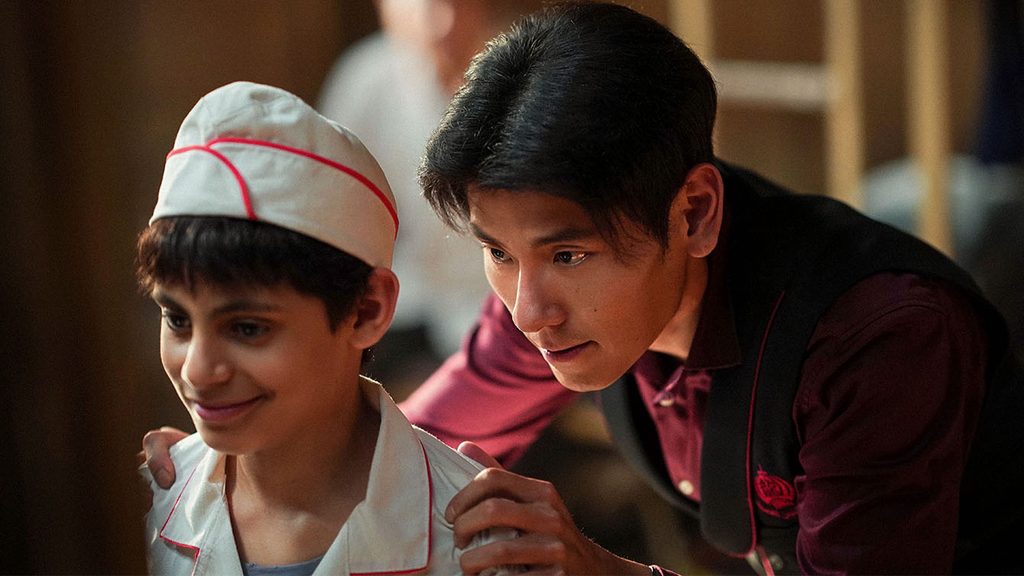
Can we think of this film as being interested in projecting “Chinese values,” the way that American films of the late 20th and early 21st centuries were interested in exporting a particular version of U.S. values? Some moments in the film might certainly suggest so; for example, a brief flash of text before the film’s end credits informing viewers that “the international community, including China,” is trying to advance the U.N. Convention on the Rights of the Child to help kids like Saif. Chinese state media has certainly taken notice of this connection to the real world: A review from China Global Television Network praises the film for depicting a “community of common destiny,” a phrase used by Chinese authorities to describe their country’s vision of an alternative world order.
More broadly, the film’s approach toward conflict in the Middle East is single-minded enough for us to draw clear distinctions around a Chinese way of doing things: The Chinese characters are friendly and good-intentioned, with a reluctance to get involved in other people’s problems even as they hold the key to solving them; the foreigners are redeemable and worthy allies, though mired in violence and desperately in need of moral guidance.
At the same time, the film ultimately remains ambivalent about its Chinese protagonists, suggesting that the more mercenary parts of their activities in the Middle East — illegal liquor sales, borderline war profiteering — are socially undesirable, or perhaps even counter to the spirit of a responsible Chinese presence in the outside world. Often, these activities arise out of too much acceptance of foreign ways of doing things, such as when Tony convinces Xu to sell liquor that he and Ma wanted to enjoy themselves. The film is explicitly aware of a tension between Chinese characters engaging with the world versus their being influenced by it: Xu’s decision to stay working at the Loong Restaurant after the U.S. invasion is portrayed as both a good thing (for his bonds with Saif and others) and a profit-driven abandonment of his duties to his Chinese family; elsewhere, we see Xu and Ma grappling with whether they have a responsibility to watch over Arab children around them, even as it risks dragging the two Chinese chefs further into involvement in the war.
With this in mind, it would be wrong to suggest that “Once Upon a Time in the Middle East” is solely an anti-American film, or even an anti-Arab one. If anything, it’s an anti-foreign movie, although not in a particularly xenophobic way. Instead, like the Western intellectuals who once decried “Oriental depravity,” the film positions itself against an endless cycle of foreign depravity. Foreigners fight foreigners, torture foreigners, invade foreign countries. The entire Middle East, and by extension the Western world that invades it, is an undifferentiated mass of foreigners entangling everyone else in a never-ending war.
What can the Chinese do in this environment? Something, the film suggests. The movie depicts its Chinese characters bringing some joy and civility to all parties, Americans or Arabs. They move fluidly and happily between cultures, Xu donning the locals’ clothes as easily as he puts on a U.S. military jacket and a Santa hat. It suggests, sometimes lightly and sometimes forcefully, that there might be a better way — a more Chinese way — for these depraved and benighted foreign people, Arabs and Americans, to treat one another.
Become a member today to receive access to all our paywalled essays and the best of New Lines delivered to your inbox through our newsletters.