


Just before the lights dimmed for a screening of “NAZA” at a Montreal cinema, someone seated to my left ripped open a cellophane bag of gummy bears and popped two into her mouth. Another woman, seated to my right, rummaged loudly in a bag of popcorn. I was reminded of an experience that Guardian journalist Jonathan Freedland describes in his gripping book “The Escape Artist: The Man Who Broke Out of Auschwitz To Warn the World.” It’s about Rudolf Vrba, a Slovakian Jew whom Claude Lanzmann interviews in “Shoah,” his epic nine-hour documentary about the systematic genocide of the Jews of Europe during World War II. When Freedland, then 19, saw “Shoah” in early 1980s London, the friend who accompanied him brought a bag of popcorn into the screening room; as he began to eat it, chewing loudly, a woman who had “an accent thick with the sound and memories of pre-war Europe” leaned over and said to him: “Have you no respect?”
Lanzmann’s film makes an appearance in “NAZA,” the searing documentary by Israeli investigative journalists Yuval Abraham and Rachel Szor, as do many other Holocaust references. Jonathan Glazer, whose 2023 film “Zone of Interest” depicts the lives of Auschwitz Commandant Rudolf Höss and his family in their idyllic home next to the death camp, is a “NAZA” executive producer; his influence on the production is clear. While soldiers serving in an elite military intelligence unit sit on Tel Aviv rooftops and describe to Abraham the army policies that translate into the wholesale dehumanization of the people of Gaza, the sounds of Tel Aviv are muffled but audible, just as the sounds from the death camp were audible in the garden of Höss’ home in “Zone of Interest.” The proximity between normal life and the horror of mass killing is emphasized by an intertitle reminding the viewer that Gaza is just 60 kilometers (40 miles) south of Tel Aviv.
In “NAZA,” the camera pans over Tel Aviv’s glittering high-rise apartment buildings, its shops and bustling cafes. It peeps in through the windows of apartments while their occupants go about their lives, which often means eating, tidying up after a meal or sprawling on a sofa while watching the news on television. At one point, the camera passes over the Cinematheque, an art house cinema in Tel Aviv, where Lanzmann’s “Shoah” is being screened on Israel’s Holocaust Memorial Day. The residents of the idyllic house next to the death camp are indifferent to the faint sounds of killing that seep into Höss’ beautifully cultivated garden in “Zone of Interest.” In Tel Aviv, the muffled sounds of the city — the voice of the television news presenter, the clinking of cutlery on porcelain plates, the ringing of hammers on metal at construction sites, the rhythmic clacking of an interurban train — provide a haunting and sometimes not subtle (as with the train) accompaniment to the often graphic testimony of Abraham’s interview subjects. NAZA, they explain, is the acronym for “nezek agavi,” or collateral damage. And the army has decided that up to 500 NAZA is an acceptable consequence of targeting a single Hamas operative.
From the computers on their desks at the Ministry of Defense in the center of Tel Aviv, the soldiers in the elite intelligence unit 8200 can see and hear everything that happens in Gaza. What they tell Abraham is that they can hack into a 12-year-old girl’s mobile phone and hear her asking when daddy is coming home. That they can hear a mother screaming that her daughter’s body is on fire. They explain to Abraham that they know the army’s definition of acceptable collateral damage for targeting a single low-level Hamas operative includes the children watching television in the living room when the drone responds to the artificial intelligence program’s command and drops a bomb on their house. They tell Abraham that they can see snipers shoot children who unwittingly wander into an area the army has designated as a “no-go” zone. There are no warnings about no-go zones, clarifies one of the soldiers. In direct contradiction of the army spokesperson’s claim that they warn people in advance of a bombing, the soldier on the Tel Aviv rooftop tells Abraham that people are not informed in advance. They are expected to learn that a place is out of bounds, he explains, by seeing others get killed. Family members or rescuers on the ground can’t retrieve the corpses; if they do, they, too, will be killed. Gaza is piles of bodies, says one soldier. There are open graves — pits — filled with dead bodies, he adds. One soldier says that he’s seen dogs eating corpses. Another sketches on a pad of paper to show how and why snipers shot people who unknowingly deviated from an invisible path that the army delineated but did not announce, as they rushed to a food distribution point.
Everything we hear from the soldiers who are interviewed in “NAZA” has been in the public domain for some time, with almost no reaction from Israelis. Over the past three years, Abraham reported all the revelations in lengthy investigative features that were published by +972 Magazine (I’m a co-founder of the magazine, but am no longer involved in its production) and Local Call, together with The Guardian. For example, in 2025 he reported that, according to the Israeli army’s own data, civilians accounted for about 83% of the death toll in Gaza. In 2024, he reported that the army had implemented an AI program called Lavender to select targets in Gaza, with only the barest human involvement, and that it was the reason for the unprecedented death toll. The power of the film is in hearing the voices of the people who approved the command to kill dozens at a time by clicking on a keyboard, and who saw the death and destruction via their computer monitors at the Ministry of Defense in Tel Aviv. It is in watching normal civilian life in Tel Aviv swirl on the streets below the rooftop on which they’re sitting while describing what they have seen and done. Some are horrified and deeply disturbed, while others are detached. I’m doing a technical job, says one, in an echo of Hannah Arendt’s “Eichmann in Jerusalem.” If I didn’t do it, someone else would, says another. One of the more affected soldiers says that he has seen the Nazi death camps in Poland and knew that the people who committed those acts were evil, then asks rhetorically what that makes him.
The intelligence officers in “NAZA” are a familiar Israeli type. They are highly educated liberals from Tel Aviv and its suburbs, who were accepted over thousands of applicants to the most elite unit in military intelligence. It’s the Israeli equivalent of getting accepted to the Massachusetts Institute of Technology or Harvard. After their military service, they will go on to lucrative jobs in high tech. In “NAZA,” they tell Abraham that they are not Arab haters; they reject the racist rhetoric of the far right. I knew many young men like them in Israel. Like the soft-spoken officer who alternately commanded his soldiers to beat and tear gas unarmed teenage protesters at a West Bank village demonstration, and asked a photojournalist friend about his camera lens, explaining that he was an avid amateur photographer. He didn’t carry out the beatings, but he directed others to do so. He would probably say, just like the intelligence officers in “NAZA,” that they reject the violence of the extremist settlers. But in practice they kill far more than any radical settler group.
I saw “NAZA” twice in two weeks. The first time was at an invitation-only screening in New York, for a small audience composed mostly of journalists who knew one another. The atmosphere was similar to a classical music concert attended by serious music lovers who glare at anyone who makes the slightest noise. No one ate snacks at the New York screening. They watched the film with quiet intensity and sat silently as the end credits rolled, then stood outside in clusters and had serious conversations about what they had just seen. The experience of seeing it the second time with a general audience who paid for their tickets, and who probably would not write about it, was palpably different. People whispered comments to one another during the film. They coughed, sneezed and rustled; I felt that they were there to feel the film rather than analyze it, and there was something both annoying about that (the cellophane candy wrappers) and humanizing. I found the film no less powerful on second viewing; it’s a work of art, which means it lends itself to repeated viewings. I braced myself for the final moments of the film, when the scene switches from the rooftops of Tel Aviv to an enormous bomb crater in Gaza. The scale of the destruction from this one bomb is difficult to grasp, but the visuals make the human toll of the AI program used by the Ministry of Defense as powerfully clear as a gut punch. A man who is mindless with grief searches for his children, shouting their names and terms of endearment as he scrabbles futilely at the ruins of his house; the camera shows us a row of small bare feet sandwiched between two slabs of concrete.
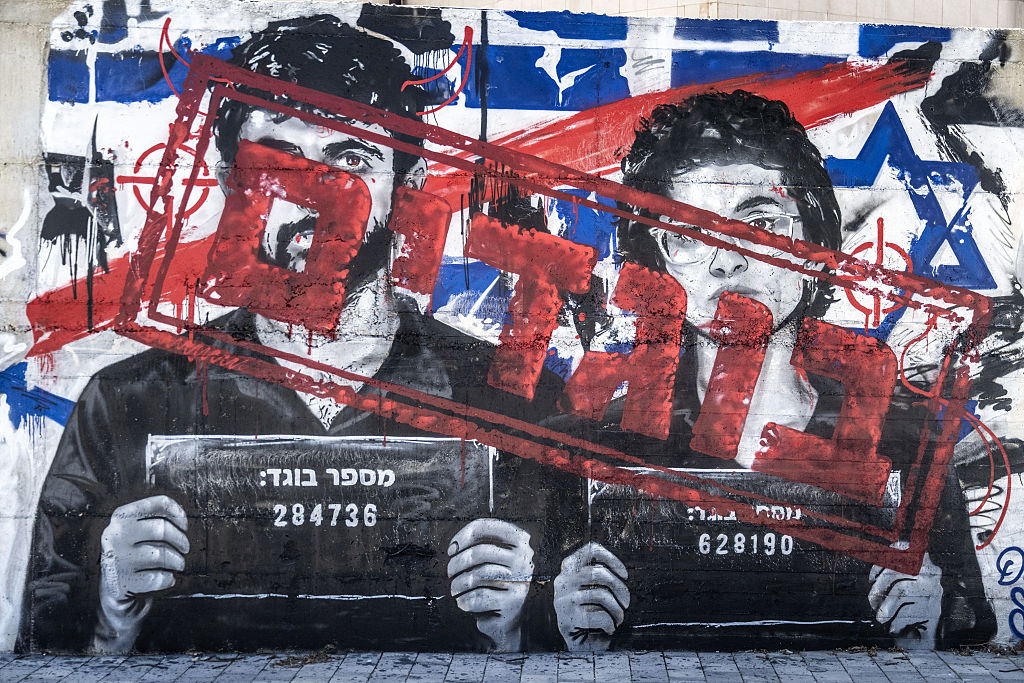
Readers of this article are probably aware that “NAZA” has caused an uproar. Prime Minister Benjamin Netanyahu responded to the film by calling for legislation that would strip citizenship from Israelis who “defamed” the army. Reactions in the media have ranged from denial to overt incitement against the directors; the latter is reflected in social media posts, many of which are borderline unhinged. A handful of pro-Israel commentators who identify as liberal created video clips in which they purported to explain why the numbers quoted by the soldiers interviewed in the film don’t meet the legal definition for genocide. Crowds of people gathered outside the home of Szor’s parents and chanted threats. Someone painted a mural of Abraham’s and Szor’s faces, superimposed with a sniper’s crosshair symbol and the caption “traitor.” The two directors were abroad when the threats began; it’s now too dangerous for them to return home, though they say they intend to do so.
What’s particularly remarkable about this initial flurry of reactions is that they came from people who had not seen “NAZA.” Almost no one, beyond a few journalists and film festival attendees, saw it before it was released this week. The 25-minute standing ovation at the Venice International Film Festival is what seems to have triggered the outpouring of rage in Israel. The vast majority of Israelis, more than 95%, believe that the war in Gaza was a necessary and justified response to the Oct. 7, 2023, Hamas-led attack, which is a deeply felt national trauma. They reject the term “genocide,” believe that any other country that had been attacked as Israel was would have responded in the same manner, and are convinced that those who criticize Israel are motivated by antisemitism.
But some Israelis are deeply critical of the war and abhor the shift to the right in Israel’s sociopolitical culture. Director Nadav Lapid is one of them. His 2025 film “Yes!” was filmed on location during the height of the Israeli military’s campaign in Gaza, and is a relentless evisceration of Israel’s corrupt ruling class and the venal complicity of educated liberals in the Gaza war.
Midway through “Yes!”, the protagonist, Y. (in Hebrew it’s the smallest letter of the alphabet, a vertical dash, which might symbolize his feeling of insignificance), and his ex-girlfriend Lea embark on a road trip from the Dead Sea to the edge of Gaza. “From the sea of death to hell,” narrates an off-screen voice as they set out in Lea’s car. The title of “Yes!” is both a reference to Weimar-era German satirist George Grosz’s memoir “A Little Yes and a Big No” and to a cheerful 1979 Israeli pop song called “Forever Following the Sun,” which has a chorus that begins with “yes, yes, yes, yes!” In “Yes!,” the song is performed in an over-the-top Israeli independence day celebration that takes place on a Russian oligarch’s yacht.
As they embark on their road trip, Lea lights a hand-rolled cigarette, which might be a joint, as she drives. Y. directs his phone to play Tammy Wynette singing “Stand By Your Man,” and the two of them quarrel in a familiar way that makes it clear they know each other very well. They alternate between relitigating their long-ended relationship and arguing over who has become more of a sellout. Is it Lea, a polyglot who, left without an income when her corporate VIP clients stopped coming to Israel after Oct. 7, has taken a job translating government propaganda statements that justify the war in Gaza? Or is it Y., the man who says “yes” to the worst people in Israel’s ruling class? Y. is a talented musician, a pianist who excelled at the conservatory; now, he accepts a commission from a Russian-Israeli oligarch to compose the music for a dark, fascistic poem that celebrates the Israeli military’s actions in Gaza.
As they approach the “closed military zone” that borders Gaza, Lea comments that she can smell the stench of death. Plumes of black smoke are visible above clusters of bombed buildings in Gaza, just a mile or so away. The chatter of gunfire and the dull thud of artillery are audible. None of this was recreated for the film; Lapid filmed on location, in real time. I visited the same place at more or less the same time; it looks exactly the same on film as I remember it in reality.
A soldier who turns Lea and Y. away from the closed military zone tells them that if they want to see what’s happening in Gaza they should drive five minutes to the Hill of Love (a real place), where they can have a picnic and watch the bombardment. But go before dark, he advises, if you want the best view. Y. asks Lea to pull over so that he can urinate in a ploughed field; as he stands between the furrows of earth peeing to the live soundtrack of war, he takes the folded piece of paper printed with the words of the poem he is composing for from his breast pocket and reads them aloud.
He’d used the page earlier, at the Dead Sea, to blot the blood seeping from his knee where he’d tripped and fallen on the rocky beach. The blood-stained page is clearly meant to recall the one taken from Prime Minister Yitzhak Rabin’s breast pocket after an assassin shot him in 1995. But the page in Rabin’s pocket was printed with the lyrics to “Shir LaShalom” (“Song For Peace”), which he had been singing alongside a famous performer in front of 100,000 exuberant Israelis, who had gathered to celebrate the signing of the Oslo Accords. In 30 years, Israelis have transitioned from celebrating peace to cheering a catastrophic war on Gaza.
Lapid expresses his opinion of this transition with bodily excretions. His characters are continually vomiting, peeing and bleeding. They are avaricious, venal and solipsistic, but also agonized and filled with inchoate self-loathing. Y. sees that the oligarch who offers him the commission is a repulsive character, but he envies his yacht and longs, together with his beautiful wife Yasmine, to leave behind their bohemian-but-not-chic Tel Aviv apartment. Lea comes from the educated, secular middle class that loathes Netanyahu, but now she is effectively working for his government.
In the car, Lea tells Y. that she has seen video clips of dogs eating dead people “over there,” meaning in Gaza. Y. expresses horror and asks: Don’t they bury them? They don’t have enough time, answers Lea. Lapid made the film in 2025, a year before “NAZA” was screened in Venice. What seemed like grotesque hyperbole in the fictional film is confirmed as fact in the documentary. The conclusion: Despite the Israeli media’s shockingly complete silence about what was happening in Gaza, people knew. They just couldn’t handle what they knew, so they denied it and they attacked those who held up a mirror.
In what seems like an agonized attempt to staunch his self-loathing for accepting the tainted commission from the oligarch, Y. asks Lea to repeat the first-person accounts of people who survived the Oct. 7 attack. She knows them so well that she can recite them from memory, since her job is to translate and post them to the government’s official social media channels. But familiarity has not lessened the trauma. Lea is visibly upset as she repeats by rote the horrific survivor stories; her voice becomes shaky and tears fill her eyes, and she spares no violent detail, however agonizing.
One of the many achingly sad realizations that comes with following the reactions to “NAZA” and “Yes!” is that these films do not have the power to change minds. People have staked out a position, and they will not be moved. This is certainly true of the people I’ve spoken to who have seen both films. The reactions fall more or less into three separate categories — the triumphalists who see the films as validation, the denialists who see them as grotesque lies, and the pained liberals who seem to feel trapped between their intellectual and ethical understanding and their emotional, or tribal, identity. While the last group believes that Israel might have gone too far in Gaza, it fully rejects the accusation that it committed a deliberate, planned destruction of the place and its people — even if soldiers who committed and witnessed those acts say that this is precisely what they did, and that their orders came from the very top.