


When NATO bombed the Chinese Embassy in Belgrade on the night of May 7, 1999, I was a teenager whose wall was plastered with posters of the Backstreet Boys and Andre Agassi. The news reached us in China the following morning. U.S. President Bill Clinton apologized, saying the attack was an accident, and that the CIA, working from outdated maps, had mistaken the building for a Yugoslav military procurement office. The Chinese government rejected the explanation: The United States of America does not make stupid mistakes like that. The news was unavoidable for weeks. To this day, I can recall the names and faces of the three journalists who died: Shao Yunhuan, Xu Xinghu, Zhu Ying. Xu and Zhu were a young couple.
A fortnight later, a boy in Belgrade turned 12. It was the 60th day of the NATO bombing campaign against Yugoslavia, launched to stop Slobodan Milošević’s ethnic cleansing in Kosovo. The boy, his parents and his two younger brothers had been sleeping in his aunt’s bomb shelter. At night, he shivered at the sound of explosions above. During the day, he played tennis. He and his coach held their practices at the sites of the most recent strikes — “figuring,” as he recalled, “that if they bombed one place yesterday, they probably wouldn’t bomb it today.” That’s when he first played probability tennis. They played without nets, on broken concrete. His birthday party was held at his tennis club, near a military school. As his parents sang “Happy Birthday,” he later wrote, “their voices were drowned out by the roar of the bombers flying overhead.”
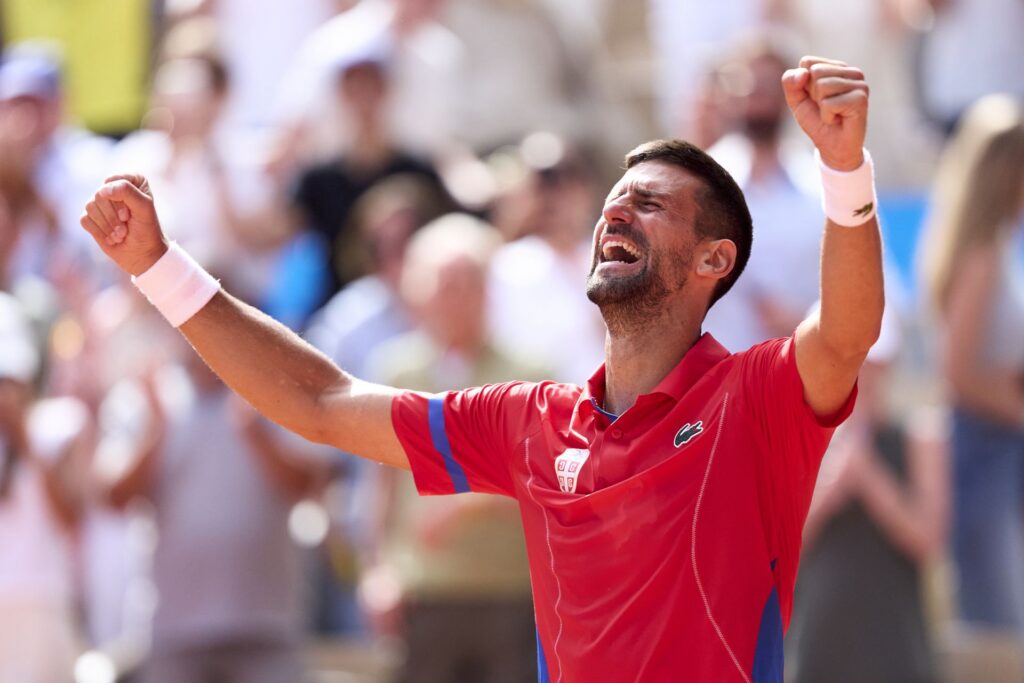
Novak Djokovic has never muted his love for his country the way athletes from suspect nations are expected to. Of all his sport’s prizes, the one he wanted most was Olympic gold — the one that had escaped him for 16 years, through four summers of heartbreak. When he finally won it in Paris in 2024, at the age of 37, two months after knee surgery, against a player 16 years his junior in Carlos Alcaraz, he sank to his knees on the clay and wept as he had never wept for any of the 24 Grand Slams he had won for himself. He said that, until that day, carrying the Serbian flag into the opening ceremony of the 2012 London Games was “the best feeling that an athlete could have.” He was still wearing the medal days later.
Tennis is a Western sport. “The West” is not a direction or an ethnicity but a club; its members issue the visas, go to war together and host all four Grand Slam tournaments (Wimbledon, the French Open, the U.S. Open and the Australian Open). Tennis is a game of English lawns: Wimbledon dresses its players in white, famously down to their underwear, and instructs its crowds, over the loudspeaker, in the sport’s most dignified imperative: “Quiet, please.” It is a game of French kings: “Deuce” is from “deux”; “love,” by legend, from “l’oeuf” — the egg, the shape of a zero. In tennis, love means nothing.
Between 2005 and 2010, the two best tennis players in the world won 21 of the 24 Grand Slams, and they happened to embody the two ideal types of Western masculinity. Roger Federer was the prince. Swiss, serene, sponsored by banks and watchmakers, he walked onto Centre Court in a cream blazer with a gold monogram and never seemed to sweat. His game was praised in the vocabulary of art criticism: liquid, effortless, sublime. David Foster Wallace called watching him a religious experience. Rafael Nadal was the warrior. Spanish, sleeveless, covered in sweat and clay, he bit his trophies and treated every point like a cavalry charge. He was loved for his ferocity, for the off-court shyness that contradicted it, and even for his quirks. The picking at his shorts before every serve was not vulgarity but ceremony — the warrior and his rite. Rivers of ink have been spilled about the pair: the marble and the clay, the heir and the conqueror, the immaculate and the carnal, the grace from above and the valor from below.
So when a jocular Serb prone to sliding into the splits entered the room and began dethroning the prince and the warrior with a game that appeared neither graceful nor valorous, the club recoiled. The crowds cheered every time his opponents won a point and applauded his faults — a breach of the sport’s oldest etiquette. They booed his celebrations, even a fist pump. And he noticed. He was the party crasher — “the third guy,” as he put it much later. There were now three of them in this rivalry. In Princess Diana’s immortal phrase, it was a bit crowded.
He had tried, at first, to be liked. The young Djokovic did impressions of other players to please the crowd: Maria Sharapova’s demure hair-tuck and Nadal’s solemn rite, including the famed picking at the shorts. His impressions were awfully good. The audience howled and demanded encores; they called him the Djoker. But somewhere along the way he recognized the real register of the applause: He was the jester, who entertains the court but cannot join it. He wanted acceptance; he got laughs.
The locker room, however, was not laughing. Long before he posed a real threat to the genteel sport’s rules-based order, the club had decided that he was a fraud. In his early years, Djokovic kept breaking down mid-match: gasping, collapsing, retiring. Commentators criticized his lack of fitness and what they believed to be a lack of respect for the game. The prince had delivered the verdict earliest of all: “I don’t trust his injuries. … I think he’s a joke when it comes to his injuries.” Andy Roddick, then the top American player, was asked about Djokovic’s ailments and wisecracked a list: “cramp, bird flu, anthrax, SARS, common cough and cold.”
By a lucky accident in 2010, Djokovic learned he was gluten intolerant and changed his diet. The collapses stopped, his fitness surged and within a year he was the best tennis player in the world. In 2011, he finally took Wimbledon and won three of the four majors — a feat he would repeat a decade later. The following January, in Melbourne, he outlasted the warrior himself in the longest Grand Slam final ever played — five hours and 53 minutes. But the medical diagnosis never lifted the moral verdict. Nearly two decades after the prince’s ruling, holding more major titles than any man in the history of the sport, Djokovic was booed off the same Melbourne court for retiring with a torn muscle — and had to post his MRI results to prove it.
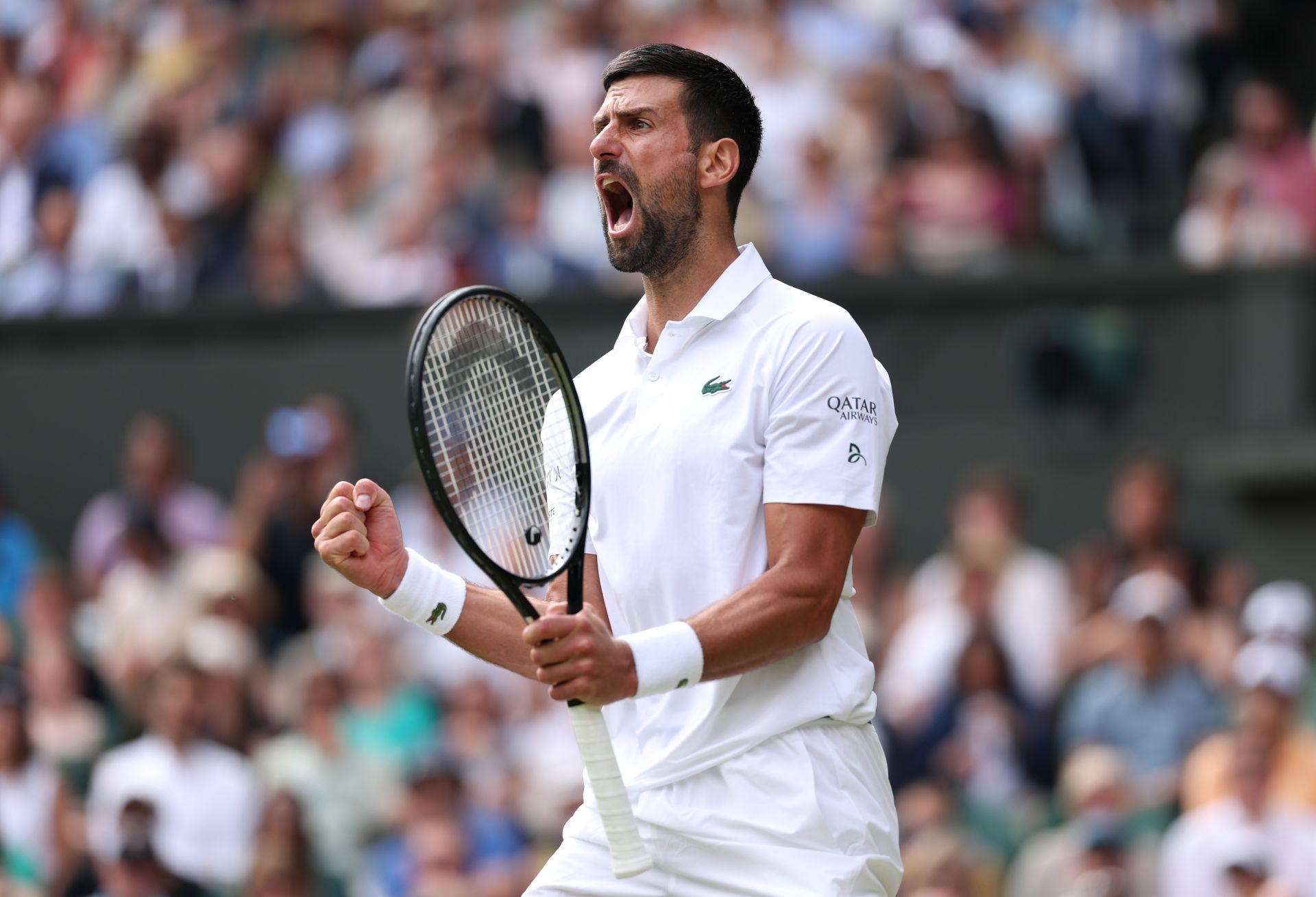
When he walked onto the court at the Paris Masters in a Darth Vader mask on Halloween in 2012, the joke was no longer on him. The order of things had been overturned, and he was officially the villain. He had long since retired the crowd-pleasing impressions, replacing them with crowd-provoking retorts. He won the 2015 U.S. Open final in a stadium that cheered his faults. So he talked back, turned to the stands when Federer missed a forehand and shouted “Yes! Yes!” Four years later, on the same court, he told a heckler to “shut the f— up.” In a match against the Dane Holger Rune at Wimbledon in 2024, after two hours of the crowd chanting “Ruuuuuune,” which Djokovic heard as boos, he took the microphone, thanked the respectful, and wished everyone else a “very gooooood night.” In those years, he perfected the trick that would turn hostility into fuel: “When the crowd is chanting ‘Roger,’” he said after lifting the Wimbledon trophy in 2019, “I hear ‘Novak.’”
Looking back on that hostility, he has admitted that some part of him needed it; that the club’s refusal to grant him the respect commensurate with his record became, over time, an indispensable ingredient of the record itself. He needed the indignation, the spite, the doubter to prove wrong. Even now, with most of the world having come around, he looks for the one face in the crowd that remains unconvinced and plays the rest of the match to them. In “The Wolf in Winter,” a new documentary about Djokovic streaming on Prime Video, Agassi, who coached him briefly in 2017 and 2018, says, “I was surprised by how much darkness he had to feel in order to get the best out of him. He needed fear and anger. Love took away his edge.” If anyone is qualified to measure another tennis player’s darkness, it is Agassi, who has written in his own memoir about his fraught relationship with the game, the tour, the media and the crowd.
The darkness had a birthplace. A child who spends 78 nights squeezed into a bomb shelter was never going to come out mild and mannerly. During the bombing, Belgraders took to the bridges at night wearing paper targets pinned to their chests, daring the warplanes to aim. Djokovic often tells the story of the targets when asked to explain himself. His native language offers a word for this: “inat” — defiance, spite as fuel, doing something just because someone told you that you couldn’t.
It was on display in the 2011 U.S. Open semifinal. Federer was serving at 5-3, 40-15 in the fifth set, with two match points to close it out. The stadium roared, having already given the match to the prince. Djokovic waited. As he dropped into his return position, the corners of his mouth turned down and he nodded twice, agreeing with something. Federer served. Djokovic stepped in and whipped a forehand so hard and blind that Federer never moved. Walking to his towel, he raised his arms to the stands: Do I not get a little applause here? The crowd answered. He took the next four games and the match, and beat Nadal in the final. That’s inat. Twelve years earlier, while the prince was a ball boy at the Swiss Indoors Basel, Djokovic was running from bombs — and learning, somewhere in the running, to turn around: When they aim at you, wear the target.
A part of him would always long to be let in. After all, one of the boy’s earliest memories was standing in front of a mirror, lifting his parents’ cups and bowls, imagining himself on that pristine English lawn: “Nole is the champion! Nole is number one!” But “The Wolf in Winter” shows that he now wants something rarer than acceptance. Jason Hehir, the director (who also made the documentary “The Last Dance” about Michael Jordan and the Chicago Bulls), put it this way on a podcast after the film’s release: What Djokovic wants is not to be loved but to be understood. He would rather be understood exactly — why he thinks what he thinks, does what he does — and have half the world hate him for it, than be loved blindly, “because he’s smart enough to know that’s bullshit.” This is his settlement.
For years now, Djokovic has talked about love in interviews. Hate, he said, is not an emotion worth carrying: “How can you be fueled more by anything else but love?” But “The Wolf in Winter” quietly keeps a different ledger. The film plays, in full, the clips of the men who sneered at him, the ones who bothered him the most: the coach and former pro Brad Gilbert calling for smelling salts at Djokovic’s suggestion that he could beat Nadal, Roddick reciting his ailments, Federer calling him a joke. In the winter of his career, the wolf may forgive, but he does not forget.
The West has two kinds of love of country: its own, which it calls patriotism, and everyone else’s, which it calls nationalism. Its own patriotism is “civic” — a peaceful contract among strangers of any color. The nationalism of others is “ethnic” — a primordial bond that easily turns violent against other blood. When the historian Hans Kohn wrote one of the field’s founding studies in 1944, he divided nationalisms between the “Western world” — England, France, the Netherlands, Switzerland, the U.S., the British dominions — and the rest of the world, where nationalism arrived, he wrote, at “a more backward stage of social and political development.” In book after book, the binary of civic versus ethnic traveled with a caravan of loaded twins — reason versus passion, universalism versus particularism, modern tolerance versus ancient hatreds.
Serbia in the 1990s was the theory’s favorite Eastern exhibit — the ancient-hatreds capital of the ancient-hatreds decade. In 1993, amid the Yugoslav wars, the Carnegie Endowment reissued its 1913 inquiry into the Balkan Wars and asked George Kennan, once U.S. ambassador to Belgrade, to say what 80 years had changed. Very little, he concluded. The wars of 1913 and 1993 alike were driven by a nationalism that “drew on deeper traits of character inherited, presumably, from a distant tribal past.” Centuries of Ottoman rule had left on the continent’s southeastern edge “a salient of non-European civilization.” Kennan’s essay is a specimen of what the historian Maria Todorova calls Balkanism. In her 1997 book “Imagining the Balkans,” she argues the region has long served as the mirror against which Western Europe composed its own flattering portrait: conflict-prone not because of the empires that carved it up or the powers that armed it, but because it is “tribal,” “backward,” “primitive,” “barbarian.”
Such theories do not stay in books. When the Russian villain went into temporary retirement at the end of the Cold War, Hollywood promoted the Serb. In “The Peacemaker” (1997) — DreamWorks Pictures’ first-ever film — a Bosnian Serb carries a nuclear backpack toward the United Nations, only to be thwarted by George Clooney and Nicole Kidman. In “Behind Enemy Lines” (2001), Owen Wilson spends the entire film running from a Bosnian Serb general and his tracksuited executioner.
Tennis ran the same casting office. Ilie Năstase, the first great Eastern European champion of the Open era, was “the Bucharest Buffoon” in the Anglophone press. Monica Seles was the grunting interloper against Steffi Graf’s classical purity; the British tabloids brought a “gruntometer” to Wimbledon to measure her noise. Ivan Lendl, who won everything the 1980s offered, was the robot — the champion, as one American cover story had it, that nobody cared about. (Although Lendl is from Mitteleuropa, the region whose entire 20th-century self-presentation emphasized that it is not the Balkans.) That the Balkans and Eastern Europeans are mostly white and Christian means they can be booed at no cost to anyone’s conscience.
So when Djokovic spoke of “a boy like me, growing up in Serbia,” and of rivals who came “from Western powers,” he was speaking from a 12-year-old’s memory — however partial that memory must be. “The Wolf in Winter” gives the world the origin story of his inat. It is not a history of the war, and his memory is only a fragment of the region’s. During the same 78 nights that the young Novak hid in bomb shelters, the Yugoslav army and Serbian police and paramilitaries drove some 850,000 ethnic Albanians from Kosovo and killed thousands more. Writing that spring, the Slovenian philosopher Slavoj Žižek asked whether anyone could picture the “real targets” — the ones in Kosovo — wearing paper bullseyes on a bridge, daring the planes to shoot.
The 1999 decision to bomb Yugoslavia remains one of the most contested Western interventions of the post-Cold War era. After 11 weeks of bombing, Milošević folded, and the Kosovar Albanian refugees walked home. But the campaign proceeded without U.N. Security Council authorization and killed hundreds of civilians. Its bombs struck a hospital, a passenger train, a television station and the Chinese Embassy. And it cast a long shadow into the new century. It forced Russian Prime Minister Yevgeny Primakov, mid-flight to Washington, to make a U-turn over the Atlantic. It disrupted the late-century U.S.-China honeymoon. It left Serbian politics a grievance that outlasted Milošević — and that landed on a camera lens, one afternoon at Roland Garros in 2023, where the man who had been that boy wrote: “Kosovo is the heart of Serbia.” And it set precedents that others would later claim for themselves. Within four years, the Security Council was bypassed again for Iraq. In 2014, Vladimir Putin invoked the West’s blessing of Kosovo’s secession from Serbia to justify the annexation of Crimea. In 2022, he announced the invasion of Ukraine as a mission to stop a genocide, borrowing the vocabulary of the intervention his own government had denounced.
Something has shifted since the spring of 1999 — something much bigger than tennis. The Western club still issues the visas and holds the slams, but it has lost the monopoly on longing. When the Chinese player Zheng Qinwen took Olympic gold in 2024, on the same red clay as Djokovic, she was “Queen Wen” by morning, and the replay was unavoidable for weeks. Nobody knows what the rise of the rest will bring, or what a world without a self-styled monopoly on grace will look like. But whatever comes, the boy from the bomb shelter got there first. With a wolf’s inat, he barged into a house not built for him, took a seat at a table set for two — and still refuses to leave. He was never elevated to heaven, he said to himself, and he knew why. But he was grateful, he said: It made everything sweeter. He is not faultless but, to much of the world, he is familiar. Watching Novak Djokovic is a redemptive experience.
Become a member today to receive access to all our paywalled essays and the best of New Lines delivered to your inbox through our newsletters.