


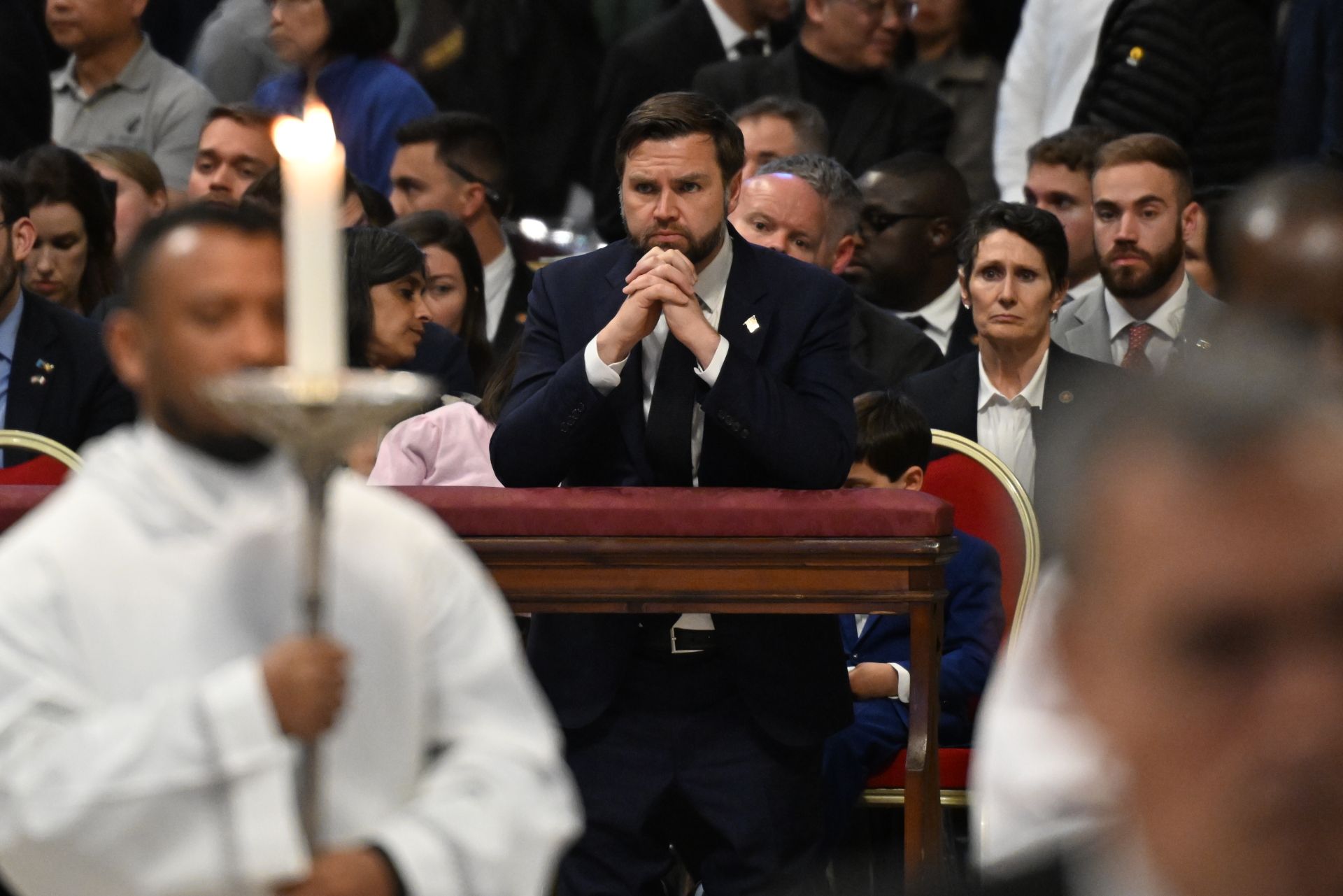
If I hadn’t heard of JD Vance before I picked up his latest book, “Communion,” I would have found in its pages a portrait of a thoughtful individual wrestling with modernity and his place in the world — albeit someone struggling for coherence and clarity. But of course I had heard of the American vice president, and how much power he wields. I knew him for his provocative statements on childless cat ladies and immigrants eating people’s pets, and also for his immense capacity for changing his beliefs to suit the political moment — going from claiming he’s a “Never Trump guy” (calling the current president variously “cultural heroin,” “America’s Hitler,” an “idiot” and “reprehensible”) to being his VP, which has to go down as one of the biggest U-turns in history. This background knowledge is what makes much of the book a jarring read: Vance’s values and wishes for America in some of these pages are so at odds with his public statements and actions that I often felt I was reading a book by a different person.
They are also at odds with his bestselling first book, “Hillbilly Elegy,” published in 2016. The two books cover much of the same ground (both are memoirs), but “Communion” is less coherent, seemingly addressing more than one audience about the benefits of the Christian faith to himself and to the country. Gradually, through discussions of society and politics, work and class, community and values, Vance reveals the real substrate of the argument. This is not really about Vance’s own individual faith, but about his feelings toward “Christian civilization” and his fear that it is declining. By the epilogue, then, Vance the public figure has come into alignment with the Vance writing this book.
This underlying message is a dog whistle to the far right, a nostalgic vision of European Christian society and the need to bring it back, with overtones — never explicit — of white supremacy. But the dog whistle has been embedded in caveats, such as saying that America’s religious liberty is, in fact, a Christian concept: “Because we’re all creatures of God, we must respect each individual’s pathway to that God,” he writes. Perhaps the caveats are to reassure more centrist readers of the reasonable, moderate nature of the vision, and he goes even further: The body of the book has critiques of society that would resonate with liberals across the world. I nodded along to many sections, such as when he advocates for less emphasis on financial health as a marker of success for both individuals and countries, or when he argues that strong unions are necessary to ensure living wages for workers, only to be horrified by some of the conclusions they led to. I found myself preoccupied with the question: Who is this book for? Wouldn’t different sections of this book turn off every single voter bloc in America? Or is Vance trying to pull off something truly ambitious: a reasoned argument to appeal to every single voter bloc in turn, from the liberals to the white supremacists, with the hope that they might all end up with a “he’s not all bad” image — enough, just possibly, to vote for him in a 2028 bid for power?
It is customary for politicians with an eye on the presidency to publish a book explaining their background. But Vance already did the classic version of this with “Hillbilly Elegy,” which propelled him to the fame that led, eventually, to the vice presidency. Subtitled “Finding My Way Back to Faith,” Vance’s new account of his life is his journey from his unorthodox religious upbringing, through doubt and alienation from religion, and back to Christianity — though not a return to his grandmother’s nondenominational faith or his father’s Pentecostal roots, but to the Catholic church.
Each chapter takes on a different part of his life, starting with his hillbilly background. He was brought up largely by his beloved, cursing, gun-toting, staunch believer Mamaw (his father gave him up for adoption when he was 6; his mother introduced him to a long line of stepfathers and eventually succumbed to addictions that meant he moved full-time to her mother’s, Vance’s Mamaw). He details his service as a Marine in Iraq, his return to Ohio for college, which he completed in two years despite holding down three jobs, and doing well enough to get into Yale Law School. He met his life partner Usha at Yale; they both have successful careers in law and business, and they have four children together (the fourth is on the way by the end of the book, and was born this month). Vance ran for the U.S. Senate, serving for just two years before becoming Trump’s running mate.
The material is the same as in “Hillbilly Elegy” up to his time at Yale, but the two books, despite following exactly the same pattern, diverge significantly and in telling ways. “Hillbilly Elegy” is the portrait of the community and wider society Vance is from: a community characterized by underachievement, shorter life expectancy, higher drug dependency and all the other markers that come with poverty. It tells the story of how Vance defied the odds to end up with a place at Yale Law School, and questions why he was the one to do so from among his many talented peers, and why his mother succumbed to years of addiction when others in his family, with the same background, had fulfilling relationships, families and careers.
His answers contain no magic bullets. Policy does have ways to “put the thumb on the scale” for the most needy, he writes, but there are far bigger influences in the culture and its expectations of individuals. He balances compassion for the harshness of life in the social milieu he describes with preoccupations about people’s need for personal responsibility and agency, and the saving nature of their social relationships. Details that bring home how loved he felt include how many letters he received while at boot camp compared to others, with his Mamaw sometimes writing multiple times a day. (My favorite is surely reminiscent of many families’ brand of loyalty: Mamaw is outraged at Vance’s reports of a particularly tough instructor. “Hello sweet heart all I can think about is them dicks screaming at you that is my job not them fuckers.”)
One of the stark differences to the retelling found in “Communion” is that the warmth of this extended family and its importance has all but disappeared. There really is no one but Mamaw left in this web of social relations in this second account of his life. His sister Lindsay and Aunt Wee, who both gave him homes at different times, barely make an appearance (precisely once each by name, a few more for Lindsay as “my sister,” but in passing). This gives a sense that Vance did it all alone: The account of school didn’t have the stories of Papaw helping him with math from an early age; the account of the Marines didn’t include the avalanches of letters from home; the account of saving for law school doesn’t have Aunt Wee taking him in after Mamaw died.
A generous reading would be that he assumes everyone has already read “Hillbilly Elegy,” or is at least familiar with the material from the wide attention it received, especially when a Netflix adaptation was released in 2020. But the fact that there are gaps in “Communion” isn’t the real problem. More important is that the excising of most of the support in his life shapes the argument in fundamental ways: He comes across as someone who made it alone, the epitome of an individualistic ideology, a picture he is explicitly rejecting in “Hillbilly Elegy.”
This solipsistic rewriting of his memoirs extends to the later material, too. Tech billionaire Peter Thiel is cited as a key influence in Vance’s journey back to Christianity after an appearance during his years at Yale, but then fades from the picture: His role in Vance’s political career, including the $15 million spent on his senatorial campaign, is missing. The way Vance narrates his political successes is as if they simply happened — a gift from God, as it were.
God, though, is also strangely absent from this account of Vance’s faith. He repeatedly states that he was an atheist for a while, even a “strident atheist” at one point, but the word is left unexamined and sits awkwardly with his feelings about Christianity throughout his life. This is an atheist who takes the works of theological writer C.S. Lewis with him to Iraq, and who carries “at the back of his mind” the memory of a purportedly miraculous, supernatural rescue from driving off a mountain. (The same anecdote is given a very different spin in “Hillbilly Elegy”: driving back from his Mamaw’s funeral, he believes it is her intervention which stops the car going over the mountainside. In the account of his conversion to Catholicism, it is God. This is just one example of how adaptable the world and his life are to Vance’s changing priorities.) There is nothing about his own actual belief, except for when it comes through the mouths of others, whether written or spoken, and little about his own spiritual experiences. “Catholic teachings touched the part of my heart and mind that demanded I focus on the things that actually matter,” he wrote about his baptism. Vance’s return to religion appears to have been less about his personal experience of God or the tenets of Catholicism than about joining a church with history and community. Of course, it is a sense of belonging that draws many people to religion, but I increasingly felt uneasy at this “way back to faith,” as the subtitle has it, containing so little actual faith.
Much like the account of creation in the Book of Genesis, there are two separate versions of his route to and from atheism: what might be called sociological and intellectual pathways. “What paved my path to atheism,” Vance writes, about how various churches failed to fulfil promises of redemption, “wasn’t books or ideas, it was sadness and a sense of betrayal.” Yet soon after, he says: “In my atheism, I fancied myself enlightened and rational,” and books and ideas play a major role throughout his journey. Reading C.S. Lewis in Iraq gives him a much richer sense of Genesis than that he got in his childhood, partly through Lewis’ direct exegesis, though Vance also gives a touching account of his response to the “Chronicles of Narnia”: “I found myself longing for a Christ more like Aslan than the one I’d encountered in church and scripture,” he writes. He tells us that the “first proverbial crack in my atheist armor” came courtesy of St. Augustine, in a passage on the interpretation of scripture. And it was Ayn Rand who led him away from Christianity in the first place: “my encounter with her ideas left two lasting impressions on me,” he tells us. “I no longer called myself a Christian, and I saw myself as deserving of everything that came to me. Thanks to Rand, I was a self-professed atheist and meritocrat.”
The idea of meritocracy is a preoccupation, as it is in “Hillbilly Elegy,” but there’s a harder edge to it in “Communion.” “Any sense of community attachment — that we owe something to the people from whom we came,” he writes of his time at Yale, “gave way to the one-upmanship of modern meritocracy.” He talks of how, as a society, we have developed the wrong markers of success. “People once worked because they had to, but in the new world — where work has supplanted religion as a core source of meaning — people pour themselves into their jobs.” This is one of the points in the book with which surely many people across the political spectrum can agree: “A corporate culture that tells us to worry more about McKinsey’s bottom line than about our families’ health is insane,” he says. “The McKinseys of the world are doing just fine. Do you know who isn’t doing fine? The American family, which has so taken to heart the message that work and family are incompatible.”
This is where Peter Thiel makes his crucial, if oddly distanced, appearance, given the close friendship that later developed between them. He gave a talk while Vance was at Yale that crystallized a few key points in Vance’s mind. The first was the hypercompetitiveness Vance was already uneasily noticing. “At each juncture, [Thiel] said, our jobs would offer longer hours, social alienation from our peers, and work whose prestige would fail to make up for its meaninglessness.” Thiel also spoke critically of Silicon Valley, saying we could tweet but had no cure for dementia. But just as influential on Vance was Thiel’s unashamed commitment to Christianity. “Possibly the smartest person I’d ever met, he identified very openly as a Christian,” Vance writes, contradicting his general perception at the time that “dumb people were religious and smart people were atheists.”
A later chapter on economics reinforces the sense that we are using the wrong measurements for success, and again, it’s hard to disagree. He cites a trip to Japan, which was at that point suffering economically, yet 5-year-olds rode the subway in perfect safety, the trains ran on time and the strawberries tasted great. America, meanwhile, is booming (he claims, with no evidence), but the population is not, ripped apart by uncertainty, opioids and financial stress. “A healthier society would recognize how gross it is to send sixteen-year-olds to work from 4 p.m. on Thanksgiving to 4 a.m. on Friday,” is one typical example of how he argues that politics based on economics is missing the point, but he also delves into research on varied issues, from the effects of unpredictable shift work on individuals and families to iPhones and the attention economy. “All this economic abundance coexists with intense spiritual misery,” he writes. “We orient people toward a life of consumption … and add their consumption — price club mega-size junk — to our national GDP. We use that GDP as a yardstick for our broader society, which is why it’s possible for false prophet economists to argue the American Dream is healthy even as suicide and addiction rates soar and the laughter of children fades from our streets.” He seems to be setting out future election promises on this score, in phrases such as: “I’m uninterested in making people servants to the economy. The economy ought to be serving us.”
He even takes on Silicon Valley, noting that tech executives themselves don’t allow their children unfettered access to what they have created. He details the studies that show damage to mental, cognitive and physical health, and again advocates for regulation. “Predictably, we’ve faced withering attacks from some for showing insufficient respect to “the market,” as if it violates some iron law of the economy to help people erect barriers between the digital economy and their very real personal lives,” Vance argues, again laying foundations, possibly, for his future platform.
Throughout these critiques of Western society, Vance draws on Christian values and thinkers to develop his ideas about what a healthier country might look like. A 19th-century encyclical by Pope Leo XIII, “Rerum Novarum,” is a guiding text, coming up again and again. “Pope Leo XIII’s theory of human nature strikes a balance so perfect it seems divinely inspired,” he says, describing how it rejects the excesses of libertarianism, liberalism and communism alike. “It rejects the libertarian view of culture that brackets ‘personal responsibility’ from the political choices that influence how people make decisions. It rejects the liberal view that encourages superficial achievement and meritocratic rise, favoring a more measured emphasis on duty and family,” Vance writes, picking up on the encyclical’s emphasis on respect and dignity through work, involving living wages and workers’ rights.
Even in such reasonable critiques of Western societies, of the rewards given for late nights at the office rather than consideration for life satisfaction or happiness, other values creep in, sometimes quietly, sometimes not so much. “For the first time in our history, women are having fewer children than they want,” he says on more than one occasion, without evidence; men wanting children are apparently not in the equation, despite his happiness and pride in his own. The same chapter, on Yale, also contains the first sign of what becomes, eventually, the main theme. “The bones of this institution were Christian,” he says, walking around campus, “and its Christian heritage echoed in every corner — from its halls of learning, meant to look like cathedrals, to the famous alumni who counted Christ as an inspiration.”
He sees “groupthink” everywhere, including discussions at Yale about gender, responses to the pandemic and geopolitical meetings with international allies about Russia. Each time, he gives a sense that he is a beleaguered truth-teller while the majority succumbs to various forms of secular fundamentalism, which means more people to police the acceptable lines of thought. “We replaced real diversity of thought with superficial diversity,” he writes in the epilogue, another point many people would agree with, but then takes it much further than most would be comfortable with, by immediately linking it to Christian culture — without an explanation. “Our Christian culture is weakened, but far from gone,” he concludes.
This is no ringing endorsement for Catholicism. Throughout, Vance acknowledges how aspects of the practices are strange to non-Catholics; the Eucharist, with the belief in transubstantiation, meaning the body of Christ is literally, rather than metaphorically, in the wafer and wine consumed during Mass, can be seen as cannibalism, Vance admits, and the near-worship of the Virgin Mary could be seen as blasphemous. For each of these objections, Vance does the work of neutrally observing his chosen faith, pointing out seeming oddities rather than attractions, before giving justifications, mostly in the words of others. At no point does he tell us why he personally finds these practices spiritually nourishing compared to the opposing practices in other churches, including his father’s, which he attended. In fact, there is very little in the way of spirituality in the whole book; Vance has other concerns.
“I was also drawn to the hierarchy and sense of authority in Catholicism,” he writes. “That the Church spoke with literally thousands of years of tradition behind it, that it had long-established processes for evolving doctrine and responding to new realities, made me feel that it was firmly rooted.” It is a visit to a cathedral in Burgundy that brings the epiphany leading to baptism. Even here, though, God is only mentioned in passing. The feelings are due to a sense of belonging, and to the beautiful building which has endured for so long in testament to a long tradition of worship — which leads to further thoughts about threats to this tradition.
“I couldn’t stop thinking about the emptiness of the cathedral and what that said about Europe’s cultural decline and Christianity’s slow evaporation from the continent,” he wrote. “Christianity was on the retreat in Europe, just as it was in the United States.” He sees this as the reason for the collapse of the international world order, which had been founded when Christianity remained a social force, as well as behind all the ills of the contemporary world. But this doesn’t appear to be about the values and beliefs of Christianity, but the cohesion that a church gives to a community.
“Religion was the social glue that had bound me to my family,” he writes in “Communion,” in stark contrast to “Hillbilly Elegy,” where religion only makes an appearance via Mamaw’s Bible reading and his teenage attendance at his father’s church: hardly “social glue.” “Even if I might make more money than a friend from back home or have different attitudes from my sister about nutrition, I could still see them both at church or at least share a common spiritual vocabulary,” he writes in “Communion,” not mentioning that Mamaw was utterly against church attendance.
The writing becomes expansive in his celebration of this social glue, rather overly so. “From the intermarriage of the Spanish and native populations in Mexico to the American melting pot of the nineteenth century to the Civil Rights Movement, Christianity has long brought people together,” he writes, with no acknowledgement of the violence done by Christianity during the conquest of the Americas or in race relations throughout time.
The decline, according to Vance, is nonpartisan, with both left and right guilty of weakening the Christian bedrock of society, in his words. “Each of us,” he begins, seemingly only talking to Christians in America, by implication excluding his Hindu wife and her family, not to mention the many other faith communities in the country, “in our own weird ways, is guilty of casting aside the Christian inheritance of our civilization.” And this is what keeps Vance up at night.
“My big fear isn’t death but that we inherited a great civilization and are slowly letting it fall into disrepair,” the epilogue says. “I may never meet my ancestors in the next life, but if I do, I don’t want them to tell me that they built magnificent buildings and we let them crumble, that they drafted beautiful works of literature and we spit out clichés on social media, that they went to the moon with slide rules but we couldn’t get back even with the aid of the supercomputers that they also built.” All these achievements are credited to Christianity, which is a blinkered view of the world both as it is now and historically — but accuracy is not the point. Vance’s vision is aligned with that to be found in far-right chat rooms: the glory of Christian Europe and the need to bring back that society. Vance is not concerned with an afterlife in the kingdom of heaven and the everlasting soul, but rather an ambition to wind back the clock. This book uses disparate thinkers and traditions to explore many important topics facing America, but chooses to end on this note: a call for Christian nationalism. Vance may be trying to be all things to all people, but it will be the far-right undercurrent that will dominate any future bid for power.
Become a member today to receive access to all our paywalled essays and the best of New Lines delivered to your inbox through our newsletters.