


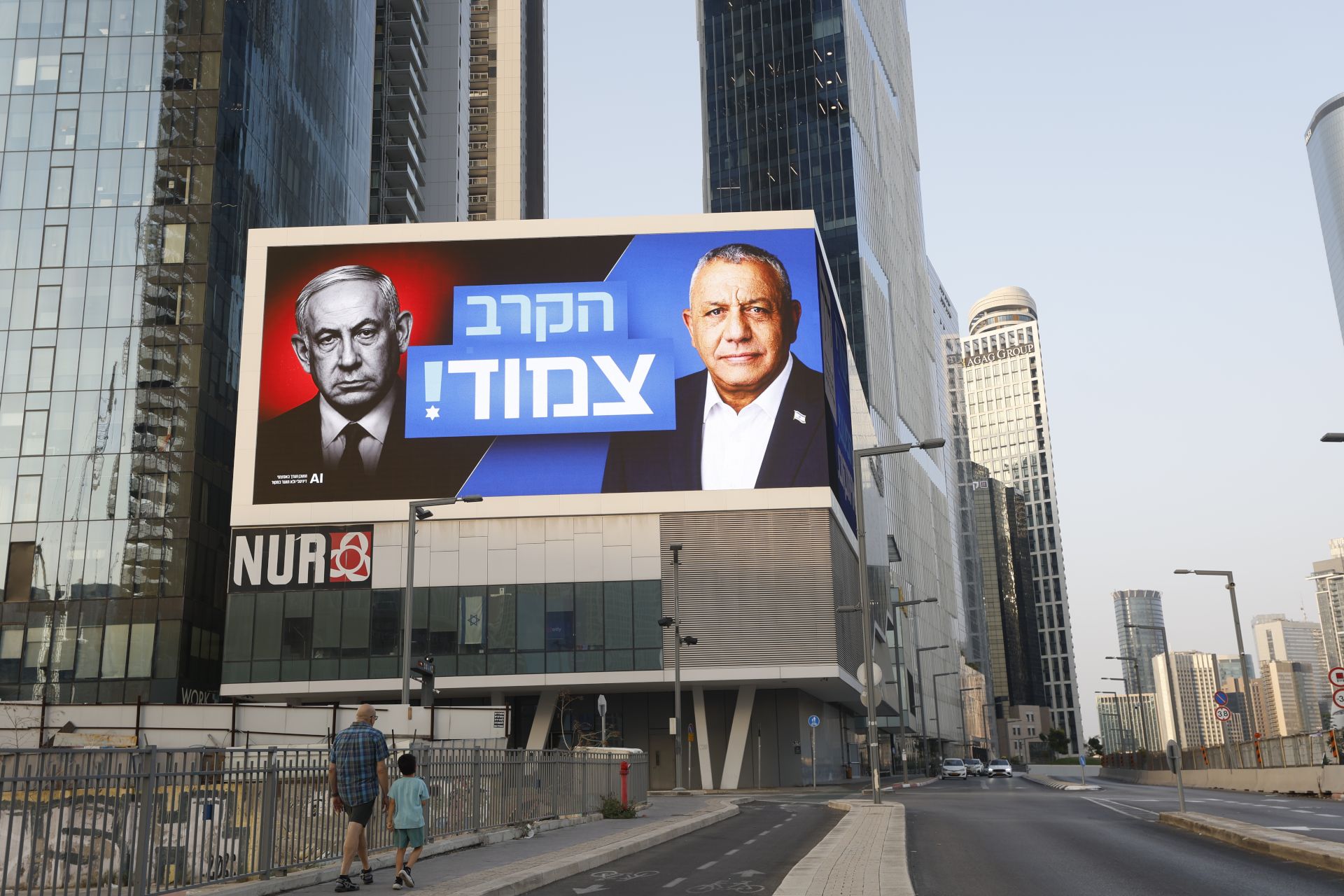
In most countries, if a prime minister were to lose his parliamentary majority in a national election, one would conclude that he was out of power. Prime Minister Benjamin Netanyahu saw his governing coalition decline from 68 to 53 seats after the Oct. 27 national election, so the natural assumption might be that he had suffered a major upset and was going to be replaced. This, however, is not what happened in Israel after the ballots were counted last week. Netanyahu, who has been in power for 19 years partly because he is a master of the political game, lost; but he also, somehow, won.
The bloc of parties that oppose Netanyahu is composed of two smaller blocs. The larger one includes four parties that identify as Zionist, and the largest of these is Gadi Eisenkot’s Yashar party; collectively, they won 48 seats. The smaller sub-bloc is composed of two groupings of mostly Palestinian parties that in Israel are referred to as the “Arab parties,” although one of them, the binational Democratic Front for Peace and Equality, identifies as an Arab-Jewish party. Importantly for the Jewish majority, these parties do not identify as Zionist. Collectively, thanks to the Arab community’s burning need to end the rule of Israel’s right-wing government and particularly of its minister of internal security, Itamar Ben-Gvir, they won an unprecedented 19 seats. Together, the Jewish-Zionist and non-Zionist Arab parties have a comfortable 67-seat majority, more than enough to form a government.
A government with the Arab parties, which together won 19 seats, or even a minority government kept alive by their votes from outside the coalition, has been taboo in Israeli politics for decades. The right’s campaign to delegitimize Arab participation in government has thus achieved what Netanyahu could not achieve at the ballot box, which is to help keep Netanyahu in power. Unless the Jewish-Zionist opposition parties accept a government that relies on Arab votes, Netanyahu stays in power — either at the head of a new majority, if one of the parties in the opposition breaks its vow and joins him (which would sink the political career of the party leader, as occurred with Benny Gantz), or as caretaker prime minister until an early election in 2027.
For decades, neither Jewish nor Arab parties sought Arab participation in government. Ironically, the first right-wing leader to try to break the taboo was Netanyahu himself, who courted the Islamist United Arab List, or Ra’am in Hebrew, after losing his majority in 2021. Since that attempt failed, and despite Ra’am’s precedent-breaking membership of the 2021-22 government of Naftali Bennett and Yair Lapid, the right has worked tirelessly to delegitimize the participation in government of representatives of 21% of Israel’s citizens. The rightward shift in public opinion after the Oct. 7 massacre made the campaign highly effective.
Three of the four Jewish opposition parties are not victims of this campaign but participants in it. Polls show that only 27% of Jewish Israelis across the political spectrum support including Arab parties in government, down from 36.5% before Oct. 7. Reading those numbers, Yashar (Eisenkot), Beyachad (Bennett and Lapid) and Yisrael Beiteinu (Avigdor Lieberman) all vowed to govern without Arab participation. The vows were made as consistently as the polls showing they could not form a government without it.
But a poll conducted by the aChord Center on election night showed that among supporters of the Jewish opposition parties, 61% prefer forming a government with Arab support over the alternatives of new elections or a government with Netanyahu or the ultra-Orthodox. The opposition to this option is greater among Lieberman and Bennett voters and minimal among voters who support the liberal-left Zionist opposition party called The Democrats, headed by Yair Golan. For this reason, the right-wing politicians in the opposition fear that if they form a government with Arab parties, large chunks of their base will defect to the current Netanyahu-led bloc.
That fear is a product of the right’s ability to shape the discourse, including on the mainstream outlets that liberals and “change bloc” voters actually watch. Netanyahu’s media apparatus, known in Israel as the “poison machine,” is usually identified with the pro-Netanyahu Channel 14, loyalist media personalities such as Yinon Magal and Sharon Gal, Netanyahu’s son Yair and other social media figures, street hooligans turned content creators such as Mordechai David, and bot farms. Centrist voters do not follow any of these media outlets. The machine’s most effective channel is therefore the mainstream media, where its talking points are repeated uncritically by veteran news presenters, reporters and panelists.
This is how the right-wing discourse has penetrated the conversation in centrist Israel, among people who would never dream of watching Channel 14 or listening to Yair Netanyahu’s podcast.
The poison machine’s messaging on Arab citizens goes beyond right-wing talking points. It is Kahanist. During the 1980s, Rabbi Meir Kahane, who was assassinated during a visit to New York in 1991, founded Kach, the now-banned party and designated terrorist group that called for expelling Palestinians from all the territories under Israeli control, and for a state governed by Jewish religious law. In his 1981 book “They Must Go,” Kahane cast Israel’s Arab citizens as a fifth column, likening them to the Sudeten Germans who served the Nazi takeover of Czechoslovakia. Their very participation in elections was the threat: “The Jew must recognize that no Arab wishes to live in a Jewish state and that ‘democracy’ is his weapon in putting an end to that state,” he wrote.
This logic was reflected in last week’s coverage in mainstream Israeli media of the elections and its aftermath. Commenting on the results, Dafna Liel of Channel 12, the most watched commercial mainstream television news broadcast, posted on X: “Great results as far as Israel’s enemies are concerned.”
For hours, Channel 12 amplified a story about three Palestinian citizens of Israel, all political activists, who were arrested after police found envelopes of cash in their homes, which they claimed were bribes from Qatar aimed at “buying” the Israeli election. This story was ultimately proven to be false, but it’s too late for a correction; the mainstream Jewish public has absorbed the claim that Palestinian citizens of Israel voted in unprecedented numbers on election day because they were bribed by Qatar. On Kan 11, the public broadcaster, news presenter Ayala Hasson claimed, without credible evidence, that there were irregularities and vote-buying at Arab polling stations. One of the participants on the panel she hosted, Uzi Rabi of Tel Aviv University, who used to head the Department of Middle Eastern and African History at the university, lent support to her claims, again without evidence, by asserting that there were “states behind” the high Arab vote count.
A second Kahanist theme is that there is no such thing as an Arab moderate. Today, the Israeli Hebrew media dismisses the Arab leadership’s condemnations of the Oct. 7 Hamas-led attack as insufficient. Moriah Asraf of Channel 13, usually considered the most liberal of the TV channels, ruled out a government supported by the Arab parties because “they are terror supporters.” Asraf claimed in another broadcast that leaders of the parties that represent Palestinian citizens of Israel “work against the principles of the security of the State of Israel.” Her co-host Eyal Berkovic falsely claimed the leaders of those parties were supporters of terrorism who “don’t fully condemn Oct 7.”
The Israeli media watchdog The Seventh Eye counted four instances in a single episode of Channel 12’s “Meet the Press” program in which guests said that, if Eisenkot were to form a coalition with the “Arab parties,” he would head a government that relied on supporters of terror.
Kahane foresaw this moment. He mocked Prime Minister Yitzhak Rabin, who was assassinated exactly 31 years ago this week, when, in 1976, Rabin promised Arab citizens equal rights as individuals “but not more than that.” Kahane asked whether liberals would deny Arabs the vote once their voice became decisive in Israeli politics. “Jewishness versus universalism,” Kahane wrote. “A Jewish state versus a Western, liberal, equal one. Zionism or open democracy. Ultimately Israel will have to choose.”
Fifty years later, Israel has reached the point Kahane described. The liberals and the center-right, who are purportedly committed to Israel’s democratic institutions, must choose. If they decide that keeping the Arab parties out of government is more important than ousting Netanyahu from power, the winner of this election will be Kahanism.
Become a member today to receive access to all our paywalled essays and the best of New Lines delivered to your inbox through our newsletters.