


Since the fall of Bashar al-Assad in December 2024, one question continues to circulate on Syrian social media, and among political elites and Western observers trying to make sense of Syria’s political transition: To what degree will the new government move toward Salafism, adopting a fundamentalist Islamist ideology?
The question arises from a number of incidents. On Oct. 8, 2025, less than a year after Assad’s fall, units of Syria’s new army marched through central Damascus in a military parade attended by interim President Ahmad al-Sharaa. The soldiers were expressing solidarity with Gaza, but the language in which they did so was striking. As they passed through the iconic Umayyad Square, a symbol of the Syrian revolution, they chanted, “We are the soldiers of Qadisiyya, the soldiers of Saad and al-Baraa,” invoking an early Islamic military victory and two figures associated with the Islamic conquests. Syrians’ identification with Palestine was hardly new. What was new was that the chant came from soldiers of the new Syrian army, marching through the capital before a leader whose own political trajectory had begun in jihadist networks.
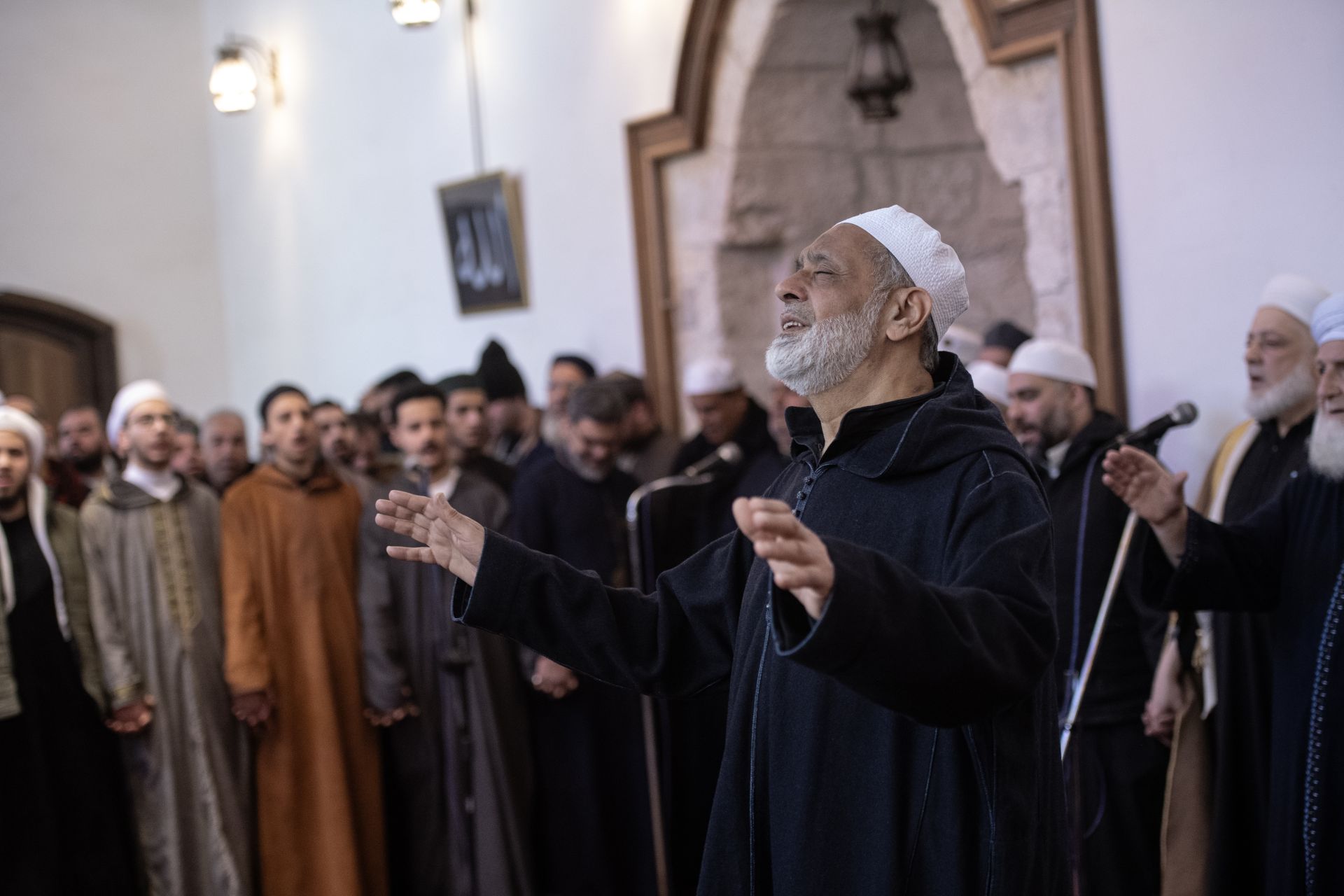
Five months later, I encountered a scene in Damascus that raised the same question in a different way. On the morning of March 20, 2026, Syrians filled the Umayyad Mosque for Eid al-Fitr prayers. Among them were soldiers in uniform, standing shoulder to shoulder with civilians, bowing and praying with them. A Damascene woman who had entered the mosque for the first time since Assad’s fall was astonished by what she saw. “We would never have imagined in our lifetime seeing our army praying side by side with civilians,” she told me, “and seeing soldiers praying in public.”
To me, her surprise makes sense against the contentious history of state and religion during the Assad era. While the Assad regime was often — and mistakenly — labeled “secular,” in practice it co-opted religious institutions, manipulated sectarian differences and intervened deeply in Sunni religious life, working with clerics it considered politically reliable such as the Kuftaro network, a Sufi-rooted school of thought that flourished under Assad during the 1970s and ’80s in Damascus. Yet it kept the army at a careful distance from public devotion, and soldiers praying in uniform in the capital’s great mosque had no place in the image it wanted to project about its military. Since Assad’s fall, public space has changed dramatically, as former insurgents have become state officials. Revolutionary legitimacy, captured in the phrase “man yuharrir yuqarrir” (“whoever liberates, decides”) has become a tool not only of political legitimacy but also of Sunni representation.
Does that mean Syria is moving toward Salafism, adopting the fundamentalist, puritanical interpretation of Sunni Islam?
I think that question is both unavoidable and misleading. It assumes that because the men who captured the state emerged from Salafism, they can simply remake Syrian society in their own religious image. Yet political victory is not the same thing as religious authority. And controlling ministries, military units and presidential offices, as the current government is wont to do, is not the same thing as controlling the extraordinarily diverse social world through which Syrian Sunnis have historically understood Islam.
Indeed, Sunnism in Syria was never homogeneous. For decades, religious life in Damascus, Aleppo, Homs and Hama was shaped by mystical Sufi orders, scholarly families, neighborhood mosques and women’s study circles, and by a Damascene tradition that combined Hanafi and Shafii law and Ashari theology — with their variations of theological interpretation within the Sunni Islam tradition — as well as a devotional culture of Mawlid al-Nabi celebrations (marking the Prophet Muhammad’s birthday) and dhikr (rituals of remembrance of God), which are traditionally Sufi or Sufi-inspired and categorically eschewed by Salafism and other conservative schools of Sunni Muslim thought.
The Assad regime understood this well, and never tried to erase those Sufi practices. Instead, it tried to manage and co-opt the clerics it found reliable while pushing out those who opposed the regime, such as the Muslim Brotherhood, Salafists or takfirists — extremists who dismiss other Muslims as apostates. During the Syrian war, Salafist currents existed alongside various other Sunni traditions, but under the Baath regime, they were kept at the margins, watched closely by the security services and denied the mosques and institutes that the regime’s chosen Sufi scholars enjoyed.
It is too early to say that Salafist traditions have replaced Sufi ones after the fall of Assad in December 2024. But one could argue that the restrictions that defined Syria’s Sunni ecosystem for decades have been shattered, and actors who had rarely shared the same institutional space now suddenly find themselves side by side. Sheikh Wisam Qassum, a member of the Syrian Islamic Council from Idlib, the de facto “capital” of the Syrian revolution, was careful when he described this to me during a recent interview. The difference between Sufis and Salafists, he said, is “within the natural difference” and nothing new. Meaning, the difference remains as it always has been: The former is esoteric and mystical, the latter concrete and ideological. What is new is the lifting of security constraints, the prominence of Salafist fighters in the military victory, and “a new contact between segments of Syrian society that had not previously been in contact with one another.” In practice, this means that the religious cadres who trained in Idlib during the war have arrived in cities where religious life has been shaped by very different traditions, and that they now compete with each other for the same mosques, pulpits and students.
One stark example of this occurred in March 2025, when al-Sharaa restored the office of grand mufti, which the Assad regime had abolished in 2021, and appointed Sheikh Osama al-Rifai, a scholar from the Damascene tradition, to lead the new religious establishment. However, appointing al-Rifai as mufti did not resolve or end the contestation within the Sunni milieu. According to two opposing views I have gathered from circles close to the Syrian authorities and the mufti, the appointment of al-Rifai was an attempt by al-Sharaa to undermine the Salafist doctrine, which cannot easily make sense of the internal dynamics of Syria’s modern religious sphere, and instead cultivate the Sufi doctrine. This move might also be rooted in another form of pragmatism. Sufi tradition has historically given a nod to the ruler, no matter the land or nation in which it finds itself. Even today, rulers of countries with a Sunni majority court Sufis, seemingly confident that the esoteric tradition will never mobilize its followers to take up arms and rebel against the state, even when the ruler is a ruthless dictator.
This contentious dynamic became obvious with a leaked video recording of Grand Mufti Osama al-Rifai that not only went viral, attracting opposing views among Sunnis, but also made this tension unusually visible. The leaked footage, which was recorded during a private meeting with an Indonesian delegation, features al-Rifai reflecting on the history of the relationship between Hayat Tahrir al-Sham (HTS) and the Syrian Islamic Council when he was its mufti in Turkey. Al-Rifai was explaining that the history of HTS was rooted in Wahhabi thought, the ultraconservative interpretation of Sunni Islam long adopted by Saudi Arabia, and even takfirist extremism. He went on to say that many actors, including the Turkish government, tried before the fall of Assad to mediate between him and HTS, but he always refused and maintained his distance from the latter, until al-Sharaa announced that he had abandoned extremism and now identified himself with “ahl al-sunna wa al-jamaa” (the mainstream Sunni Muslim community). What began as a private discussion of religious affiliation quickly became a public controversy over Salafism’s place within Syrian Sunnism, prompting al-Rifai to clarify that his understanding of “ahl al-sunna wa al-jamaa” included Salafism as part of Syria’s Sunni religious landscape.
While this might appear as theological disagreement, what interested me was the political contestation surrounding the Sunni space in post-Assad Syria, and not so much the theological differences, which are part and parcel of daily life. For example, some of the strongest criticism came from religious figures and networks historically associated with HTS, Ahrar al-Sham and Jaysh al-Islam, the organized rebel groups who fought the Assad regime. Though they shared Salafist genealogies, this never prevented intense organizational rivalry and, at times, armed confrontation during the revolution. More importantly, it would be easy, looking at this from outside Syria, to treat these actors as belonging to a coherent Salafist camp. During the war, however, their factions competed for territory, fighters and revolutionary authority. Their religious authority figures challenged one another’s legitimacy, and at different moments their organizations fought one another. That these historically competing networks found themselves defending a common position after the leak therefore reveals something more significant than assuming a shared doctrine among them.
Although al-Sharaa has largely succeeded in absorbing and diluting these currents, their social and religious constituencies have not disappeared. Political victory brought them unprecedented access to the state, but this did not necessarily translate into an equivalent authority within Syrian Sunni society. Al-Rifai’s ability, as a Damascene scholar with an established religious genealogy, to define the boundaries of legitimate Sunnism touched a deeper insecurity among revolutionary religious actors; namely, that despite having participated in the defeat of Assad and acquired access to the state, they could still find themselves religiously or socially marginalized within the Sunni community they have come to have a hand in governing.
If the fall of Assad did not erase these rivalries, it reorganized the field in which they operate. One of the most revealing examples comes from Douma, a town located near Damascus that was under rebel control for the majority of Syria’s war, where the post-Assad redistribution of religious positions has brought figures emerging from different revolutionary networks into the same institutional and symbolic spaces.
Abdullah al-Muhaysini is particularly interesting in this regard. During the revolution, his relationship with Jaysh al-Islam was marked by severe political and religious antagonism. Yet, according to testimony from a religious cleric in Douma, al-Muhaysini has since preached from the Grand Mosque of Douma, the most important religious gathering place in what was once Jaysh al-Islam’s stronghold.
I do not read this primarily as personal reconciliation, nor as evidence that the religious disagreements separating these networks have disappeared. Rather, the political environment that made those disagreements decisive has changed. Armed factions that once governed separate territories and developed their own courts, mosques, religious institutes and Sharia establishments have been compressed into a national field. Their competition is consequently no longer simply over revolutionary territory but over access to state institutions, religious appointments, public recognition and the authority to define the religious meaning of the revolution itself.
This helps explain something else I found striking in my interviews. The revolutionary religious currents have achieved something extraordinary: They won politically. But that does not necessarily mean they have won socially, a distinction essential for understanding the post-Assad religious order. Military victory gave actors access to institutions from which they had previously been excluded. It changed who could become a minister, a military commander, a religious administrator or an adviser to the presidency. But victory cannot instantly reproduce the social authority accumulated by religious institutions over generations, nor can a presidential appointment erase the multifaceted networks through which Syrians have learned, practiced and transmitted religion within families, neighborhoods, mosques and educational institutions.
Kuftaro is perhaps the clearest example. Whatever judgment one makes about the establishment’s accommodation with the Assad regime, its social presence in Damascus cannot be reduced to the political protection it once received from the state. Across decades, it developed mosques, educational institutions, teachers, students, family relationships and forms of religious pedagogy that extended throughout Damascene society. Those networks did not disappear when the revolutionaries ousted Assad from Damascus in December 2024. A victorious authority can redistribute ministerial positions — as it indeed has been doing — much more quickly than it can dismantle social embeddedness. This creates an important asymmetry within the religious field, as networks associated with the revolution possess forms of legitimacy that remain largely unavailable to Kuftaro and other institutions whose histories are tied to the Assad regime. Yet some of those older institutions retain forms of social authority that revolutionary victory cannot simply manufacture. Al-Rifai, similarly, possesses a scholarly and symbolic authority rooted in a Damascene religious genealogy that long predates the political ascendancy of the more conservative actors now governing Syria.
Revolutionary legitimacy therefore operates alongside, rather than simply replacing, older sources of religious authority.
In my interviews, one question repeatedly appeared when people assessed the legitimacy of religious figures: “Where were you during the revolution?” The question appears to concern biography, but in the new Syria it has become a means of distributing moral standing. A scholar who went about his day while living inside regime-held Syria, a cleric who was imprisoned, another who was displaced, and a religious figure who participated directly in revolutionary institutions may possess comparable scholarly credentials but enter the post-Assad order with radically different political resources.
Participation in the old regime, imprisonment or displacement by it, and sacrifices made to withstand it can now be converted into claims to Sunni authority. On the other hand, proximity to institutions that survived under Assad can become a source of vulnerability even where the social authority of those institutions remains considerable. The revolution did not merely remove the political order regulating Syrian religious life. It produced a new hierarchy through which the past is used to determine who possesses the moral standing to shape the future.
This is where the question of Salafization begins to become a political one.
The phrase “whoever liberates, decides” contains within it a powerful postwar logic. Those who fought, sacrificed and ultimately defeated the regime claim a particular authority to construct the institutions that replace it. In the immediate aftermath of victory, this claim is not difficult to understand. The new army itself emerged from armed organizations whose members experienced the war not as an abstract political transition but as a struggle in which their friends and families were killed, displaced or imprisoned. Revolutionary legitimacy therefore cannot simply be dismissed as ideological language; it is rooted in lived histories of sacrifice.
The more difficult question is what happens when that revolutionary legitimacy becomes a principle for organizing political life.
A revolutionary movement can derive its authority from victory. A state, however, must eventually govern people whose relationship to that victory is far more complicated. Some fought. Some were displaced. Some remained in regime-held areas. Some opposed Assad without joining armed organizations. Some opposed both Assad and the Islamist factions that came to dominate the opposition.
The transition from revolutionary authority to state authority therefore involves more than transforming insurgent commanders into military officers or revolutionary institutions into ministries. It requires answering a more difficult question: How long, and in what domains, should revolutionary participation continue to determine political legitimacy?
The debate surrounding the Syrian Muslim Brotherhood makes this problem particularly visible, because the Brotherhood occupies an almost inverse position to the victorious revolutionary current.
The Brotherhood has a long history of opposition to the Assad regime, and an organizational identity that predates the current leadership by decades. The Assad regime’s Law No. 49 of 1980 made membership of the Brotherhood punishable by death, driving much of its leadership and organizational activity into exile. After the start of Syria’s revolution in 2011, the Brotherhood became an important component of the political opposition, but it did not emerge from the war among the military forces that defeated Assad. This does not mean, however, that the Brotherhood was absent from the armed struggle. During the early years of the uprising, Brotherhood figures played an important role in financing, organizing and exercising influence over several armed factions. In the city of Homs, an early beacon of the revolution, the Civilian Protection Authority (Hayat Himayat al-Madaniyyin), established in 2013, operated as a civilian-military umbrella organization with an associated military wing and provided financial support to local armed groups. The Islamic Union of Ajnad al-Sham, active in Damascus and its countryside under figures including Yasser al-Qadri and Khaled Tafour (aka Abu Suleiman), was yet another formation associated with Brotherhood networks. Faylaq al-Sham, initially active in Homs before relocating to Idlib following the forced displacement of opposition forces in 2014, maintained particularly strong political and financial connections to Brotherhood figures, including Haitham Rahma and the exiled business owner Abu Abdo al-Hakami. The Levant Front (al-Jabha al-Shamiyya) was also associated with the Brotherhood, while certain wings within Ahrar al-Sham were influenced by Brotherhood-linked figures. These examples demonstrate that the Brotherhood’s involvement in the armed opposition extended beyond formal organizational structures into military formations, financing networks and factional leadership, even though it did not emerge as the principal military force behind Assad’s eventual overthrow.
Today, however, the Brotherhood confronts a Syria governed by another Islamist current, one whose legitimacy derives not primarily from having endured decades of political exclusion but from having acquired military and territorial power during the revolution and ultimately led the operation that resulted in the defeat of the regime.
In my opinion, this is what makes the Brotherhood’s recent refusal to dissolve — as it was requested to do by al-Sharaa — more significant than a dispute over the future of one organization. It brings the question of who owns Sunnism directly into the political field. As such, the rivalry is no longer only between different religious currents competing over the authority to define legitimate Sunni religious representation, but also between political currents with different histories of opposition, organization and participation in the revolution, where each carries a different claim to represent Syria’s Sunni majority. The Brotherhood’s Shura Council has insisted on the group’s continued existence, while calling for organized political pluralism, political freedoms and a legal framework regulating party activity. Its position therefore raises a larger question about who is entitled to organize and speak politically in the name of a Sunni constituency after Assad. The Brotherhood draws upon a long history of organized Islamist opposition to the Baathist state, while the current rulers derive much of their authority from a different trajectory of Islamist mobilization, armed struggle and revolutionary victory. What appears as a debate over whether the Brotherhood should dissolve is therefore also a rivalry between different political genealogies of Syrian Islamism over who can convert their particular history of opposition into legitimate political representation in the new Syria.
The legal ambiguity surrounding the Brotherhood makes the question even more revealing. Law No. 49 belonged to the coercive architecture through which the Assad regime attempted to eliminate the organization from Syrian political life. Yet the disappearance of the regime did not automatically produce a new legal framework through which the Brotherhood, or indeed political parties more generally, could establish their place in the post-Assad system. The constitutional declaration of March 2025 recognizes the right to form parties “on a national basis,” while Syria still lacks the comprehensive party framework through which organized political competition can take place. As of March 2026, no political parties had been officially registered under a new party law.
While controversy surrounds the legacy of the Brotherhood, the question about their political activism should not be reduced to whether one supports or opposes them. It concerns the relationship between revolutionary legitimacy and political pluralism.
The revolutionary legitimacy on which al-Sharaa draws can also be contested via the fact that the armed opposition was itself heterogeneous, as was the civilian opposition, and that the histories of HTS, Ahrar al-Sham, Jaysh al-Islam, the Syrian Islamic Council, the Muslim Brotherhood and displaced Damascene religious scholars intersected without ever becoming identical. Even within the Salafist-oriented revolutionary field, actors who now invoke a broadly shared revolutionary legitimacy possess profoundly different histories of conflict, accommodation and competition. Revolutionary legitimacy therefore cannot easily be claimed as the exclusive possession of the movement that ultimately captured the state, particularly when the revolution itself was produced through multiple political, military, religious and civilian trajectories. The same problem therefore exists inside the victorious constituency itself. Whose sacrifice counts? Whose revolutionary history confers authority? Does military participation carry greater political value than imprisonment, displacement or civilian opposition? And can the revolutionary biography of an organization be transferred indefinitely to individuals who later occupy state institutions?
These questions are already present in religious life, even when they are not articulated explicitly as political questions. At the level of the mosque, Abd al-Nasser al-Qadiri, a researcher who has followed the religious field closely, described to me how Sufi-rooted Mawlid gatherings, dhikr sessions and intercessory prayers have contracted in formerly regime-held areas, while Salafism-rooted Quran memorization circles, recitation of the Sahih al-Bukhari hadith and jurisprudential lessons have expanded. Mouaz Alkhatib, the first president of the revolutionary Syrian National Coalition, gave this a name: “al-salafiyya al-batiniyya” (“esoteric Salafism”). By this he meant a project that is pursued through appointments, curricula and endowment patronage, while moderation is performed in public, a project aimed at the middle layer of moderate, Sufi-inclined scholars who held the Sunni field together.
I understand this emerging condition through what I call hyper-Sunnism, a process of saturation without consolidation. Sunni references increasingly saturate political discourse, public morality and the institutional language of the post-Assad state, yet this heightened visibility has not produced a consolidated Sunni project or a single center capable of defining what legitimate Sunnism should look like. Rather, the more politically central Sunni identity becomes, the more visible its internal contestations appear, as different religious and political currents compete over which practices, histories and moral claims should define Sunnism in the new order.
Another example of hyper-Sunnism can perhaps be seen in the growing dominance of “dawah,” or public proselytizing, initiatives that gain authority through their claimed affiliation with the Ministry of Awqaf (religious endowments). One recent example comes from Hama, another bastion of the revolution and one of the most conservative cities in Syria. (It was there that Assad massacred over 20,000 people to quell a Muslim Brotherhood rebellion in 1982.) Despite the city’s bona fides as an already conservative society, a Salafi dawah group called Yaduna ila al-Khayer (Calling to Goodness), with links to HTS, took it upon itself to aggressively proselytize to the already converted. The group drew criticism for what the locals called interference in people’s private lives, particularly women’s dress, and its campaigns against music and public concerts. The group has also advertised activities under the sponsorship of the local Directorate of Awqaf.
While this might appear to reflect a state-supported, top-down process of Islamization, I still view it as saturation without consolidation. Rather than a homogeneous and centrally managed process of Islamization, it reflects the growing assertiveness of hyper-revolutionary religious actors competing with other Sunni groups, in this case the long and deep influence of the Muslim Brotherhood in Hama. Indeed, according to the testimony of locals, these initiatives are increasingly expanding into social constituencies traditionally associated with the Muslim Brotherhood. As such, it might be that what we are witnessing is less a unified project of Islamization and more an intra-Sunni rivalry over representation and religious authority.
I have come to think of the disputes produced within this condition as a form of new “nawazil,” a term in Islamic jurisprudence referring to emerging or unprecedented circumstances that require religious interpretation and legal judgment. I do not mean that the religious questions themselves are unprecedented. Their novelty lies instead in the political conditions which the fall of Assad has allowed to emerge. For example, a recent concert by the popular Syrian singer Assala Nasri generated criticism from conservative religious voices who invoked the sacrifices made during the revolution, asserting that Syrians had not fought and died to overthrow Assad only to establish a country of concerts, nightclubs and entertainment. What might have appeared to be a religious disagreement over the permissibility of music became instead an argument about whether the sacrifices of the revolution created an obligation to organize public life according to particular Islamic norms. Hyper-Sunnism, in this sense, does not consolidate Sunnism; it saturates the political and social field with competing claims about what Sunnism should mean, increasingly articulated through the language of revolutionary legitimacy.
This is where revolutionary legitimacy moves from the political history of the new rulers into the everyday life of the new Syrian state. Sacrifice can be invoked not only to justify who governs but also to make claims about what the revolution was about. In Syria today, something is changing, and it would be dishonest to pretend otherwise. Salafist-oriented religious actors have access to public and institutional spaces from which they were excluded for decades under Assad. Revolutionary religious networks have forms of political capital they could not previously exercise nationally. Conservative religious cadres associated with Idlib are reckoning with the diversity of Damascene and other urban religious traditions, and the state itself is becoming involved in the redistribution of religious authority. However, what these developments describe is a contest over authority and Sunni representation, rather than a complete program of Salafization. How this will continue to unfold will be watched closely by all parties, domestic and foreign.
Become a member today to receive access to all our paywalled essays and the best of New Lines delivered to your inbox through our newsletters.