

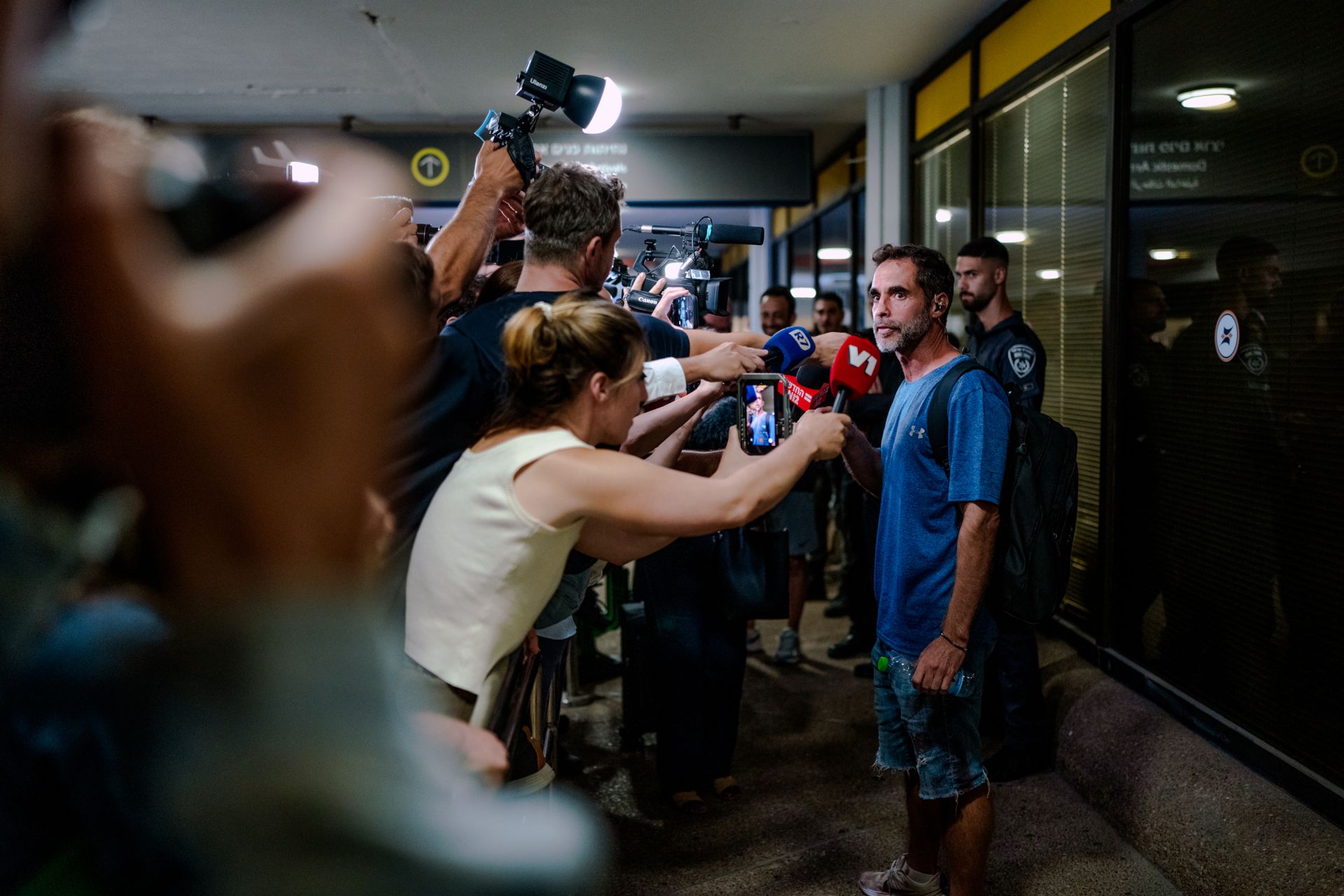
When the podcast host Avi Kaner recommended that the Israeli passengers in Tabuk try Saudi coffee, a Saudi user’s reply went viral, drawing more than 20 million views. It was a photo of a cup of coffee filled to the brim, which in Saudi culture tells a guest he is unwelcome. Meanwhile, a video of a Saudi health worker in a black niqab taking the blood pressure of a female passenger in a tank top took off on Israeli media, a stand-in for the unlikely interaction between the two nations.
Few crimes create political mythology as reliably as hijackings. Conspiracy theories thrive in the aftermath as unanswered questions linger. When reports of an attempted hijacking aboard a Flydubai flight from Dubai to Tel Aviv surfaced on Sept. 30, with the plane plunging thousands of feet before landing in Tabuk, in northwestern Saudi Arabia, reactions were plentiful, especially given the nationalities involved. The passengers were mostly Israeli, the airline Emirati, the captain Indian and the co-pilot, later identified as Hammam al-Hammami, reportedly Omani. The Tel Aviv-bound plane made its emergency landing in Saudi Arabia, a country with which Israel has no diplomatic relations.
In a call with Israeli Prime Minister Benjamin Netanyahu, Indian pilot Smit Machchhar recounted being attacked by al-Hammami minutes after the co-pilot asked to pray. The injured pilot, however, managed to open the door of the cockpit, allowing a group of passengers to corner al-Hammami. Machchhar told Indian Prime Minister Narendra Modi about chanting the “Hanuman Chalisa,” a Hindu devotional hymn, during the attack. Modi praised him for keeping his “culture alive.”
Israeli plumber Yaniv Hayoun, who reportedly pulled the plane out of its dive, a move he said he learnt from air disaster movies, was given a hero’s welcome. Netanyahu posted a five-star review for professional services on X, calling him “a hero who has saved many lives.”
The incident drew responses shaped by each country’s political realities and calculations. In Saudi Arabia, it met with humanitarian care and a cold distance. In Israel, weeks from a key national election, it became a story of national triumph and was quickly used for political point-scoring. In a polarized India, where Modi’s popularity is dipping amid continuous protests, Machchhar became a hero largely claimed by the right.
A post by David Keyes, Netanyahu’s former adviser, of a mock seating chart selling premium seats next to Israelis for extra security was among those that circulated widely. It drew more than 2 million views. Other videos followed the same joke, including an AI-generated in-flight safety guide that told passengers to locate their nearest Israeli for the best chance of survival. Other memes included President Donald Trump in the cockpit with Hayoun, the plumber, holding a wrench and taking directions from a TV screen.
In India, Modi celebrated Machchhar as a national hero and compared the averted attack to 9/11. Online, the pilot’s views became contested ground. After a screenshot circulated bearing his name and photo, commenting “respect” under a Rahul Gandhi post, right-wing outlets said the account was fake. And after Machchhar, on a call with Modi, called the prime minister his “biggest idol,” the right claimed him largely as his own. Several declared that “seculars” would be fuming because Machchhar was Gujarati, Hindu and Brahman, assuming they despise all three identities.
His surname drew its own curiosity, since “machchhar” is Hindi for mosquito. When Modi posted about him in Hindi, X’s Grok translated it as “Captain Mosquito Smith is a hero.” Moreover, in a country where “cockroach” has taken a loaded meaning after the recent anti-Modi protests, the ruling Bharatiya Janata Party’s youth wing put up billboards in Pune saying, “When life gives you a chance, be a machchhar, and not a cockroach.”
Alexandria Fanjoy Silver, a Toronto-based Jewish history teacher who writes on food, turned the incident into a satirical menu for the Jewish holiday of Simchat Torah. It included Saudi Dates for foreign policy. “Diplomats spend twenty years on this. We did it one afternoon with an emergency landing.” “The Captain’s Curry,” made the Bene Israel way, in honor of the Indian pilot, and “Applause Rugelach” was a nod to the stereotype of Israelis clapping on plane landings. “Everyone makes fun of us for it,” she wrote. “Now who’s laughing?”
The chain of events has left a vacuum for rumors to fill, especially as new information trickles out, with posts galore calling the incident a “false flag” (the Anti-Defamation League counted at least 25,000 on X in the first 48 hours). The co-pilot was reportedly grounded in Oman over extremist views and has a Syrian mother. It is still unexplained how he was cleared to fly into Israel, whether he acted alone, and whether Iran had anything to do with it — though based on what he’s hearing, Trump says yes.