

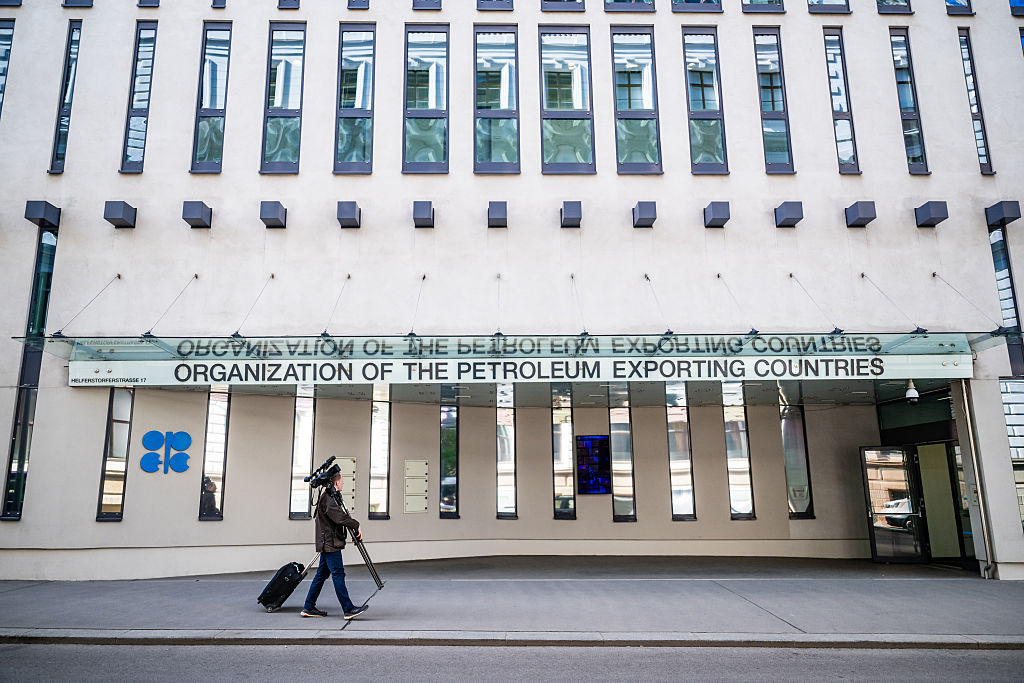
The United Arab Emirates announced on Tuesday that it would leave the Organization of the Petroleum Exporting Countries (OPEC), a cartel of major oil-producing states that includes Saudi Arabia, Iraq, Iran and others. The cartel coordinates how much crude oil its members pump, tightening and loosening global supply to influence prices.
Oil prices recently have been subject to disruptions, of course, due to the war in Iran and the closure of the Strait of Hormuz, the critical pathway for oil from the Arabian Peninsula to global markets. But the UAE’s decision, coming on the eve of a gathering of Gulf Cooperation Council members in Jeddah to discuss the war, reflects the ongoing realignment of a region grappling with incessant Iranian bombardment, a volatile oil market and what will likely be a new phase in Abu Dhabi’s relationships with its neighbors, whose lack of a forceful response to Iranian aggression has disappointed the UAE’s leaders.
The UAE, which has been an OPEC member since 1967 (first as the emirate of Abu Dhabi, then as a unified country) said it would act responsibly and only gradually increase its oil production after the war.
The departure from the cartel highlights the ongoing political and economic rift between the UAE and Saudi Arabia, which began before the war on Iran and arose from differences over how to deal with regional crises in Yemen and Sudan. Many observers expected the Iran conflict to paper over these differences, given the Gulf countries’ shared nemesis in Tehran.
Saudi Arabia and the UAE have had disagreements over OPEC policy for years: The UAE has increased its oil production capacity over the past decade, while Riyadh has canceled potential expansions. But the immediate cause is likely more political in nature.
The UAE, which has borne the brunt of Iranian missile attacks over the past two months, has spent much of the past week lambasting the weak responses to the war from both the Arab League and the other Gulf states. Anwar Gargash, an adviser to President Mohammed bin Zayed, had singled out Syria, Egypt and Morocco for what he considered their positive response to the crisis. At a conference in Dubai, he said: “The GCC’s stance was the weakest historically, considering the nature of the attack and the threat it posed to everyone,” adding that while he expected “such a weak stance from the Arab League,” he was surprised by the Gulf response. He also praised the U.S. for its support through missile defense systems.
The statements hint that the UAE may yet go further as it seeks to cement its regional alliance with Israel, one of the chief antagonists of the war, and its relationship with the U.S., which provides it with the defensive capacity to shoot down Iranian missiles and drones (there are rumors that withdrawal from OPEC would help the UAE secure a U.S. dollar swap line, but these remain difficult to confirm).
The statements also show the extent of the UAE’s frustration with the slow response to the closure of the Strait of Hormuz, which has choked oil supplies (the UAE even floated the idea of contributing to a multinational force to secure the strait). Abu Dhabi’s oil production capacity is around 4.85 million barrels per day, and the national oil company had planned to increase it to 5 million next year. The country was producing almost 3.5 million barrels per day before the war, a figure that has likely fallen to less than 2 million since the war broke out (though reliable figures are hard to come by).
Our conversations with officials and others close to decision-making circles in the Gulf support this realization that the old alliances cannot be counted on, and that it is pushing the Gulf countries into building regional alliances, whether that is the UAE with Israel, or Saudi Arabia with Turkey, Pakistan and Egypt. The war also showed that intercepting cheap Iranian drones and missiles with expensive and slow-to-replace American weapons is not sustainable. This is why there is a growing interest in cheaper, more effective alternatives from sources like Ukraine.
While the messaging from the UAE in the past week has been critical of Saudi Arabia’s role during the Iran war, there is also a push in Washington by Gulf actors to show they were more dependable allies during the war than others.
The push is being led by a number of Gulf countries, not just the UAE, and is expected to include more pressure on the Arab League to reform or lose funding. Despite the UAE’s apparent rift with Saudi Arabia, efforts are underway to strengthen shared defense cooperation within the GCC, potentially through an Iron Dome-style system and deeper coordination.
Ultimately, the UAE-Saudi rivalry is likely to continue playing out, with both countries favoring their traditional approach to regional crises and developments — the UAE maintaining an expansive remit that seeks to reshape the region in its own image, and Saudi Arabia seeking to protect and fortify the status quo.
In other words, the UAE will act as if it wields the size and resources of the kingdom, while Riyadh will continue to act as if it is the size of the UAE.