

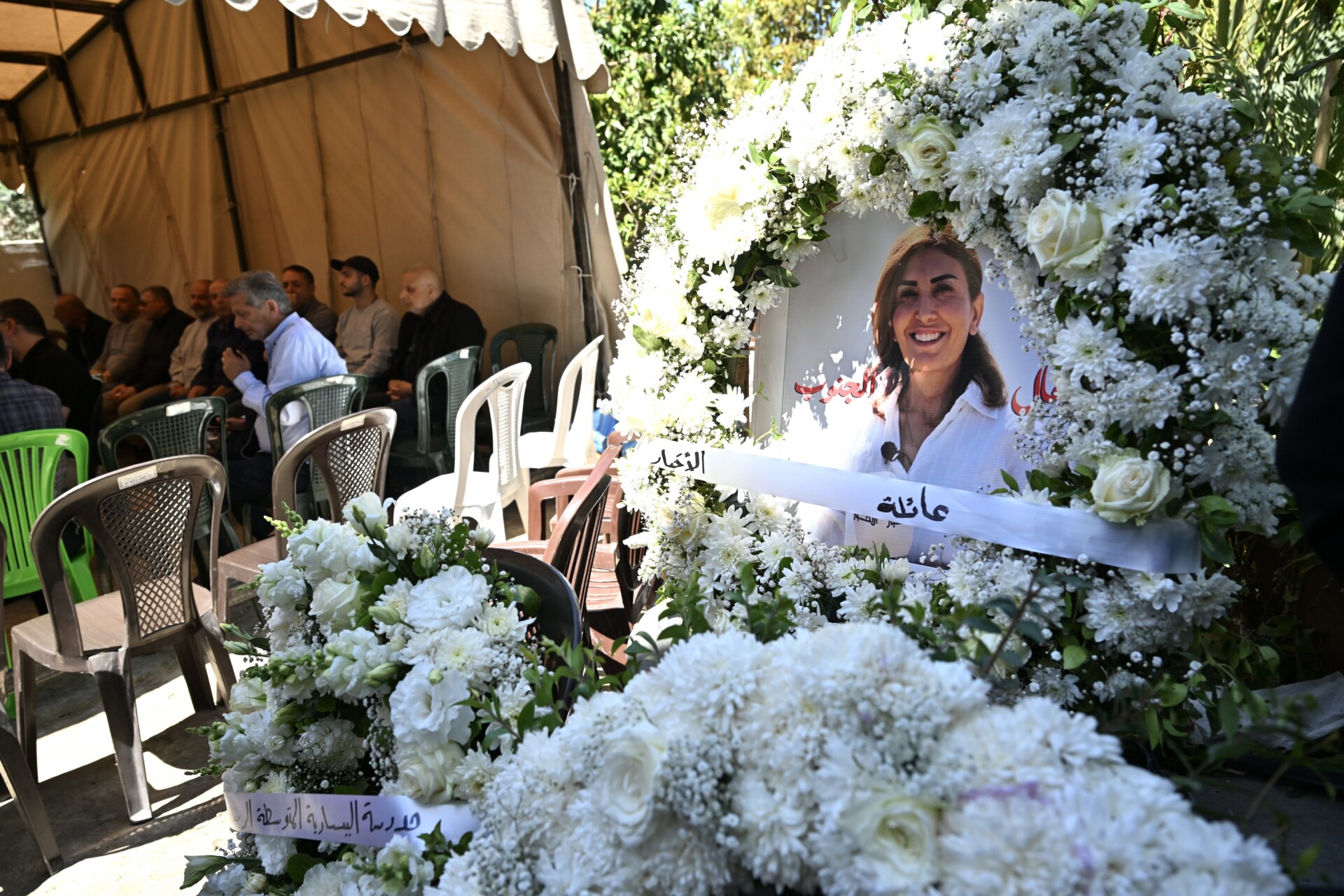
An Israeli man who sent death threats to a Lebanese journalist in 2024 says he has nothing to do with the Israeli airstrike that killed her this week.
Amal Khalil, a journalist for the Lebanese newspaper Al-Akhbar, was killed when the Israeli military targeted a house in which she and a colleague had taken shelter from a bombardment. According to several credible reports, Khalil would have survived the direct strike on the house if Israel had allowed rescue workers to pull her out of the rubble and provide lifesaving treatment. But the emergency crews came under sustained Israeli fire and were unable to reach Khalil. According to a statement released by the Committee to Protect Journalists (CPJ), Khalil was the 16th journalist in Lebanon killed by Israeli fire since Oct. 7, 2023.
Khalil reported in 2024 that she had received death threats from an Israeli phone number via a messaging app. Noah Hurwitz, a journalist who works for The Intercept, posted on X that he contacted Gal Gideon Ben Avraham via WhatsApp and confirmed that he had sent the death threat in 2024; Ben Avraham told Hurwitz that he was glad Khalil, whom he characterized as an enemy, was dead.
Based on a series of text messages in Hebrew, which he writes with significant spelling and grammatical errors, and then a phone conversation, also in Hebrew, my impression of Ben Avraham was of an audibly rattled, socially awkward young man. He spoke in a rambling style and seemed to have become aware that he might be well out of his depth.
After complaining to me that he had been inundated by calls from journalists “from all over the world” who “hate Israel,” he denied having served in military intelligence. “I’m no James Bond,” said Ben Avraham. “I’m not a narcissist or a person who seeks attention,” he added, saying that he hadn’t asked to receive all those phone calls. “I’m just good at what I do,” he said.
Ben Avraham said he was a private citizen who “helped” the security services out of patriotism, by volunteering the information he gathered online. He offered his help to the CIA too, he said, but had received no response. Ben Avraham explained that he spoke 10 languages, “including Pashto,” adding that he could speak to me in English if I preferred. He said that he made a living by offering private Hebrew lessons. He also said that he was “one of the few Israeli Jews who has memorized and could quote verses from the Quran.” He added that he often quoted verses to “terrorists” that he contacted online.
But Ben Avraham’s definition of a terrorist was a bit muddy. He said that Amal Khalil was probably a terrorist, because she had been seen near the border with Israel, “and it’s reasonable to assume that she revealed the location of Israeli soldiers in the area.” When I put it to him that Khalil’s job as a journalist covering southern Lebanon must bring her close to the border, he was unmoved.
But, he said, he had “nothing to do” with Khalil’s death. “I was actually very surprised that she was assassinated,” he said, adding that he only learned about her death when journalists contacted him about the threatening messages he had sent her via WhatsApp two years earlier.
The Israeli military has a well-documented history of using spyware to track and threaten journalists, particularly in Gaza. Journalists with +972 Magazine and The Guardian have published investigative reports that document the intelligence units’ use of these technologies to control the civilian population in Gaza and the West Bank, so it’s logical to assume they use the same methods against journalists in southern Lebanon. The army rarely denies responsibility for sending threats or for killing journalists, usually claiming they were actually “terrorists.”
But Adi Stoler, who is with the army spokesperson’s unit, told New Lines that the army had “no record” of Ben Avraham in their system. Assuming the name he used was his real one, this would mean he did not serve in the military. She said there was no record of him having served in military intelligence, either.
Ben Avraham has appeared on Channel 14, a far-right television station that is roughly equivalent to FOX News, as a Middle East analyst, but he speaks in a rambling style with a flat affect and offers up theories that sound like something a first-year undergrad might have gleaned from the popular press. He also has a YouTube channel in which he purports to “explain” the Arab Middle East to his 116 Hebrew-speaking subscribers. An Israeli colleague described the YouTube channel as “cringe.” When he quotes Arabic sources on his videos, his heavy Hebrew accent is impossible to miss.
In a video posted on April 20, Ben Avraham, wearing an ill-fitting suit jacket over a T-shirt, gestures with a metal pointer at a large video monitor that shows verses from the Quran and explains how they demonstrate that Hamas must be planning to attack Israel again. In another video posted this week, he sets out to explain the fissures in the Arab world by showing a video of a glamorous-looking Lebanese woman mocking a Bedouin man.
The CPJ published a report on Feb. 25, 2026, that cited Israel as having “committed more targeted killings of journalists than any other government’s military since the CPJ began documentation in 1992.” Data presented in the same report shows that two-thirds of the journalists killed in 2024 and 2025 were victims of Israeli fire. And while the Israeli army certainly did kill Amal Khalil this week, it seems that Gal Gideon Ben Avraham was not involved in this incident.