

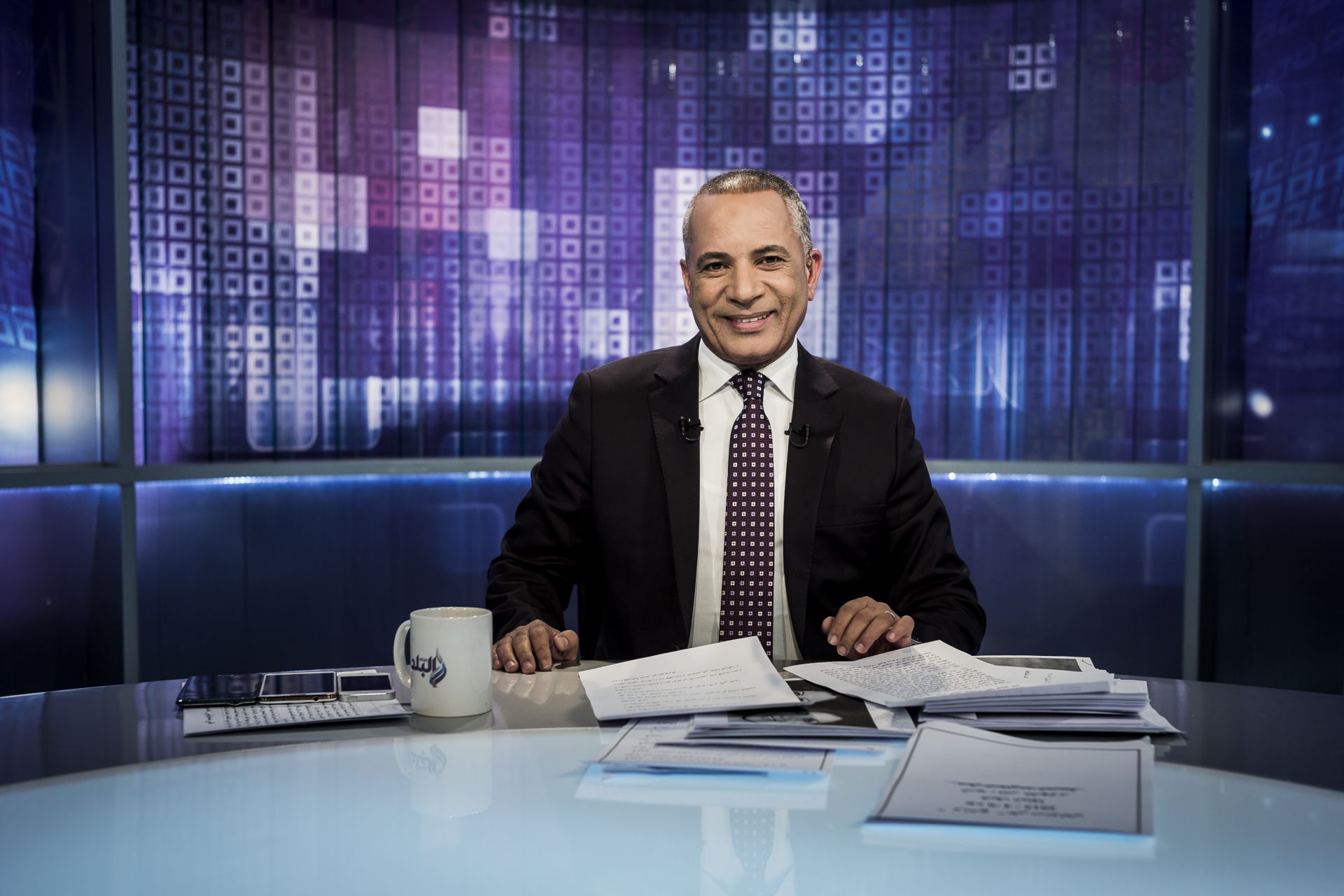
On April 13, Egyptian TV viewers were treated to a rare sight: the humiliation of a top government apologist and talk show host who strayed from the regime’s talking points.
Ahmed Moussa, who hosts “Ala Masuliati” (a phrase that roughly translates as “on my head be it”), was on air on the Sada Elbalad TV channel when he began criticizing the “Hayat Karima” initiative, a major state-led development program in Egypt, and specifically its announced cooperation with the U.N. refugee agency UNHCR to economically integrate refugees in Egypt and provide them with development opportunities.
The high-profile Egyptian presenter, known for his staunch support of President Abdel Fattah el-Sisi, his heated monologues and his hard-line, xenophobic rhetoric that amplifies state narratives, framed the new arrangement as a “cause for concern.” He repeatedly cited a figure of 10 million refugees straining the country’s resources, a number that significantly exceeds the 941,625 officially registered with the UNHCR as of last year.
“Hayat Karima was not made for foreigners or refugees,” Moussa shouted. “We didn’t make it to be used by the U.N.! Why should I care? The priority should be for our people. … Egyptians deserve the opportunities before anybody else!”
After his tirade was finished, the live broadcast cut to a commercial break. But viewers noticed something unusual when the program took longer than normal to return. During a lengthy intermission of 45 minutes, the channel aired prerecorded reports, mostly about the Shem el-Nessim spring festival. The segment was later removed entirely from the channel’s social media accounts and YouTube, with comments under the episode questioning if it had been altered.
The incident triggered immediate backlash online, focusing on both the disappearance of the clip and the broader framing of refugees’ role within Egypt’s economy. One widely shared X post called the removal a “clear indicator that reflects the Egyptian state’s control … over media discourse,” arguing that even figures closely aligned with the regime cannot cross certain “red lines” when public sentiment gets too volatile. “This announcer only works off instructions and scripts,” said another. “His whole spiel is just to fool people into thinking the refugees are the reason for the crisis, not the failed regime. … Enough of this gaslighting.”
Moussa is one of the most prominent political talk show anchors in Egypt’s post-2013 media landscape. Part commentator, part political performer — and full puppet, depending on who you ask — Moussa and his counterparts rely on sensationalized framing and ad hominem attacks targeting political opponents, activists and anyone remotely associated with the 2011 uprising, which he frames as a disaster for Egypt. Moussa’s style exploits the broader constraints on press freedom in Egypt, too, where independent journalism is heavily restricted. He often peddles disinformation to his viewers, like when he presented footage from a video game posted to YouTube years earlier as evidence of Russian military strikes against Islamic State group positions in Syria at the time.
Following the online firestorm that erupted when some users shared clips from the deleted segment, Hayat Karima issued a statement the next day, distinguishing between their different initiatives and emphasizing that international funding channels are separate from Egyptian state resources.
The segment, and the intensity of the reactions to it online, fit a familiar register of nationalist commentary in Egypt that has previously targeted the Syrian, Palestinian and Sudanese communities. But this time, a threshold seems to have been crossed. The renewed sensitivity around the issue comes amid Egypt’s deepening economic struggles during the Iran war. The energy disruptions and soaring import costs, also exacerbated by the war in Ukraine, have led to early business closures, limits on electricity use and hikes in fuel prices, which are reshaping daily life in cities like Cairo.
“If your country’s gotten stable, then return to your country,” Moussa said at one point in the deleted clip, implicitly referencing Egypt’s relationship with its Syrian population (which sources like the International Organization for Migration estimate has grown to 1.5 million, though the exact number is unclear, given the absence of official data). After the 2011 uprising, Egypt initially hosted Syrians fleeing the war with relative openness. But its stance shifted sharply after the 2013 coup. Under Sisi, Syrian refugees were increasingly accused of backing the Muslim Brotherhood. As the government painted them as internal enemies, they became entangled in the regime’s security and surveillance apparatus. This fed a broader climate of suspicion toward refugees, especially those perceived as politically affiliated or economically competitive.
Following Bashar al-Assad’s fall in late 2024, Egypt cancelled the $25-on-arrival entry rule it had for Syrians, replacing it with mandatory prior security clearance from embassies. Meanwhile, Syrian residents in Egypt are now required to have official permits to leave and reenter the country. The new restrictions are contributing to a public discourse that is more openly hostile to outsiders. In the wake of the Moussa segment, hashtags calling for mass deportations circulated widely online.
The posts were accompanied by commentary presenting these views not as fringe reactions, but as popular sentiments. And they keep coming, despite Sada Elbalad and Moussa offering no explanation for the April 13 incident.
The cooperation between Hayat Karima and UNHCR may reflect a quieter shift in Egypt’s external positioning on Syria and refugee governance in general. Despite domestic policy tightening significantly over the last decade or so, Cairo has also publicly maintained a relationship with international agencies managing refugee populations internally, allowing the regime to access much-needed development funding and international legitimacy, while still keeping its political messaging aligned with a nationalist “Egypt for Egyptians” narrative. This can also signal a regional shift, particularly in Egypt’s Syria policy after Assad. If there are any hopes of engagement between the two countries, the Egyptian regime must first temper its long-standing security concerns.
The Moussa episode — or, rather, its abrupt disappearance — reveals more than just a moment of censorship or state control of media narratives, which is old news. It points to the fragility of the Egyptian regime’s attempts to balance economic anxiety, the needs of refugees and its regional alignments.