

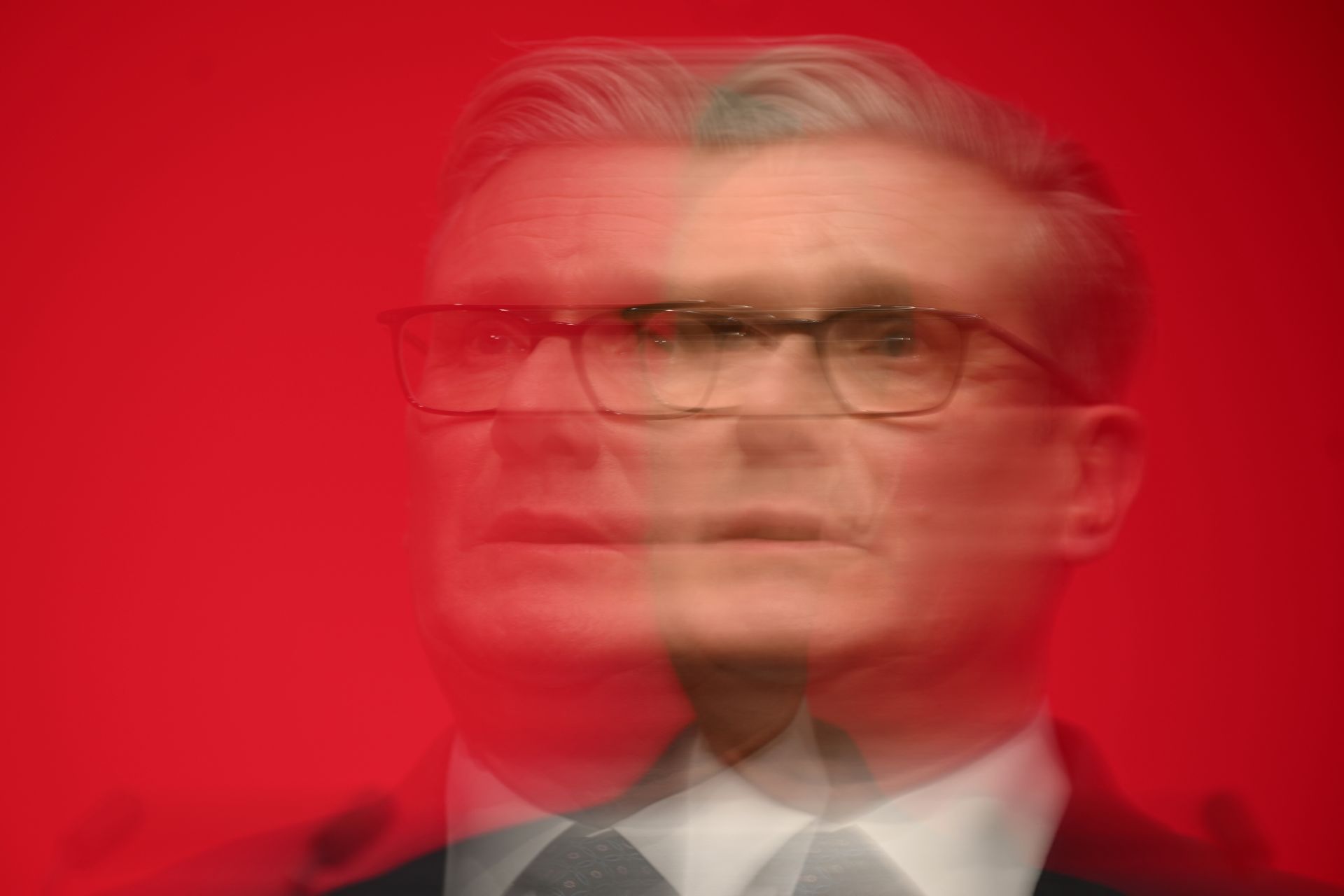
Is it election time already?
The minutiae and arcane details of British political life are a regular source of confusion, within and without the British Isles. Why, on Monday of this week, was the prime minister saying he wouldn’t walk away from a position he was elected to less than two years ago? Why, two days later, was another man in Parliament talking about “my government”? And was that King’s Speech different from the speech of the “king of the North,” a man who was apparently about to become prime minister and lead Parliament, despite not yet being in Parliament (and at that moment not even in the North)? It wasn’t like this on “The Crown.”
Britain is in the midst of a political crisis, but it’s a confusing one. Keir Starmer has barely been in office two years, but after a disastrous set of council elections last week, his rivals are plotting to unseat him.
And yet they are curiously tepid rivals. Andy Burnham is a popular mayor of Manchester, and barely a week passes without his “supporters” claiming to political journalists that a sitting parliamentarian has agreed to step aside for the king of the North to return triumphant to Parliament. (Burnham has lost two elections for leader of the Labour Party.) On Thursday, finally, one Parliament member confirmed they were standing aside for Andy.
Angela Rayner, a former deputy prime minister with an inspiring personal story, had to resign last year when it was revealed she had paid too little in taxes when purchasing an apartment. (On Thursday, in what Netflix execs would have decried as a too-obvious reveal, the tax agency cleared her and did not issue a penalty.) And finally, Wes Streeting, health secretary until his resignation Thursday morning, has made no secret of his ambition to take over from Starmer, but has shown curiously little ambition to actually trigger a leadership contest.
Viewed from outside the U.K., this crisis is rather comical, and mostly procedural — a drama about tedious rules and titled people taking place in a palace in the midst of a war. (No, that’s Downton Abbey you’re thinking of.) And yet, it’s important for what it reveals about Britain’s political system of the past decade, and the politicians who run it. There’s a reason British prime ministers can’t seem to last more than a few years.
The revolving door at the top of British politics is real. Since 2016, the U.K. has had five new prime ministers, and is on the verge of a sixth — the same number that it had in the nearly four decades prior. For most of the 20th century — through two world wars, recessions and the fall of the empire — British prime ministers lasted an average of around four or five years. Since Brexit, the average is less than two.
Why is this happening? Why is Britain — a country that has long prided itself, with some justification, on being a stable, mature democracy — cycling through leaders? Most trace the change to Brexit, the seismic departure of Britain from the European Union, decided on in a 2016 referendum.
One explanation is populism. The years since 2016 have seen several populist “waves”: the election of Jeremy Corbyn as Labour leader; the more general right-wing populism of Reform, but also the Conservative Party; and the newer surge of the Greens.
Taken together with the rise of new parties (at least three political parties have been founded since Brexit), the old system of two major parties is cracking. Anand Menon, professor of European politics at King’s College, London, has noted that the most recent election in 2024 saw the two main parties attract their lowest combined vote share since universal suffrage began. When Zack Polanski, leader of the Greens, declared the two-party system “dead and buried” on May 8 after local election success, he was merely stating what the numbers had long shown.
I prefer a slightly different explanation. A major part of democratic politics is telling a story, about who “we” are and where the party or leader is taking us. In U.S. politics, those who have combined a personal story with a strong message (the outsider bringing Change and the outsider Making America Great Again both count) have usually found strong support. But Britain, since Brexit, has not been told strong stories by its leaders.
From Boris to Rishi to Keir, none has managed to articulate a strong vision of where he wants the country to go. They have instead leaned into vibes: a sense of optimism, a sense of competence, a sense of decency. (Look at the resignation letters sent this week and note how often they refer to the prime minister as “decent.”) But decency isn’t a vision, not in the midst of two wars and a spiraling cost-of-living crisis. When the parliamentarian Miatta Fahnbulleh resigned this week, she wrote that “people are crying out for the scale of change” required.
That is the part that is missing. British leaders have not had a sense of mission since Brexit, perhaps because the loss was such a surprise to the establishment that they remain shell-shocked, reluctant to replicate Brexit’s prodigious promises. Instead of offering a sense of hopey changey stuff, they have retreated behind technocratic processes. In Silicon Valley, the adage is that technology doubles in power every two years. Britain has managed to find its own version, a new prime minister every couple of years, each somehow less powerful than the last.