


In recent weeks, Argentina’s President Javier Milei has launched an unexpected ultranationalist offensive: a sudden, high-profile attempt to claim the Falkland Islands, also known in Spanish as the Malvinas, which have been under British control since 1833 and which Argentina tried and failed to take by force in 1982. This marks a startling ideological pivot for an anarcho-capitalist leader who has professed open admiration for Britain’s prime minister at the time of the 1982 war, Margaret Thatcher, and whose election platform barely mentioned the islands.
Yet Milei’s gambit is more than a momentary rush of patriotic fervor. Faced with a worsening domestic crisis marked by surging poverty, rising unemployment and deepening wealth inequality, the president has seized upon the country’s most inveterate national cause as a smoke screen. More alarmingly, this nationalist wave serves as cover for a dangerous bid to introduce antidemocratic legislation that criminalizes political dissent under the guise of fighting “disinformation” and protecting national sovereignty.
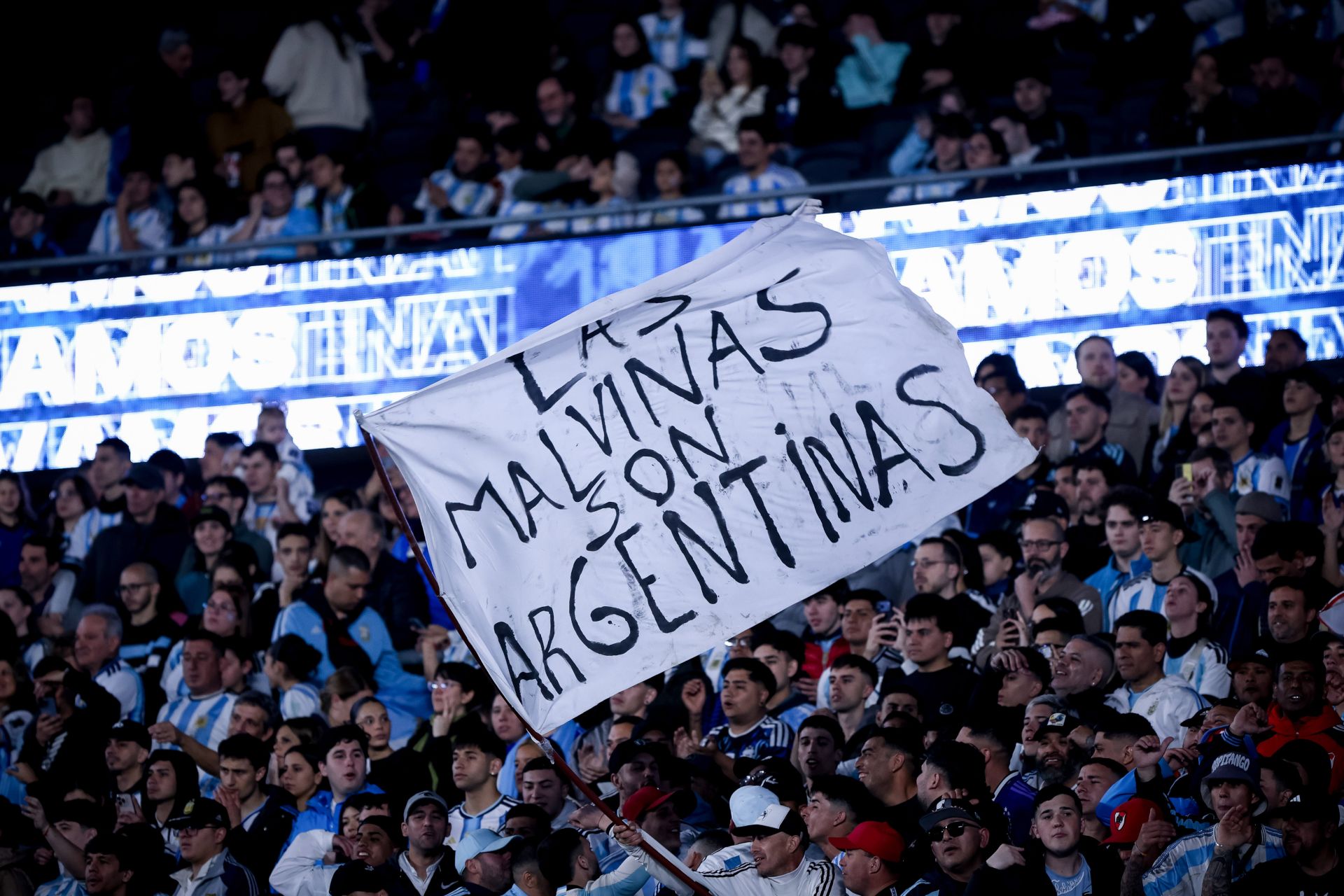
Bizarrely enough, this whole political maneuver didn’t start in the halls of the Argentine Congress — it began with a little flag at a soccer match.
In July, I wrote an article for New Lines about how the ghosts of the 1982 Falklands War loomed over the World Cup semifinal match between Argentina and England. As I noted then, the relationship between the two countries is crisscrossed by a vast number of issues — some historical and political, others purely soccer-related and, in some cases, a potent combination of both.
To grasp that complexity, consider a few examples. England invented the sport, but Argentina considers itself the nation that reinvented it — replacing the direct, physical “English style” of long passes and quick transitions with a distinctly “criollo” style, defined by short passing, individual flair and inventive dribbling. Beyond soccer, the relationship is characterized by ambivalence. The British Empire attempted to invade Buenos Aires twice, in 1806 and 1807, while the territory was still under Spanish colonial rule, and was repelled both times. Still, from the late 19th century until the mid-20th century, the two nations maintained close ties: England bought Argentine food products and sold manufactured goods and railway infrastructure in return. Argentina’s commercial reliance on the British was so pronounced that, in 1933, an Argentine vice president notoriously proclaimed his country to be “one of the most precious jewels in the British Crown.”
A century earlier, in 1833, the British Empire had occupied the islands in the remote South Atlantic — remote for both Argentina and Britain, but vastly more so for the latter — evicting an official appointed by the government in Buenos Aires. Successive Argentine governments maintained a sovereignty claim as persistent as it was fruitless (and often lacking in vigor). That was, until 1982, when Argentina’s military dictatorship occupied the islands, which the British militarily reclaimed two months later. The resulting war proved that the “heroic feat” was merely a disastrously miscalculated adventure by military rulers who were as bloodthirsty in repressing their own society as they were incompetent at fighting a foreign power. From that moment on, the young victims of that dictatorial madness came to be known as “the kids of the Falklands War.”
These issues intersected definitively on June 22, 1986, when the two national teams met in the World Cup quarterfinals in Mexico. Argentina won 2-1, thanks to an extraordinary performance by Diego Maradona, who scored both goals: one with his hand, the other sublime and unforgettable. Nobody in Argentina viewed that match as anything short of revenge (however symbolic and futile, it was revenge nonetheless), and Maradona’s career as a national popular hero was launched that very day.
Given that history, no one was particularly surprised when, at the end of this year’s July 15 match — following another 2-1 Argentine victory — a group of fans displayed a homemade banner crafted on a bedsheet stolen from a hotel, bearing the words “Las Malvinas son argentinas” (“The Falklands are Argentine”). Because political banners were banned — a restriction explicitly reiterated by Argentina’s security minister hours before kickoff — and because they were facing the threatening presence of security guards preparing to confiscate it, the fans tossed the banner onto the pitch. The Argentine player Giovani Lo Celso picked it up, and his teammates joined in the victory celebrations holding that little flag.
No one was surprised, but everyone was caught off guard. Nobody knew that everything was just beginning. Or beginning all over again.
The connection between the flag and the match against England had been foretold back in 2022. It shouldn’t have surprised us. The 2022 World Cup was won by Argentina to the soundtrack of fans chanting a song that opened: “In Argentina I was born / land of Diego and Lionel / and the kids of the Malvinas whom I’ll never forget.” These were obvious signs of the enduring presence of the islands and Maradona (now linked with Lionel Messi, who had never played against England) in a popular soccer memory that extends far beyond sport.
In 2026, it all could have unfolded very differently. Argentina could have lost the game, instead of winning it in agonizing fashion. The banner could have never made it to the pitch. Instead, it slipped past security, defied the prohibition of Argentina’s own government and landed at the feet of a player who lifted it high. His teammates could have dismissed his gesture, but instead they celebrated with the banner taking center stage — right in front of a few hundred million viewers on television and social media.
That was an ephemeral and unpredictable gesture, especially from a squad that has kept its distance from political statements. And yet it tapped into something deep in popular memory. In other words, the banner stirred something dormant in Argentine citizens by reawakening a powerful myth: that of a united country, free of divisions, demanding justice. It revealed that, 44 years after the war, many Argentines feel the claim over the Falklands to be inherently just, without any need to glorify a futile conflict or resort to warmongering jingoism.
Two weeks later, that shared myth reemerged with even greater emphasis. In August, the Argentine parliament debated a bill — introduced by the government — that would allow foreign capital to purchase national land without any limits. The opposition and the thousands who marched toward parliament under the slogan “Argentina is not for sale” considered the bill a betrayal of Argentine sovereignty. The bill ultimately failed and was rejected.
The banner didn’t create anything that wasn’t already stored in collective memory. President Milei had previously dismissed arguments connecting soccer, the Falklands and land sales as “jingoistic nationalism.” However, the arrival of that little banner coincided with a time of indifference and political pessimism. With its unexpected appearance at a World Cup semifinal, it changed the mood, opening the possibility of a more just society and an idea of justice that excludes selling off territorial sovereignty or burning down forests for agricultural exploitation.
The consequences of the little banner did not end there.
On Sept. 3, President Donald Trump gave an interview to the British media outlet GB News, voicing his disagreements with the current British government regarding the U.S. war with Iran, criticizing the U.K.’s lack of support in the Strait of Hormuz, claiming it faces domestic energy and migration crises and ultimately tying this argument to what might happen in a potential new conflict with Argentina over the Falklands. The islands are very far away, Trump remarked, and U.S. military backing could no longer be taken for granted. It is highly likely that Trump was entirely unaware of the flag incident at this year’s World Cup.
Argentines, however, were well aware of it. Between 2024 and 2026, Milei had barely mentioned the islands 24 times in 33 months — 18 of those instances occurring during official ceremonies held every April 2 (the anniversary of the 1982 war’s onset and a national holiday). It hardly seemed like an obsession. He had also openly expressed his admiration for the late British Prime Minister Margaret Thatcher, who led the 1982 war effort and personally ordered the sinking of the cruiser General Belgrano — an attack that claimed the lives of 323 Argentines, half of all Argentine fatalities in the conflict. Nevertheless, the reemergence of the islands on the public agenda sparked a fantastic idea among the president’s political advisers: They needed to frame the territory as a central pillar of his platform, even if it had never existed before (it wasn’t even mentioned in his campaign manifesto).
Between Sept. 3 and 18, the public opinion consultancy Synopsis noted that Milei used the word “Malvinas” 18 times in a span of 15 days.
On Sept. 3, Milei delivered a national address on broadcast television. He declared the islands a “national cause” — a tired formula invoked by every administration since the dictatorship, whether they truly believed in it or not — and outlined a series of measures his government would pursue to reclaim them. His arguments almost mirrored those made by Trump hours earlier, featuring explicit quotes: “The United States is considering this shift in position because they know that in Argentina they have a reliable partner, aligned with Western values, in a position of strategic relevance, who can serve as a valuable ally in the decades to come.” From there, a comparison with the U.K. naturally followed: “Argentina, in dynamic terms, is a country with natural resources in a geographically strategic position, unburdened by uncontrolled immigration, the violence it entails, and the national security threats currently haunting Europe.” He then expanded on the assertion: “If we assess the structural conditions of the United Kingdom, by contrast, they face multiple migratory, demographic and economic crises that have no easy solution. It is clear they are walking a path of decline. Argentina’s future, however, is flourishing, and it will prevail.”
It is worth noting that, in the week following Milei’s address, official data revealed that Argentina had suffered increases in unemployment, informal labor, poverty and especially child poverty (affecting 44.5% of children and adolescents up to age 14) over the previous three months. Inflation stood at 21.3% between August 2025 and 2026 — much lower than under the previous administration, but far from the 0% predicted by Milei. The country’s Gini index, which measures economic inequality, rose slightly in the first quarter of this year.
One thing is true: Argentina does not have an immigration problem. What neither Trump nor Milei explained was what Britain’s immigration problems actually consist of, beyond the far-right xenophobic talking points in both countries.
In that same address, Milei announced a “defense of sovereignty” bill, which he presented as a stark contrast to all the previous administrations — failing to mention that it merely updated a 2011 law passed under President Cristina Fernández de Kirchner, which first introduced sanctions against oil companies operating in the waters surrounding the Falklands. That remains the core of the conflict: the offshore drilling project in the Sea Lion basin surrounding the islands, involving the British firm Rockhopper Exploration and Navitas Petroleum, which holds a 65% stake. Navitas is dominated by Israeli capital — a detail Milei’s administration has meticulously omitted.
Finally, Milei announced the creation of a naval base in Ushuaia, the southernmost city in Argentina and the closest urban center to the islands and Antarctic territory. He forgot to point out that construction of the base had begun in 2022 under the Kirchner government, and that work had been halted by his own administration in a bid to save money.
Milei eventually brought his new obsessions to the United Nations General Assembly, which he addressed on Sept. 23: “For us, the Malvinas is a national cause. I repeat: The Malvinas is a national cause for us.” The remainder of his speech was a staging of his usual preoccupations: railing against international bodies, condemning any remotely progressive agenda and proclaiming unconditional alignment with the policies of Trump and Netanyahu, whom he views as beacons of the West.
The primary novelty was his closing announcement, in which he advocated the accelerated development of artificial intelligence. “Man has now built machines capable of performing tasks that until very recently seemed reserved exclusively for human intelligence,” Milei said. “Where many see a threat, we see a frontier.” He then once again paid homage to Trump: “Artificial intelligence — or superintelligence, as President Donald Trump calls it — can multiply our productivity by orders of magnitude we do not yet comprehend.” He concluded: “That is why I tell you, in the face of artificial intelligence, Argentina will place itself at the forefront of freedom. We have the critical minerals, the energy, the talent and the capacity to compete in every link of that value chain. And we want to be the most competitive place in the world to develop it, supported by a cutting-edge legal framework and a commitment against precautionary regulation.”
With these declarations, Milei formalized his alliance with Big Tech moguls — a move I discussed in a New Lines essay on Peter Thiel’s move to Buenos Aires. But he chose to end his speech with a peculiar quotation: “We are living in one of those rare moments in history when one world is beginning to disappear before the next has finished being born. These are dangerous moments, but they are also extraordinary moments.”
It is unclear if Milei is aware of the original source of that phrase: the Italian Marxist thinker Antonio Gramsci, who died in a Fascist prison in 1937. “The old is dying and the new cannot be born; in this interregnum a great variety of morbid symptoms appear.” Precisely.
Milei did not detail the specifics of his Falklands bill at the U.N., but he has already submitted it to Congress. The political opposition — whose rhetoric currently lacks both force and momentum — pointed out that sanctions against companies exploiting the islands’ oil or aiding their local economy have been on the books for 15 years. Only segments of the press and human rights organizations highlighted one of the bill’s most dangerous provisions.
One such organization, the prestigious Center for Legal and Social Studies (CELS), denounced the bill for creating a National Security Council acting as a quasi-superministry with broad powers to dictate policy, conduct administrative investigations, issue sanctions and direct the use of military forces and national strategic intelligence. Most alarmingly, this body would have the authority to persecute any kind of offenses related to “national security,” investigate them and penalize those deemed responsible without judicial oversight. To make matters worse, it establishes prison sentences of five to 12 years for “anyone who, acting on behalf of, under orders from, or with total or partial financing from a foreign state, organization, or agent, seeks to alter electoral processes or manipulate public opinion through coordinated mass disinformation campaigns.”
Expanding the scope to ill-defined concepts like “disinformation” or “interfering in the electoral process” opens the door to using the law to police public opinion and persecute political dissent without needing to prove criminal conduct in a court of law.
This is likely why the presidential adviser Santiago Caputo — widely suspected of orchestrating this ultranationalist pivot in Milei’s policy — posted the following threat on X hours after the president’s first address: “100% of the people crying are agents of the British Crown. Mark them.”
“Agents of the British Crown”: that is, traitors to the country.
Ultimately, Milei’s sudden embrace of the islands’ cause is little more than a nationalist smoke screen. Even as he invokes the country’s “national cause,” he aligns Argentina more closely with Trump’s geopolitics and quietly offers up the country’s resources as a neo-colony for foreign capital, especially tech moguls. More dangerously, it represents another repressive turn. In August, Milei claimed during a television interview that, within academia and street protests, “there are terrorists disguised as students, terrorists disguised as professors, terrorists disguised as researchers.” All of them are, in Milei’s words, “zurdos de mierda” (“shitty leftists”) whose actions might be persecuted in the future if the proposed legislation were passed.
As evidence of this repressive trajectory, on Oct. 15, police violently cracked down on a demonstration of tens of thousands of university professors and students protesting against funding cuts to higher education. Although the demonstration was peaceful, while speakers from universities and faculty unions were addressing the crowd, police attacked participants with tear gas, water cannons and rubber bullets, arresting more than 30 and charging them with attacking the “constitutional order.” That evening, the mayor of Buenos Aires, an ally of Milei’s, accused those detained of being “leftist infiltrators.”
Milei’s alignment with Trump, in any case, remains the primary orientation of all his policies, speeches, and gestures — with or without the Falklands. The bill has not yet been approved by the National Congress and has been modified in several respects, including the clause that imposed sanctions on companies associated with oil exploitation in the islands, after it was revealed that Jared Kushner, Trump’s son-in-law, holds shares in Navitas Petroleum, one of the companies involved. U.S. Deputy Secretary of State Christopher Landau also requested additional modifications in this regard, which were promptly accepted.
Finally, the Argentine government organized, alongside the U.S., the flight of Flávio Bolsonaro from Brazil to Miami via Argentine territory. Bolsonaro’s defeat, the recent fall of Paraguayan ally Santiago Peña following a banking scandal, and Trump’s own defeat in the midterms are leaving the Milei administration increasingly isolated. In this context, Milei may not end up gaining much from this course of action that began with that little banner painted in a hotel room, on a stolen bedsheet, for a soccer match.
Become a member today to receive access to all our paywalled essays and the best of New Lines delivered to your inbox through our newsletters.