


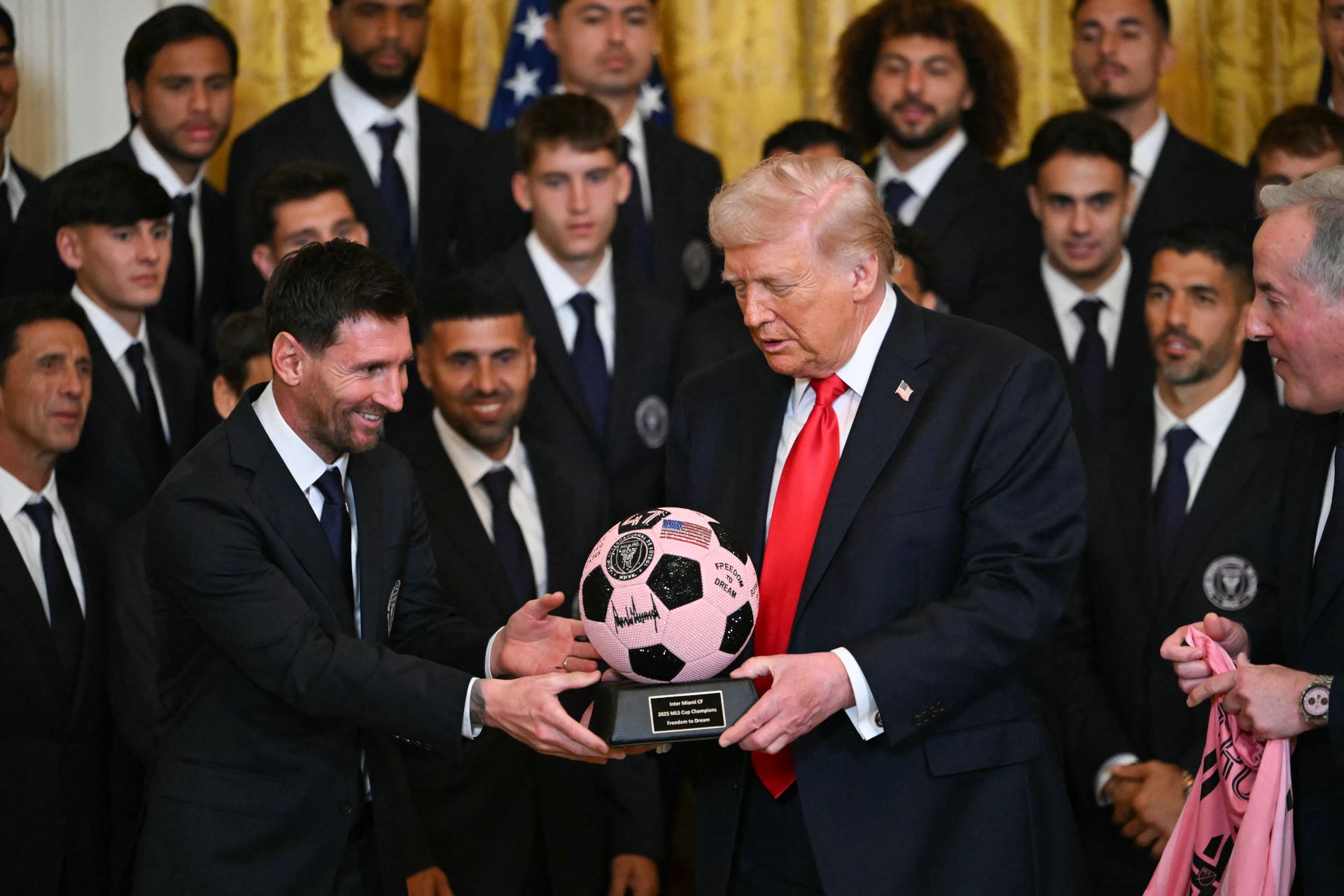
On March 5, 2026, the Inter Miami CF soccer squad visited President Donald Trump at the White House. Although soccer is not yet a sport that draws massive audiences in the country, as traditional American sports do — and Trump may not understand much about its rules — it has already been incorporated into an old presidential tradition: greeting champions. As winners of the last season, the players and club owners went to take photos with the president and listen to some of his boasts, including about the success of his attacks on Iran. Among those present was the captain and central figure of the team, Lionel Messi, arguably the best player in the world from 2009 to 2022, who is also set to play in the upcoming FIFA World Cup starting this June in the U.S., as captain of the Argentine national team.
It is highly probable that Trump gained no real benefit from this meeting with Messi; it is even more likely that Messi gained no benefit from it. On the surface, the encounter appeared to be merely the televised encounter of two titans of the global spectacle. For Argentine audiences, however, the event was no simple PR photo. Instead, it could be seen as a symptom of a transformation of the country’s greatest sporting idol from apolitical to political — and, more troublingly, of an ethical capitulation. This shift has ignited a growing public debate, raising alarms among Messi’s followers while fueling diatribes among his detractors.
For a U.S. audience, accustomed to seeing athletes as brand ambassadors, social justice advocates, or both, the figure of the sporting idol in Argentina requires a prior translation. In Latin America, soccer is not merely a sport; it is the language through which the nation is narrated, the traumas of the 1982 war against the United Kingdom are processed, and class identity is debated. To understand why Messi’s visit to Trump is a gesture that grates, we must first understand the throne upon which the Argentine player sits.
To understand Messi, one must acknowledge the shadow of Diego Maradona. In Argentina, Maradona was not just an athlete; he was the nucleus of a national-popular narrative. He emerged as a public figure in the late 1970s and became central to Argentine identity over the following two decades, in a nation attempting to reconstruct itself after a bloody military dictatorship (1976-1983) and a traumatic defeat in the war over the Falklands, known in Spanish as the Malvinas.
When Maradona scored two goals against England in the 1986 World Cup — one with his hand, which he called “The Hand of God,” and another by eluding six rivals in a prodigious run — the Argentine people did not just see soccer. They saw a symbolic revenge against imperialism. Maradona embodied the figure of the “pibe”: the poor child from the slums (known in Argentina as the “villas miseria”) who, through cunning, mischief, trickery and talent — the weapons of the weak — manages to defeat the powerful. Crucially, and this is what made Maradona a popular myth at that precise moment, his performance did not consist of stories or declarations, but of something undeniable and unrepeatable. His weapon was his body in motion. This is the incomparable advantage of sporting idols over other figures in entertainment or politics: In the body of athletes, fiction is impossible.
A year later, Maradona’s dazzling performances led Napoli — the flagship team of southern Italy — to win the Italian championship against the large, powerful clubs of the north. He repeated the feat two years later, additionally winning the UEFA Cup — the only international title Napoli has won in its entire history. His status as a popular hero doubled, attaining a political dimension: His triumphs belonged to the weak and the oppressed. His erratic behavior — an intense nightlife, cocaine use, public infidelities — only ratified this condition, typical of the popular hero. He was great precisely because of his weaknesses. Flawless heroes only appear in the nationalist narratives of the state or in school textbooks.
From that moment on, even as his playing career waned, his relationship with political power was one of confrontation, and he explicitly allied with rebellious social movements. Maradona used his voice to insult FIFA officials, to align himself with Latin American leftist leaders against President George W. Bush, and to personify Peronism — the political movement that has historically represented the Argentine working class.
Maradona was a verbal machine, grounded in his word, and, for added symbolic density, his voice proclaimed itself as proudly humble, as in his famous retort: “Just because I was born in a villa [slum], can’t I speak?” His autonomy resided in his ability to say “no” to anything that signified power, whether it was the Vatican or the White House. (Maradona always criticized the Vatican’s “display of wealth,” but in 2014 he visited the Argentine Pope Francis, claiming that the pope had “won his heart” through his defense of the poor.)
The peaks of this saga were Maradona’s explicit friendship with Cuban President Fidel Castro — signified by a tattoo of Che Guevara, Castro’s old guerrilla comrade, on his arm — and his active role in the 2005 protests against Bush’s visit to Argentina to propose the Free Trade Area of the Americas, a failed free trade agreement that sought to include all the countries of the Americas. At that moment, his activism united him with the entirety of Latin American “progressive populism”: Néstor Kirchner from Argentina, Luiz Inácio Lula da Silva from Brazil, Hugo Chávez from Venezuela and, later, Evo Morales of Bolivia and Rafael Correa from Ecuador, with whom he shared plenty of hugs and photos.
In 2014, when I first analyzed the figure of Messi, I noted an anomaly: Contrary to Argentine tradition, Messi was not a “pibe.” Although born into a lower-middle-class family in Rosario, he was trained from the age of 14 at FC Barcelona’s academy in Spain, because no Argentine club agreed to pay for a growth hormone treatment. Messi was thus more a product of European technical excellence than the “mud” of the Argentine “potrero,” even though he had played since childhood in the youth divisions of Newell’s Old Boys, his hometown club. The “potrero” is the mythical territory in which Argentine players are forged: a vacant lot where children play freely, far from school or sporting discipline. “Having ‘potrero’” was — and, to an extent, still is — the mark of the creative, irreverent player.
For more than a decade, Messi’s relationship with Argentina was one of silent tension. The public demanded he be Maradona: that he shout, that he insult, that he show passion. But Messi offered muteness. He didn’t even sing the national anthem before Argentina matches; eventually, he learned to do it. Messi was the genius who spoke only with his body, and only while playing for FC Barcelona. Whether due to his shyness, his reticence or the advice of his press agents, Messi simply did not open his mouth.
More than 10 years ago, when Argentina’s national team, led by Messi, had already been defeated in three finals (two Copas America, one World Cup), I argued that the Maradona comparison — let alone replacement — was impossible for several reasons. First among them is class: Messi was not a poor boy and could not pretend to be one. There is no hunger or poverty in his history, and while Maradona was a mixture of Indigenous peoples and descendants of enslaved Africans, Messi is a typical descendant of Italian immigrants.
Second, there are historical reasons: Even if Messi played against England and scored 43 goals, that would never happen four years after a war. In fact, despite representing Argentina in 196 games, he has never once played against England. Third, the political reasons: Any attempt to cast Messi as a populist hero falls flat because he is a product of the global spectacle, and his image is too polished and commercial to carry the weight of a traditional national narrative.
Fourth are sporting reasons: Although his soccer quality is equally exceptional (if not more so), Messi’s career has always been spent in top-tier teams (Barcelona and Paris Saint-Germain — let’s not count Inter Miami) surrounded by world-class players, such as Spain’s Andrés Iniesta, Brazil’s Neymar and France’s Kylian Mbappé. He never played, nor will he ever play, for a humble club like Argentinos Juniors, where Maradona began, nor for the perpetually defeated Napoli — which, as already noted, was a perennial loser until Maradona’s arrival.
Finally, there are broadly moral reasons: Messi is not charismatic. He limits his exhibition to the script that the global spectacle demands of him — an abundant script, to be sure, but meticulously predictable and foreseen. He hardly speaks: When he does, he does so in the game, or to sell global merchandise of all kinds. Maradona could be a charlatan; Messi is merely a spokesperson for commercial brands or a peddler of cliches. Messi is mute, and the mute do not become national symbols. (And let’s not even mention that he will never be discovered with a woman other than his wife, nor with a substance other than caffeinated “mate”).
In short, of all the aspects of Maradona’s story that made him a figure of popular devotion, Messi shared only one — the exceptional nature of his play. That is sufficient for soccer, but insufficient for nationalist myths. Messi, devoid of the conflicts and the working-class background of a Maradona, could not embody the sporting narrative of the fatherland. That muteness, at the time, functioned as a form of immunity: Messi was a transnational brand so powerful that he did not need the Argentine state to be legitimate. While Maradona “Peronized” popular joy, Messi “transnationalized” it. His stardom seemed to create a total autonomy from the political system. Or so we thought.
Messi’s triumph in the 2022 Qatar World Cup seemed to close the rift. The pop song that became the anthem of that victory, “Muchachos,” composed to cheer on the team both inside and outside the stadiums, taps into a deep historical memory essential to capturing the magnitude of the symbol. The lyrics state: “In Argentina I was born / Land of Diego and Lionel / Of the ‘pibes’ of Malvinas / Whom I will never forget.”
Here, popular culture crafts an original and unexpected transformation. It calls the soldiers of the 1982 war “pibes,” rescuing them from militaristic narratives and placing them in the same pantheon of innocence as Maradona and Messi. In this song, the fatherland is no longer something narrated by the government; it is an autonomous territory belonging to soccer. The “Land of Diego and Lionel” is a zone liberated from political power. Therefore, the sporting idol in Argentina carries a greater responsibility: He is the guardian of that space of happiness that politics often fails to provide.
The song concludes:
“And Diego [Maradona] / From heaven we can see him / With Don Diego and La Tota [the popular names of Maradona’s parents, also deceased] / Cheering on Lionel / And to be champions once again.”
In this way, the fans finally proposed a transition: The new idol was displacing the now old and weary hero — who, to make matters worse, had died two years earlier. This did not happen in Naples, of course; the Neapolitans celebrated the Argentine championship with joy, but wore Argentine jerseys with Maradona’s name. “Chi ama non dimentica,” says one of their mottos: “Those who love never forget.”
In 2025, the ghost of Maradona reappeared in Argentina with all its popular and political potency. Crowds self-organized to defend retirees protesting against the far-right government of President Javier Milei and invoked his name on banners as a renewed symbol of rebellion.
By contrast, the encounter with Trump breaks Messi’s spell. The argument that Messi is an “apolitical” subject no longer holds. In the grammar of contemporary power, the “apolitical” or indifferent do not exist. To visit a political leader like Trump — a figure who built his career on the rhetoric of exclusion and aggressive nationalism — is a political decision, whether a single word is spoken or not.
If Messi is a sovereign idol, that sovereignty should have been his shield. Unlike a lower-ranking athlete who needs state favor, Messi possesses a symbolic capital that allows him the luxury of refusal. He did not need Trump, just as LeBron James, Stephen Curry, Megan Rapinoe and the Olympic women’s hockey players — who all refused to visit the White House — did not need him either. Trump, however, needed Messi to “humanize” his image before the growing Latino electorate. The criticism from politicized sectors of the Argentine public is not a partisan issue, but one of mythical stature. Maradona, for all his contradictions, would never have been a decorative piece in the campaign of a leader who represents the opposite of popular Latin American sensibilities. By sitting with Trump, Messi demonstrates not neutrality, but indifference. As an anonymous user put it on X: “In the end, Messi didn’t understand a damn word Bad Bunny said.” Quite possibly, he didn’t care much anyway.
Indifference is the end of autonomy. The moment the idol allows his image to be captured by the political power of the day, he ceases to inhabit that free zone of popular joy and becomes just another cog in the machine. Fans who saw him cry over his (their?) victory in Qatar now might feel that this homeland — the homeland of the “pibes” from Malvinas and the rebellious Diego — might have been sold off in exchange for a meaningless photo at the White House.
The Trump-Messi encounter marks the end of the mystique of the “mute idol” as a form of resistance. Messi has shown that his autonomy was merely commercial rather than ethical. While Maradona continues to appear on the banners of social protests in Buenos Aires as a symbol of the rebellion that is not for sale, Messi risks being remembered as a brilliant player who forgot that his crown was not given to him (just) by the market, but (also) by his community and his fans.
A few days ago, Ernesto Cherquis Bialo, a dean of Argentine sports journalism, passed away. For Cherquis, Maradona embodied a type of “personal, human behavior.” Messi, by contrast, has an institutional conduct, typical of a corporation. “Corporations do not get emotional, they do not get involved, they do not commit,” he once said. Perhaps he wasn’t far wrong.
Become a member today to receive access to all our paywalled essays and the best of New Lines delivered to your inbox through our newsletters.