


More than 40 years on, this joke still lands.
It circulated among Argentine exiles in Spain during the years of Argentina’s last military dictatorship (1976-1983). Its protagonists are two such exiles who meet at a party in Madrid. One of them — let’s call him X — spots his friend Z in the company of a stunning Spanish woman. Z appears hopelessly in love. Days later, X and Z cross paths again. Unable to resist the urge, X offers a compliment, “That woman you were with — she was beautiful.”
Blushing, Z agrees: “Yes, she’s beautiful. Wonderful.”
Sensing a moment of intimacy, X presses further: “Are you in love?”
“To the marrow,” Z replies.
“Are you going to marry her?” X asks.
“Marry a Spaniard? Absolutely not,” Z declares, suddenly unblushing.
X recoils. “That sounds racist.”
“No, no,” Z insists. “Spanish women are amazing.”
“Then what’s the problem?” X asks, now thoroughly intrigued.
Z sighs. “The problem is that if you marry one, at some point — inevitably — they’ll ask the fatal question.”
“What question?”
Mimicking the Spanish accent, Z says: “Oye, tío … Can you explain what the hell Peronism is?”
Peronists pride themselves on being inexplicable. Even today, Peronism is often described as less a political doctrine than a feeling — something lived rather than defined. And yet, like all political movements, it can be understood. Let’s try to explain this mystery, which isn’t all that mysterious but does require patience.
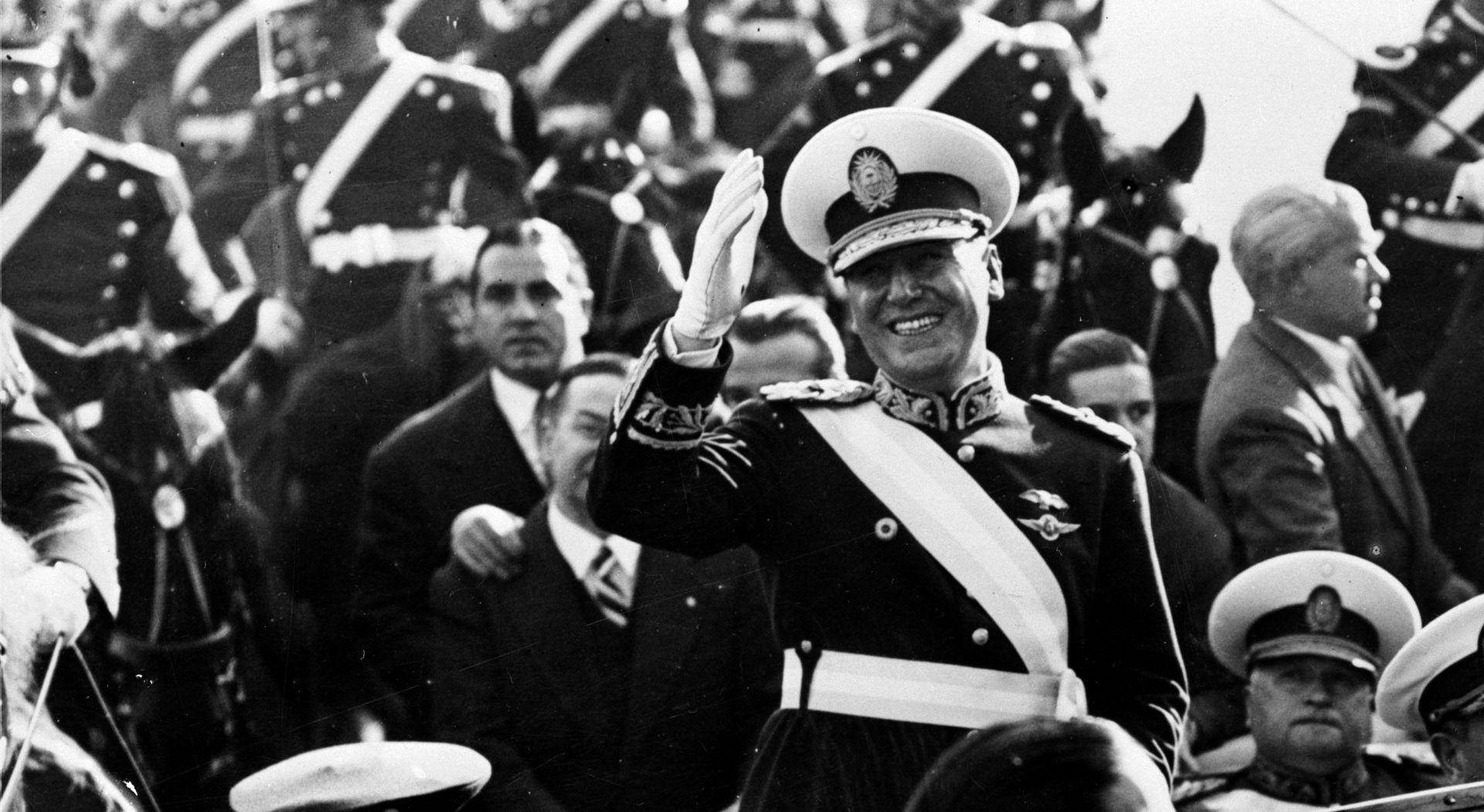
Peronism takes its name from Col. Juan Domingo Perón, yet every library agrees that it was born on Oct. 17, 1945, when a workers’ mobilization secured Perón’s release from prison. Two years before, Perón had been part of the military group that overthrew a conservative government. Since 1930, conservative groups had won elections through electoral fraud, while maintaining a policy of labor exploitation and political repression against unions and leftist forces. The 1943 coup, however, was not a leftist revolution. On the contrary, it was dominated by factions sympathetic to European fascism — although in 1945 they ultimately declared war on Germany, compelled by pressure from the United States.
After the coup of 1943, Perón assumed leadership of the Labor Department, gradually amassing popular support and political influence. In just two years, he enacted the Rural Laborer’s Statute, which regulated the work of farmhands; established labor courts to oversee relations between workers and employers; introduced the payment of a year-end bonus equal to a month’s pay (known as the “aguinaldo”) along with mandatory paid vacation days; regulated children’s and women’s labor by reducing working hours; and compelled wage increases. These policies earned him the unanimous support of the unions. But more conservative factions within the military, alarmed by the growing prestige he enjoyed among the popular classes, sought to remove him from power, stripping him of his positions and placing him under arrest.
Swiftly organized by the unions, the popular mobilization of Oct. 17, 1945, which demonstrated that working-class support for Perón was nearly unanimous, forced his release. Perón quickly built a political party, which he called Laborism in a nod to the British Labour Party, with significant participation from unions and former socialists. A few years later, he renamed it Justicialism, in reference to the concept of social justice that animated his political program. With this party, he won the 1946 elections with 54.4% of the national vote. He was reelected in 1951, this time with 63.62% of the vote, which for the first time included women. Yet in 1955, he was overthrown by a coup orchestrated by military forces, allied with conservative parties and nationalist-Catholic factions (Perón had supported a divorce law in 1954 that put him at odds with the church hierarchy). He was forced into exile until 1972, returning to power by winning the 1973 presidential election with 61.85% of the vote.
Alongside the working class, very diverse political groups had converged in Peronism by 1945: former socialists and anarchists; nationalist groups, which would form the right wing of the new movement and took charge of educational and cultural policy; industrialist military officers, who saw in Perón the possibility of developing a robust national industry; and a new bourgeoisie, linked to light industry for the domestic market, which grew rapidly as a result of the economic orientation of the Peronist government.
Beginning in 1946, Peronist economic policy radically intensified the timid process of import-substitution industrialization that conservative governments had initiated in previous years. Perón nationalized the Central Bank of Argentina and created the Industrial Credit Bank to direct credit toward the industrial sector; introduced new controls on foreign trade; diversified markets to avoid dependence on agricultural exports to Great Britain, which purchased roughly 80% of Argentina’s meat exports; and sought to channel the country’s trade surplus from agriculture toward the development of industry. This reorientation involved substantial investments in infrastructure: nationalization of railways and telephones, creation of a merchant fleet, construction of gas pipelines and routes, support for state oil production, and the creation of factory schools to rapidly train labor.
The consequences of government action were quickly evident: Industrial production increased by 50% between 1941 and 1948. Industrialization was, as noted, fundamentally light and based on import substitution. Its production was oriented toward the domestic market, helped by the increase in the purchasing power of the popular classes. Redistributive policies that spread Argentina’s wealth to workers were central to Peronism. Controls on foreign trade and currency exchange allowed the use of currency reserves to help finance a redistributive policy, with notable similarities to the contemporary construction of welfare states in European countries. Correspondingly, there was a sustained increase in the purchasing power of the working class: Real wages rose dramatically from the mid-1940s to the early 1950s.
The support of the popular classes for Perón was also due to his social policies: To pensions and the annual bonus were added paid vacations, severance pay, the creation of a labor court system that systematically favored workers, the accelerated construction of schools, free university education, a National Workers’ University specialized in technical careers and reserved for workers, and an effective health policy — which, through the construction of hospitals and the extension of coverage, made possible the eradication of diseases that had until then been endemic, such as tuberculosis.
The president’s wife, María Eva Duarte de Perón, was a critical figure who became a symbol of the era. An illegitimate child from a humble provincial family, she came to Buenos Aires in the 1930s to work in the entertainment industry as a radio, theater and film actress. After marrying Perón in 1945, she turned to politics, leading the Eva Perón Foundation. This institution would focus on charity work: granting subsidies, supporting schools and children’s institutions, and donating toys, furniture and clothing to the poor.
Eva Perón’s active participation in the social sphere quickly generated polarized reactions: idolization by the popular classes (reinforced by official propaganda through epithets such as “standard-bearer of the humble” or “spiritual leader of the nation”) and hatred from the bourgeoisie, who saw in the president’s wife an embodiment of undesirable social transformation: the lower classes (or worse, a bastard) had gained access to power.
Eva Perón was a magnificent orator, dramatic and passionate. By 1951, after the first attempt by conservative military groups to overthrow the president, her political activity radicalized. Ahead of the presidential elections, the General Confederation of Labor proposed the ticket Juan Perón-Eva Perón. Powerful groups and the military strongly opposed this proposal; Eva was a young woman, a former actress, a bastard — too many provocations at once. On Aug. 22 of that year, after 2 million people had gathered to urge her to seek the vice presidency — the largest show of public support for her to date — she renounced her candidacy altogether. A year later, on July 26, 1952, she died of cancer at the age of 33.
Eva Perón’s death coincided with a gradual process of bureaucratization of the Peronist government and an advance of its authoritarian tendencies, manifested in censorship, persecution of opponents and ideological control in education. The overwhelming state propaganda, based on a cult of personality, also increasingly alienated the middle and upper classes, which never managed to adapt to the profound social transformations brought about by the new leading political role of the popular classes.
This process weakened Peronism and ultimately led to its overthrow in the 1955 coup. Successive governments banned the Peronist Party for 18 years. In fact, in 1957, even the use of the words “Perón,” “Eva” or “Peronism” was prohibited. Despite this, the working class remained loyal to Peronism, as did the unions, until Perón’s return to power in the 1973 elections. These were the first free and democratic elections after his downfall, and Peronism once again achieved a sweeping victory.
This chronology alone does not explain Peronism as a political and cultural phenomenon, one that seems inexplicable to Argentines and foreign observers alike. One key reason for this is that it has swung across the ideological spectrum over its 80-year history, rejecting the traditional left-right divide. Instead, Peronism has often proclaimed itself as a “third position” with the slogan “neither Yankees nor Marxists, but Peronists.”
Perhaps the best way to understand Peronism is through Perón’s own definitions: He conceived it as a “national-popular movement” (rather than a mere political party), whose “three banners” were explicitly “social justice, economic independence and political sovereignty.” In other words, it advocated for pro-labor policies, economic nationalism and anti-imperialism. This framework allowed for its constant political oscillations, which saw it prioritize the control of workers — to prevent their shift toward radical leftist positions — and a fairer distribution of economic income, while never questioning the basic architecture of the economic system itself.
Peronism had deep roots in working-class culture. These roots enabled the emergence of a distinct “Peronist left,” which played a central role in shaping Latin America’s “pink tide” of leftist populism in the late 1990s and early 2000s: Hugo Chávez and his “Bolivarian revolution” in Venezuela, Evo Morales in Bolivia, the Kirchners (who identified as Peronists) in Argentina, Rafael Correa in Ecuador, Lula in Brazil and other governments and movements.
But Peronism is not an exclusively leftist movement. For this reason, it lends itself to comparison with almost any political force. Indeed, Peronism has also been likened to Varguismo, which takes its name from the populist Getúlio Vargas, president of Brazil from 1930 to 1945 and 1951 to 1954; to Peruvian Aprismo, referring to the old American Popular Revolutionary Alliance of Raúl Haya de la Torre, founded in 1924 and only reaching power in 1985 with Alan García — who later turned neoliberal (much like Peronism itself); and to British Labourism, also successful in the postwar era and grounded in Keynesian economics.
Even if it sometimes appeared to be, Peronism wasn’t fascist, despite the fact that Perón had experienced Italian fascism (he spent two years as a military attache in Mussolini’s Italy) and used the unions as intermediaries for social control. Fascism was about disciplining the masses from above. Peronism, by contrast — at least until Perón’s death — was always attuned to ordinary people’s demands, whether addressing these directly or negotiating over them.
Accounts that examine Peronism from “outside” — outside Argentina, outside Latin America, outside politics (in popular culture) — are often wildly off the mark. But among foreign commentators, one must, without a doubt, make an exception for the work of British historian Daniel James, a sharp interpreter of Peronism who surpasses many of his Argentine counterparts. In his excellent 1988 book “Resistance and Integration: Peronism and the Argentine Working Class, 1946-1976,” James clearly identifies one of Peronism’s defining traits: its ability to take the everyday experience of Argentina’s popular classes and turn it into political doctrine — without attempting to transform that experience into class consciousness, as socialist movements do.
In Perón’s words, “the people are never wrong” and “they must be listened to with humility.” This emphasis on popular experiences implies several simultaneous claims: that these experiences have inherent worth, that they can become the luminous center of a new social and cultural order, and that all intellectual critique should be dismissed as interference with the people’s will, which Perón interpreted without intermediaries. His dialogue with the people at mass rallies was enough. It was, of course, a symbolic dialogue, since Perón commanded the microphone. Yet the people believed he truly heard them and transformed their will into action.
Herein lies Peronism’s deeply anti-intellectual posture. Because it is based on people’s raw experience, it considers itself to be beyond intellectual critique. To criticize it would mean denying the daily reality of millions. Any critique, moreover, can equally be dismissed as an attack on a political doctrine that brought a systematic improvement in living conditions, increased consumption and wealth redistribution.
Once again, what is fascinating about Peronism is that its virtues and defects coexist in the same space. This elevation of popular experience is both democratic — because it speaks of respect and attention to popular voices and desires — and authoritarian, because Peronism asserted that Perón was the sole authority who could interpret this experience. Any social group that opposed the people was labeled as part of the “oligarchs.”
Especially in its early phase (1945-1955), Peronism was irreverent toward bourgeois and conservative language and culture. On the one hand, the mere fact that a high‑ranking military officer married a commoner — and an actress at that — 24 years younger, after living with her for an entire year, was seen as a moral affront. On the other hand, the political language of Perón and Eva became colloquial, avoiding pompous phrasing and adopting affectionate turns of speech. Eva Perón, for instance, called the workers “my little greaseballs.”
Thanks to Peronism, workers flocked en masse to public spectacles such as cinema or football, popular dances and concerts were organized in parks, and women grew in importance within the labor force and were even granted the right to vote.
With these changes, working-class Argentines began to occupy public spaces where previously they had long been excluded. One example was the construction of union-run hotels in the seaside city of Mar del Plata, which enabled the rise of mass tourism and transformed a beach that had, until then, belonged exclusively to the bourgeoisie.
This is why the Oct. 17, 1945, popular demonstrations that brought Perón to power were, above all, a violation of middle- and upper-class social codes. The streets of downtown Buenos Aires and the Plaza de Mayo, the symbolic center of power of the Argentine state, had never before been filled with hundreds of thousands of workers dressed in their work clothes. Working-class crowds occupied spaces that had long been reserved for the upper class. The conservative press and politicians referred to the masses as “cabecitas negras” (a derogatory term for dark‑skinned, working‑class migrants from northern Argentina), “descamisados” (“shirtless ones”) and a “zoological flood.” The upheaval was crystallized in the image of workers’ legs submerged in the Plaza de Mayo fountain, described as “las patas en la fuente” (“the workers’ ‘paws’ in the fountain,” implying that they were animals). This image and expression would become one of Peronism’s quintessential symbols, proudly appropriated by the movement.
But Perón, despite all this, was a military man, a colonel trained in the undemocratic order of the barracks. Hence the authoritarianism that early Peronism displayed in its public gestures — an authoritarianism that, above all, ruffled the feathers of Argentina’s intellectuals and their readers: the moderately educated middle classes.
Yet that same irreverent plebeianism — that transgression of bourgeois codes, that democratic impulse — of Peronism is its most compelling feature, and it allowed it to win over the left and young people between its fall in 1955 and Perón’s death in 1974. Consequently, it also made Peronism the target of repression by the classes that couldn’t tolerate even the symbolic redistribution of wealth.
That Argentine drama would only reach closure 20 years later, in the alliance between conservatism and populism forged by Peronism itself in the 1990s, during its neoliberal turn under President Carlos Menem (1989-1999). In the 1960s, the dominant catchphrase came from a politician and Peronist intellectual, John William Cooke, who defined Peronism as “the cursed fact of the bourgeois nation.” Sociologist Carlos Altamirano argued, a few years ago, that such a statement could now only be repeated as a joke. And yet, the joke still circulates: During the 2008 conflict between the Peronist government and landowners demanding tax cuts, some factions of the Peronist left revived the phrase. By that point, it was already clear that Peronism had become quite the opposite, “the bourgeois fact of the cursed nation.”
There is no doubt that Peronism is a form of populism. But what, exactly, does that mean? Today, contemporary political language has become so contaminated and diluted that the word “populist” has turned into a caricature. Words, however, carry trajectories, histories, libraries. It’s a distortion to present populism as nothing but the degradation of democracy and republicanism, as many commentators do.
Contemporary political theory — at least since “On Populist Reason,” the 2005 book by the late Argentine thinker Ernesto Laclau — understands populism as a style of politics that, on the one hand, defines “the people” as the protagonist of politics, and on the other, operates as a pole of conflict in which the popular bloc is positioned against elite adversaries, whether political, economic or cultural.
This definition helps us understand why Peronism has been able to survive until today: It can come dressed in many costumes. Some are closer to the left, others to the right. The key difference lies in which “elites” are defined as the adversaries of what Perón called “el pueblo” (the people) — and, just as importantly, who the declared enemies are.
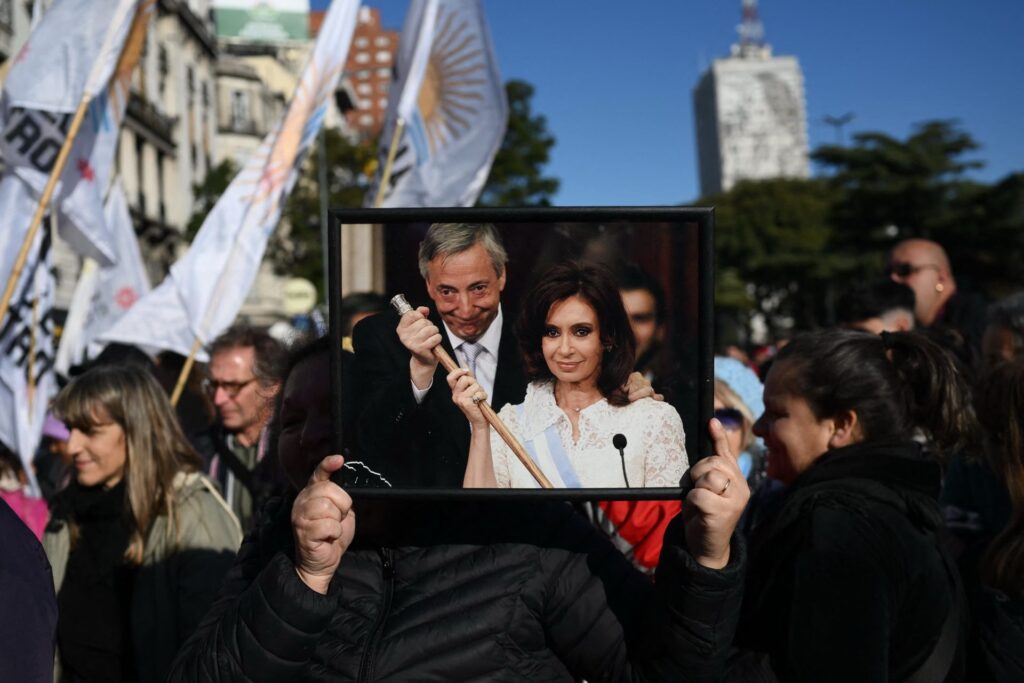
Through this populist lens, we can also better understand the most recent iteration of Peronism: Kirchnerism, which derives its name from Néstor Kirchner and Cristina Fernández de Kirchner, the couple who governed Argentina between 2003 and 2015. Néstor died in 2010, and his widow later returned to office as vice president under Alberto Fernández from 2019 until 2023.
The organizing axis of Kirchnerism was always the critique and overcoming of “neoliberalism,” branding any criticism as a return to that unhappy past (in 2001, Argentina was plunged into social unrest triggered by a deep economic crisis). During their governments, the Kirchners adopted exactly the same recipe used by all progressive Latin American populisms: relying on the export of raw materials (the so-called “extractivism” model) to pursue income redistribution through social policies designed to help the most vulnerable groups. At the same time, they adopted a timid policy of import restrictions that allowed for slow reindustrialization and absorption of industrial labor.
Kirchnerist social plans helped ease social tensions. The transfer of wealth was effective, though also timid. It did not involve any radical change in economic concentration, but rather the classic mechanism of wage increases and expanded popular consumption, which had a positive impact. At the same time, Kirchnerism adopted key points from progressive agendas, such as the recognition of ethnic and sexual minority rights and the prosecution of military officials responsible for the brutal crimes of the 1976-1983 dictatorship.
The failure of its post-pandemic economic policies, however — which led to inflation exceeding 100% annually — showed that the Kirchnerist signature buzzword of “inclusion” could lose even its symbolic effectiveness. Paradoxically, this variant of Peronism collided with the very thing it was founded on: popular experience. As daily life grew harsher, another populism emerged — this time from the right. It claimed all politicians belonged to a corrupt elite and reframed the language of rights and inclusion as morally suspect in contrast to the “power” of individual entrepreneurship.
Although Peronism is a Latin American phenomenon, populism’s confounding blend of left-wing and right-wing elements is a global puzzle: How can Donald Trump and Bernie Sanders both be “populists”? The 2018 “yellow vests” protest movement in France blended left-wing and right-wing aspects, making it confusing for many commentators to pin it down ideologically — but everyone agreed it was a populist revolt. Understanding Peronism can help us make sense of the miasma surrounding these contemporary movements and figures.
As mentioned, populism consists of picking out adversaries and enemies, identifying elites opposed to a “people” that is never precisely defined. As the late British historian Eric Hobsbawm once noted, the word “people” combines maximum emotional resonance with minimum precision. Defining adversaries follows the same logic, as long as it’s emotionally credible and effective. For example, right-wing populist movements have cast immigrants as among their main enemies, a message that has often found popular resonance — even among people who have never encountered an immigrant in their lives. Progressive populisms, by contrast, tend to discourage such enmities — though not always successfully, as the case of Gabriel Boric’s Chile has shown. Immigration remains an easy target for xenophobic resentment, as is well known.
Elites, on the other hand, don’t enjoy the best reputation. In everyday discourse, they’re seen as the ultrarich oligarchy; in the political realm, as corrupt politicians who steal people’s money; and in the cultural arena, as the cold heart of the highly educated who reject the people’s culture. Current President Javier Milei’s far-right populism focused on traditional politicians: He called them “the caste” and promised his government would eliminate them. Of course, the first thing he did was ally with the right-wing “caste” and label everyone else as “radical leftists” or guilty of being culturally “woke.” The tactic, as you can see, is far from original.
The real difference lies in economics. Progressive populism (including left-wing Peronism) tends to redistribute wealth through taxes on capital and sometimes through state-led investment strategies, with a particular emphasis on public infrastructure projects. Right-wing populisms (including right-wing Peronism) prefer to lower taxes on wealth and invoke a defense of “the people’s labor” and individual initiative.
That’s why understanding Peronism can help us understand the world today.
Become a member today to receive access to all our paywalled essays and the best of New Lines delivered to your inbox through our newsletters.