


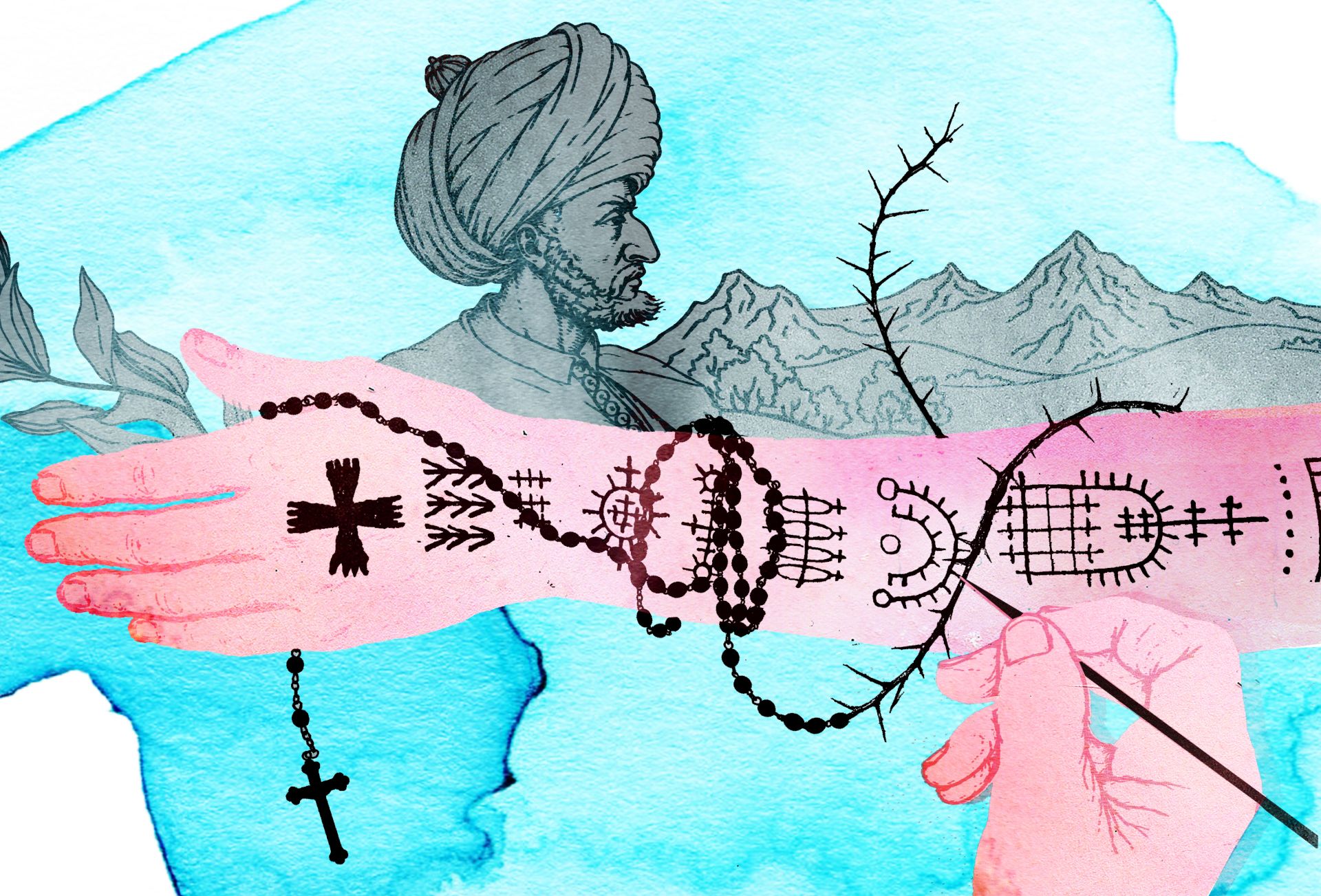
Mara sits at an outdoor table, in the dappled shade of a bright afternoon, a pergola of grapevines rustling gently in the breeze behind her. She is soft-spoken but remarkably robust for a woman born in 1935; her hands are sturdy, and she’s rolled up the sleeves of her crisp, white shirt to show her wrists and forearms, which are covered in faded tattoos. Mara calls them “krizi” — “crosses” — but what begins as a simple cross branches into patterns resembling embroidery that spread across the skin. Some look like fir branches, stars or crescents; others resemble symbols from a secret language known only to the initiated.
Her tattoos have faded slightly, but her memory of them remains vivid. She remembers a woman who specialized in “sicanje” or “bocanje” — cutting and poking — and offered her services on Sundays after Mass. The girls chose their own designs, and the woman would etch them in their skin using a mixture of lampblack and honey.
In a 2019 interview for the Sicanje Project, which set out to document the last generation of Bosnian Catholic girls and women who had their hands, arms and sometimes chests covered in intricate tattooed designs, Mara explains what her tattoos mean. Lowering her voice, she said their story went back to the “Turkish times” — the centuries of Ottoman rule over Bosnia. The tattoos, she explained, were meant to mark girls as Catholics and protect them from the advances of Ottoman Muslim men. “They would sleep with girls however they wanted,” she said, invoking the familiar story that landlords claimed the “jus primae noctis” — the supposed right to spend the first night with a new bride. The tattooed crosses were meant to guard against such a fate — or so the stories go.
No one knows exactly when the practice of “sicanje” or “bocanje” began among Bosnia’s Catholics; by the time ethnographers started documenting it in the 19th century, it was already deeply rooted in rural communities. Once common among both women and men in Bosnia, the custom gradually faded over the course of the 20th century. In recent years, however, the designs of Bosnian Croat tattoos have experienced a revival. Search “Bosnian tattoo” online, and photographs of elderly women’s hands appear instantly. Tattoo artists advertise the motifs on Instagram; discussions flourish on Facebook groups. Temporary versions can be ordered online, and familiar designs appear on clothing. In early 2026, the trend reached a new level of visibility when the Croatian folk group Lelek performed their Eurovision qualifying song “Andromeda” with versions of this kind of tattoo drawn across their faces and arms.
Alongside the resurgence of the tattoos themselves is the revival of their apocryphal origin story — a gendered and sexualized narrative in which the supposed struggle between Christianity and Islam plays out on the skin of vulnerable Catholic maidens. For many getting the tattoos now, they are framed as symbols of resistance to Islam and guardians of Catholic identity in a region with centuries of fraught political and religious history.
But the truth of these tattoos — their origins, what they symbolized for the women who wore them and for Bosnia’s Catholic community at large — is far more complicated. The nationalistic narratives swirling around them today are little more than skin-deep. Their true roots speak to the deep connection between a community and its land; to the bonds of young womanhood; to creativity, faith and identity in a complex period of history.
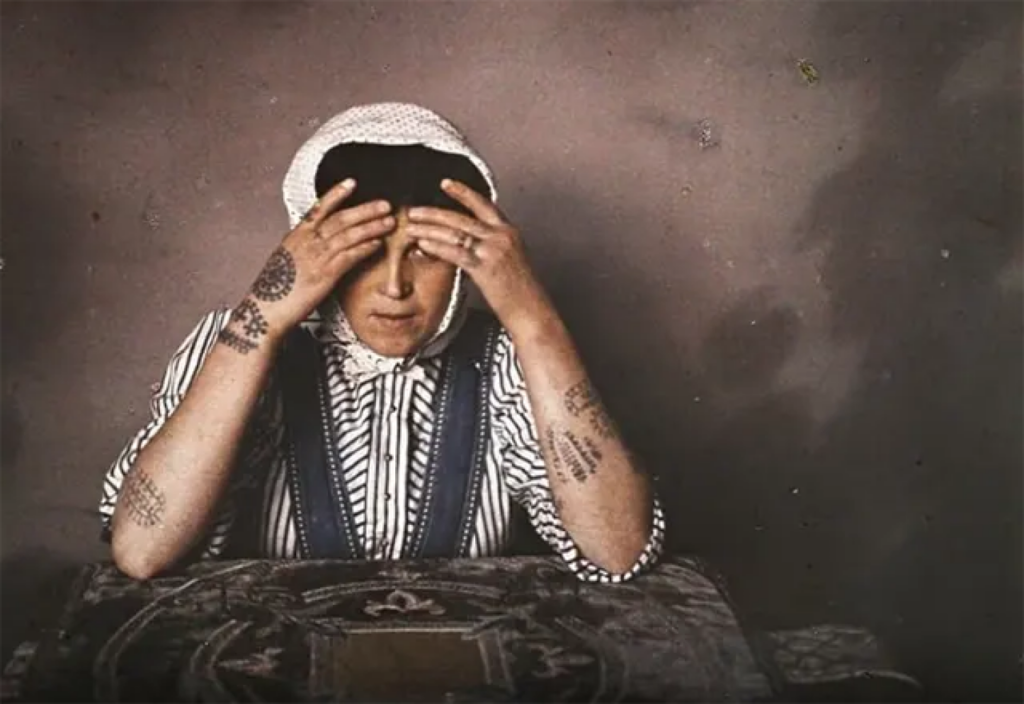
The first published record of the tattoos comes from a late 19th-century Habsburg physician, Leopold Glück, and his 1889 piece of writing, “Tattooing Among the Bosnian Catholics.” In it, he wrote, “If you find yourself passing by a Catholic church after a Sunday Mass,” you will certainly see that “every maiden, every peasant woman’s shoulders, arms, hands, even fingers and somewhat more rarely their foreheads” are covered in tattoos. He proposed that the tattoos were meant to prevent Catholic conversions to Islam.
Glück’s interpretation of the tattoos aligned in many ways with prevailing sentiments in the country. Even though the Ottomans left Bosnia in 1878, the memory of Ottoman rule loomed large in the social, political and cultural imaginations of Bosnians. During Ottoman rule, roughly half of the Bosnian population converted to Islam, turning Bosnia — with its three main religious groups: Catholics, Orthodox Christians and Muslims — into a proverbial place where the West meets the East. Inequalities and grievances between Muslims and non-Muslims carried over into the new postimperial period — and continue to polarize communities to this day. Despite nuanced scholarship that highlights complex social, economic and cultural interactions among different religious groups, popular memory often frames the Ottoman era as a stark clash between Muslims and Christians.
Five years after Glück’s piece came out, the same journal published an article by another Habsburg appointee, the prolific archeologist and historian Ćiro Truhelka. He had a different interpretation, suggesting that, rather than something devised by the Franciscan friars to visibly set the Catholics apart from the Muslims, the tattoos’ origins went back to the pre-Ottoman and even pre-Christian period. (Alongside his analysis, Truhelka published drawings of the tattoo motifs that he’d copied from hundreds of individuals, a record which still serves as a blueprint for contemporary tattoo artists.)
But the anti-Ottoman tropes prevailed, and the tattoos’ meaning came to be tied up in the sentiments around the sexualization of conflict during the Ottoman wars. As the historian Cemil Schick writes, “sexual violence provides a symbolically dense representation of territorial appropriation and of the inability of men to defend their territory and manhood.” This “pattern of sexualization of national conflict” was pervasive, with one of the most stark examples published in 1909: “Balkangreuel” (“Balkan Cruelty”) by Gottfried Sieben was an illustrated collection depicting Muslims raping Christian women — essentially a pornographic work disguised as anti-Ottoman war propaganda.
Tattooed women, too, appeared as part of this imagery, in illustrations and as photography became more prevalent. At the turn of the 20th century, photographs of tattooed Christian women circulated in Western reporting on Ottoman Macedonia, a region synonymous with political unrest and anti-Ottoman activism. In April 1903, months before an anti-Ottoman uprising, The St. Louis Republic published a photograph of Macedonian women with prominent cross tattoos on its front page. The brief caption explained that “this distinctive mark of the Greek Church adherents in Macedonia is placed upon every young girl when she approaches maturity or begins to show signs of unusual beauty, to forestall her abduction by the Turks.”
A similar set of references and associations was at work in Bosnia and the post-Ottoman Balkans more broadly, precisely at the moment when tattoos were becoming a subject of more sustained conversations. Numerous stories, some more or less explicit, circulated, depicting Christian-Muslim struggle through the imagery of chastity and sexual violence. Truhelka himself wrote one such sprawling story about a Catholic girl named Diva Grabovčeva, a virgin who chose death over conversion and defilement. In his own words, the story was inspired after he was asked to inspect a site near Rama in western Bosnia where Catholic (and sometimes Muslim) young women came to pray. The local Franciscans wanted proof that the site contained an actual human grave, and who better to determine that than a famous archaeologist? Reluctant at first, Truhelka hiked to the hills and indeed unearthed a human skull at the revered spot. Just by glancing at the time-bleached bones, he imagined the face of a fair woman framed by golden locks. It wasn’t difficult to then take another leap of imagination and come up with a story about the woman herself. The result was a vita of Diva, who — like a Bosnian Joan of Arc — died a martyr’s death after being pursued by a local Muslim lord.
Over time, this melodramatic piece became an undisputed historical source. The Catholic Church now officially promotes the site as a place of pilgrimage; a sculpture of a young virgin has been installed there; nationalist songs have been composed and, in its most recent iteration, the commemoration of a Catholic maiden killed by Muslims has taken the form of a 2025 film advertised as a “true story” of Diva. It seems that the tattooed women of Bosnia have been folded into this larger narrative.
A decade ago, I spent some time in two Franciscan monasteries in the Bosnian heartland, and I saw that these decidedly male spaces were nevertheless kept together — if not exactly run — by a community of women. Yet such women rarely figure in historical documents, even though they appear so central to collective memory. Despite a few articles, to my knowledge there is not a single monograph dedicated to the history of Catholic women under Ottoman rule (a period of more than 400 years). The interest in portraying mythologized, victimized women seems to be inversely proportional to the actual research devoted to their history. Yet there is no question that women were often central to the anxieties of everyday life.
Franciscan friars, who served as key communal leaders among Bosnian Catholics during the Ottoman period, closely monitored marriage, engagement and sexual propriety. Unlike in Islamic law, where marriage is primarily a legal contract, in Catholicism marriage is a sacrament and has long been subject to close clerical oversight. In Bosnia, however, regulating marriage was not only a matter of theology. It was also a way of policing communal boundaries and preventing conversion. For that reason, in the 19th century and earlier, acts such as breaking an engagement, elopement or contracting marriage before an Ottoman Islamic court could be treated as grave offenses — sometimes even sins punishable by excommunication.
But they did happen. Take, for example, the case of Manda and Marijan, a Catholic couple who appeared in the court in Kresevo in central Bosnia in 1769. The two separated “due to the lack of harmony between them,” and Marijan agreed to pronounce “I divorce you” three times, as is the Islamic legal custom, while Manda gave up her dowry and demands for financial support. “We never had a pleasant life,” Manda declared in the document. Here is a Catholic peasant whose voice we hear only because she was brave — or desperate — enough to have it registered with a Muslim clerk. A friar would not have granted a divorce, and neither would he have let her speak. In the early 19th century, a French diplomat left a vivid description of the Franciscan practice of ordering women who transgressed in some way to wear gags during Mass. He compared this silencing contraption to “what our veterinarians would use on a horse.”
The Franciscan sources only corroborate this. The monastery in Fojnica holds a register of “the damned, the kidnappers, and outlaws” dating to 1828. The kidnappers and outlaws recorded here are Catholics themselves, men and women who have crossed the lines of appropriate sexual behavior by violating engagement rules or family wishes, having children outside of wedlock or marrying at the Ottoman court. The likely author of the notebook was Bishop Augustin Miletić, who was invested in overhauling both the monastic and communal archiving systems. In this case, recordkeeping was not only in the service of communal remembrance — the names of the transgressors were to be read out loud in the church once a year — but also for prescribing the punishments. These included, predictably, intense prayer and fasting, and, less predictably perhaps, kneeling in front of the church congregation during Mass with heavy stones suspended around their necks and black veils hung over women’s heads. More than anything, they record that there was already sex, drama, defiance and violence within the Catholic community without the Muslims being involved.
The existing historical sources suggest that women’s bodies did indeed function as sites of inscription. But contrary to the popular stories enshrined in the contemporary tattoo revival, instead of protective barriers against the Muslims, they were canvases onto which cautionary tales were written and enforced.
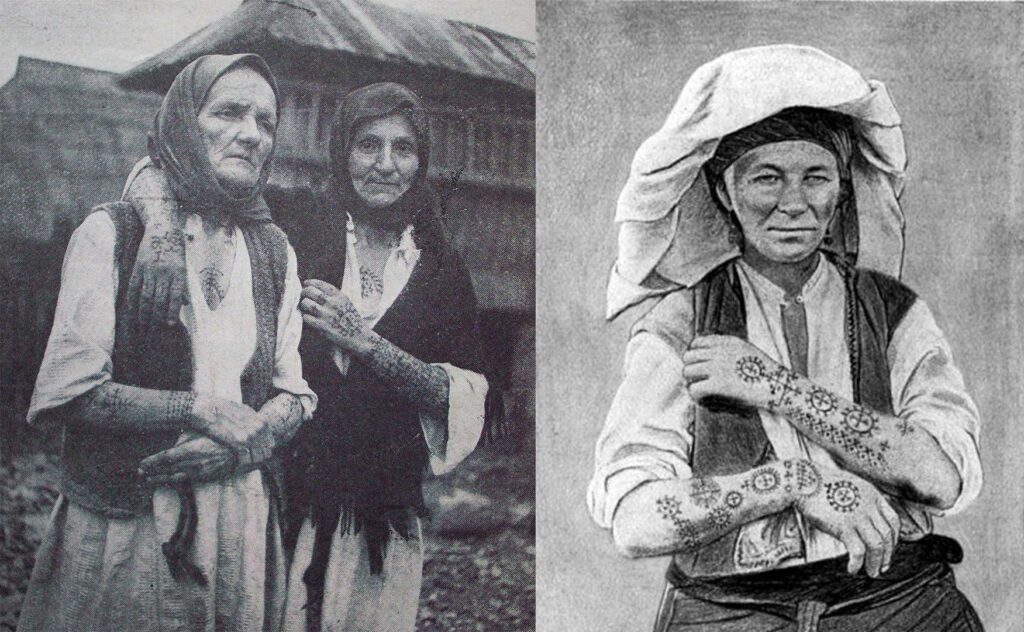
I always wondered how exactly a tattoo would protect women from violence and conversion. Was it a talisman of sorts? Or would it have an effect comparable to how garlic is said to ward off vampires? Glück claimed that Muslims would have been repulsed by the cross. Some nowadays explain that “Islam forbids tattoos,” likely referring to the doctrinal rulings based on the hadiths that consider tattoos impure. Despite that, many Muslim communities have a long history of practicing tattooing across the Middle East and North Africa. In the late 19th century, Truhelka himself witnessed a number of Catholic women who married Muslims, converted to Islam and walked around with their tattoos.
The modern discourse insists on casting the Catholics as eternal victims at the mercy of the predatory Muslims. But it seems to me that if tattoos are to be understood as factors in preventing conversion, they at the very least complicate that narrative. They point to the Catholic fragility or susceptibility to temptations of conversion. The tattoos were meant for the Catholics, not for the Muslims. Curiously, Glück himself offers some clues. For him, the key to understanding the power of tattoos was their permanence and the pain one would have to endure should one want to remove them, as in the case of conversion to Islam. The change of faith would require not only a spiritual realignment, but growing an altogether new skin. The tattoo would have been a reminder — and a promise — of pain to be endured for leaving the communal fold. It’s not that the Muslims ran away from the cross; it was that Catholics had to be constantly reminded of it.
Questioning the history behind the tattoos’ myths doesn’t dismiss sexual violence or paint the Ottoman Empire as a harmonious, egalitarian place. The Ottoman state was patriarchal, hierarchical and harsh, not because it was Muslim but because it was a premodern empire. Contemporary narratives around the tattoos point to a gap between the realities of past life and an ever-evolving fiction that is constantly expanding, especially among those who should know better. The stories we are left with now seem to have taken on a life of their own, every new telling an opportunity for a more mysterious, fantastical tale. They are seductive and animating, but they speak to deeply seated expectations, not history. In a pamphlet about the tattoos compiled by the Croatian author Vesna Haluga, a tattoo artist named Eva Balažin explains how some of her clients embraced those narratives. “Foreigners were curiously approaching the emergence of tattoos under Ottoman occupation,” she says. “As I applied their tattoos, I educated them a bit along the way, and sales went surprisingly well.” Stories of vague violence and women, marked by undertones of transgression, seem to be always in demand.
Melissa Pizović is a busy tattoo artist. According to her Instagram account, which has more than 70,000 followers, she is often bouncing around Europe from her studio in Paris to short gigs in Vienna, Zagreb, Zurich and as far away as Stockholm. She specializes in sicanje and bocanje and has become the face of the Bosnian/Croatian tattoo revival.
She learned about the tattoos through her Croatian father. In an email, she tells me that she “had never seen an artist tattoo these symbols in an ancestral way, explaining their history, so I said to myself, why not me?” The result is beautiful, detailed designs: shins, shoulders, chests covered in recognizable patterns — crosses, branches — woven together in Pizović’s unique ways. Some of her designs indeed resemble and draw inspiration from embroidery. The old patterns published in Truehlka are an inspiration, she says, but she designs motifs and compositions specific to each person. Where she doesn’t take any liberties is in the technique. Instead of the common tattoo gun, Pizović proudly relies on the hand poke technique.
The majority of Pizović’s clients come from the Bosnian and Croatian diaspora. The interest was “timid” at first, stemming from roots and heritage, but it has since grown into a sign among the far-flung diaspora to “recognize each other and connect on their common origin.” That’s how I recognized the Croatian American speculative fiction writer Natalie Kikić when I spotted her tattoo in one of her Instagram posts. She had it done by Pizovićin Paris, and says that it’s a way to show pride in her Croatian origins. Her upcoming novel about a female healer is set in Dalmatia, and Kikić considered introducing the tattoos into the narrative. In a matter of a decade or so, the tattoos have found new bodies, audiences and contexts.
The tattoos seem to have a mystical pull on women in particular. Haluga’s pamphlet, “The Sign: Traditional Tattoos of Croatian Catholic Women from Bosnia and Herzegovina,” includes the testimonies of women in Croatia who have recently gotten one of the tattoos. They emphasize, in somewhat vague terms, themes of strength and survival, endurance and tradition. The tattoos carry similar meanings for Pizović’s clients. Even those who don’t have direct ties to the region see in them “a kind of ancestral sorority” or even a “form of feminism.”
But that alluring, sexually charged narrative at times directly takes away from the women-centric stories that many of those in the older generations, who wore the tattoos, actually tell about them. In the videos from the Sicanje Project, the women tell rich stories of girlhood, despite the researchers’ attempts to steer them back to the anti-Ottoman narrative. They speak about their friends, sisters, aunts and grandmothers giving each other tattoos. It was a communal event, done in the springtime around St. Joseph’s feast day in mid-March, that was celebratory and creative. For many of the women, their tattoos prompt memories of female connections, friendship, ingenuity and expertise.
Posts on Pizović’s Instagram routinely draw admiration — and spark discussions about just who can get a “traditional Croatian tattoo.” Recently, one follower wondered whether it would be “hypocritical” to get one of the tattoos; she loves how they look but she’s “neither Balkan nor Catholic.” “Yes,” that would be “an epitome of appropriation,” cautioned someone. “Of course no, dear,” another chimed in. “Aesthetic always comes first.”
The question about appropriation is just about as murky as the origin stories of the tattoos themselves, and strikes right to the heart of the collective identities of modern Bosnia-Herzegovina. In the 19th century, Catholic subjects of the Ottoman Empire began identifying with Croatian national identity, and their art — including the culture of tattooing — became Croatian, too. There is no question that today the tattooed Bosnian women identify as Croats, and proudly so. Yet to describe the practice as “Croatian tattoos” complicates what is already a historically fraught and trope-laden narrative. Sicanje and bocanje may be old, ancient even, but calling them Croatian is pretty new.
Research from the mid-20th century shows that, in fact, this kind of tattooing was widespread in many pastoralist communities in the mountains around the Balkan Peninsula — in Macedonia, Greece and Albania, as well as Bosnia. It spanned religions, touching Catholics, of course, but Orthodox Christians and Muslims as well. What seems to draw them together is a rhythm of life. In the Sicanje Project, Mara and the other women talk about getting their first sicanje while they “were looking after.” They don’t feel the need to specify after what exactly: the sheep, of course. If there’s a tradition integral to tattoos, it is that one.
Doing justice to that tradition means tracing it back to a particular way of being in the world: bodies moving with animals, managing boredom through creativity and play. The tradition is living, bodily and immediate; its richness is inseparable from the rhythms of pastoral life. To talk about Croatian traditional tattoos and harp on about the stories of the Turks is to overlook the world in which they actually mattered.
But the idea of these tattoos being “traditional” is also up for debate. Raymond Williams writes that the idea of “tradition” harks back to the timeless, even though much of it is new. “It is sometimes observed by those who have looked into particular traditions,” he writes, “that it only takes two generations to make anything traditional.” It’s in the moments of rupture that the new link with the past becomes necessary.
This seems to be a productive way to understand the contemporary revival of Bosnian Catholic tattoos, especially within the diaspora. Both the Bosnian and Croatian diasporas now number in the millions, dispersed across Europe, North America and Australia, in some cases approaching or even exceeding the populations remaining in the homeland. It’s not surprising that in such contexts the skin becomes a site of inscribing and archiving stories of belonging.
Yet there has never been a single, stable meaning to these tattoos. Crosses and geometric forms have shifted in style, placement and interpretation. Some of the earliest writers, like Truhelka, observed the instability of the cross as a sign — it clearly had pre-Christian origins and was used as a tattoo symbol in decidedly non-Christian contexts. Signs don’t mean anything in and of themselves until someone agrees on their meaning.
A new generation is making the practice its own. Claims that the tattoos reach back to prehistory in the Balkans only underscore how dramatically their meanings have shifted. In that sense, the tradition may be coming full circle: The tattoos continue to mark bodies on the move, tracing belonging across communities and geographies, and — as many of the older Bosnian women insisted — are etched not just on the skin but, in a way, in the bones.
Perhaps the only real pity is that the phenomenon still rarely receives clear-eyed historical treatment. As these tattoos gain visibility in the internet age, myth will travel faster than research. It already has. The question remains: When will history be allowed to complicate heritage without being perceived as its enemy? Will there be a moment when attachment to the past does not require embellishment, when belonging can coexist with ambiguity?
Become a member today to receive access to all our paywalled essays and the best of New Lines delivered to your inbox through our newsletters.