


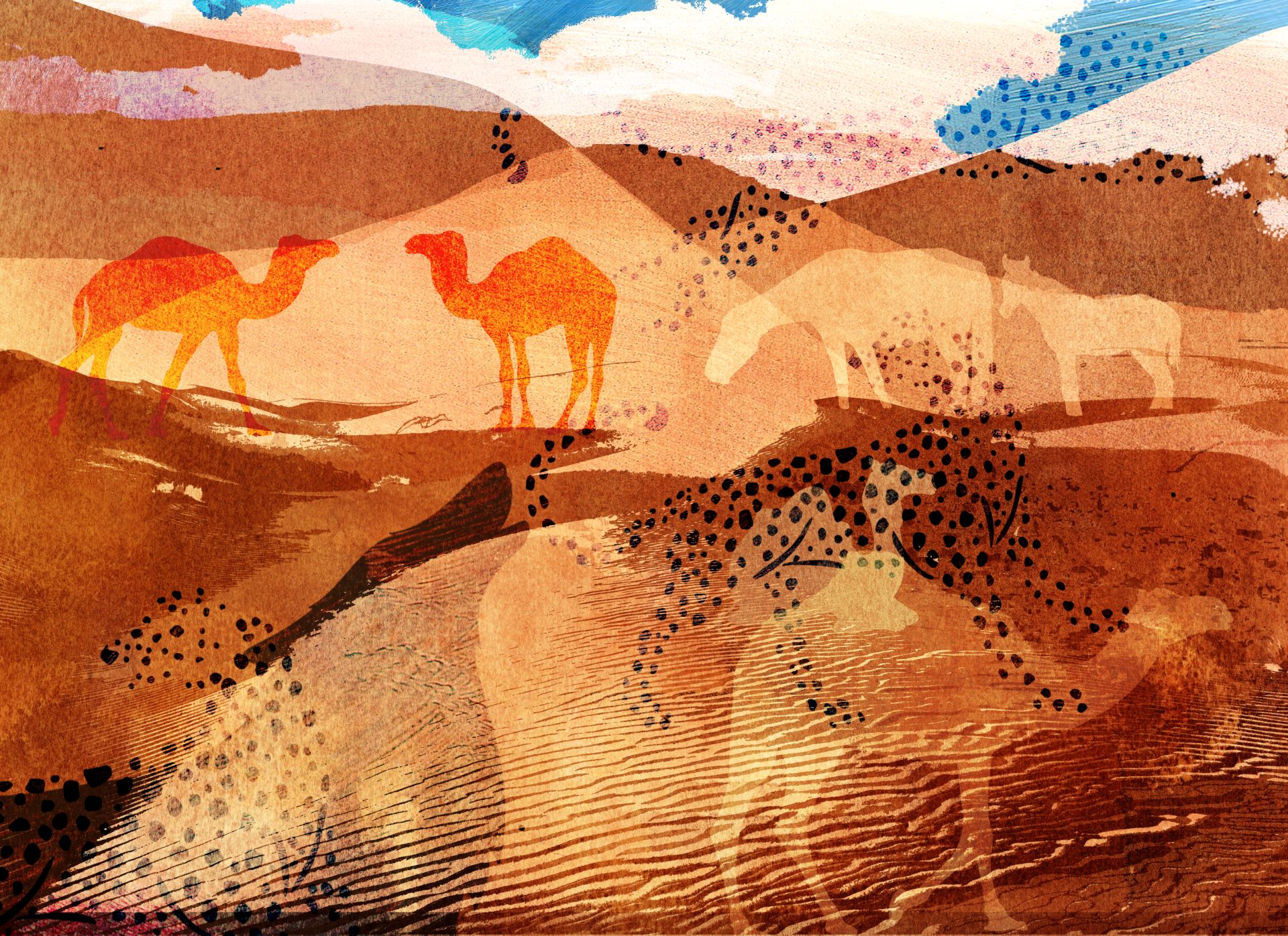
A century ago this year, the Egyptian writer and thinker Taha Hussein, one of the commanding figures of modern Arabic letters, published a volume that became, almost overnight, the most controversial book in the history of modern Arabic literature.
Hussein, a graduate of Al-Azhar University in Cairo and the Sorbonne in Paris, applied Cartesian doubt to a fixture of the Arab-Islamic literary tradition and a founding corpus of the Arabic language: pre-Islamic or Jahili poetry, long and short poems that constituted an important aspect of Arab culture before Islam. (The word Jahili refers to pre-Islamic Arabia. It comes from “jahl,” a state of tribal rashness, arrogance, moral disorder and life outside prophetic guidance.) He cast doubt on the vast majority of what has come down to us from this literature, claiming that much of it had been fabricated by transmitters, grammarians and theologians. It’s hard to overstate the weight of this claim: This poetry had long served not merely as literature, but also as linguistic evidence, tribal memory and a window into the early Arabic imagination.
The resulting furore led to powerful and evidence-backed challenges to Hussein’s thesis. The more nuanced position, and perhaps the prevailing one today, is not that every transmitted verse is beyond dispute, but Hussein’s audacious claim — that the bulk of Jahili poetry was a later Islamic invention — has been refuted in its most absolute form by multiple strands of historical and textual evidence. Fabrication, false attribution and editing certainly took place, and Hussein was right to problematize that. Yet the corpus as a whole cannot be dismissed as the work of later minds.
My concern here, however, is not only with proving authenticity by refuting Hussein’s arguments, although it’s worth touching on briefly. I am arguing for the unique qualities that Jahili poetry exhibits, and for the fact that it preserves a state rarely found in world literature, namely a way of experiencing life before the modern severance between the human being and nature, subject and object, inner feeling and outer world. In this poetry, human beings, animals, weather, place, time, sorrow and desire appear to belong to a single living matrix rather than to exist as entities set against one another. The question of authenticity, therefore, becomes even more important, because what is at stake is not merely the age of the corpus but the form of consciousness it preserves, a state in which the world isn’t looked at from outside, but felt and experienced from within. The distinctness of this consciousness is, in its own right, another point in favor of the poetry’s authenticity.
Pre-Islamic poetry is strictly metered, with a single end rhyme. The oldest examples we have date back to about a century before the birth of Islam, that is, to the sixth century CE. Modern and classical critics alike regard the works as among the finest achievements of classical Arabic poetry. Moreover, they have for centuries been widely accepted as the standard by which poetic quality and linguistic eloquence are measured. Classical Arabic grammarians and lexicographers frequently cited this corpus of poetry.
Among its masterpieces are long poems known as the “Muallaqat,” the canonical “suspended odes,” so called because of the belief — now treated with caution — that they once hung on the walls of the Kaaba. Their themes range from lamenting abandoned campsites of nomadic Bedouin pastoralists to love and erotica, pride in oneself and one’s tribe, panegyrics and descriptions of the desert, horses, riding camels, rain, wild animals and battles.
Hussein wasn’t the first to question the authenticity of pre-Islamic poetry. European Arabists and orientalists had already raised doubts about parts of the corpus in the 19th century, and medieval Arab critics themselves knew perfectly well that fabrication and false attribution existed. They accused particular transmitters — most famously the early Islamic poetry collectors Hammad al-Rawiya (born around 694) and Khalaf al-Ahmar (born 733) — of forging poems or assigning them to earlier poets. But those accusations were selective rather than wholesale, unlike Hussein’s thesis, which cast almost the entirety of the tradition as a later invention. The same philological tradition that exposed forgery also tried to sift the genuine from the spurious: a tradition of scholars and collectors such as al-Asma’i (born around 740) and al-Mufaddal al-Dabbi (his date of birth is unknown but we know he died around 794). Both became associated with anthologies bearing their names, and later scholars treated those collections as among the soundest witnesses to early Arabic poetry.
Hussein’s book is a watershed in the history and study of modern Arabic literature, not so much because of the views it contained but because of the controversy it set in motion for decades. It ignited perhaps the greatest Arab literary dispute of the entire 20th century, and one of its consequences was the production of remarkable studies whose scholarly conclusions strengthened the grounds for believing in the authenticity of a large body of the pre-Islamic poetry that has come down to us.
Hussein’s claim that much of the corpus was inauthentic rested on several interconnected points. He argued that the poetry was linguistically too uniform, appearing in a literary Arabic close to the language of the Quran rather than reflecting the dialectal and regional variety that must have existed among the Arabs before Islam, especially between Yemen and the Hejaz. He also thought that much of it failed to reflect pre-Islamic religious, political and social life as reliably as the Quran did. Many poems, in his view, bore the marks of later Islamic-era motives, including tribal rivalry, Islamic-era claims of prestige, religious argument, storytelling and the interests of transmitters and grammarians. His claim, then, was not merely that some poems had been forged or wrongly attributed, which medieval scholars themselves had known, but that much of the pre-Islamic past had been reconstructed after Islam in the language, anxieties and ambitions of a later age. A substantial body of linguistic and historical scholarship after Hussein has undermined several major premises of this thesis.
Jahili poetry, as we have it, is the culmination of a long process of development about which scholars know little. Work on the sources and transmission of pre-Islamic poetry suggests that the preservation of this tradition wasn’t a simple passage from a purely spoken Jahili past to later codification by Abbasid philologists and collectors. A more complex story was at play here, including strong oral preservation, written notation, tribal and personal transmission, revision, citation, and later collection and classification. While epigraphic evidence — inscriptions and other forms of writing — doesn’t prove that Jahili poems were written down in the form in which we now have them, it does challenge an idea that supported Hussein’s skepticism, namely that pre-Islamic Arabic was almost entirely an oral, undocumented world until Islam and later philology codified it. On the contrary, inscriptions across Arabia and its surrounding regions show that Old Arabic, in various forms and scripts, had a documentary presence before Islam. This type of evidence makes it easier to understand Jahili poetry as part of a longer continuum of Arabic expression, preserved through a mix of written and oral transmission.
A key point here, as the Turkish scholar Fuat Sezgin meticulously argued in the mid-1970s, is that some of the poetry was written down much earlier than previously thought, with limited writing beginning before Islam and continuing into the Islamic period. On top of that, the linguistic unity of the pre-Islamic poem isn’t proof of forgery. Recent work on early Arabic inscriptions, transmission, regional poetic traditions and Arab identity before Islam has made the older picture of a sudden Islamic invention increasingly difficult to sustain. The unity of the poem can instead be understood in light of an elevated poetic language that crossed dialects and tribes, shaped by desert markets, transmission, artistic convention and the formation of broader Arab identities before Islam.
Likewise, the early citation of poetry to explain obscure words in the Quran — especially the book “Questions of Nafi ibn al-Azraq,” attributed to Ibn Abbas, a cousin of the Prophet Muhammad — can’t properly be turned into an indictment of the poetry as Hussein did. If anything, it shows that, from the earliest Islamic period, poetry was treated as a linguistic authority and as evidence for Arabic usage. The claim that fabrication and false attribution are present in part of the transmitted corpus remains valid and important to address, but this feature doesn’t harm pre-Islamic poetry as a whole. Multiple strands of evidence show that the belief that the bulk of Jahili poetry has been fabricated does not stand on solid ground anymore. The fact that the artistic structures, language and themes, and the consciousness of the world found in this poetry all differ markedly from those of early Islamic verse all point to a thriving, earlier tradition of poetry, unlike anything composed in Islamic times.
But why, a hundred years after that battle first broke out, do I still concern myself with it — I, a longtime aficionado of classical Arabic poetry and a voracious reader of medieval Arabic writings more broadly? The reason isn’t merely that I am convinced of the authenticity of significant portions of this poetry, but that I believe this is a unique piece of world literature that ought not to be abandoned, however difficult or strange it may appear.
Suzanne Stetkevych is a renowned scholar of classical Arabic poetry, who was named “Cultural Personality of the Year” by the Sheikh Zayed Book Award in 2019, together with her husband Jaroslav Stetkevych. At the award ceremony, which I attended, she said that she had asked herself early in her career: Why trouble herself with studying this old poetry? Her answer was: If one knew that a treasure lay hidden somewhere, would one leave it untouched merely because some labor was required to extract it? She felt this poetry was indeed a treasure, and deserved every hardship and exertion required to bring its jewels to light.
I noticed recently, while listening to recitations of Jahili poems, that the singularity of pre-Islamic Arabic poetry lies not only in its being one of the foundational bodies of Arabic language and culture, nor in the uniqueness of its music or its wealth of linguistic and imagistic jewels, but also in the fact that it has preserved for us a rarely glimpsed phase in the history of human consciousness.
By that, I mean a womb-like matrix of existence, in which human beings and what we now call nature have not yet been separated. This shared matrix isn’t a form of sentimentality toward nature, but rather an older state of experience in which the human being, animal, place, weather and time are felt as belonging to a single order of being. In this state, people aren’t placed outside nature, looking at it as something separate from themselves; nor is nature simply the larger container that holds them. Both the human being and nature appear within the same pattern. Nature is “here” and “there,” yes, but it isn’t “another” thing. The poet doesn’t stand before it as an abstracting contemplator. In the Jahili verse, the human being appears as something kneaded with the world, seized by its phenomena, and formed alongside animals, weather, place and time in a single weave.
The poet’s relation to the world, then, isn’t the relation of a subject to an object, but a relation formed through belonging to this single matrix. This doesn’t mean that all things are one thing, nor that they dissolve into a single reality. It means that the human being, night, mountain, riding camel, sea, sorrow and time all exist in the same way in the consciousness of the Jahili poet. They are capable of acting and being acted upon, of growing heavy and stretching out, of hurting and of taking part in the formation of feeling.
This isn’t to say that Jahili poetry is rudimentary. It achieved an extraordinary degree of craft, rhythm, thought and feeling, and represents a high point of human expression. At the same time, the Jahili poet isn’t a Romantic poet who has gone out into the countryside or wilderness to be overwhelmed by its “transcendent” beauty, and has then returned to give us a “beautiful,” “deep” or “metaphorical” text about the experience. Any talk of “closeness to nature” already belongs to a modern conception, one that assumes a separation between humans and nature, as though humans were one thing and nature another, and that poetry’s role is to describe it, bridge it or sing of it. This is far from being the case with Jahili poetry.
Let’s absolve the Jahili poets, then, of “describing nature” in the Romantic or ordinary sense. Description here isn’t the placing of a subject before an object, a human being standing here and a world extending over there. In this shared matrix, night isn’t a psychological backdrop, the desert isn’t a scene, the camel isn’t merely a means of transport, and the abandoned campsite isn’t merely a site of memory. All of them enter into the formation of the self and into the perception of time, place and body. Ancient Arab traditions that imagined poetry as possession by a jinni contain a remarkable intuition, which is that poetic speech doesn’t arise from a detached observing self, but from a force that seizes the poet and brings world, body, memory and feeling into speech at once.
The poetry of Imru al-Qays, the most legendary of the pre-Islamic poets, offers some of the most important examples through which we can glimpse how ancient Arabs experienced the world. He was, as the reports tell us, a Kindite prince, the son of Hujr, who was said to have ruled over the tribes of Asad and Ghatafan. Absorbed in pleasure and poetry, Imru al-Qays was driven away by his father and took up, we’re told, with bands of outcasts, living a life of hunting, diversion and wandering, until news reached him that Hujr had been killed by members of the Asad tribe. At that point, his life became that of a “wandering king,” a king without a kingdom. He sought to avenge his father and recover his rule, but couldn’t find enough support among the Arabs. So he went, in the most famous reports, to Qaysar, the Caesar of the Romans, the Arabic title for the Byzantine emperor, usually identified as Justinian I. He then died, according to the legend, on the road near Ancyra, modern Ankara, either from a poisoned robe sent by the emperor or from the sores and ulcers that gave him his epithet, Dhu al-Quruh.
In the muallaqa of Imru al-Qays, we find a line about Thabir, a mountain near Mecca (all translations are my own):
As though Thabir, beneath the first rush of a downpour,
were a tribal elder swathed in a striped cloak.
This is among the most beautiful similes in Arabic poetry. Its excellence lies not only in the brilliant passage from mountain to human being, but in its condensation of the Jahili consciousness that made this image, and this passage, possible in the first place. The mountain, even before the poetic image touches it, is already humanized by virtue of being one of the characters in the living epic inhabited by the poet. It is “Thabir” and nothing else. And as soon as the image arrives, Thabir becomes a venerable chieftain wrapped up in his garments. In a single instant, we can no longer tell the mountain from the elder. Yet the poet hasn’t abolished the mountain, nor made the human being a passing metaphor. Both belong to one order of being. Nowhere in the line does the image appear like an imposition. It is a natural birth, an almost magical touch, free of strain.
This immediate and participatory presence of nature, indeed its weight as part of the order within which the poet himself takes shape, can also be seen in his words about night:
And a night like the waves of the sea drew down its veils over me,
with every kind of care, to try me.
This line reveals another face of the shared matrix. Night doesn’t bring sorrow as an abstraction. Its cares arrive with the weight of sea waves pressing upon his chest. The line comes roughly midway through the poem, after a tour de force that moves from a lament over campsites to the ache of unrealized love, to erotic boasting about lingering with women of high birth and slipping into guarded spaces of intimacy. Here, he reminds us that at night, perhaps when he is no longer crossing into a lover’s enclosure, he is left alone with his endless worries. Perhaps the old story of his banishment by his father lies behind this loneliness, if we give any weight to that widely narrated tradition.
In the next line, in one movement, as though we were inside a surreal dream, the sea-weighted night assumes the body of a camel-like beast:
So I said to it, when it stretched out its loins,
followed with its haunches, and bore down with its breast.
Night, sea, camel, sorrow and human consciousness are all drawn into the same order, acting upon and being acted upon by one another. Night is like the wave in its extension and weight, and like the camel in its stretching, its haunches and its heavy breast. Sorrow doesn’t arrive as an inward feeling alone, but comes borne upon this night, as though it were a material weight pressing on the chest. There is something peculiar in these two lines. Sorrow is no longer merely something that happens during the night, nor is night merely the time of sorrow. They almost become one thing, with the extension of the sea and the weight of the camel. In this whole order, night doesn’t remain abstract time, nor sorrow an inward feeling, nor the sea a scene, nor the camel a separate animal. Each crosses into the other, but not in a way that erases the differences between them.
In Imru al-Qays’ verse, the “kaf,” the Arabic particle of comparison, roughly “like” or “as,” and one of the oldest instruments of simile, deeply rooted in Arabic and its neighboring Semitic languages, doesn’t seem an innocent formula of comparison. Here, it’s not a bridge joining two distant things, but an instrument that reveals that a thing isn’t truly perceived except through its companion. You won’t know night in Imru al-Qays unless you know the wave and the camel. You won’t know Thabir unless you know the cloaked elder. The kaf here isn’t saying that this resembles that from the outside. It’s not an analogy but a manifestation. It says that “this” is made visible by “that,” because these things, however different their names and forms, belong to a single, unruptured order of being.
It’s worth noting that this state of consciousness began to change with the rise of Islam, as a new scriptural, linguistic and communal force that set in motion a vast transformation in the Arabs’ position within, and relation to, everything around them. It began moving them from a sense of belonging to a local tribe to the far more capacious identity of a Muslim nation, or “ummah”; from the plurality of dialects to the centrality of a “clear Arabic tongue,” as the Quran says; and from a world whose beings were encountered within a shared matrix to a world whose beings could be read as signs, that is, created things pointing beyond themselves to God. This didn’t happen overnight, nor did Islam erase the Jahili way of experiencing the world, or its poetic and sensory residues, in one stroke. But it did bring into being a new form of attention. When the Quran asks, “Do they not look at the camels, how they were created?” the camel becomes not only the companion of the desert and the beast for riding, almost an extension of the human being, but also an occasion for reflection, consideration and recognition of divine signs. The matrix didn’t disintegrate here, but it began to change. The world became a book filled with the signs of God, after having been the encompassing matrix of existence.
The pre-Islamic mode of perception could also explain the singular presence of animals in Jahili poetry. The camel, the horse, the male ostrich, the wolf and the gazelles, all frequent desert figures in early Arabic poetry, aren’t ornamental add-ons in the poem, placed there so that its expected elements are complete, though there are strict structures guiding the composition of the Jahili ode. These conventions include opening with a reflective halt at the beloved’s abandoned campsite, of which nothing remains but lamentable traces, and the description of the journey and its mount, whether horse or camel. But these creatures are not a function of the form; they are partners in the same theater of being. The poet knows them as one who has lived beside them, an expert through companionship, and he describes them from extreme proximity and with astonishing tenderness. In no way is this classificatory knowledge. It is lived knowledge.
Labid ibn Rabia, one of the major pre-Islamic poets who lived well into the Islamic era, came out of the rugged Najdi Bedouin world of central Arabia. His verse is closely bound to the lexicon of the desert, its animals, plants and places. In his muallaqa, he places us inside a cinematic scene, beginning with a reference to the remains of his beloved’s old campsite, which has been effaced and emptied of its people. But he doesn’t immediately stop, as Imru al-Qays does, to lament over the vanished traces. He postpones his grief a little. He recalls the coming of thunder and spring rain after the area was emptied of its human inhabitants, until the ayhaqan plant — possibly a type of wild rocket associated here with spring growth after rain — had risen, the two flanks of the valley had grown fertile, and the gazelles and ostriches had produced offspring. Then he brings his lens closer to a delicate scene. The wide-eyed oryx mothers stand still over their young, gathered in the open. A stillness and tranquility one almost sees:
And the wide-eyed oryx mothers, [their gaze] still fixed on their calves,
mothers fresh from birth, their little ones gathering across the open plain.
The place abandoned by humans hasn’t become empty, but has turned into an abode for plants, rain, animal mothers and their young, and, most poetically, the stillness and tenderness of the mother oryxes as they watch over their calves. Similar to this is the line of Zuhayr ibn Abi Sulma, another of the great pre-Islamic poets, famed for odes that took a year to compose, describing the former dwelling of Umm Awfa, his first wife. Here too, the place is ruined after its people have gone, but it becomes the site of another life moving in their wake:
There the oryxes and gazelles walk one after another,
and their young rise from every resting spot.
We see this shared matrix at an extreme in al-Shanfara, one of the legendary “saalik” poets, outcasts disowned by their tribes. Wild beasts cease to be merely wild beasts and stand in for human kin. In his “Lamiyya” — his famous ode rhyming on the letter “lam,” or “L” — predatory animals become part of the family:
In place of you, I have family: a sleek wolf,
a spotted, fleet leopard, and a long-maned hyena.
They are the family: No secret entrusted among them is betrayed,
nor is the offender abandoned for what he has done.
Antarah ibn Shaddad, the Black Arab warrior-poet, emerges from his poetry as a man whose enslavement denied him status but never honor, a warrior who slays noble heroes while still consumed by love, chivalric pride and the struggle to prove his freedom through valor and untarnished character. In his muallaqa, Antarah reveals that his tenderness doesn’t stop at his beloved, but extends to his horse, which swerves after the spears pierce its breast:
It swerved from the thrust of the spears against its chest,
and complained to me with a tear and a low neigh.
Had it known what speech was, it would have complained;
and had it known words, it would have spoken to me.
This brings us to two lines that dramatize this partnership between the human and the animal, lines that are included in some recensions of the muallaqa of Imru al-Qays, but were also attributed to the outlaw-poet Ta’abbata Sharran; as medieval critics noted, they fit Ta’abbata Sharran better than the Wandering King. The poet, whichever one it might have been, finds himself crossing a barren wadi where a wolf joins the human in its howling, a call so touching and deep it is akin to that of a dispossessed man burdened by the thought of his children, while the human joins the wolf in poverty:
And a wadi, desolate as the hollowed carcass of a wild ass, I crossed,
where a wolf howled like an outcast burdened with children.
So I said to it as it howled: Our condition
is one of little wealth, if you have not yet come into any.
Finally, a line attributed to the pre-Islamic poet al-Munakhkhal al-Yashkuri — a court poet whose death was tied to a royal love scandal at the Lakhmid court in lower Mesopotamia — goes to the heart of this world:
I love her, and she loves me,
and my camel loves her she-camel.
With lightness and spontaneity, he places his hand on the very pulse of this shared matrix between the human being and nature. All distinctions fade when the camel loves his master’s lover’s she-camel, just as al-Munakhkhal loves his own lady.
This highly particular state of consciousness that brings together humanity and nature is what truly distinguishes Jahili poetry. However serious Hussein’s doubts were, and however necessary it remains to distinguish the authentic from the fabricated, this reading — grounded in the poems themselves — adds another layer of evidence for the poetry’s antiquity. The value of this poetry cannot be reduced to the archival question of whether every line can be securely dated. The deeper question is what kind of consciousness this poetry preserves. Its distinctness is itself part of the case for its authenticity, because it gives us a world unlike the one made by later Islamic literary culture, however much that later culture preserved, reshaped and transmitted its predecessors. Poets don’t describe an independent aesthetic object, nor do they present the “self” as a separate center that rearranges the world according to its own emotions. Rather, they present an older, simpler and more intimate state — existence before it splits into inside and outside, object and subject, experience and world — hence its exceptional density. In this poetry, the image is disclosure, simile is a precise response to real affinities in sensation, and description is a way of perceiving being. Perhaps this is the secret of why Jahili poetry remains one of the deepest bodies of poetry ever produced. It places us before a stage of consciousness in which humanity had not yet lost its organic bond with earth, night, rain, animal, fear, desire and continual departure. What keeps the Jahili poem alive is that antithetical relation to pretense and its affinity toward nature. It doesn’t present nature to us from the outside, nor does it try to explain or frame it. All the Jahili poem does is bring us back to that rare moment in which the world appears fully inside consciousness. Not knocking upon it from without, but arising within it, joined to it, as though part of its first matter.
Become a member today to receive access to all our paywalled essays and the best of New Lines delivered to your inbox through our newsletters.