

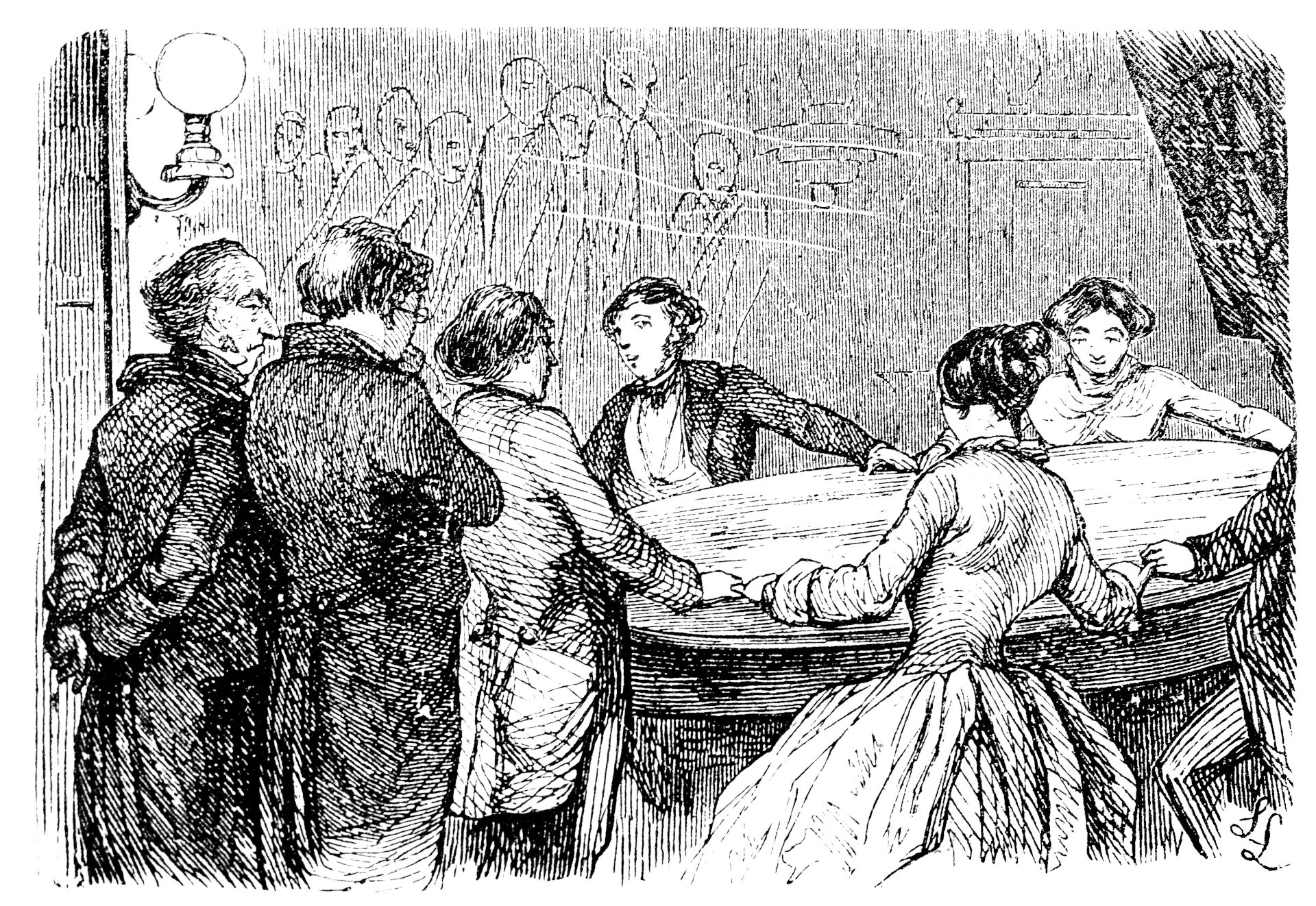
Last summer, I was at a loose end in the manuscripts room in Cambridge’s University Library, waiting for a meeting with one of the archivists. I got into conversation with someone at the front desk about the superb collection the university holds, but in passing they mentioned something utterly different from the medieval illustrated manuscripts I had been asking about: the Society for Psychical Research. There was already a substantial archive, and it was gradually growing as the society sorted through their own holdings. “Like what?” I asked. “Well, we’ve got some great samples of ectoplasm,” she began. “What, like, um, ghost residue?” I said, a little hazy as to what ectoplasm actually is. She smiled. “Well, allegedly, yes, and boards of the messages that various seances produced.”
I liked the image of these ghostly residues — at the very least, they were messages from the 19th-century craze for spiritualism, if not from spirits themselves — jostling up against priceless religious and philosophical manuscripts from centuries ago. But the archivist I was due to meet emerged from his office, so I just had time to scribble down the email address of a contact at the Society for Psychical Research, storing away the knowledge of such a trove of documents and artifacts. The society itself, I knew, had been the subject of extensive academic research, and I resolved to read up on it. What I didn’t know was that not only was this subject — previously called paranormal research — still around and being studied, but that many of its subdisciplines are slowly claiming a place in the mainstream. From experiments with psychedelics to Nobel Prize winners interested in fitting consciousness into physical theories, research into the inexplicable is gaining ground throughout the academy.
The Society for Psychical Research, or SPR, was founded in 1882 by a group of illustrious academics, “with the purpose of investigating mesmeric, psychical and ‘spiritualist’ phenomena in a purely scientific spirit,” according to its website. The founding president was Cambridge philosopher Henry Sidgwick, and early members included prominent academics and other intellectuals: Frederic Myers, a classical scholar who would transform the study of such phenomena; physicists William Barrett and Lord Rayleigh; philosopher and future prime minister of Britain Arthur Balfour; and Eleanor Sidgwick, mathematician and later principal of Newnham College, Cambridge.
As well as high-profile intellectuals, the SPR had all the trappings of any other scientific society: a board, meetings and a journal to publish the results. The methodology was also modeled on the science of the day: collecting and investigating reports of phenomena that science struggled to explain, such as communication with the spirit world in seances, “thought reading” (soon to be named “telepathy” by founding member Myers), mesmerism or hypnotism, and clairvoyance. The results were published in their journal as case studies, dry and factual, a genre based on medical research.
But such academic work was only the most visible part of the society’s output. The SPR “works in at least two registers in its early decades,” Richard Noakes, historian of science and author of “Physics and Psychics: The Occult and the Sciences in Modern Britain,” told me in a lengthy interview, which ranged from 19th-century seances to the development of technology allowing for military aircraft to be guided by spirits. “There is the very empirical, nonmetaphysical and nontheological material that’s in its official publications.” This is presented in the form of case histories. “Another register is the unofficial register, and this reflects where they explore things that they shy away from in the official publications — where they indulge in connecting the evidence with the bigger questions, religious, philosophical and moral.”
This second register is abundantly represented in the archive. Before I visited, I spoke to Melvyn Willin, who has been the archivist for the SPR for almost 30 years. This role has involved cataloging the huge numbers of manuscripts, photographs, objects and audiovisual records collected over the 140 years of the society’s activities. It’s painstaking work, which has its compensations. “There was a metal box I discovered, and no one knew what might be in it. So I opened it up, and it had about a hundred letters in it — all sealed, with multiple wax seals.” He called in a fellow SPR member and professor of criminology at Cambridge, Donald West, and together they sat opening up these long-sealed letters, many marked to be opened posthumously. One of the first they found was signed “Howard Carter,” he told me. “What, the Howard Carter, who discovered Tutankhamun’s grave?” I asked excitedly. “Exactly!” he replied. Given my interest in Egyptology, this is what I sought out first when I visited the archive myself. Did Carter’s work in Egypt affect his beliefs in the soul, I wondered? What does such a belief add to our understanding of his major contributions to archaeology?
Archives are always a strange mixture of the exciting, the mundane and the overwhelming, at least for me. I ordered up the first couple of boxes and settled into patient unfolding and scanning of handwritten letters, wondering what would catch my eye and what I would miss in the sifting process, and what this says about my unconscious biases and interests. I started with the first folder of the first box that came to me, and a shower of envelopes fell out, all weighted with multiple seals. This was exactly what Willin had described, and just a few letters in, there it was: the signature of a certain Howard Carter.
Alarm bells started to ring when I saw the date and calculated he would have been only 17 when writing the letter. Even more damning is that it was enclosed, along with others with similar content, within another, from “Henry James” of the American Society for Psychical Research. (This at first confused me, as the novelist Henry James’ brother, William James, was a founding member of this society. But it isn’t the same Henry James, and I quickly moved back from that rabbit hole to the letters themselves.) The cover letter explained that they were all being deposited with the SPR, awaiting their use should the spirits of their authors return; all contain a snippet of poetry, a Bible verse or an anecdote to test returning spirits and ensure their identification. It’s not just implied that they are all coming from America; the cover letter explicitly refers to “Howard Carter, of St Louis.” Not the discoverer of Tutankhamun, then.
Nevertheless, the archive is gripping. This box is mostly from the American sister society, and some letters are headed with the stamp of Columbia University, written by the professor of psychology Gardner Murphy. Members of the elite universities on both sides of the Atlantic always had an interest in the paranormal, if you know where to look.
When Noakes described the gulf between the dry case studies in the society’s journal and the more spiritual register of individuals’ work, he pointed to the 1903 magnum opus by Myers, “Human Personality and Its Survival of Bodily Death,” as a perfect example. This is an enormous work, two volumes of 700 pages each, the culmination of over 20 years’ research. “Half of the pages are appendices of very empirical case studies,” Noakes explained. “The other half are more like philosophy or religion — you see really nicely where the SPR is trying to fit, effectively between science and religion.” Many members, Myers included, found the Christianity of their day problematic, both morally and intellectually. “The doctrines of eternal damnation, original sin and so on — they were seen as morally appalling, difficult to accept. But the sciences were felt to be equally problematic, because of materialism — a cosmos devoid of spirit and soul, according to Myers.”
This is at the very heart of the difficulties psychical research has always faced: reconciling not only the requirements, but the antipathies, of two entirely different worlds, those of the material body and those of the soul. Many scientists did and do feel that human experiences of consciousness, however manifested, have no business being inserted into the process of discovering the physical laws of nature, even if they do believe in phenomena such as telepathy, shared consciousness, ghosts and so on (which many do not). This means that any attempt to unify the fields must fly under the radar — or wait until the scientist’s reputation is rock-solid enough to withstand the side-eyed looks from their peers.
Bernard Carr is a cosmologist, a professor emeritus of mathematics and astronomy at Queen Mary University of London. He was a student and subsequently a research fellow at Trinity College, Cambridge, studying under Stephen Hawking, who was famously skeptical about paranormal phenomena, for his doctorate. Besides this career spent studying the cosmos, Carr has been a member of the SPR since the 1970s, serving as the president of the society from 2000 to 2004. He is also on the committee that awards the Perrott-Warrick fellowship in psychical research through Trinity College.
I had heard about a “chair of psychical research” at Trinity College when I was a student at Cambridge, a position then held by Rupert Sheldrake. Sheldrake was, and remains, famous for his theories of “morphic resonance” to explain multiple phenomena that mainstream science cannot, from interspecies interaction to reincarnation. The theory is based on the belief that “memory is inherent in nature,” according to Sheldrake’s own website, meaning that “most of the so-called laws of nature are more like habits.” (He has been dismissed as a maverick by most, including Jeffrey Epstein, who called him a “wacko scientist” in an email — perhaps a badge of honor, in the circumstances.)
I had never been able to find evidence of this “chair,” and it turns out that’s because it was called the more neutral “Perrott-Warrick fellowship,” harder to find with an idle google if you don’t know the name, added to which it does not have a prominent listing on the university’s website. I wondered why it was based at Trinity College, the largest and richest of the Cambridge colleges by some margin, famous for having 34 Nobel laureates among its fellows. I also couldn’t help but wonder how any of the elite academics at the college might respond, perhaps over lunch or dinner, to a Perrott-Warrick fellow’s theories about telepathy or life after death.
“The mainstream scientific community … after 140 odd years, is still skeptical of these phenomena by and large,” Carr told me, referencing the founding of the SPR as the starting point of attempting to make psychical research into a science. But he is not, and neither are some others at Trinity, including one among the illustrious group of Nobel winners at the college.
Brian Josephson won the Nobel Prize for physics in 1973 for his work as a graduate student, when he developed a theoretical model known as the “Josephson effect,” predicting that a supercurrent could flow between two superconductors that were separated. This was an effect of “quantum tunneling,” an implication of quantum theory that was first developed over a century ago and still challenges physicists and philosophers today. Just last year, the Nobel Prize in physics was awarded for research carried out in the 1980s that directly rested on Josephson’s work: proving that particles could move through a wall, leaving the wall unchanged. The implications for psychical research are legion: Is this one way that events previously attributed to poltergeists might be explained? There is a lot of work to do, but the finding opens the door to experimentation on larger scales. As another fellow of Trinity College, theoretical physicist David Tong, put it: “It’s like you’re kicking a football against a wall, and one time it makes its way through, leaving the wall untouched.”
Josephson is now director of the Mind-Matter Unification Project of the Theory of Condensed Matter Group at the Cavendish Laboratory, Cambridge. This is, in the website’s words, “a project concerned primarily with the attempt to understand, from the viewpoint of the theoretical physicist, what may loosely be characterized as intelligent processes in nature, associated with brain function or with some other natural process.” Thus his thinking differs fundamentally from Sheldrake’s attempts to reformulate the laws of nature; rather, he is attempting to incorporate intelligence into physics.
This, too, is Carr’s project. His career in cosmology leads him to focus on the evidence, which is precisely why he can’t dismiss his own experiences. I’ve had all sorts of experiences of apparent telepathy, precognition and synchronicities, which have convinced me that there are levels of reality that go beyond ordinary material reality,” he began, “and I record these in a diary I’ve had for 50 years.” He recognizes the difficulty in distinguishing between coincidences and what requires some other type of explanation — i.e., the need for experimentation in psychical research — but what he’s most concerned with now are the theoretical aspects. “Because I am a physicist, I want to expand physics to accommodate those sorts of phenomena.”
Carr wants nothing less than a new paradigm of physics to accommodate consciousness, and freely acknowledges the vast scale of such a task. “Before you get on to paranormal phenomena, there’s a huge challenge explaining ordinary mental phenomena,” he begins, and even this much is controversial within physics. “Most physicists will say consciousness may be real, but it’s nothing to do with physics.” Carr hopes otherwise, and sees glimmers of possibilities opening up, especially within that holy grail of modern physics: the quest for a unified theory of everything, which brings together Einstein’s theory of relativity with quantum mechanics. Given many of the implications of quantum theory, where particles respond to how they are observed, it doesn’t feel far-fetched to consider that consciousness might have a place. Carr hastens to add: “This isn’t the mainstream theory, but it is the view of other well-known physicists, like Roger Penrose.”
Penrose, like Josephson, has a Nobel Prize in physics, making his support for the field of consciousness studies valuable. He has written seriously weighty tomes on the mysteries of the mind and how they might fit in with physics. (One Christmas, I was given “The Road to Reality: A Complete Guide to the Laws of the Universe.” “You can always use it as a doorstop,” my sister-in-law joked as she handed it over.) This, however, is only the first step in Carr’s hopes for physics. “[Penrose] also takes the view that the final theory of physics will make reference to consciousness,” Carr explains, “but he’s skeptical of psychic phenomena.” The next step, then, once consciousness is accepted as a valid subject within physics, is to extend it to the paranormal — an even harder task, but one firmly in the tradition of the SPR.
“Although in many ways [Carr] is different to Myers,” Noakes said, in terms of his discipline and position as an academic, “There is a similar preoccupation in interpreting established sciences in ways that make psychic phenomena and the bigger spiritual understanding of the cosmos more plausible. Myers saw plenty of ways in which psychology and psychiatry were already creating opportunities and possibilities for psychical research; Bernard sees the same opportunities through cosmology, hyperdimensional space-time, string theory and so on.”
Contemporary psychical research is not all about big theories of the universe. One of the current holders of the Perrott-Warrick fellowship is more interested in policy applications. Donna Thomas used to work for local government in the U.K., conducting research with children. Through her specialization in linguistics and identity, she explored how to include children in decision-making if their language isn’t yet developed enough or, perhaps, if English isn’t their first language.
One particular evening, Thomas opened up the floor to the children, asking what they’d like to talk about. All of them began to share “weird” experiences that they hadn’t wanted to tell anyone about for fear of being labeled in some way — experiences of seeing or sensing invisible beings. Thomas’ research quickly led her to believe that this was both a common phenomenon among children and that it was also quickly pathologized by medicine. And so her research turned toward the SPR’s interests, and in 2025, she was awarded the Perrott-Warrick fellowship to continue the work.
Thomas is also working with Great Ormond Street Hospital for Children on near-death experiences, which have been dismissed as “delirium” for years, despite the reports being very similar to adult near-death experiences. Many are transformative: feeling deep peace, unconditional love. “One child described it as feeling like they’d gone home,” Thomas told me. What motivates her is that a better understanding of these transformational experiences has real-world implications for the medical care of very sick children — research that has been avoided until now because of the subject matter. “It’s seen as woo woo,” she said. “Even though all I’m doing is listening to the children and how they feel.”
From unified theories of physics to medical care, an increasing number of people are pushing the boundaries of study within academia, and simultaneously pushing on our understanding of what it is to be human. The challenges are legion, not least because “deniers” are as firm in their convictions as believers, those who have had direct experiences they would like to understand. The 140 years of the SPR’s history have played a role in promoting psychical research as a legitimate scientific investigation, and with its strong membership, funding and structures for disseminating and debating the findings, the foundations are there for another 140 years of pursuing questions that expand our conception of both mind and science.
Become a member today to receive access to all our paywalled essays and the best of New Lines delivered to your inbox through our newsletters.