


I wrote my doctoral thesis on soccer and homeland. It has made me a sort of permanent interviewee in the Argentine press on the subject of soccer and nationalism, especially whenever the World Cup rolls around.
Wednesday marks the first time the national team will play England since I gained this status — their last clash was on June 7, 2002 — and the inquiries are piling up. These matches have always been highly charged and steeped in drama, from Diego Maradona’s “Hand of God” in 1986 to David Beckham’s infamous red card in 1998. The thrust of many of the media inquiries has been: “Tell me, professor: If we win the match, are we going to get the Malvinas back?”
To understand the logic of this question about the future of the Falkland Islands, known in Spanish as the Malvinas, I must tell a story — one that spans over two centuries.
For Argentines, the history of the dispute over these remote islands, some 300 miles off the coast of southern Argentina, is inseparable from the wider history of British imperial ambitions in the region. An important early chapter in this story took place in 1806 and 1807, when the British made two attempts to conquer the Rio de la Plata estuary on the east coast of South America, then under Spanish rule. The British were defeated both times in Buenos Aires, the capital of the viceroyalty. The episode is still known today as “the English Invasions,” and it is celebrated in Argentine schools as the first gesture of “criollo” independence. (In Argentina, the term “criollo” carries a deep cultural weight that goes far beyond its literal translation of “creole” or “native.” Historically referring to Spanish descendants born in the Americas, in Argentine culture it evolved to signify a localized, grassroots identity.)
In 1833, British ships arrived at the islands in the South Atlantic, which were then occupied by a delegation from the province of Buenos Aires — the Argentine state did not yet exist as such, but Gov. Juan Manuel de Rosas managed the foreign relations of a confederation of provinces. The British said they were reasserting a claim to sovereignty that they had first made in the 1760s, while for Argentines the moment is viewed as a forceful invasion.
In 1845, combined British and French fleets attempted to open “free trade” navigation along the Rio de la Plata and the Parana River, all the way to Paraguay, defying Gov. Rosas’ refusal. To do so, they had to force their way through a river blocked by chains in the Battle of Vuelta de Obligado. They won but ultimately negotiated their retreat. In Argentine schools, this is celebrated as National Sovereignty Day.
From that moment on, the British decided to pursue a less forceful policy: They simply transformed Argentina into a sort of economic neo-colony, buying its agricultural goods and selling its industrial products, laying down its railways and managing its banking, insurance and meatpacking industries. In 1933, following the Great Depression, Argentina and Britain signed a trade treaty enormously advantageous to the latter. Opponents dubbed it the “statute of colonialism,” while an Argentine diplomat boasted that the country was “the most precious jewel in the British crown.”
These turbulent relations led to a significant British community, particularly in Buenos Aires, complete with their own schools and English-language newspapers. From 1860 onward, this community introduced the game of soccer. By 1910, the sport had become the most popular in the country. Around 1920, the press began to speak of a “criollo” style of play, in direct opposition to a British style. (The British players were mostly Scottish, but no one paid much attention to that detail and simply called it the “English style.”)
Argentine soccer, in short, was invented as an appropriation of British soccer, which was always viewed as a distant mirror. The first match between England and Argentina was played only in 1951, in London. The English won, 2-1. A rematch took place in 1953 in Buenos Aires, which the Argentines won 3-1, and the second goal was deemed exceptional for its sheer “Argentinidad” (Argentine-ness): Ernesto Grillo dribbled past three English players to score it. In his honor, the Argentine Association named May 14 “Argentine Soccer Player’s Day.” In 2020, the association changed the date to June 22: the day Maradona dribbled past five English players to score the greatest goal in World Cup history in 1986.
Between those dates, there were few matches, and every single one is remembered with absolute precision by Argentine fans. The most famous one before Maradona’s was played in the quarterfinals of the 1966 World Cup in London, when the Argentine captain was sent off for protesting to the referee. As he left the pitch, he crumpled a small British corner flag and was escorted out to the crowd chanting “animal!” That captain, Antonio Rattín, passed away on July 11, the day before Argentina’s quarterfinal match against Switzerland.
But in 1982, as is widely known, the Argentine dictatorship decided to retake the Falkland Islands by force, invading on April 2 and surrendering on June 14, leaving 649 Argentine soldiers dead in combat. The vast majority were 18-year-old conscripts without training or adequate equipment. Some were tortured by their own officers — the very same officers who had kidnapped, tortured and disappeared opponents of the regime — under the brutal pretext of “hardening them up” for battle. Of those casualties, 323 died in the sinking of the cruiser General Belgrano, torpedoed outside the exclusion zone on the direct order of Prime Minister Margaret Thatcher — an unnecessary slaughter that should have been avoided.
This military failure caused the fall of the dictatorship a year later, leaving a painful scar on the Argentine imagination. Few Argentines doubted the legitimacy of Argentine claims over the islands, but to this day there is debate over whether the invasion should have been supported or criticized as a useless military adventure doomed to fail. The date of the invasion is commemorated in schools as the Day of the Veterans and Fallen of the Malvinas War.
Three episodes of Argentina’s relationship with the United Kingdom — personified as “the English” — are celebrated and remembered in Argentine schools. They are part of both state and popular memory. The remaining episode, the famous match where Maradona scored two goals — the mischievous hand goal, known as the “Hand of God,” and the most celebrated goal in World Cup history — is not only commemorated on a special day; it was the moment when Maradona ascended into the pantheon of Argentine popular idols. This is because those two goals were scored exactly four years after the war in which more than 600 soldiers had died — soldiers who were the same age as Maradona. Many in Argentina experienced that sporting victory as a sort of symbolic revenge.
The Argentine team won the World Cup again 36 years later, in 2022, this time led by Lionel Messi. Argentine fans sang until they lost their voices a song that went: “In Argentina I was born / land of Diego and Lionel / of the Malvinas boys whom I will never forget.” The triumph coincided with the 40th anniversary of the war; it wasn’t necessary, but the anniversary revived the experience of the conflict, as well as the Maradona-Messi continuity.
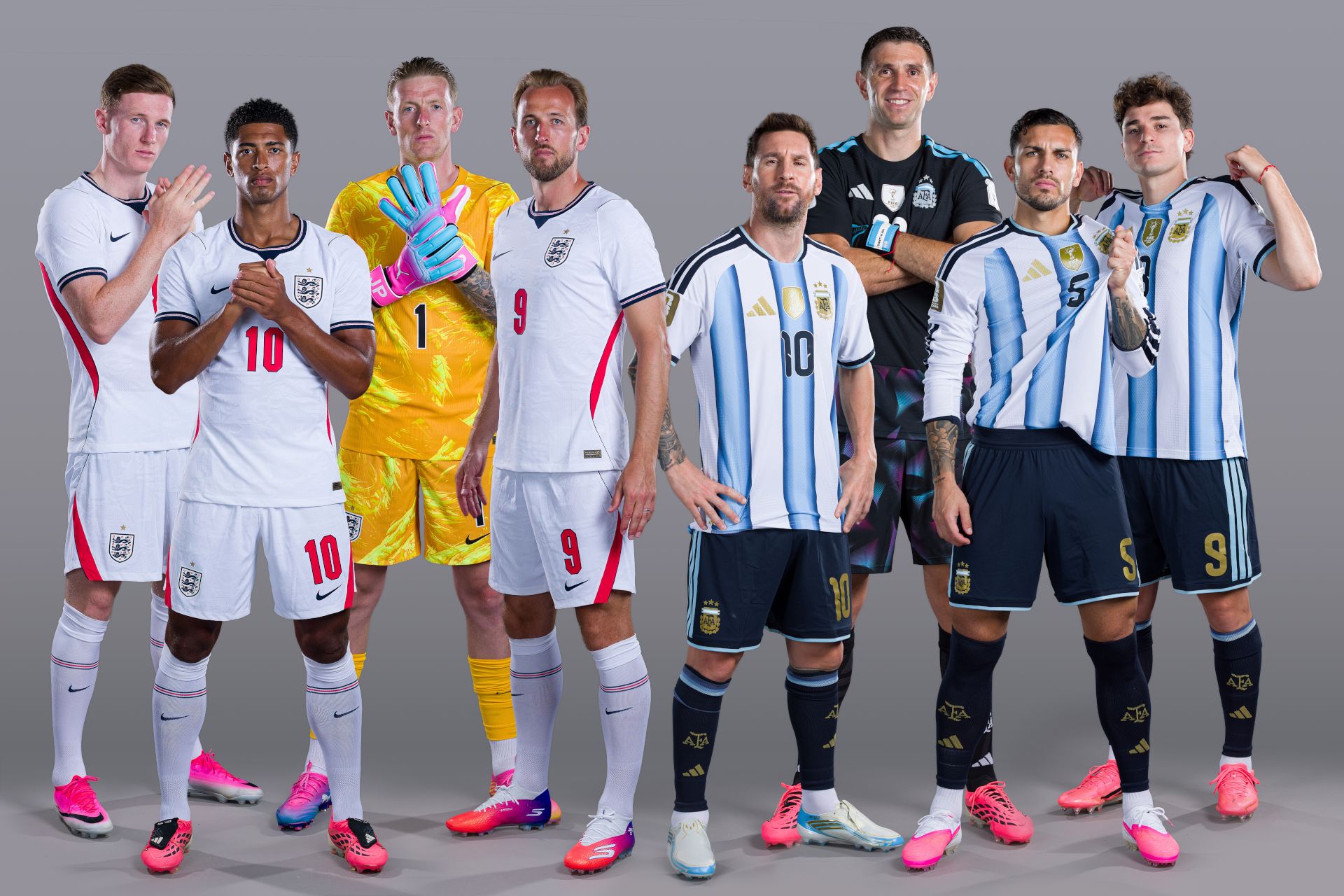
Argentina and England now play each other once again. Can anyone who sang that song four years ago believe this is just a game of soccer? This history and this memory are far too powerful for Argentine fans. So much so that the Argentine manager Lionel Scaloni himself has warned that it is exactly that: just a game. And I believe the same. Although on Tuesday the country’s vice president, Victoria Villarruel, posted on social media: “Tomorrow we play against the usurping pirates. This isn’t just another match. I’m not going to be politically correct or chicken out; against the English it’s always something more.”
But the relationship between soccer and war does not necessarily imply a xenophobic or bellicose nationalism. It can, of course, and there is no shortage of examples these days. Perhaps it has more to do with the wound that war left behind: not the defeat itself, but the grief for those young soldiers who died uselessly because of the decisions of three generals, more than 40 years ago. There is no revenge (there cannot be), but there is, perhaps, a bit of solace.
“Spotlight” is a newsletter about underreported cultural trends and news from around the world, emailed to subscribers twice a week. Sign up here.