


During the recent youth uprising in India, some profanities and slurs that most Indians would hesitate to repeat made their way into a handful of popular slogans aimed at Prime Minister Narendra Modi. They shocked not only the older generations, but also some millennials, as well as seasoned members of civil society, the independent media and leaders of progressive rights movements, accustomed to a certain decorum and seriousness in protest language.
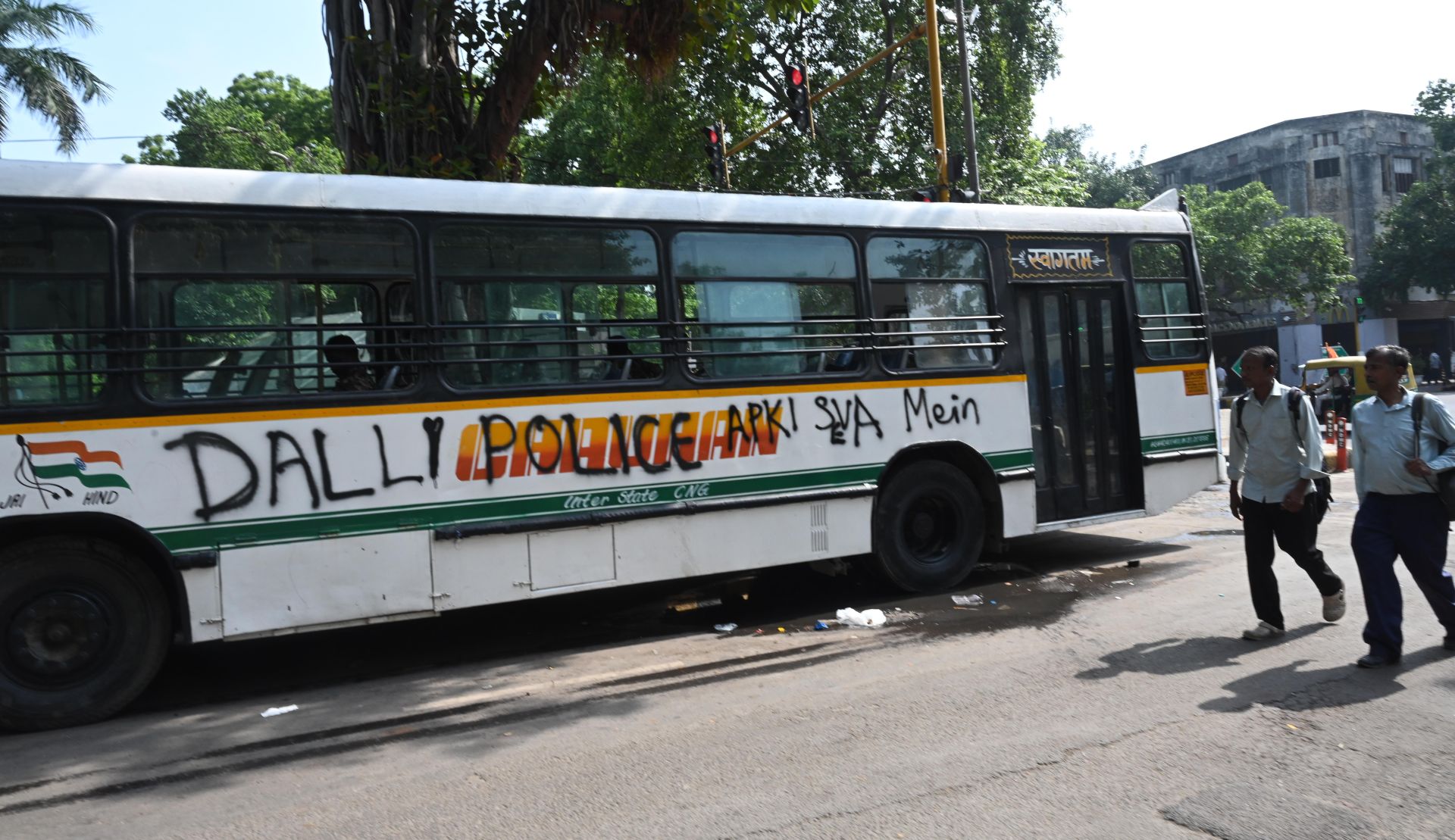
A popular slogan rhymed the Hindi word for “bitter” with the Marathi word for “pimp”: “Neem ka patta kadwa hai, Modi sala bhadwa hai” (“The neem leaf is bitter, Modi is a pimp”). In others, crude Hindi words for penis and buttocks were used. There was also some unsubtle wordplay on the English word “dictator.” Profanities appeared in graffiti on walls and police barricades around the central district of the city, especially after the police brutality that unfolded on July 20.
Some protesters also played an audio of Modi reciting a Sanskrit verse on righteousness and moral duty to poke fun at him. To them, his pronunciation of the Sanskrit phrase “lavanena bhojyam” (“food is tasty because of salt”) sounded like a crude term for a penis. A popular meme on Instagram for a couple of years, it made its way to the streets alongside many other old and new memes.
The recent protests were initiated by the satirical Cockroach Janata Party. The ruling Bharatiya Janata Party’s (BJP) social media troll networks and the mainstream Indian media that toes the government’s line have previously vilified protesters and critics of the Modi government, but failed to portray this movement as the handiwork of foreign agents, because most protesters belonged to the mainstream Hindu middle class, the BJP’s core support base.
Only after the protests ended with the resignation of Education Minister Dharmendra Pradhan, a move aimed to contain the damage to Modi’s carefully crafted image after a decade in power, did a new line of attack emerge: discrediting the movement retroactively over the profanities used against Modi in its slogans, especially by young women.
Shashi Shekhar Vempati, chairperson of the country’s Central Board of Film Certification, popularly known as the censor board, raised the issue of “mouthing of gender-demeaning profanities” in a post on X. So did Kanwal Sibal, a former diplomat, who took offence at what “young girls” were saying against Modi — language, he said, “only the most uncouth males would employ.”
Kangana Ranaut, an actor and member of Parliament, targeted “young Hindu women” for their use of curse words, dismissing them as “generation gutter.” Veteran actor Anupam Kher, who has appeared in films like “Bend It Like Beckham” and “Silver Linings Playbook,” expressed his distress at Modi being “insulted and disrespected.”
The government is leading a crackdown against the slogans, invoking online laws to get social media platforms to pull down posts and lodging police complaints against social media users in different parts of the country. Meanwhile, BJP supporters are circulating images online of people filmed hurling abuse at the prime minister, in an attempt to doxx them and expose their personal information. Yesterday, the police in Noida, a satellite city of Delhi, booked a 25-year-old woman after videos of her using profanities against Modi spread online.
As different sections of society grapple with this crudeness and the anger directed at Modi, its bluntness has created divisions, exposing generational and political fault lines over what can be said in public, and who gets to say it.
To younger people, cursing may feel authentic, even funny; to the older generation, it is riddled with shame and outrage. In between are millennials, amused by the whole cultural shift.
Earlier public profanity remained a fiefdom of men across classes and was a marker of masculinity. But now women are no longer hesitant to curse and sling slurs of their own.
The moment has also opened up a broader conversation on profanity in Indian politics, where vile abuse has been normalized and weaponized by the BJP’s online troll network for over a decade.
The recent slogans shocked even someone like Swara Bhasker, a Hindi film actor known for her socially conscious films and outspoken criticism of the Modi government. She has been on the receiving end of vile abuse as well as death and rape threats from BJP trolls since 2014.
“We’re a traditionally feudal and patriarchal society where we instinctively bestow respect on older people, and Modi is an elderly man,” Bhasker told New Lines.
“For a lot of people, Modi has been made to seem like such an invincible figure. Even if you disagree with him, there’s this idea that he must be placed on a pedestal,” she added. “But this is a generation that is much more direct. They don’t necessarily adhere to the etiquette we were taught.”
Varun Grover, a well-known Indian screenwriter, lyricist and stand-up comic, told New Lines that Gen Z is not using profanities for shock value, or even as a conscious tool of satire. “They just speak like that. And this is their first protest on the street. This is the first time they feel like there is a collective anger that they need to express, and this just comes naturally to them.”
Although some of the posters and slogans startled him, Grover recognizes that Gen Z “are not tied up in the same moral cages we grew up in.”
They are also perhaps the first generation to be in touch with their emotions, he said, so maybe that’s why they are unfiltered in the way they express themselves.
Mukul Gautam, a Delhi-based researcher and political consultant, argued that the government’s reading of the protests as simple abuse misses what’s actually happening. The Gen Z protesters, he told New Lines, are living out every part of their identity openly and authentically, and humor is central to that.
“The government sees only the crudeness, in binary terms,” he said, “without recognizing that the abuse itself is inseparable from a comic sensibility.” It wasn’t abusive for its own sake, in his view, but abuse doing double duty as a joke.
As a millennial born and raised in India, I can feel this shift myself. I see it, too, in my mother, who has taught at Delhi University for four decades and now complains about the lack of hesitation or restraint among her students.
Even though profanity and curse words have been deeply embedded in certain traditional Indian folk songs, they remain taboo, especially in middle-class and elite families, where ideals of respectability and moral rectitude shape everyday behaviour.
“India is probably the most cuss-heavy [society]. The various languages we have are extremely cuss-heavy on the streets,” Grover said. “But at home we are the most cultured, non-cuss-wordy kind of people.”
“India is a very family-oriented society, with close-knit and slightly orthodox family structures,” he added. “It is seen as some kind of big breach if you use a cuss word in a family setting, especially with your elders or even your siblings around.”
Some may call it hypocrisy, but it is how Indian society is built, he said. “The heaviest cusser on the street would be the first to frown at someone cussing in a family setting.”
Apart from religion and caste, Indian profanity leans on incest and the fact that sex in India is largely treated as an arena of male honor. One of the most popular crude terms is similar to “stick it up your ass,” though the Hindi version is much more loaded.
Other profanities reference male or female genitalia, or the buttocks. But because these terms are bound up with honor, and because sex remains a taboo subject, their use carries an outsize charge of outrage and shame, heavier than their equivalents in English typically carry.
Slurs targeting women, however, are tied to sexual reputation, including variations of “slut” or “prostitute.” Among the most ubiquitous is “randi,” which is used day in and day out by both men and women against women they disagree with online.
Clinical psychologist and content creator Divija Bhasin popularized a social media discussion on it in 2025 by adopting a hashtag to “proudly” reclaim the gendered slur. But the move led to a deeply polarizing conversation given how offensive the word remains.
Perhaps this current moment signals that a dam is finally giving way — crumbling under two forces that have steadily dragged cursing into the mainstream of Indian public life.
The first is popular culture. Streaming platforms broke the censorship regime that had kept Hindi cinema’s language sanitized for decades. Since the late 2010s, shows like “Sacred Games,” “Mirzapur” and “Pataal Lok” (“Netherworld”) have built entire reputations partly on unfiltered, expletive-heavy dialogue.
Before them there was “Gangs of Wasseypur” (2012), a two-part epic crime film that achieved cult status over the years, and songs like “Bhaag DK Bose,” used often during the recent protests.
Stand-up comedy did similar work on stage, using profanity as a deliberate marker of authenticity and rebellion against inherited decorum.
“There has been a change in the Hindi film industry in the last 15 or 20 years,” said Grover, who wrote the lyrics for “Gangs of Wasseypur” and was a writer and executive producer on “Sacred Games.” “It is this idea that we want realism in TV and cinema.”
Earlier filmmakers self-censored, but at some point a new generation of writers and directors, including Grover, decided that they would not follow suit. “Of course, the censor board will still chop some of the stuff, but we will go with what we think is the real scene on the ground.”
That shift was coupled with a more cynical use of profanity for shock value and also commercial appeal to a specific audience — men who like using curse words but are frustrated that they can’t do so publicly, in family settings.
Since then, most films — including “Dhurandhar,” the highest-grossing Hindi-language film in India — have made liberal use of such language, frustrating older generations.
“All of that is part of the mainstreaming of cussing,” Grover said.
The second force is political language itself. The BJP’s own online apparatus was built around a practice of coordinated abuse, rape threats and death threats against journalists and critics, especially women. It has spent a decade demonstrating that profanity is an effective political weapon with little institutional cost to those deploying it.
“If public discourse has become coarse, the responsibility lies with Modi and his ecosystem, and not the students,” said Bhasker, who has been receiving abuse, rape and death threats for years, along with journalists, such as Rana Ayyub and Barkha Dutt, critical of the establishment.
“We’ve been pointing out for a decade that Modi has continued to follow Twitter trolls who are notorious for abusing women and minorities.” These accounts have proudly written “Followed by Narendra Modi” in their bios and some even changed their headers to “I am a troll.” “They wore abuse as a badge of honor,” she said.
Bhasker also pointed to an incident before the 2019 general elections. After she starred in “Veere Di Wedding,” a women-centric comedy film that featured her in a masturbation scene with a reference to a vibrator, Bhasker saw ministers and BJP leaders liking posts that sexually harassed her online.
“BJP influencers repeatedly weaponized that scene with slogans like, ‘Don’t be Swara Bhasker. Use your finger wisely,’” she said.
Political commentators and journalists also point to a pattern in Modi’s own language. In 2012, he mocked Shashi Tharoor’s wife, Sunanda Pushkar, who died in 2014 — as a “girlfriend worth 500 million rupees.” He has called Sonia Gandhi a “Jersey cow,” a jab at her Italian origin, and “widow of the Congress party.” Her husband, former prime minister Rajiv Gandhi, was assassinated in 1991.
In 2023, BJP lawmaker Ramesh Bidhuri — who would later liken a Delhi road to Priyanka Gandhi’s cheeks — called his Muslim colleague a “terrorist” and a “pimp,” and used a slur meaning circumcised on the floor of the Parliament, as two former BJP ministers sitting beside him laughed.
In media interviews, young women who participated in the recent protests have described growing up hearing right-wing leaders and TV news anchors use crude and abrasive language against dissenters, opposition leaders and minorities.
“Nobody from that ecosystem is in any position to take a moral stand on abusive language,” Bhasker said. “They created this culture.”
“Spotlight” is a newsletter about underreported cultural trends and news from around the world, emailed to subscribers twice a week. Sign up here.