


The Yemeni content creator Fidaa al-Din Yahya has produced a video taking apart the Houthi movement’s argument that standing with Gaza places it beyond criticism for its conduct in Yemen, and that anyone who opposes it is on Israel’s side — a video that some viewers have called a “nuclear bomb” for Houthi messaging.
The 17-minute video, posted on Oct. 27 under the title “The People of Yemen Have Come to You,” was not just another of the critiques Fidaa has long directed at the Houthis. To some followers, it read as an attempt to dismantle a narrative years in the making by comparing the group’s words with its deeds, and by exposing a recurring pattern in which only the labels the Houthis pin on their opponents change.
The video poses this central question: Can the Houthis be right in one position and then become wrongdoers in others? Does championing a just cause entitle them to override the injustices they commit inside Yemen?
My research suggests the clip spread further than perhaps any video Fidaa has previously posted across his social media accounts. It circulated on a large scale, carried by his considerable digital following: some 1.8 million people on Instagram, 1.24 million on YouTube, 2.4 million on TikTok and 2.2 million on Facebook, plus about 224,000 on X.
On X alone, the video had passed 11 million views at the time of writing, with tens of thousands of likes and reposts. Nor was its reach confined to the platforms where Fidaa posted it. It was shared and reposted widely on WhatsApp and Telegram; his name dominated discussion on X and Facebook; and users translated the clip into several languages, including English, French and Spanish, bringing it to a much wider audience.
Fidaa’s fame did not come from nowhere. His way of presenting information and popularizing educational, moral and religious subjects has won him a wide audience, especially among young people. Alongside his digital activity, he has an academic background in control and automation engineering and holds a master’s degree from the Technical University of Kaiserslautern in Germany.
His criticism of the Houthis carries added weight because of his popularity across the Arab world, which his support for Gaza has strengthened. Gaza is the cause that most shaped the Houthis’ image in the region, and it is hard for them to question his position on Palestine or accuse him of siding with Israel.
At home, Fidaa’s message touches one of the pillars of Houthi mobilization, particularly in Amran governorate, where he was born. He questions the mobilizing slogans that brand the group’s opponents as “Zionized,” “hypocrites” or “agents,” which raises the possibility that his criticism could resonate in the tribal milieu the Houthis rely on for mobilization and recruitment.
The widely praised video also looks like a response to criticism from Fidaa’s followers, in Yemen and beyond, of his silence over the Houthi assault on the city of Taiz, and the siege of its residents on all sides. They contrasted that silence with how vocal he had been during the Gaza war, especially as comparisons between the plight of residents in the two places spread.
Before the new video, Fidaa’s engagement with events in Taiz had been limited to two posts, the first in early October and the second on Oct. 22. Five days after the second clip, he returned with a video far longer than usual, dissecting Houthi rhetoric from the group’s beginnings in Saada through its seizure of the capital, Sanaa, to its role abroad.
The video opens with security camera footage of a man giving money to a woman in need outside a mosque, then coming back to steal a motorcycle. From this scene, Fidaa asks: Can charity erase theft? Is a good deed enough to justify a wrong?
With this opening, he lays the groundwork for the idea he wants to discuss. He refuses to let a position grant its holder immunity from criticism, or license the wrongs and abuses committed inside their own country.
He then turns to acknowledging the Houthis’ support for Gaza, a stance that would draw criticism from some commentators. But his starting point is fairness to those he disagrees with, grounded in a religious principle that condemns denying what is right out of enmity.
Some commentators described this as a shrewd move to deny the Houthis an easy line of attack, especially since the group has long invoked its stance on Gaza to defend itself against critics.
But Fidaa soon returns to the questions aimed at the heart of this narrative. Does supporting Gaza, or any just cause, grant its champion an indulgence? Can that support become a pretext for overlooking other injustices?
Here he raises the dramatic tension a notch, as though confronting some of the Houthis’ Arab supporters over the group’s stance on Gaza. He reminds them of the non-Muslims who stood with Gaza and puts them to a practical test: Would you stand with them on other causes you don’t believe in?
He arrives at the line that has since circulated widely on social media: “However much you stand with me in what is right, I will not stand with you in what is wrong.”
Watching the video, one feels that Fidaa is speaking from a stage to a pro-Houthi audience, putting to them the question that may be on their minds: Are the Houthis really in the wrong, or is this just political rivalry and media campaigning?
Once again, Fidaa is setting the stage for another level of argument. He recalls statements by Houthi leaders and sets them against what happened on the ground, laying bare what he sees as a recurring pattern of contradiction between rhetoric and practice.
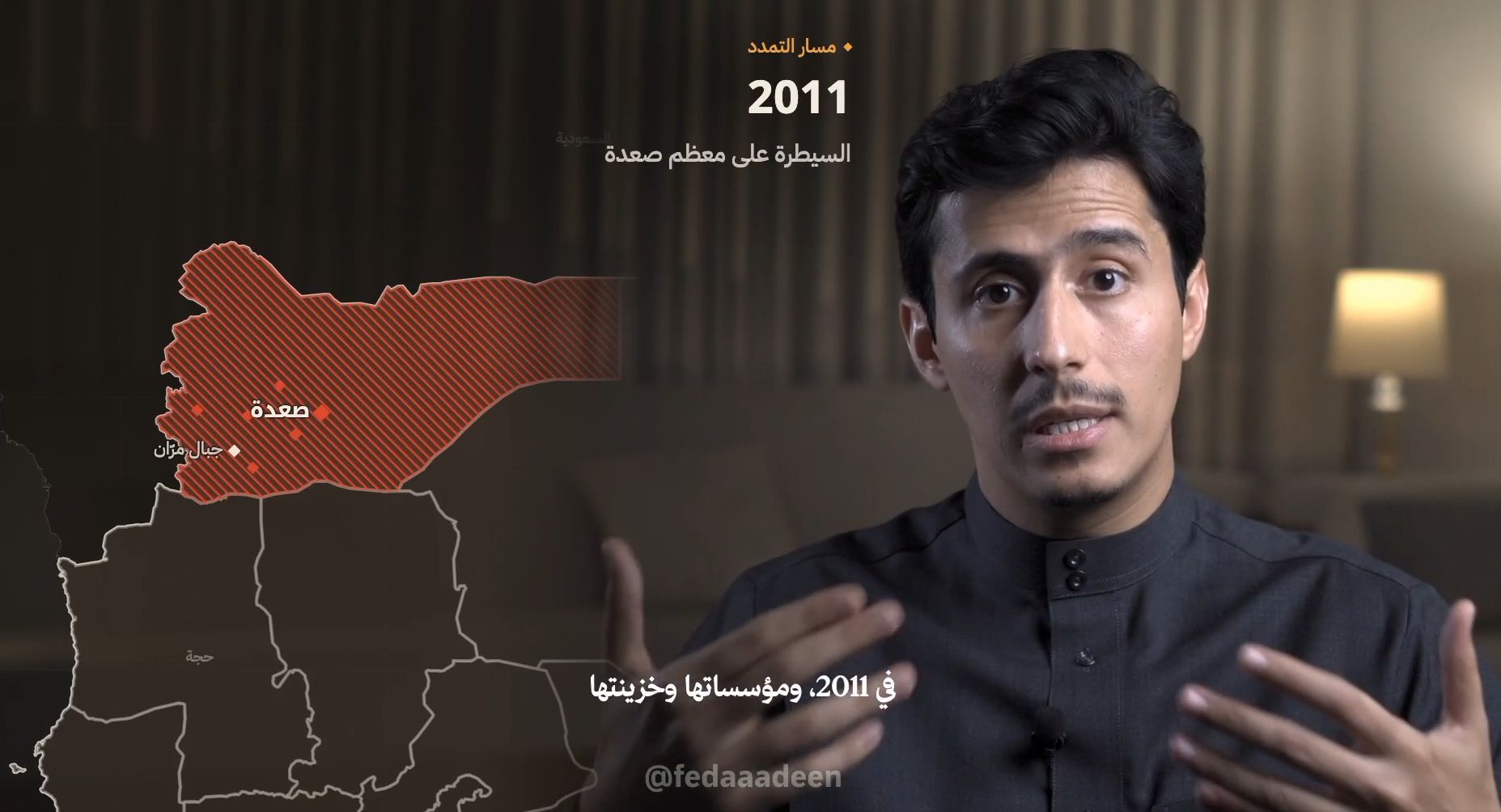
In this section, the video is closer to a documentary charting the Houthis’ political and military path over more than 15 years. They began as a group with limited influence in Saada governorate, then exploited the political turmoil that followed the 2011 protests against the former president, Ali Abdullah Saleh, and the collapse of state institutions and weakening of central authority that came with it.
Fidaa traces the Houthis’ expansion within Saada as far as Dammaj, home to the Salafist-affiliated Dar al-Hadith center, and their wish to take control of it and expel those living there. When the Salafists refused, clashes and a siege followed, ending in their displacement.
He then recalls the rhetoric the Houthis used to justify their moves, playing a statement by Mohammed al-Houthi, the group leader’s brother, in which he spoke of expelling those he called hypocrites.
Fidaa pauses briefly to ask the short question that recurs throughout his step-by-step dismantling of their narrative: Did the Houthis stop there?
After Dammaj, the video moves to Amran governorate, Fidaa’s birthplace, into which the Houthis expanded under the banner of fighting corruption. He plays a statement by the senior Houthi leader Abu Ali al-Hakim, who said their presence in the governorate was civilian and that talk of other intentions was baseless.
But Fidaa sets those reassurances against what came next. The Houthis seized the city, captured the commander of the brigade stationed there and killed him along with his guards, displaced some residents and blew up homes, among them the Abu Bakr al-Siddiq House for Quranic Education.
Here he judges the group by the name it gives its political rise, the “Quranic March.” How does blowing up a Quran school square with a project that claims to defend the Quran and its teachings?
Fidaa then moves on to the Houthis’ entry into Sanaa under a new pretext: bringing down a government they called corrupt and rejecting fuel price hikes. He plays excerpts from speeches by Abdul-Malik al-Houthi, who gave assurances that the group had no intention of taking Sanaa or joining the government, and urged Yemenis to “give us a try.”
Comparing statements with conduct, Fidaa points to the vast gap between the two. The Houthis did the opposite of what they had promised, seizing the capital and its state institutions, then pushing south and into other governorates, including Aden.
At every stage, the Houthis use the same method and repeat the same reassurances; only the epithets for their opponents change. When the Saudi-led Arab coalition intervened in 2015 at the request of Yemen’s then-President Abd Rabbuh Mansur Hadi, they cast themselves as defenders of Yemen against foreign intervention and called their opponents mercenaries and agents.
When the U.S.-led international coalition began its war on the Islamic State group, they took up the slogan of fighting terrorism and branded their opponents members of the group.
After the Oct. 7 attack and the war in Gaza, they adopted the language of confronting Israel and began calling their opponents “Zionists” and “Zionized.”
Fidaa argues that this pattern of accusation has spread to villages and cities across Yemen, so that anyone who refuses to submit to the Houthis risks being branded a Zionist, even if they have taken no position on the war in Gaza.
He then anticipates a question a Houthi supporter might ask: Didn’t these events happen nearly a decade ago? Might the group not have changed since? He answers with a recent case from July 2025, when Sheikh Saleh Hantous, a Quran teacher in his 70s, was killed in his home in Raymah governorate. Fidaa’s video shows a statement by the Houthi leader Nasruddin Amer, accusing Hantous of taking a negative stance toward what the group had done for Gaza, presenting the killing as evidence that the same rhetoric is still turned against opponents.
The pattern has repeated itself in Taiz, where the Houthis are besieging a city of 2 million people and have attacked it daily since October. Their pretext, Fidaa says, is no different from their general rhetoric, and he cites the Houthi official Mohammed al-Bukhaiti speaking of “purging the land of mercenaries and Saudi mobilizations.”
From there, Fidaa addresses the Houthis’ supporters among Palestinians and Arabs more broadly, especially those who have called for reconciliation and an end to bloodshed since the current military escalation began. Calling for peace, he says, is a commendable stance. But he asks in turn how one should deal with repeated aggression, citing Quranic verses that command reconciliation and also command confronting the aggressor.
He comes back to them with a challenge: Are you prepared to fight the party that transgresses, if it transgresses, or does your call for peace become a way of escaping the duty to confront it? He then lists examples of the Houthis exploiting past truces to consolidate their gains, asking how such precedents and patterns can be ignored in favor of a peace that, in his view, would only empower the group and entrench its control.
Fidaa does not stop at the Houthis’ words and actions. He goes on to dismantle their political and ideological project, citing remarks by the group’s founder, Hussein al-Houthi, that confine responsibility for leading the Muslim nation and the faith, guiding people to the truth and establishing justice to those he calls the “House of Muhammad,” to which he claims to belong.
At this point, Fidaa links what he sees as a project built on discrimination by lineage to the group’s hostility toward some of the Prophet’s companions, among them the Caliph Umar ibn al-Khattab, whom Hussein al-Houthi blames for what he calls the decline of the Islamic community and the calamities it has suffered.
From there, he turns to Yemenis who support the Houthis and puts to them questions about the nature of the war they are fighting and whom they are fighting for: “Whom are you fighting? And for whom?” He reminds them that the people they aim their guns at are Muslims like them, fighting to defend themselves against aggression.
In the same vein, he picks apart the Houthi rhetoric that rallies fighters under the banners of confronting “hypocrites,” “Zionists” and “agents,” then asks these supporters directly: Have you actually found the people the Houthis say you are fighting, or are you facing Muslims like yourselves?
In this way, Fidaa tries to move the debate from the question of who stood with Gaza to a broader one: What has this party done in its own country, how has it treated those who disagree with it, and do its practices match the slogans it raises?
Yet Fidaa does not ignore the responsibility of the other side in Yemen. There is no need, he says, to dwell on the corruption and failures of the internationally recognized government, since these are well known, and those failures contributed to the loss of Taiz and the abandonment of other fronts. But in his view, the government’s failure does not justify what he calls the forsaking of Taiz’s people and of everyone facing Houthi attacks, who deserve support.
With this argument, Fidaa has reopened debate on social media among Yemenis of every persuasion, and the video continues to draw wide engagement.
Reactions to the video varied. Yemenis opposed to the Houthis saw it as shoring up the resolve of Taiz’s people and countering the narrative the Houthis are trying to entrench about their stance on Gaza, which they use to justify their military operations. Some also saw it as exactly the role an influencer of Fidaa’s stature should play for his compatriots in these circumstances, especially amid the siege of Taiz.
For them, the video became ammunition against the Houthis. They reposted and shared it and weighed in on the accounts of the group and its supporters, drawing on the statements by Houthi leaders themselves that Fidaa had presented.
The general Houthi response, by contrast, was one of denial and confusion, even though Fidaa had refuted their narrative not with political argument but with their own leaders’ statements, set against what happened on the ground. The response can be broken down into three main elements.
First, the group denied Fidaa’s arguments, whether about the goals the Houthis proclaimed at each stage, the slogans they used or the labels they applied to their opponents.
The replies focused on disputing that there was any gap between the leaders’ statements and the group’s actions, and on claiming that Fidaa had presented statements without their broader context.
Nasruddin Amer, deputy head of the Houthis’ media authority, said these allegations had already been answered over 12 years and were untrue, citing what he described as the Yemeni people’s refusal to believe them.
But his reply did not address Fidaa’s comparison between statements and conduct, or how he used those statements to dismantle the group’s narrative. Instead, it cast doubt on everything he presented wholesale.
Second, the Houthi response shifts the debate from the video’s content to its maker’s political identity, by labeling Fidaa as aligned with the Islah party, which is part of the anti-Houthi coalition, or more directly with the Muslim Brotherhood. This tactic took the form of videos posted by some Houthi-affiliated figures, along with photos circulating of Fidaa with people said to include Islah affiliates. It was not possible to verify the photos.
This line seems aimed largely at Gulf — and specifically Saudi — public opinion. It plays on fears associated with the Muslim Brotherhood and tries to curb the video’s circulation, or cast doubt on its content, by raising its maker’s political affiliation.
Third, the Houthis recirculated statements by Palestinian figures linked to Hamas, among them the former head of the group’s political bureau, Ismail Haniyeh, and the former spokesperson for its armed wing, Abu Obeida. Both had praised the Houthis in past statements and called them “brothers in truth.”
Some of the group’s supporters use these statements as evidence of the legitimacy they believe the Houthis earned through their stance on Gaza, holding up the praise of Palestinian figures as testimony that they are in the right.
Beyond this aim, the Houthis are seeking to preserve the stature they have gained in Arab and Muslim public opinion through their declared stance on Gaza. This matters all the more as criticism of their conduct in Taiz mounts, prompting religious scholars and bodies across the Arab and Muslim world, as well as public figures in several Arab countries, to take positions against the group.
Among Arab audiences, comments and posts about the video showed Palestinians backing Fidaa’s argument. Some Palestinians said the video had led them to see the Houthis in a different light and revealed aspects of the group’s behavior that had been missing from their earlier assessment, helped by an engaging style and direct arguments grounded in Houthi leaders’ own statements.
Objections did come from another quarter, though they appeared less prominent than the support. They centered on how Fidaa used his opening example. One commenter asked why he had chosen to liken Gaza to a woman begging outside a mosque. Another called the comparison inappropriate, arguing that Gaza, which fought for its dignity and held out against a vast military arsenal, cannot be portrayed as a beggar pleading for pity and charity.
Another commenter expressed displeasure with the video, asking what the Palestinians had done to have their cause treated this way, before voicing weariness at seeing the Palestinian cause used in political disputes and asking that it be left out of them.
Of all Arab audiences, Saudis were among the most engaged with the video and supportive of it, especially with the kingdom facing Houthi attacks. Many saw the video as a direct rebuttal of the group’s rhetoric, exposing its contradictions through its own leaders’ statements.
Some called it a “nuclear bomb” dropped on the Houthis, while one said Fidaa had stayed silent for a long time before speaking out in a way that brought the group’s narrative down.
Most Saudi reactions praised the video’s content and style, and shared it widely as showing the Houthis in a different light from the one they try to entrench through their stance on Gaza.
How widely the video was shared varied across Saudi currents. Some in religious circles, particularly Salafists, along with conservative elites and proponents of nationalist discourse, showed more interest in sharing and engaging with it than some associated with secular and liberal currents, who did not engage with it to the same degree.
Yet there were still objections, centered on two main points. First, some objected to Fidaa’s acknowledgment that the Houthis had stood with Gaza. In their view, what the group did was not genuine support for the Palestinian cause but a politicized use of it to make regional gains and extend its reach.
Second, some criticized the video for not mentioning Saudi Arabia’s role in supporting Yemen and what the kingdom has provided over the years, which they saw as disregarding Saudi efforts, or even as ingratitude.
Others asked why the video did not address Houthi attacks on Saudi Arabia, especially the accusations that the group had fired missiles or drones toward Mecca and Medina.
Kassab al-Otaibi, a former Saudi dissident, said that in a matter of minutes Fidaa had blown apart the Houthis’ lies, laid bare what he called their hypocrisy and crimes, and exposed with evidence their vilification of Abu Bakr and Umar, the two former Muslim caliphs.
Ali al-Qarni, a cleric, said Fidaa had gone beyond analysis to raise awareness, setting out the Houthis’ creed, ideas and contradictions in clear, simple language, with arguments that could reach every kind of audience.
In the end, the video raises a question that goes beyond the Houthis: Does championing a just cause shield a party from having to answer for its conduct elsewhere? Or should it still be judged by what it does in its own society and how it treats those who disagree with it?
“Spotlight” is a newsletter about underreported cultural trends and news from around the world, emailed to subscribers twice a week. Sign up here.