


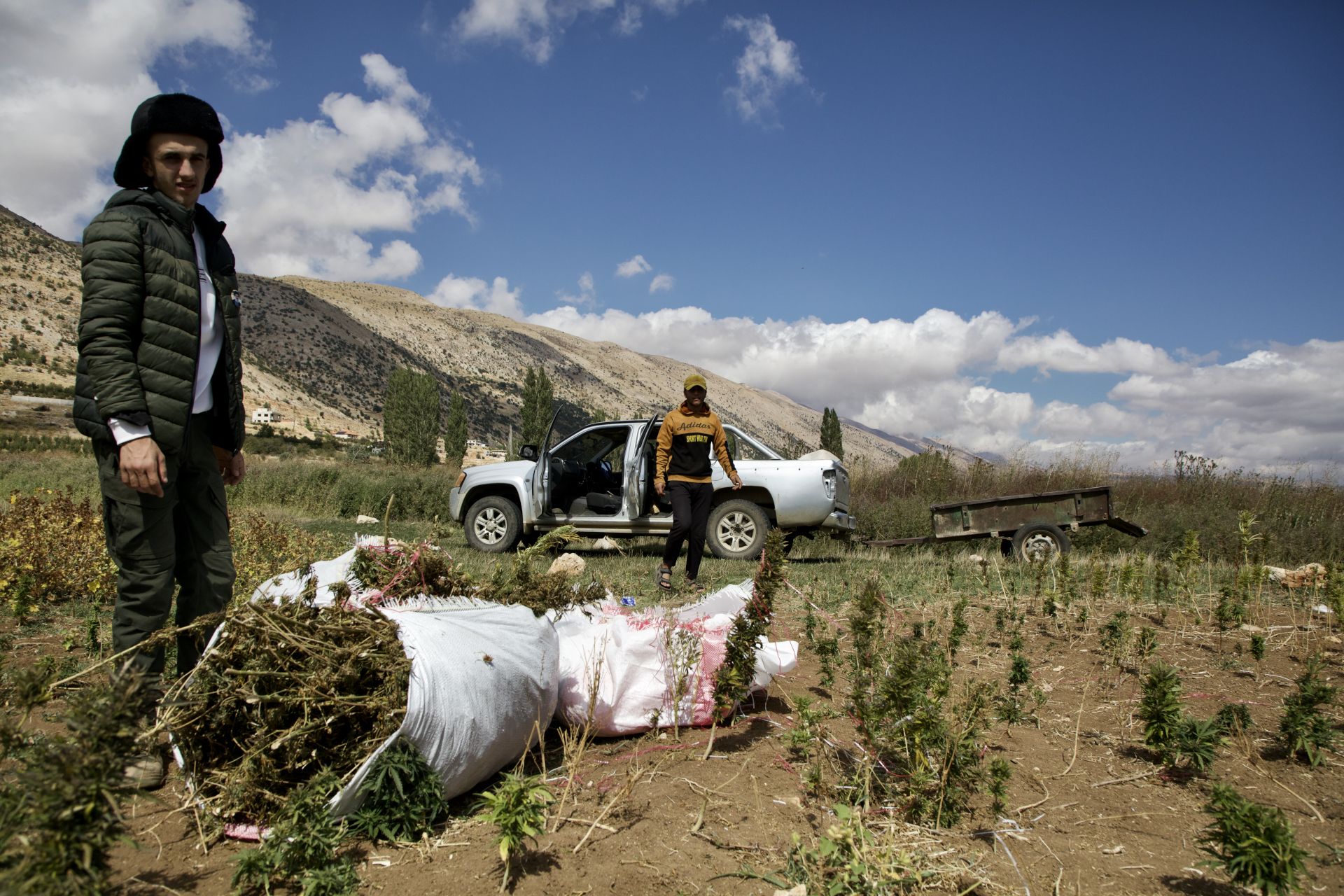
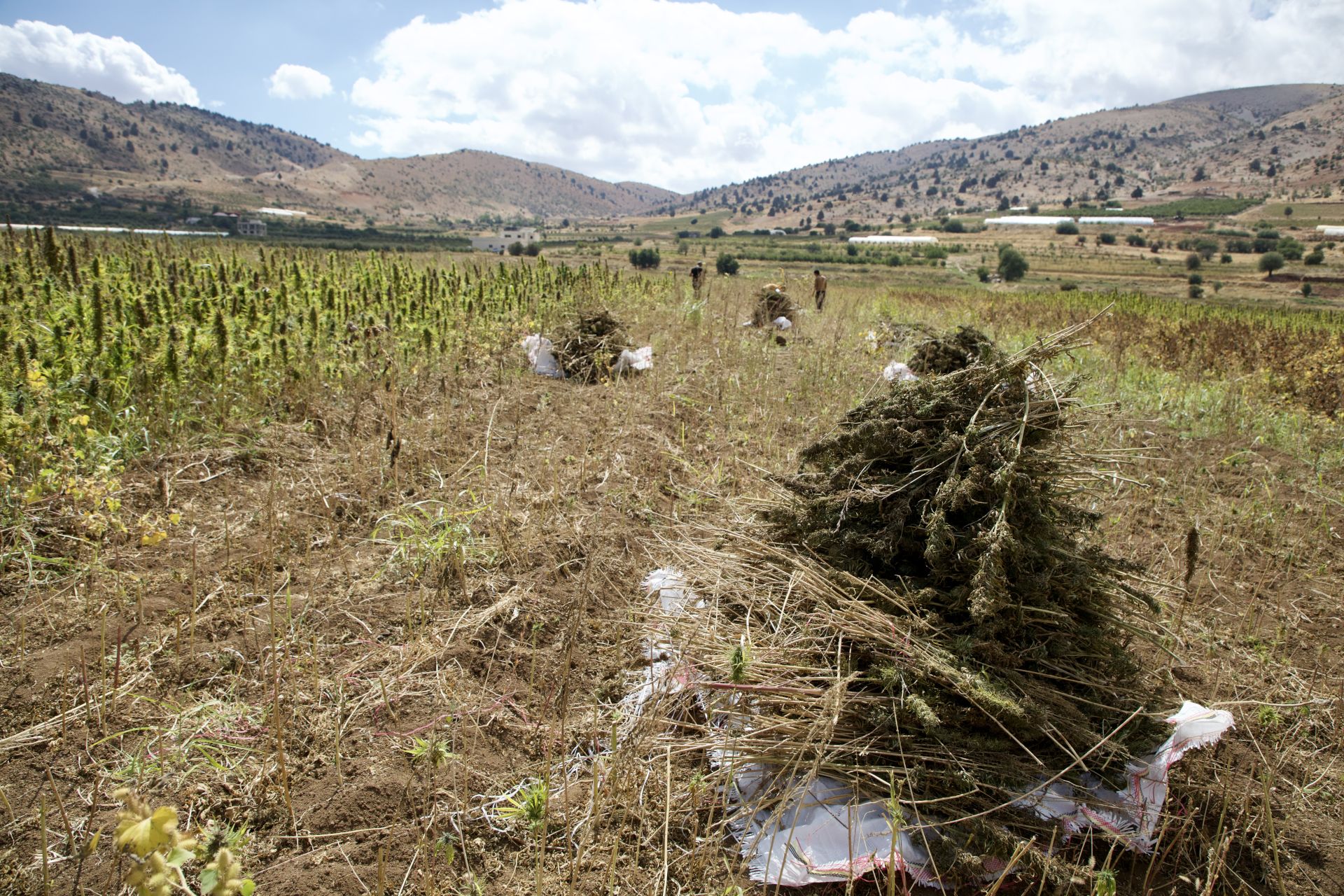
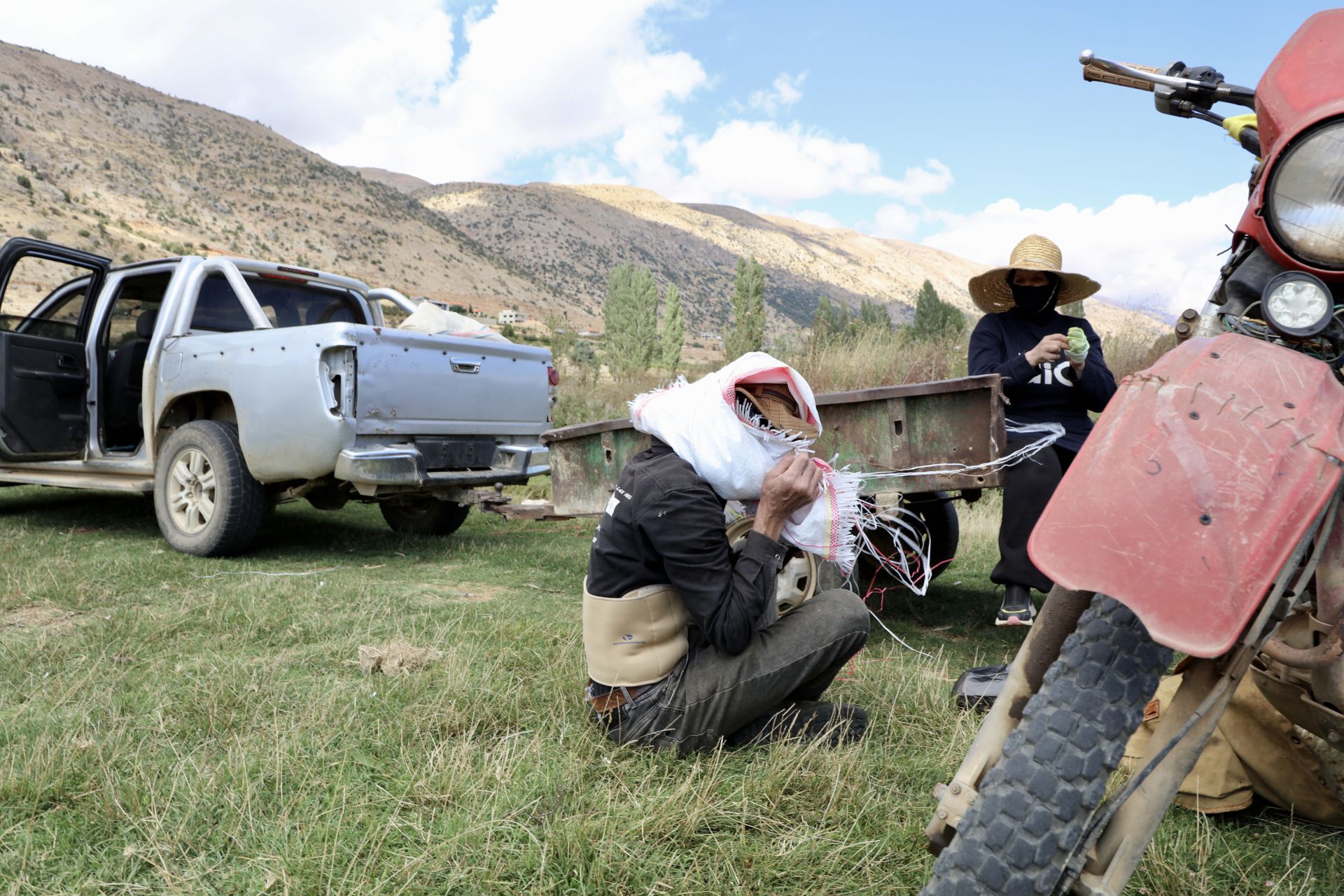
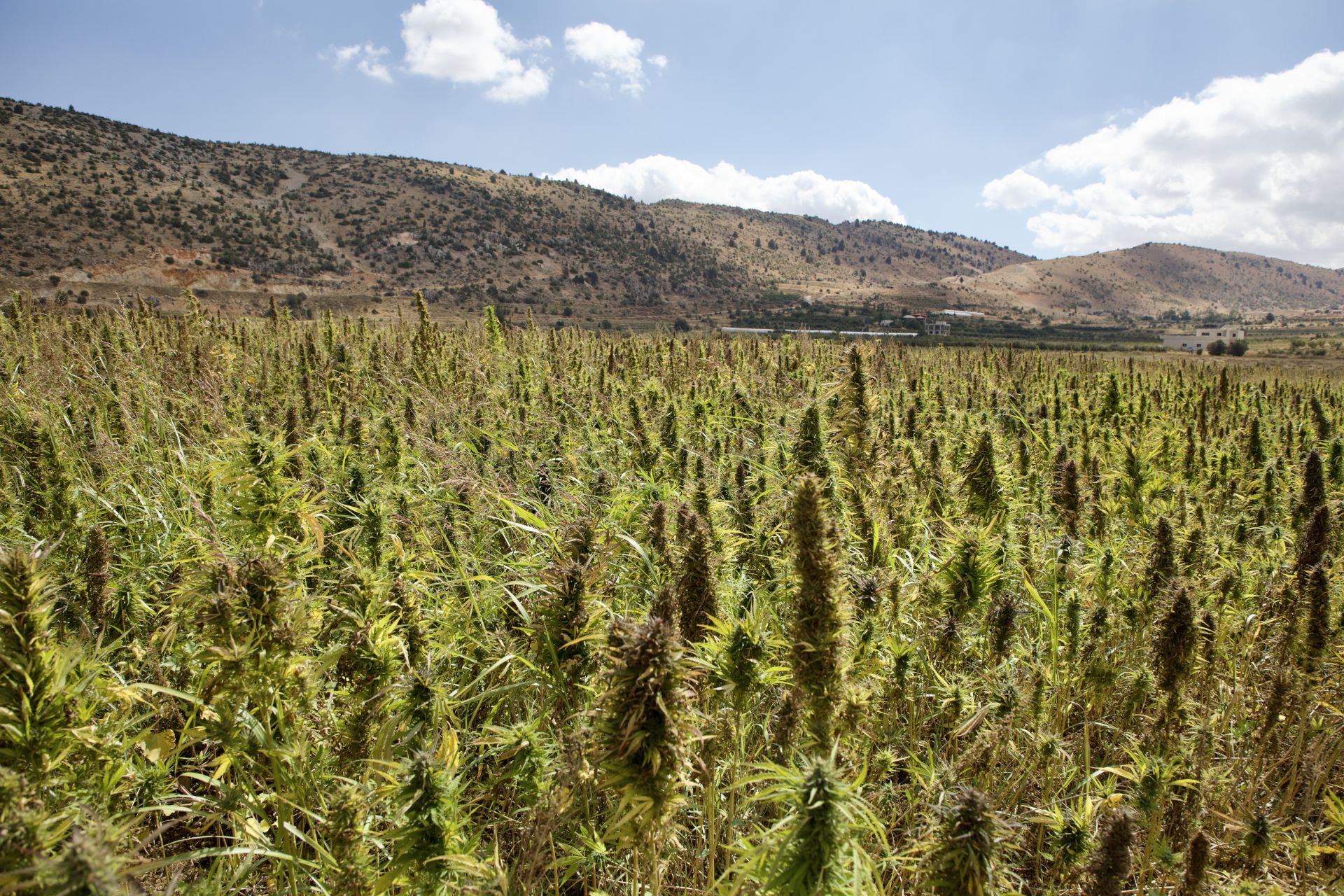

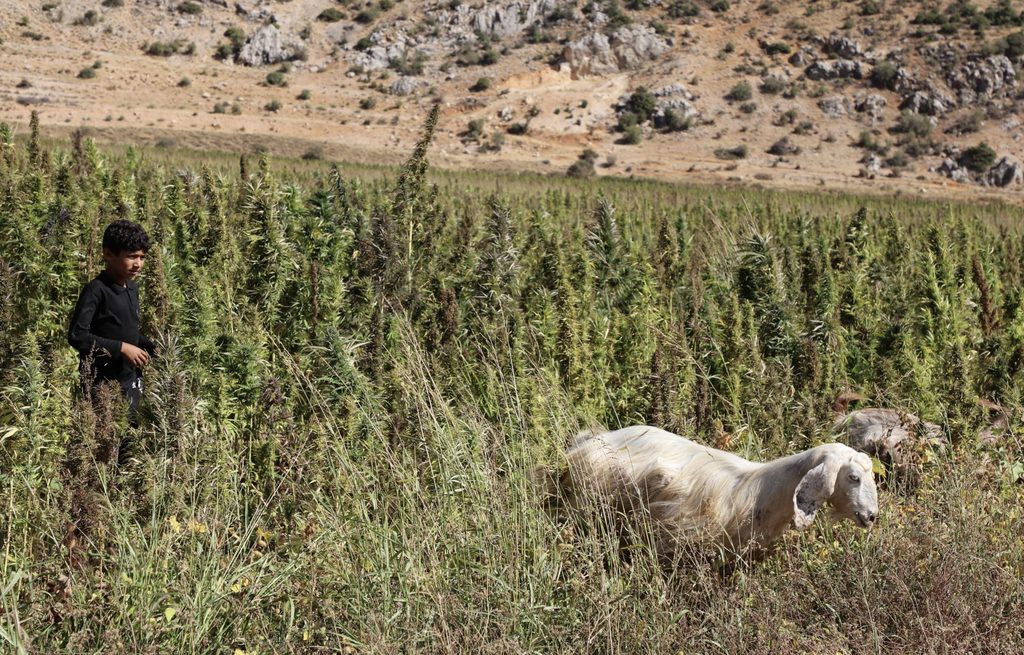
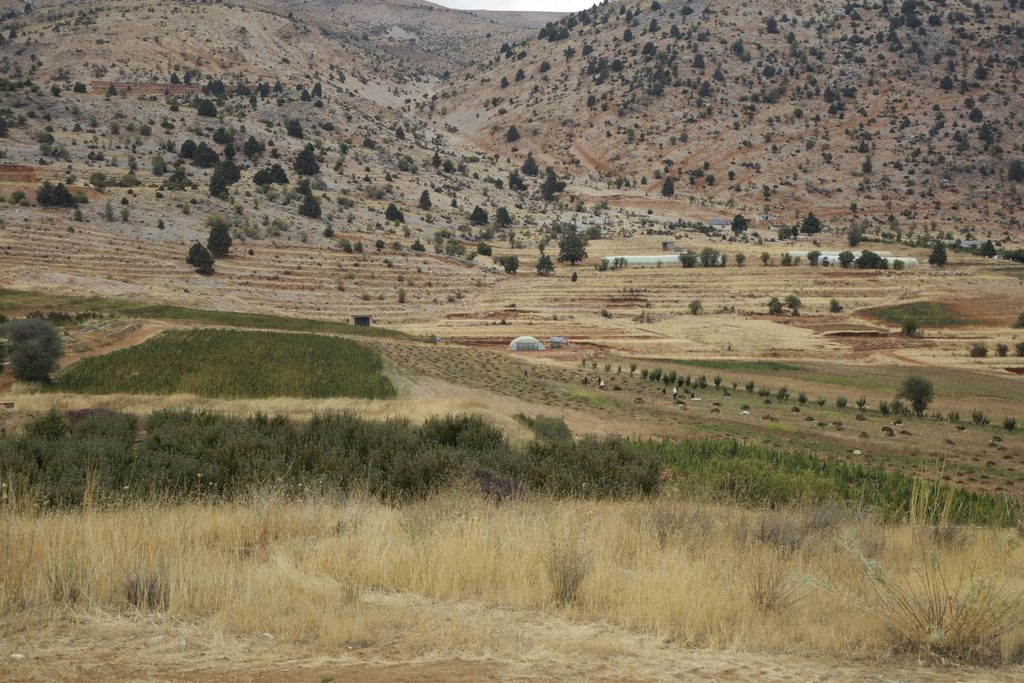
We cross the valley, and the mountain pass reaches a plateau. We find ourselves in a field that stretches from one horizon to another, surrounded by mountains. In the middle, the houses of Yammouneh huddle as if looking for shelter from the already freezing wind of late September. It is a harsh environment that contrasts with the flourishing, ripe green fields that spread out before us.
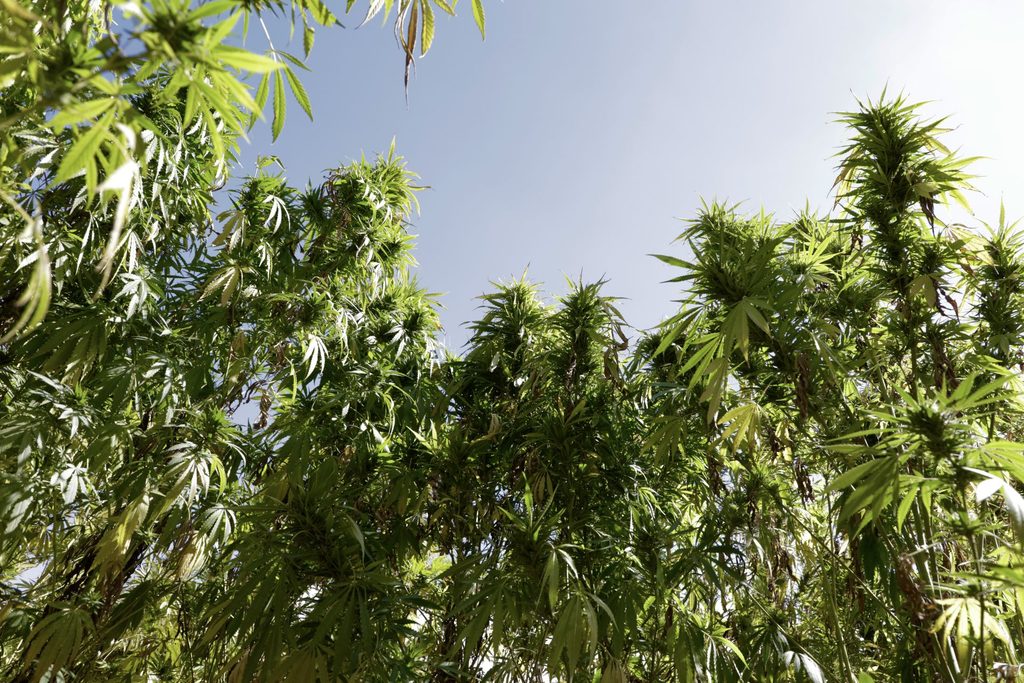
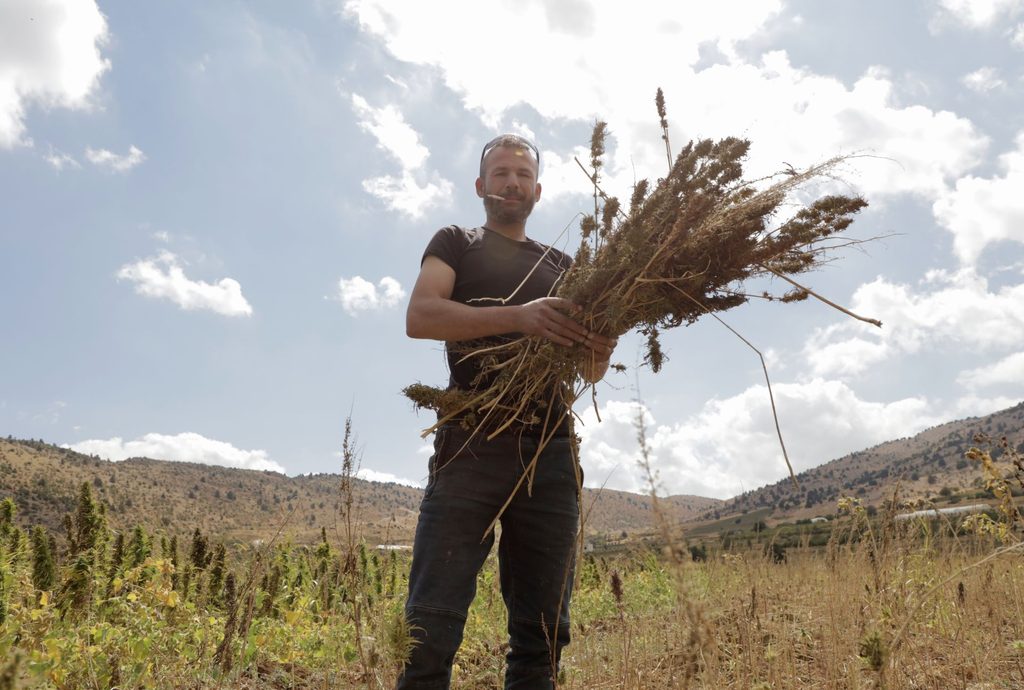
“They are the same, apples and hashish,” Ahmad tells us, as we move through the apple orchard toward the cannabis field — his land, inherited from his father, who inherited it from his grandfather.
The same, yet six years after Lebanon legalized cannabis cultivation, Ahmad is still growing outside the law.
In 2020, the Lebanese parliament passed a law legalizing the cultivation, processing and trade of cannabis, albeit strictly for medical, pharmaceutical and industrial purposes, under regulation by the state. It did not legalize recreational cannabis, the most common and sought-after form in Lebanon.
The farmers have continued cultivating outside the legal system into 2026, because the legal framework was still absent and they felt unable to wait for the law to catch up with the reality of their lives.
In the meantime, the region remains largely outside of state control, its cannabis farmers living in a twilight legal zone as outlaws, and as time goes on they increasingly find themselves having to compete or ally with bigger drug dealers who traffic in more profitable drugs.
Like the land and dirt under our feet, Ahmad learned the cultivation of cannabis from his father. He also inherited the apple trees planted by his grandfather. He says this year he needs to cut some of them; they are no longer profitable, and he wants more space for the new greenhouses of marijuana — a complement to hashish, but not an alternative, he says.
On July 17, 2025, the Regulatory Authority for the Cultivation of Cannabis was formed, with a president and board appointed by the Lebanese Cabinet. At the time of writing, even though the licensing platform has been built, it cannot be activated because the regulations and decrees necessary for implementation are still absent.
Important questions still exist about how licensing will work: Who will benefit from the licenses? Will all farmers, big and small, be able to obtain them and competitively enter the market? Will it be profitable for the growers or just for the large industries and politically connected investors?
Ahmad is not sure and is not interested. He says that they have already tried the government route, in reference to the repeated failed attempts at legalization and crop substitution by the state.
The farmers of the region have never waited for the state, but rather take matters into their own hands and create their own solutions.
In 2012, the clans of the Bekaa Valley joined together and confronted the Lebanese army in an attempt to stop the destruction of cannabis fields. Ali Nasri Shamas, one of the major figures in the drug trade at the time, appeared on national television wearing a military vest, a Kalashnikov slung over his shoulder, and declared, “We will not allow [the Lebanese army] to destroy our livelihoods without offering an alternative.”
One key challenge farmers in the area face is the land itself: the hostile, harsh mountains. Temperatures can fall below freezing, with over 6 feet of snow in some winters, while summer temperatures can reach 95 degrees in the arid, dry summer. At these high altitudes (4,900-5,900 feet above sea level), the growing seasons are short, frost and aridity threaten every crop, and the high cost of irrigation and the poor profitability make alternative ways of farming difficult to justify.
Abu Muhammad, a 60-year-old farmer, does not limit himself to cannabis. He has to diversify his crops as much as his land allows to counterbalance the low yield. He keeps many of the vegetables he grows for his family’s requirements and sells the rest (usually around 1 ton of potatoes each season). Two of his workers are Syrian: Mohammad, 18, whose family fled Raqqa during the war, and Ali, 41, an Alawite who came to Yammouneh fearing for his future under the new Syrian government.
Abu Muhammad’s reliance on Syrian workers points to another side effect of the changes to the drug market in the village and the region surrounding it — part of a broader panoply of economic and social relations that are being reshaped because of the drug trade.
Syrian labor has been used in the Bekaa since the 1980s, but it was limited to seasonal work during harvests when family members alone could not finish the job in time. After the start of the Syrian war, many Syrians, like Mohammad and his family, stayed in Lebanon. During the winter, they relied on odd jobs and construction work for income, while in the spring and summer they returned to farming. And so cannabis (and farming in general) became central to the labor relations between the Syrian and Lebanese communities.
From above, the turquoise lake is striking, feeding the hundreds of acres of cultivated land below, most of it turned over to cannabis cultivation. As we descend the hill and reach Yammouneh, the atmosphere becomes calm, completely removed from the noise and bustle of Beirut, making the absence of state power almost tangible. But that does not mean there is no order or security.
The inhabitants of the village belong to a single family. The Shreif family has around 10,000 members spread across Lebanon and different parts of the world (including the co-author of this piece). Many leave for the winter and come home in summer. Around 500 members of the family live permanently in the village itself.
Yammouneh has a mosque, a church, a secondary school and a primary school. It is made up of a collection of century-old houses that stand in contrast with the new houses being built around them, some of them luxury mansions intended for a single family with only a few children.
Groundwater is accessible, but not without effort: Reaching it requires deep wells and a constant flow of energy. With rising fuel prices and a lack of government electricity, growers have moved to solar energy to power their water pumps. Solar is a one-time expenditure with a low maintenance fee (a change of batteries when the cells fail, and, in rare cases, panel replacements); it is independent, free and constant.
Most importantly, it is scalable. Each person can adapt it to their needs and financial means and buy what they can afford. The larger farmers have entire solar farms with up to 100 solar panels; any excess energy is often shared with the neighboring fields.
Many farmers in the region are increasingly choosing to grow more profitable drugs, yet the practicalities of the Bekaa mean they still prefer cannabis, due to the low-risk and low-cost nature of the plant. It does not need as much water as vegetables and potatoes, and because it is planted in mid- to late March and harvested in late September, it is not exposed to the cold and frost that can and often do kill entire crops.
Ahmad’s new parallel crop is an imported, high-THC cannabis cultivar grown for its flowers and buds that locals refer to as marijuana to distinguish it from the local cannabis plant that is primarily used and processed for its hashish (resin). More and more of the younger farmers are switching to it, or simply adding it to their usual crop, because it is much more profitable on the local Lebanese market. One kilogram (2.2 pounds) of marijuana could fetch up to $1,500, while hashish prices have gone down to almost $350 per kilo.
Both remain illegal, but one is a more attractive proposition.
And beyond these variants, some growers in the region have gone farther still.
Lebanon has historically ranked among the world’s major sources of hashish; United Nations data from the previous decade placed it behind only Morocco and Afghanistan. Declining hashish prices in the region, the government’s halting efforts at legalization and recent geopolitical turmoil have pushed large-scale traffickers into more profitable hard drugs. The most popular of these in the region is Captagon, the common name for a powerful drug in the form of pills; modern tablets are usually a type of amphetamine mixed with other substances. It played a major role during the Syrian war of 2011-2024, fueling both Bashar al-Assad’s war machine and opposition factions. Nicknamed “chemical courage,” it kept soldiers and militia members awake for long periods of time on the front lines.
Ahmad speaks of the “ravages of capitalism” beginning to infest this small community. New mansions that have arisen in the town belong to owners who have abandoned cannabis and the traditional hashish business in favor of trafficking cocaine (imported raw from Latin America) and Captagon. Some of these groups prey on the Shreif family’s hashish-linked trade.
Illegality strengthens these cartels and their associates and intermediaries: The farmer, afraid and excluded from state institutions, has no other option but to resort to the illicit buyers, selling them his crops and avoiding the risks involved in moving the product beyond the small realm of the village. Once in the hands of the smugglers and traffickers, the product can reach the more profitable European and Gulf markets, where the value increases substantially the further one goes down the trafficking chain.
Majd is the son of Abu Majd. He is 23 years old and is about to take over the 49 acres owned by his father, who has worked in the hashish business for more than 40 years. It is a business that has passed from one generation of the family to the next. The family does not consider itself to be part of the drug trade — they see themselves simply as farmers.
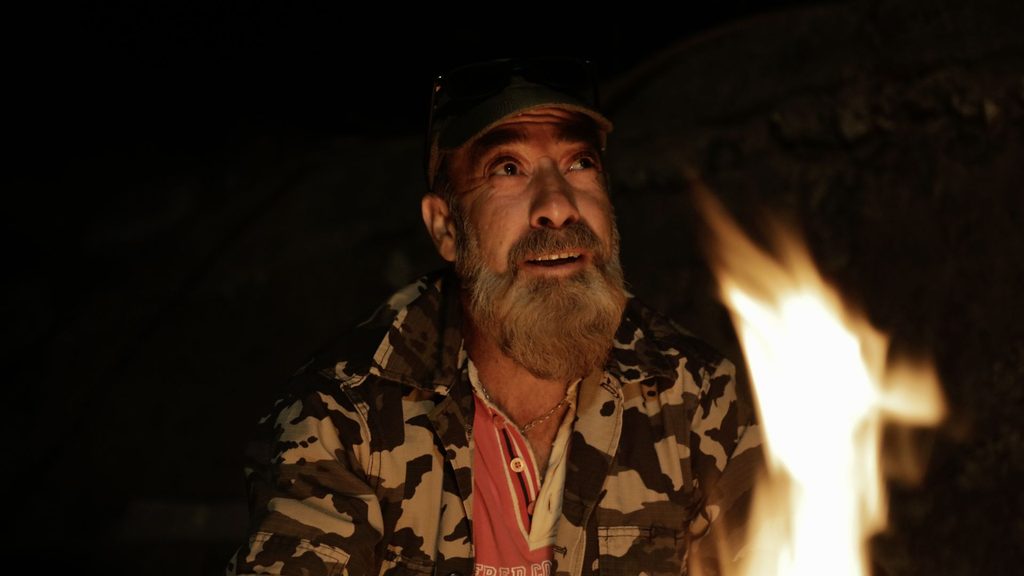
“If things continue like this, I don’t think I’ll be able to stay in the business,” Abu Majd says, sitting in the dining room of their house, surrounded by old farming tools. “But I’m not going to become a cocaine or Captagon trafficker either. Those products harm the people who use them, and I don’t want to be part of that. I would rather open a small shop and sell coffee, or live only from my sheep. Those of us who work with hashish are not mafiosi or drug dealers. We are simply farmers.”
As his son Majd nods beside him, he continues: “Today, it is very difficult to trust the buyer, because sometimes they want to pay later, and that means they don’t have the money. Maybe afterward they won’t pay you at all. This is because of what the war has done.”
“People no longer have enough money to do business,” Majd adds.
According to Abu Majd, the price depends on production and the season.
“Normally, one hoqqa [around 2.6 pounds] of hashish is around $300 within the village economy. For the buyer who comes to sell it outside, though, it can be worth much more, around $4,000 if, for example, he sells it in Egypt. Egypt is our main buyer. But there are also some European countries like the Netherlands. The Gulf countries prefer cocaine and Captagon.”
Lebanon sits at the heart of this trafficking, serving as a production and transit hub in the regional Captagon economy, which also has major consumer markets in the Gulf. The mid-1990s saw the rise of a central figure in the Lebanese criminal underworld, Nouh Zaiter, known as Noah Zaitar by the U.S Treasury Department, which has described him as a known arms dealer and drug smuggler with ties to Assad’s military and Hezbollah members.
Following the example of Pablo Escobar, Zaiter self-styled as a Robin Hood to the poor and a symbol against government control over the clans of the Bekaa region. Zaiter’s mansions sat for years in public view, scarcely 300 yards away from a Lebanese army checkpoint. Wanted for drug and arms trafficking, narcotics manufacturing, robbery, firing on soldiers and kidnapping for ransom, he was condemned in absentia to life imprisonment with hard labor. His exploits went as far as founding his own small armed militia.
On Nov. 20, 2025, Lebanese army intelligence arrested him in an ambush near Kneisseh in the Bekaa.
Zaiter may have received much media and public attention, but he was far from the only drug lord, nor the most violent. Others — Abbas Ali Saadun Zaiter, Ali Monzer Zaiter (aka Abu Salla), Hasan Abbas Jaafar, to name a few — became intolerable for the army. Their alleged involvement in kidnappings, shootings and the killing of army soldiers made it increasingly difficult for the state to turn a blind eye. During the last few years, they were hunted down and killed during raids.
This is where the figure of the “tafer” is created, in this atmosphere of illegality and exclusion. “Tafer” (plural “tuffar”) is a Lebanese dialect word, particular to this part of the Bekaa, used to denote outlaws, fugitives and wanted men living on the run.
Socially, the term has outgrown its original definition and become an umbrella term encompassing an entire swath of the Lebanese population, widely associated in the national imagination with the Bekaa and, specifically, the vicinity of Baalbek.
The line between a small farmer, cultivating cannabis and barely surviving, and crime lords and large-scale traffickers has become blurred: All now belong to the same social category. In the public imagination, a mythical image has been created of the rebellious, backward and archaic man living outside the reach of the state in his own lawless Bekaa, where the authorities cannot reach him.
There is some truth to the myth. Despite the heavy and increased presence of the security and military apparatus, the region has become more and more marginalized due to weak public services, uneven state penetration and informal governance, which have pushed the communities and individuals to fill the gaps left by state institutions. For decades, people in the geographically isolated villages of the Bekaa felt abandoned by the state and the entire country. Electricity and water are even scarcer here than in the rest of the country, and even telephone coverage disappears in some areas of the mountains. And so people had to survive on their own without relying on the state.
This label, and the association of “tuffar” with illegality and exclusion, complicate the legalization process and present a logistical hurdle: How can farmers wanted by the authorities with outstanding warrants to their names obtain the licenses needed to grow and cultivate their crops?
The movements of farmers with outstanding warrants can be restricted to their villages, due to the many checkpoints in the region, further confining and isolating them from the markets. Under prohibition, the farmer becomes dependent on the local traffickers and illicit buyers, a dependency that puts the farmer in the weakest position in the supply chain. A small group of these smugglers and buyers dominate and control the market. How is this reflected in the current legalization efforts?
Without an amnesty that could free the farmer, the legal status of the crop might be changed, but the farmer’s weak position will not. The amnesty cannot come after legalization; it is a prerequisite.
One particular concern raised by the growers we met was that the licensing requires detailed information on their land, production, costs and every detail related to the business. “How can we trust them [with this information] when we are still ‘tuffar’?” Mohammad asks. This privacy that has kept the growers away from the eyes of the law cannot be breached without assurances from the government, namely the proposed general amnesty.
On Sept. 4, President Joseph Aoun promulgated Law No. 70/2026, which grants a general amnesty for offenses committed before March 1, 2026, eliminating public prosecutions and principal sentences for covered offenses. But less than a week after the law was promulgated, the Constitutional Council suspended it, pending a challenge by certain political parties. As of the time of writing, the law remains suspended.
For cannabis growers carrying old cultivation cases or warrants that would otherwise fall within the amnesty’s coverage, the promised legal reset therefore remains unresolved, the law suspended, and they remain wanted — “tuffar.”
The same political and logistical standstill that affects the general amnesty law also affects legalization. In June 2026, Decree No. 3222 put into effect a strategic cooperation framework agreement between the Cannabis Regulatory Authority and Zhonghua Lianchuang International Holdings Limited for developing the cannabis industry in Lebanon. The decree was published in the Official Gazette on July 2. Separately, on June 8, the Lebanese state and the company signed a $10 million agreement at the prime minister’s headquarters. The money would go to fund research and testing laboratories. The media rushed to claim that “China” wanted to invest in the Lebanese cannabis industry. Our research found no public evidence establishing that it is a Chinese state-owned company, although one with a similar name appears to exist in Hong Kong. This raises more questions: What did the company receive in return for financing the laboratory, given that reports describe the funding as being provided without direct compensation? Was there a competitive selection process with bids before this company was chosen?
Nearly four months later, we still have no answers.
For now, legalization, in Ahmad and Mohammad’s words, remains “ink on paper.” Here in the orchard, the uncertainty is not a matter of passing a law or implementing a framework; it is a livelihood for fathers and sons.
“Spotlight” is a newsletter about underreported cultural trends and news from around the world, emailed to subscribers twice a week. Sign up here.