


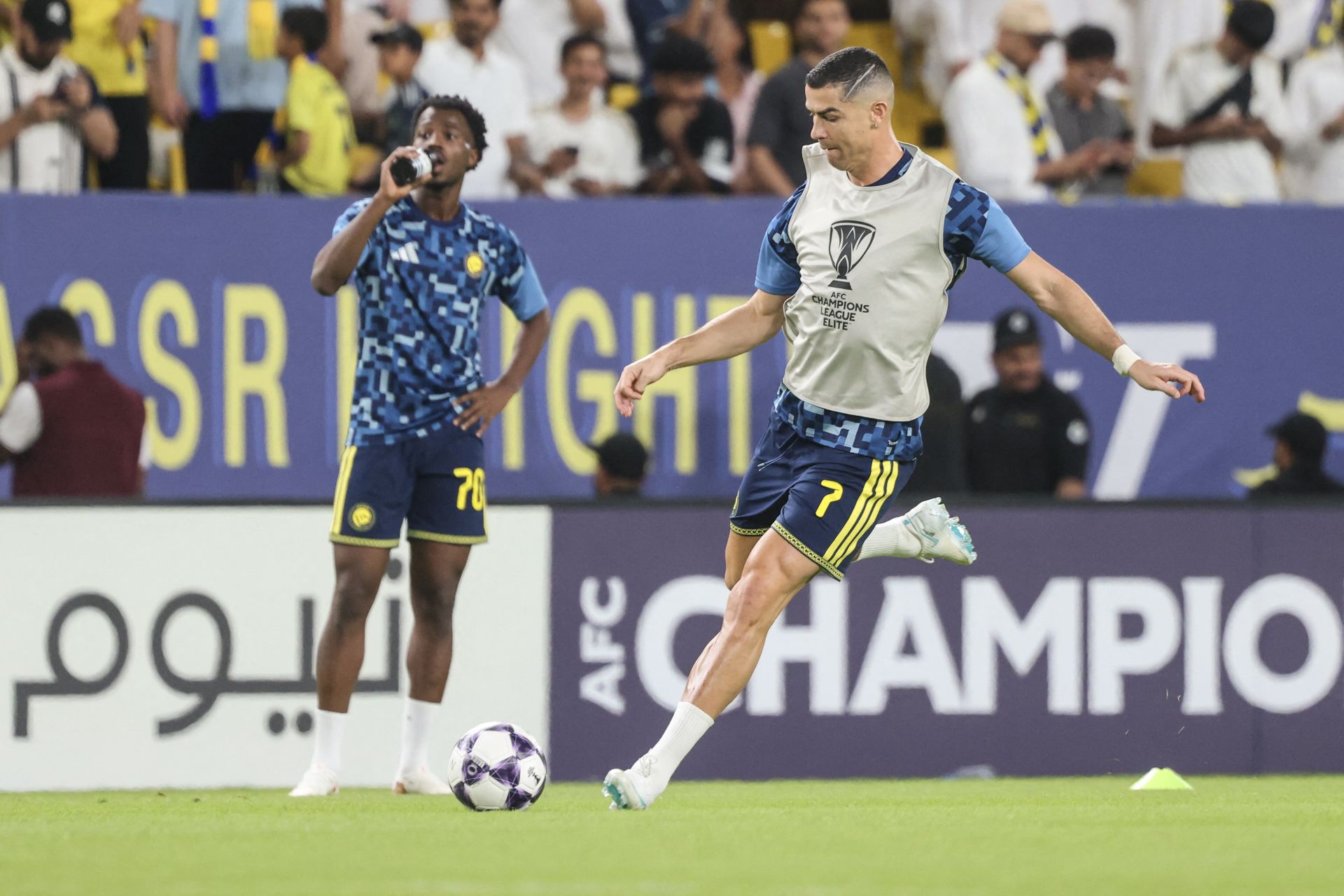
On Oct. 12, 2026, Cristiano Ronaldo, the most followed person on Instagram, with some 680 million followers, was walking around the Al-Awwal Park stadium in Riyadh with a Saudi Arabian flag scarf around his neck. After the game, he took to social media and posted: “I am Portuguese, but I belong to the Kingdom of Saudi Arabia.” It was the kind of image that his bosses at Saudi club Al-Nassr would have absolutely had in mind when the club signed the megastar in December 2022.
On the pitch, he scored career goal number 981 in a 3-1 win over Neftchi Fergana of Uzbekistan in Asia’s Champions League. Unusually for “CR7,” the Portuguese superstar’s nickname, this was not the main headline. The start of the game had been delayed by one hour due to a missile alert issued around the capital. Two weeks later, Al-Nassr’s next Champions League clash against Al-Wasl did not go ahead at all, as the Dubai club never made the journey to Riyadh. The Asian Football Confederation (AFC), which oversees and organizes soccer on the world’s biggest continent, postponed the game without giving a reason, but everyone knew why.
It was not the last sporting event to be affected. On Nov. 3, the AFC bowed to the inevitable. It announced that its flagship tournament, the 24-nation Asian Cup, due to be hosted in Saudi Arabia for the first time beginning on Jan. 7, 2026, was being postponed for almost a year.
The decision is a blow to Saudi Arabia’s attempts to become a sporting destination of global importance. On the field, the arrival of Ronaldo, one of the biggest names in world soccer, was the first visible move. But even the five-time Ballon d’Or winner and record international goal scorer can’t rise above geopolitical tensions or do anything about the Iran-backed Houthi group firing missiles from Yemen into Saudi Arabia.
On Oct. 10, an attack on King Khalid International Airport in Riyadh killed at least 13 people and injured over 300 others. On the following day, there were more attacks as the conflict with the Houthis escalated. The militant group had taken the Yemeni capital Sanaa in 2014 and had, for much of the time since, been battling with the Saudi-backed and internationally recognized national government, now based in the southern port city of Aden.
This escalation came at a time when Saudi Arabia was preparing to host a number of events, of which the Asian Cup was just one. The WPC Energy Congress went ahead in Riyadh from Oct. 11-15, but attendees from companies such as BP, Shell, ExxonMobil, TotalEnergies and others pulled out of the international energy summit. The country’s marquee investment conference has also been postponed. The Future Investment Initiative summit, which drew 8,000 participants in 2025 from the world of business and finance, was scheduled to start on Oct. 26. Organizers initially discussed holding the event, nicknamed ”Davos in the desert,” remotely to allow speakers to give lectures on video, but the decision was taken to stage it next year instead.
Such business events reflect Saudi Arabia’s attempts to diversify an oil-dependent economy. Vision 2030 was launched in 2016 by Crown Prince Mohammed bin Salman with three official pillars: a vibrant society, a thriving economy and an ambitious nation. It seeks to create jobs, attract foreign investment and position Saudi Arabia as a global hub that connects Asia, Europe and Africa through business, travel and sport. Saudi Arabia’s population is young — the government said in 2025 that roughly two-thirds of the country are 35 or below and 37% are below 25.
Becoming a sporting destination would create jobs as well as leisure and social activities (after all, authorities in Riyadh don’t want lots of bored young people with nothing to do), but also have beneficial lifestyle consequences for the population.
In 2024, Saudi Arabia’s General Authority for Statistics estimated that 23.1% of young people aged 15 and over are obese, with a further 45.1% classified as overweight. That means roughly 68% of adults are overweight or obese based on standard body mass index thresholds. Vice Minister of Sport Bader Alkadi said earlier this year that the sporting industry was valued at around $8.5 billion, a rapid growth from $1.3 billion in 2016 but still far short of, for example, the United Kingdom’s sporting industry, which a government study said in 2021 had an economic output of around $135 billion and provided around 1.25 million jobs.
The target for Saudi Arabia is about $22 billion by 2030. The country has staged major events in a variety of sports: tennis, snooker, Formula One, the America’s Cup in sailing, and boxing. There have been suggestions that the country might seek to host the 2040 Olympics (the next available one is 2036, but the field is seen as highly competitive). But soccer is by far the most popular sport in the country and around the world.
Ronaldo’s arrival paved the way for others to follow. In the following summer, clubs in the Saudi Pro League spent a total of $957 million on signing some of the most famous players in soccer: Karim Benzema, N’Golo Kanté, Neymar, Roberto Firmino, Riyad Mahrez and others. Only England’s Premier League splashed out more. At the same time, Saudi Arabia’s “Big Four” clubs — Al-Hilal and Al-Nassr of Riyadh, and Jeddah rivals Al-Ittihad and Al-Ahli — were taken over by the country’s Public Investment Fund (PIF).
It was all leading to Saudi Arabia hosting the 2034 World Cup, the most coveted event of all. Although the Asian Cup is, to an extent, seen as preparation, it is still a major deal in its own right. This is the biggest soccer tournament on the world’s biggest continent, held every four years and featuring 24 nations from Australia and China to Singapore and Iran. It was due to be held from Jan. 7 to Feb. 5 in three cities: Riyadh, the Red Sea port of Jeddah and Khobar in the Eastern Province. Now it will begin on Dec. 23, 2027 — or that, at least, is the hope.
The decision to postpone was taken, the AFC said, in light of the “current exceptional circumstances” (a phrase used twice in the statement issued on Nov. 3), which are “arising from developments in the region, including substantial logistical complexities and travel disruptions … making the postponement necessary in the interest of all participating teams, officials, spectators and other stakeholders.”
When the October attacks started, the AFC had wanted to wait longer. The confederation’s president, Sheikh Salman bin Ibrahim Al Khalifa, a member of the Bahrain ruling family with close ties to Saudi Arabia, said when visiting FIFA headquarters in Zurich in October that “things can change very quickly for better or worse in the region, and it is a question of seeing what happens. We can wait until the end of November.”
Other high-ranking AFC officials, however, were already talking about the second week of November as the deadline, with pressure around the continent starting to rise. The media in China, Korea and Japan, which have bemoaned the increasing reliance on West Asia to host soccer events in recent years, were quick to raise concerns, full of questions about the attacks and the tournament.
Just hours after the attacks on Riyadh’s airport, Japan’s head coach Hajime Moriyasu was asked whether the Asian Cup should go ahead. His reply was equivocal. Others’ were less so. “The ongoing military tensions and security instability in the Middle East are serious issues that cannot be overlooked,” Lee Keun-ho, president of the Korea Pro-Footballers Association, said. “The safety of our national team and all athletes participating in the tournament is a grave concern. The Asian Cup is the most prestigious tournament representing Asian soccer and a glorious stage where players compete for their country’s honor. However, no tournament’s value can take precedence over the lives and safety of players and soccer fans.” Football Federation Australia also expressed concern.
At the same time, other sporting events were being affected. The Saudi International has been postponed by golf’s Asian Tour, as was the Six Kings Slam exhibition tennis tournament. The Urban Cycling World Championships were canceled, and FIFA’s video game competition in Jeddah was also delayed.
By the end of October, it was clear that a decision had to be made. There had been hope that, in the words of one AFC official, there would be a “positive development” of some kind. In short, some kind of peace deal was needed, and there was even talk that Donald Trump, nothing if not unpredictable, could pull something off and end the war with Iran, after which Tehran would — assuming it could — deliver a deal that involved the Houthis. It was always a long shot. If that does actually happen, it will be too late for the Asian Cup, at least the January 2027 edition.
In the end, the biggest problem was that governments around the world were warning their citizens not to travel to Saudi Arabia. The South Korean Ministry of Foreign Affairs said: “South Korean nationals currently in Saudi Arabia should depart unless they have urgent business, and those planning to travel should cancel or postpone their trips.”
The question was obvious: How can a country host a major international tournament when teams and players are told not to go by their respective governments? There was another one. What would happen if there were more attacks in the days before the kickoff, or even during it? Teams like Japan and South Korea are full of stars who belong to clubs in the top European leagues. Would powerhouse clubs like Bayern Munich, Liverpool and Atletico Madrid allow Kim Min-jae, Wataru Endō and Lee Kang-in to head to a conflict zone? The debate would be all over the international media, creating headlines that nobody in Saudi Arabia would want to read. Sheikh Salman was persuaded that, with just over two months to go, it was best to take some control of the situation and provide some clarity.
There is no guarantee that the picture will be any brighter or clearer in December 2027, and it could even be worse. The delay does, however, give the AFC time to come up with a backup plan. There have been calls to switch the Asian Cup to another destination in January, but few countries could get ready for such a big event within two months. Qatar, the former World Cup host, stepped in when China announced, in 2022, that it could not stage the 2023 Asian Cup due to its COVID-19 prevention policies, but handing duties over to Doha this time was never going to be accepted in Saudi Arabia. Japan and South Korea have been cited as possible destinations, but playing or watching soccer in much of East Asia is rarely pleasant in the freezing months of January.
Whatever happens, it is a blow to Saudi Arabia’s sporting ambitions, but there were signs that these were being recalibrated even before the Houthis started launching missile and drone strikes. The attacks on Iran by the United States and Israel in February hit the Saudi economy hard. It shrank year on year in the second and third quarters of 2026, by 4.7% and 3.8%, respectively.
Spending on sport is less of a priority. The unloved LIV Golf has been a major casualty. PIF, which also owns English Premier League team Newcastle United (where there have been questions asked about a lack of ambition), invested around $5 billion in setting up this alternative to the established PGA Tour in 2021. PIF announced it was withdrawing its support in April, and LIV filed for bankruptcy in September.
The Asian Cup will eventually, hopefully, feature three cities — Jeddah and Khobar as well as the capital. The 2034 World Cup was originally planned to feature 15 stadiums spread across five cities, but now, according to The New York Times, 10 arenas are being planned in four cities. One of those quietly dropped, according to Reuters, was to be the most spectacular. According to reports, the NEOM Stadium was designed to be constructed as an elevated area in the ambitious megaproject known as The Line, a proposed 100-mile-long city of steel and glass. PIF boss Yasir al-Rumayyan said in April that it was no longer vital to build the stadium before the original first-phase delivery target in 2030. The 46,000-capacity stadium was reportedly due to cost $2.5 billion.
And in the Saudi Pro League, the spending has also slowed somewhat. No longer are clubs looking for big names who are approaching the latter stages of an illustrious career. Instead, club managers seek more value from the market. Al-Hilal — the club that, in 2026, saw its majority stake sold to Kingdom Holding Company, the firm run by billionaire businessperson and royal family member Prince Alwaleed Bin Talal — still splashed out almost $200 million on English Premier League stars Ollie Watkins, Gabriel Martinelli and Crysencio Summerville. But in total, the league spent $407 million on summer transfers, less than half of the 2023 peak. The focus is on younger players who are not only cheaper but can potentially be sold back to European clubs for significant sums. It makes financial sense, even if the transfers aren’t as headline-grabbing as in the past.
All that can be said with certainty is that these are uncertain times. As the AFC’s president said in October, things in the region can change quickly, for good or for bad. The postponement of the Asian Cup may end up being seen as a necessary reaction to a difficult but temporary situation, or a turning point when geopolitics tightened its grip on Saudi Arabia’s sporting ambitions. Even Cristiano Ronaldo can do little about that.
“Spotlight” is a newsletter about underreported cultural trends and news from around the world, emailed to subscribers twice a week. Sign up here.