


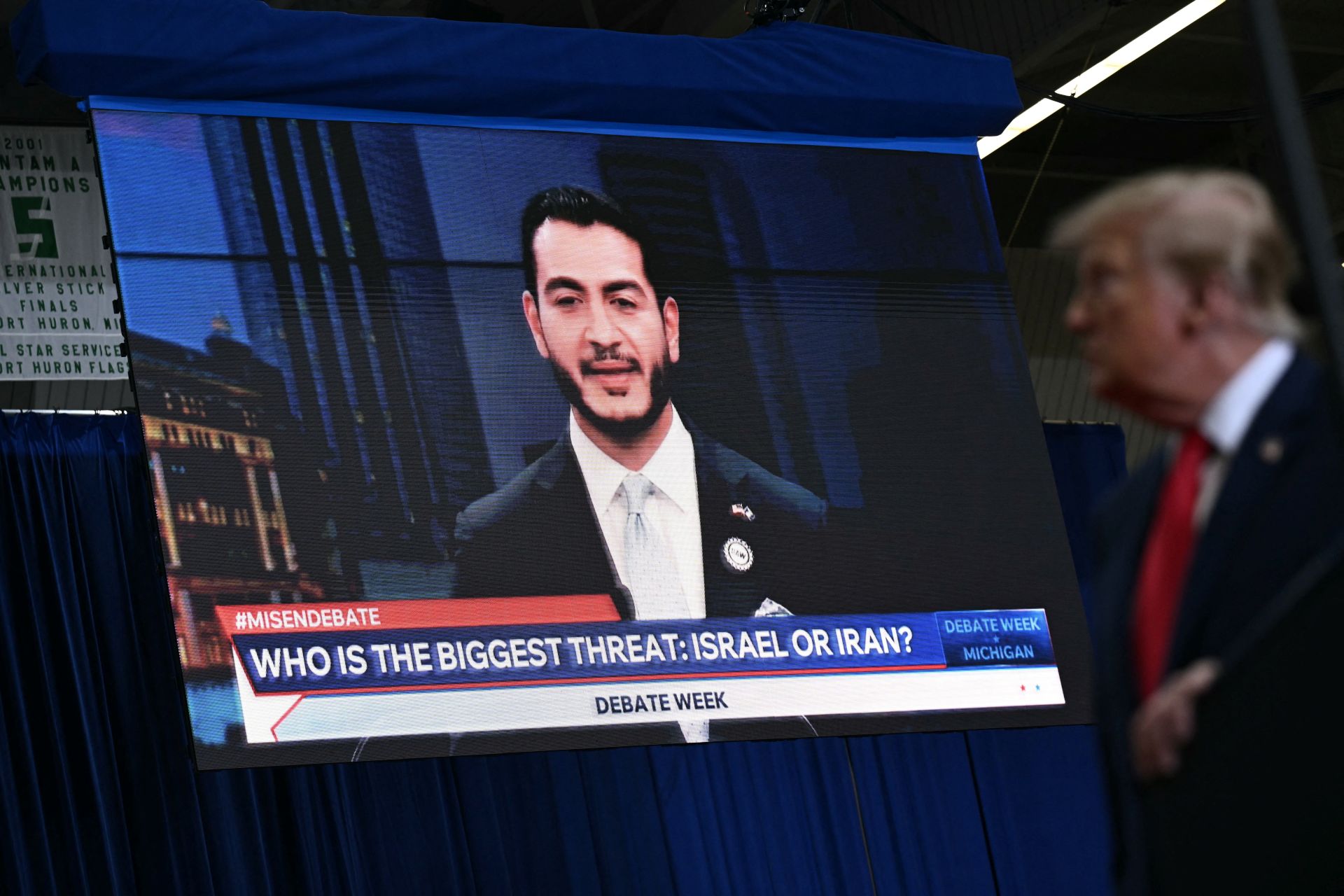
In mid-October, at a lively town hall with Democratic Senate hopeful Abdul El-Sayed in Caro, Michigan, a young man with a square jaw and sandy brown hair stood up to address the candidate. “I have one simple question,” he projected across the crowd. “Will you disavow the Muslim Brotherhood?”
El-Sayed quickly replied, “Sure, yeah, absolutely,” before turning the thrust of the inquiry back to the young man, who had identified himself as “Tommy.”
“Why are you asking the question?” El-Sayed demanded.
“Because they’re a terrorist group,” replied Tommy.
El-Sayed went on to give Tommy, who reporting later would show had been a staffer for Republican Sen. Josh Hawley of Missouri, a lecture on John F. Kennedy, faith and the Constitution. But this simple exchange at the beginning of a viral moment revealed how deeply a new epithet has penetrated the political zeitgeist in the U.S.
The Muslim Brotherhood has existed for almost a century, but the 2026 midterms have brought it into the mainstream in U.S. politics. It has been trotted out at campaign rallies by President Donald Trump, who has called El-Sayed a “jihadist Muslim Brotherhood member”; invoked by Health Secretary Robert F. Kennedy Jr., who claimed the organization’s rise led to the decline of the Arab world’s contributions to science and literature; and been the subject of a podcast episode by Sen. Ted Cruz of Texas, who claimed El-Sayed was seeking to “infiltrate” Congress to potentially leak classified information to the group, which he described as “radical Marxist Islamists.”
Though the label of “Muslim Brotherhood” may be new to a U.S. voter, the playbook that applies it is not. Rather, it is evidence of a rich rhetorical exchange between the U.S. and its autocratic allies in the Middle East, as each finds ways to delegitimize, demonize and even prosecute unwanted elements, particularly those who might threaten the illiberal status quo of their regimes.
Throughout its history, the Muslim Brotherhood has been at turns embraced, rejected, used, maligned, persecuted, prosecuted and promoted by states and regimes throughout the Middle East and North Africa for their own ends.
Founded by a young school teacher and imam named Hassan al-Banna in Egypt in 1928, the movement began largely as a social organization attempting to counter the influence of Western imperialism by recentering Islam’s role in society through preaching a populist message of traditional values and worker protection against foreign monopolies, as well as performing charity. Over its first two decades, the Brotherhood gained hundreds of thousands of followers, and moved into the political sphere, where it sought to counter British rule in Egypt and bring the country under Islamic law. At times, its members engaged in acts of violence, whether against British forces in the Suez Canal Zone or against Egyptian officials, such as Prime Minister Mahmud al-Nuqrashi, assassinated by a “Brother” in 1948.
The Brotherhood’s reach in Egypt was deep, and its political traction strong. After his Free Officers staged a coup in 1952, ousting the monarchy, Gamal Abdel Nasser undertook a campaign to break the ancien regime, using the Brotherhood and its hostility to the monarchy, the British and the country’s largest political party to rally support for the junta, before turning on the Brotherhood two years later. The organization was banned — prompting an attempt on Nasser’s life in 1954 — and many of its members were imprisoned or fled into exile, particularly to Saudi Arabia, where the conservative regime found them a useful counterweight to rising Arab nationalism and secularism in the region.
For several decades, members of the Brotherhood found a home in the Gulf, though branches were set up in most Arab nations. In some, they were tolerated; in others, persecuted. In Syria, once the Baath Party consolidated power, the Brotherhood considered it un-Islamic and attempted to overthrow the government. In 1982, after Brotherhood militants seized control of the city of Hama, the Assad regime surrounded and shelled the city for 27 days, killing tens of thousands of civilians.
For most of the 20th century, the Brotherhood was a Middle East story. But in the early 2000s, as the “war on terror” heated up, and governments around the world began using the fear of terrorism — sometimes as a rallying cry, sometimes as a threat to political opponents — Gulf rulers found it convenient to direct U.S. attention toward the Muslim Brotherhood.
We see this in a leaked diplomatic cable sent in November 2004 from the U.S. Embassy in the United Arab Emirates to the National Security Council and a half-dozen other high-level recipients. “In their diplomatic activities,” it read, “Sheikh Mohammed bin Zayed and his brothers Hamdan and Hazza rarely fail to tell high-level USG interlocutors about the threat to stability posed by the ‘Muslim Brotherhood,’ their generic term for extremists.”
The U.S. had built an entire geopolitical project on the basis of “terror” and “extremism.” Here was a Gulf ally, metabolizing that rhetorical playbook to its own ends by pointing at its enemy and applying the label of “terrorism,” before handing it back to the U.S. to be adopted.
The cable also described an interaction between Mohammed bin Zayed and a U.S. counterterrorism coordinator, wherein the former expressed that he “is convinced extremists have a plan to ‘hijack’ the UAE curriculum.” Those “extremists,” it went on to say, are the Muslim Brotherhood. “He and others said the Muslim Brotherhood’s influence in the Gulf dates back to the 1950s when Egyptian and Syrian teachers spread across the region. They have concentrated on Arabic, history, and Islamic religion, all key components of the UAE curriculum. ‘We are having a (culture) war with the “Muslim Brotherhood” in this country,’ Sheikh Mohammed said.”
That Bin Zayed spoke of a culture war with the Brotherhood was also no coincidence. The U.S. had spent the 1990s mired in public battles over morality, religion, race and identity. The 9/11 attacks had briefly unified the nation, but the fissures were once again beginning to appear. Bin Zayed would have been aware of this — and the conservative sentiments of the George W. Bush administration — and his deployment of an American turn of phrase to impress upon the diplomat the threat posed by the Brotherhood showed the savvy with which he operated.
The Muslim Brotherhood reached its political zenith in 2011, when the wave of popular uprisings across North Africa and the Middle East brought down President Hosni Mubarak in Egypt. Although the Brotherhood was not the driving force behind the revolution, it was its greatest winner: Mohamed Morsi, a Brotherhood member, was elected president in 2012, and his party won the greatest number of seats in parliament.
After years of relative stability in the region, the Arab Spring forced autocratic rulers who had not faced uprisings in their countries into existential crisis. Popular political participation became the prevailing threat to their regimes, and the Brotherhood’s success in the wake of the uprising had rulers in the Gulf scrutinizing their tolerance for the organization.
But the Brotherhood’s success in Egypt was short-lived. Three days after Morsi celebrated one year in office, the military, led by Gen. Abdel Fattah el-Sisi, deposed him in a coup. The Brotherhood was, once again, banned in its native Egypt. Other countries took note and seized the opportunity to broaden their attacks on the Brotherhood. The UAE, in particular, persuaded its biggest regional ally, Saudi Arabia, that the Brotherhood was a serious enough threat that the kingdom labeled it a terrorist organization and began cracking down on its membership.
Soon, any undesirable element in Egypt, Saudi Arabia or the UAE became “Muslim Brotherhood” and treated accordingly. Political opponents from across the ideological spectrum were labeled “Muslim Brotherhood” and disqualified, discredited or worse. In the years after the 2013 coup, dozens of lawyers, academics, judges and teachers in the UAE were accused of Brotherhood ties and sentenced to long prison terms. Saudi Arabia has arrested dissident religious scholars under the same pretext, and some now face the death penalty. Journalists in Egypt are regularly labeled “Brotherhood” and imprisoned. In 2019, the Egyptian government even arrested the Coptic Christian activist Ramy Kamel for supposedly belonging to the group.
The label of “Muslim Brotherhood” — used in the broad, catchall way — also became a useful tool in other counterrevolutionary currents across the region. In Tunisia and Morocco, the native Islamist movements of Ennahda and the Justice and Development Party were smeared as “Muslim Brotherhood,” despite neither having sprung from the organization (though both drew inspiration from the movement). In both countries, the epithet signified a fundamentally foreign ideology that would be “imposed” on the populace if these parties achieved any kind of electoral success.
Just as the “terrorist” label had made its way from Washington to capitals all around the world, so the use of “Muslim Brotherhood” as a sweeping term for something extreme and alien made its way back to the United States.
In the new president of Donald Trump, Egypt’s Sisi found a willing ear. In 2019, in a private meeting at the White House, Sisi, whom Trump once affectionately called “my favorite dictator,” urged the American president to designate the Brotherhood as a foreign terror organization, a process that Trump initiated but was unable to see through before the end of his first term.
In early 2026, Trump was able to follow through in part on his promises to Sisi, and the U.S. designated several chapters of the Muslim Brotherhood as terrorist organizations. This gave further gravity to the application of the “Muslim Brotherhood” label to Abdul El-Sayed (who has publicly said he would push for the elimination of military funding to Egypt) in the Michigan Senate race. Tommy, the young man at the debate, wasn’t making assumptions — he was drawing his language directly from the administration.
Though the rhetorical use of the “Muslim Brotherhood” label as a political boogeyman may be similar in the U.S. and the Gulf, there is another element at play, argues H.A. Hellyer, a senior associate fellow at the Royal United Services Institute for Defence and Security Studies in the U.K. “There is something fundamentally different” about how the Americans and Gulf powers are using the term, Hellyer said. “In the Gulf, you have different Muslim majority countries who have a variety of perspectives on the MB organization, negative and positive — in the US, these are culture wars, using Islamophobia quite transparently and openly. Mostly, it’s the Republican Party deploying the term ‘Muslim Brotherhood’ as another way to respond to its base, which has shown to be quite responsive to different types of Islamophobia, particularly around election time.”
And it is not just individual candidates, like El-Sayed, who are feeling the effects of the label. Hellyer notes that “a number of Muslim-focused institutions in the U.S. were established in the 1960s and 1970s by people with sensitivities towards Brotherhood figures in their countries,” although they might not all have had formal affiliations. Half a century later, these founding-era sensibilities are being used to provide fertile ground for a conspiracy-minded Republican Party with the help of their allies in the Gulf, who have even funded smear campaigns against such organizations on U.S. soil.
“They found another thread they could pull on in the service of Islamophobia,” Hellyer says. “If all these civil society organizations could be linked back to the Muslim Brotherhood, it meant you could say this is one big conspiracy and they all need to be ejected from public life, irrespective of their actual political or legal positions.”
The term “Muslim Brotherhood” fits snugly into the quiver of rhetorical arrows Trump is known to let fly. The tidiness of the phrase gives it great, populist appeal. “Muslim Brotherhood” isn’t difficult for Americans to pronounce or spell, unlike, say, al Qaeda; it isn’t a jumble of letters, like ISIS, ISIL or IS. Instead, it combines a clear adversary — Muslims — with a word that evokes one of the current Republican Party’s favorite things: a shadowy cabal, a brotherhood hidden in plain sight, pulling strings and manipulating the world just offstage.
And that is precisely the claim Trump is leveling against El-Sayed: that there is an expansive, deeply connected religious organization whose aims are murky, but certainly un-American at their core, lurking behind the candidate, and that his participation in the democratic process poses an existential threat. However credulous America’s Republican voters have become, they can see El-Sayed isn’t of the extremely religious ilk. So Trump has handed them a label for the threat he hopes they’ll feel, one that has enough specificity that it appears grounded.
While the American version of the “Muslim Brotherhood” playbook is laced with the menace of racism and Islamophobia, the project at the core hews tightly to its origins in the Gulf: maintenance of an illiberal status quo. Whether or not the tidiness of the term and the specter it conjures will be effective enough to snuff out El-Sayed’s ambitions on Tuesday, American voters can be sure the Muslim Brotherhood playbook will be percolating long after the last ballot is cast.
Become a member today to receive access to all our paywalled essays and the best of New Lines delivered to your inbox through our newsletters.