


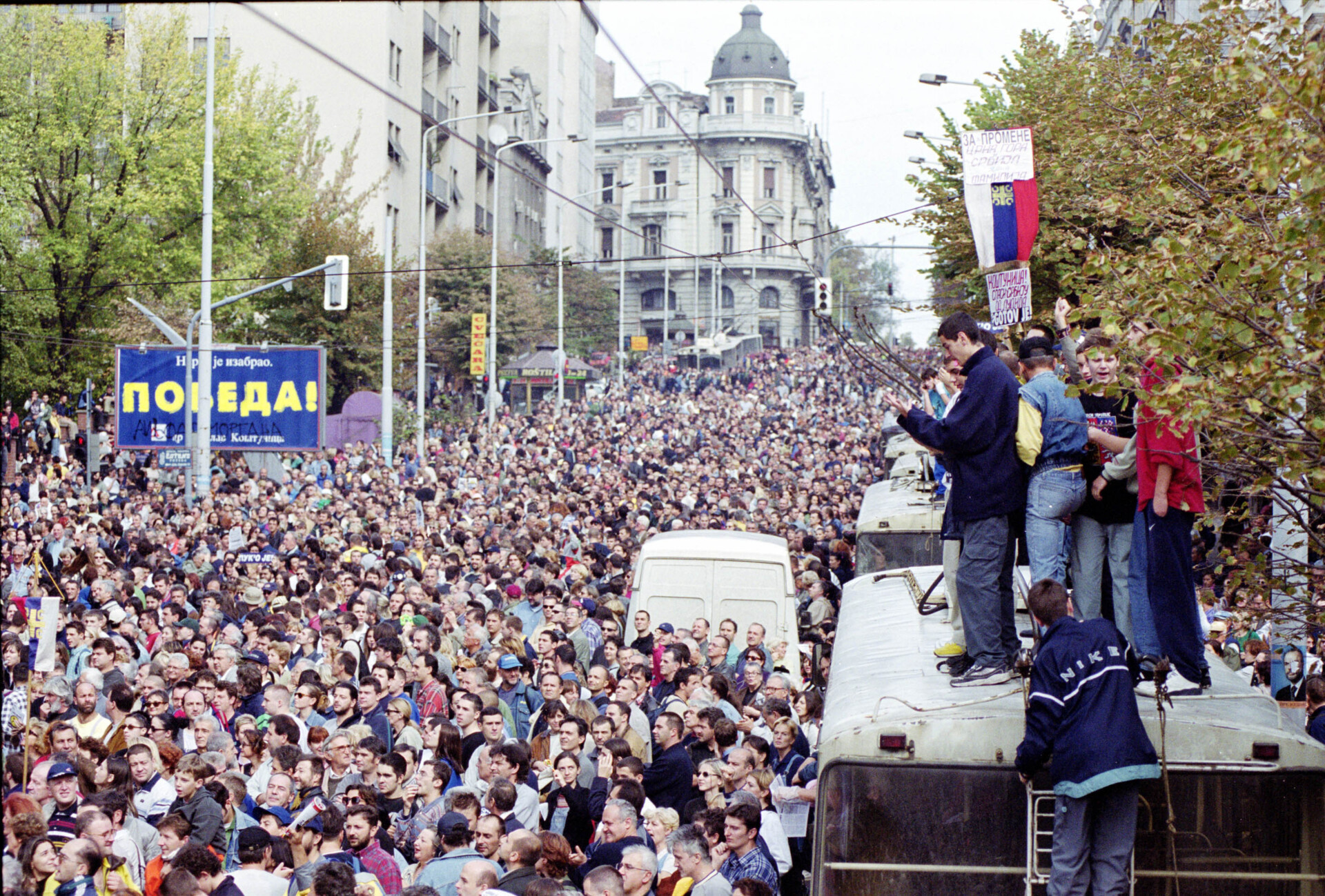
I was sitting in the studio of an independent radio station that no longer exists today, when the voice of my colleague came on air. He was reporting from the streets of Belgrade. The city was full of people, tens of thousands of them, from all over the country, marching toward the National Assembly of the Republic of Serbia. As he moved through the crowd, describing what was happening, one or more shots were heard in the distance. I remember his scared but also excited voice. He knew, just like me and many others, that we were witnessing the end of a regime. We were young, angry and determined to overthrow the government of Slobodan Milošević, which had brought us war, poverty, repression and international isolation.
On that day, Oct. 5, 2000, we set fire to the assembly. Thanks to the refusal to obey the army and the police, a civil war did not occur, but it could have. The president of the country was arrested shortly after and taken to the international prison in Scheveningen, The Hague, and we firmly believed that we had won freedom, although we had no idea then how difficult it would be to build a democratic society and state.
Twenty-six years later, a new generation of students won the elections and defeated the political establishment of Aleksandar Vučić, who had been in power for over a decade. On Oct. 25, 2026, after almost two years of protests, the student movement won the majority of votes in democratic elections and 140 seats in the National Assembly. After celebrations in the streets and squares of the capital, the citizens cleaned up the trash after themselves, and some of them took brushes and lime in their hands and started to paint over the graffiti of hatred and nationalism that proliferated on the facades of buildings and institutions over the past decade.
We burned the parliament; they cleaned the city. We were angry and aggressive because of the war and sanctions; they peacefully protested for two years, against corruption, repression and censorship. The contrast is great, and I wonder: Did these students understand something that my generation did not?
What I know is that the burning parliament did not bring us a better future, and what I want to believe, but don’t know for sure, is that the “cleaned city” is the symbolic beginning of creating a better society and a democratic state.
I was 11 years old when I first saw, on television, protesters being beaten by the police on the streets of Belgrade. They fought against the regime of then-President Slobodan Milošević. It was March 9, 1991, when the authorities used force against the demonstrators, and 17-year-old Branivoje Milinović was killed. After that event, Serbian students joined demonstrations in increasing numbers, while the former state of Yugoslavia sank into war and began to disintegrate.
I remember one evening on the sofa next to my grandmother. Watching the television news, my little brain couldn’t understand who was fighting whom and why. I was also confused by the way that the teachers in schools classified us as Serbs, Croats or Bosniaks. In my class, we were mostly Serbs, with some Croats. Until then, we had all simply been Yugoslavs.
Such divisions were not limited to television or schools, but permeated all parts of society, friendships and families. As the war increasingly spread through Croatia and Bosnia, students in Serbia protested more and more in the streets, facing police beatings, batons and tear gas. I remember the New Year’s gathering in the center of Belgrade during the winter of 1996-97, when protesters contested the election fraud. For a moment, the streets of the city looked like they belonged to people imagining some other country.
In 2000, I started working as a young journalist at Radio Index, the largest opposition media organization at the time. At the same time, I studied political science at the University of Belgrade. When Milošević finally fell, we believed that democracy would follow almost naturally. I remember that I saw the American flag flying on the building of my faculty; previously only the Serbian and Yugoslav flags had hung there. Also, a department for American history studies soon opened. These were all signs that Serbia was entering a different world. We envisioned free elections, independent institutions and a European future. Above all, we sincerely believed that the next generation would not have to fight our battles.
Democratic transition, however, proved to be a never-ending process. At the beginning, governments changed and elections were held, but the political legacy of the former regime was still strong, and politicized media and nationalist habits persisted. The assassination of then-Prime Minister Zoran Đinđić in 2003 revealed all the weaknesses of our society and the fragility of what we believed in. Just one of my experiences as a young reporter illustrates the divisions in the country. In April 2002, I was reporting from the National Assembly, after the suicide of the former minister of internal affairs, Vlajko Stojiljković, who was a Hague indictee. His supporters and sympathizers had gathered to honor him. I approached those people in the crowd, asking for comments and statements. When they realized where I worked, some called me a traitor and a liar. An old woman told me I was a witch who should be burned at the stake.
Twenty years later, the language used by the government about protesting students sounded painfully familiar. They were accused of being foreign agents, mercenaries and enemies of Serbia. One host of the public service Radio Television of Serbia compared the students to Hamas militants, calling them fascists.
The latest student movement arose from the tragedy of Nov. 1, 2024, when 16 people died due to the collapse of a railway station canopy in Novi Sad, Serbia’s second-largest city. Questions about construction oversight and corruption led to demands for accountability. Students began occupying colleges, organizing marches and building support far beyond academia. Instead of glorifying a charismatic leader, they relied on assemblies, councils and joint decisions. Their calmness, persistence, discipline and nonviolent action made them stand out from any other political movement and the usual conflicts between opposing forces. Their success should not lead us to romanticize them, however. A generation can reject the government, but without agreeing on the history of its own country, the base to build a future democratic society is weak.
During the student protests that followed the tragedy at the train station in Novi Sad, I noticed young Emilija Milenković, a student at the Faculty of Political Sciences in Belgrade, the same faculty where I once studied. She spoke about her childhood and growing up in a country where, as she said, “We never learned what it means to live in a normal society.”
At the time that I was studying, Emilia was not even born yet. Back then, I sincerely believed that my generation was building a democratic Serbia, a country where children like her would grow up free from fear, repression and the political struggles that we went through. Yet more than two decades later, Emilia and her generation found themselves fighting for the same values, for the freedom we believed we had already won. Her words made me think: What kind of land have we left as a legacy?
The question is difficult to answer, especially when you take into account the wars of the 1990s. My childhood memories of the moments when we were classified into ethnic categories at school were the beginning of an ideology based on emphasizing differences, suspicion and conflicting views of history. Serbia is still struggling to deal with the crimes committed during the Yugoslav wars. The genocide in Srebrenica committed by the army of Republika Srpska, the ethnic cleansing of Albanians in Kosovo and the siege of Sarajevo that lasted for 1,425 days remain topics that are impossible to discuss openly. Acknowledgment of crimes committed in the name of Serbia is too often presented as an attack on the Serbian people and on Serbia itself.
The student movement has brought together people who have different opinions on these issues. That breadth helped the movement grow, but it means that there are difficult conversations that remain unfinished. Some young people espouse nationalist views, while others insist that democracy requires an honest confrontation with the past, acknowledging mistakes made in the name of the nationalism of their colleagues.
It is not realistic to expect the student movement and its list of candidates, most of whom are professors with no political experience, to immediately solve the problem of decades of denial of history, denial of crimes and genocide. Yet no society, including Serbia’s, can become more democratic just by replacing the people in power. Stories must be told that teach citizens to no longer fear their neighbors. The point is not to hold the youth of Serbia guilty for the past, but to insist that responsibility, truth and empathy are not acts of national betrayal. This is where their struggle most deeply connects with, and diverges from, mine: My generation wanted a future without Milošević, but was not mature enough to understand what “freedom” required after he left. We believed that removing Milošević would be enough to set Serbia free, but the new generation knows better. They know they have work to do to build the vision we share.
The electoral victory of the student list in October 2026 opened a new chapter in the country’s history, but the challenges for the new authorities are formidable. The independence of the judiciary, media freedom and responsibility for corruption will require patient institutional work, which is never easy, but particularly not while there is still a strong network of supporters of the former regime. The students have shown that they are capable of organizing resistance; now we will see whether their representatives know how to govern the country.
The day after the election and celebration, I watched the scenes of citizens cleaning the streets and public spaces in Belgrade from my home in Milan, Italy. Some of them painted over offensive and nationalist graffiti, including a mural of convicted war criminal Ratko Mladić, whose image occupied several facades in the very center of Belgrade.
I see this generation, and hope that it is not only determined to change the government, but perhaps also ready to face the darker chapters of the country’s past. One student, who participated in the clean-up action, spoke about wanting to improve the country and his city, not waiting for someone else to start doing it for him. In his determination, I heard an echo of the hope we felt in October 2000, but this time also a more practical understanding of what hope requires. I don’t know if this generation will succeed where mine failed. Maybe they will repeat some of our mistakes or make completely new ones. Serbia may need many more years to face its past and overcome the divisions that continue to shape its society. But when I think of that 11-year-old girl sitting next to her grandmother and watching the breakup of Yugoslavia, and of the young journalist listening to reports of shootings while the parliament burned, I realize how much my life was shaped by the struggle for a different Serbia. Today, as I watch the new generation take responsibility for the future of their country, I want to believe that their story will have a different ending — that they will succeed in building the country that we once dreamed of, but failed to achieve.
Become a member today to receive access to all our paywalled essays and the best of New Lines delivered to your inbox through our newsletters.