


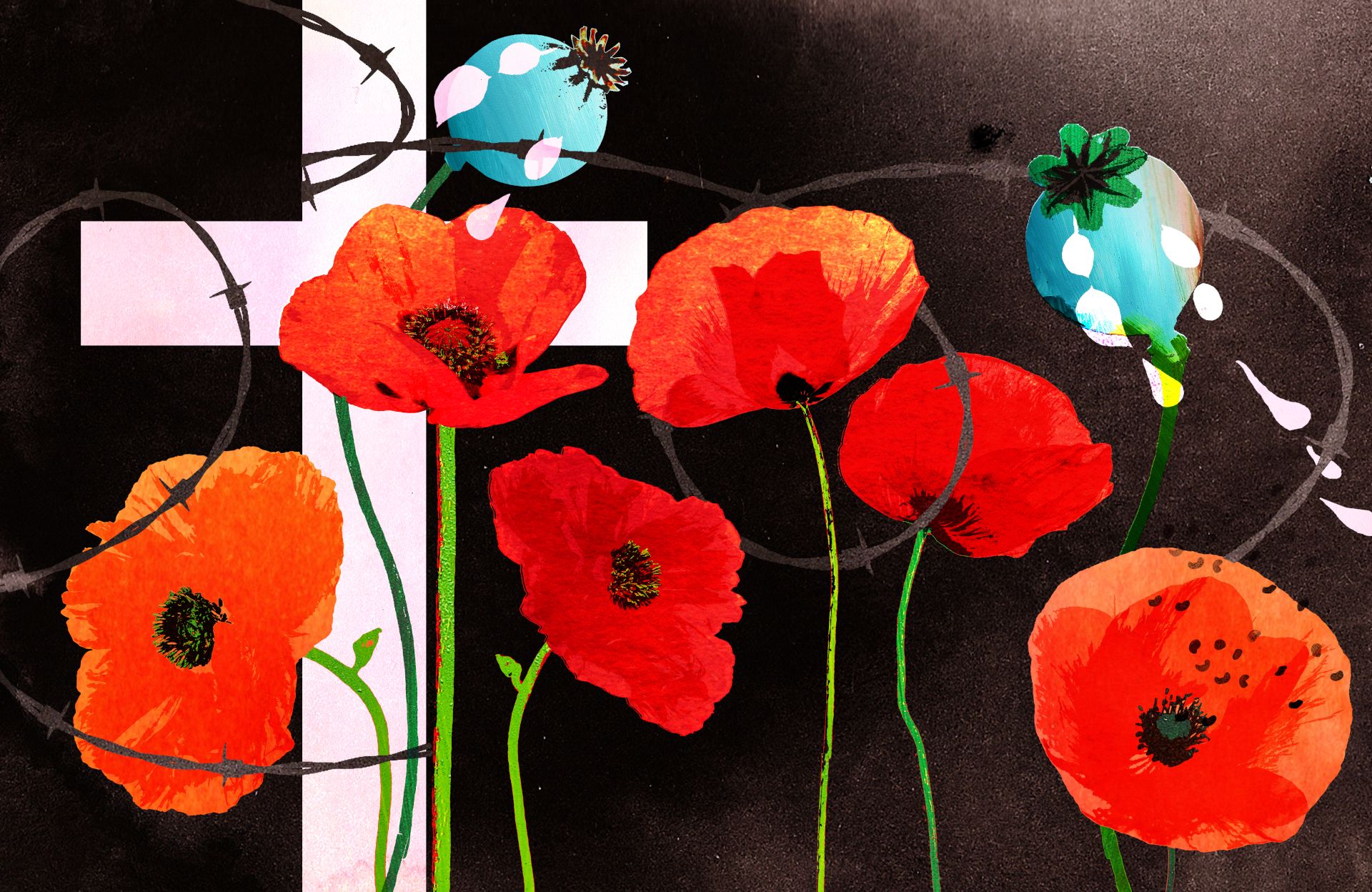
A planted seed is generally left well alone to sprout and grow in the darkness, perhaps with the help of water or fertilizer. But there is a notable exception: Poppies require light to germinate, meaning the earth must be disturbed before they grow. This feature of the flower explains much about its ubiquity and patterns across landscapes. It appears in particular density in places where earth has been turned over, such as farmland or cemeteries — or where trenches have been dug to protect troops in war.
Nov. 11 is Remembrance Day across the Commonwealth, with poppies seen on lapels throughout the month, and memorial events held on the Sunday closest to the day itself — this year, this coming Sunday. These spots of color on coats symbolize remembrance of, and gratitude to, those who lost their lives fighting in war, drawing on images from World War I of the poppies that sprouted, undeterred by violence, all along the front lines of Europe. These front lines shifted regularly, often by tiny amounts, but each time requiring more trenches to be dug and more soil to be disrupted — so that more poppies grew.
Poppies on battlefields had been noted during the Napoleonic Wars of the early 19th century, but the image was cemented in the minds of generations of schoolchildren by a poem scribbled in the back of an ambulance during World War I, by Canadian physician John McCrae. It begins: “In Flanders fields, the poppies blow / Between the crosses, row on row / That mark our place.” Its patriotism, signaling the rightness of dying for one’s country, is suitable for the military parades of Remembrance Sunday, and the simplicity and the color of the poppy make it an ideal emblem, adopted in 1921 by the newly formed Royal British Legion to fundraise to help those who served in the war.
Neither the poem nor the poppy are uncontroversial, however. “Take up our quarrel with the foe!” the last verse begins, signaling a commitment to conflict many find abhorrent; these people shun the poppy or instead choose to wear a white version, symbolizing peace rather than war. But there are far wider problems, worldwide, with what poppies represent. From the opium wars in China to the poppy fields of India and Afghanistan to the opioid crisis in America, the poppy has been a source of addiction, conflict and misery — and, for a few, wealth. And these dichotomies, between wealth and grinding poverty, memories of noble sacrifice or of oppression and addiction, are not the only meanings that have been attached to poppies over millennia of human history. This humble weed, whose seeds can survive years of dormancy to wake with the light, has been used all over the world in medicine, cooking and recreation, garnering many different connotations as it went.
There is more than one species of poppy — in fact, there are over 2,000, including many ornamental varieties — but the most widely cultivated is the opium poppy, also commonly known as the breadseed poppy. Both names give clues as to why it is so widespread, and has been for so long.
Recently, Swiss archaeologists, excavating where the underground garage of the Zurich Opera House now stands, found poppy seed capsules that show the plant was domesticated over 7,500 years ago; the Opera House is in fact sitting on a prehistoric poppy field, it would seem. We don’t know precisely how the crop was used, given the lack of records, but poppy seeds have been found in sites from the same period (throughout the sixth millennium BCE) across Europe and the Eurasian Steppe.
It is the milky sap that comes from the plant, known as latex, which provides pain relief, a cure for insomnia and the high that addicts chase. DNA analysis has shown that poppies had gained this property by at least 8 million years ago, meaning there was a lot of time for Homo Sapiens to discover their attributes. It’s also clear that at some point along the way herbivores learned to avoid them; drug-induced stupor is not good for survival.
The latex leaves no trace in the archaeological record, though there is no reason to think prehistoric people didn’t know about it: Although the mature seeds are a food source and do not contain any opiates, they can give clues. “Poppy seeds themselves possess little to no opium content but may become contaminated with opium alkaloids during harvesting,” says the U.S. Drug Enforcement Administration, meaning that consumption of the seeds can lead to a positive opiate drug test. (This has led to the development of the so-called “poppy seed defense.” Subsequent tests can actually distinguish between the two, so the defense is only temporary.) Whether our prehistoric ancestors took the drug, or what they used it for, are details they took to the grave, sometimes along with poppy seeds themselves.
The poppy’s uses in food, medicine and tombs were all recorded long ago, in ancient Egypt. Perhaps most disturbing to a modern sensibility is the description in various papyri of poppy juice as a tool for calming down children. I’m reminded that the general symbol for “evil” in hieroglyphs, which is a sparrow, is also the general classifier for a child; it seems ancient Egyptian culture had a certain ambivalence toward children. Pictures of the flower have been found in tombs, along with the seeds, symbolizing the rebirth and renewal that come after sleep.
The botanical name for the opium or breadseed poppy is Papaver somniferum: “sleep-inducing poppy.” For both the Greeks and the Romans, the poppy was associated with the god Sleep, named Hypnos by the Greeks, appearing as Somnus in Rome, the son of Night and the twin brother of Death. Ovid describes his home in the “Metamorphoses,” in a cave where the sun’s rays never reach, nor any sounds — and where “a wealth of poppies flourish” among other herbs Night gathers to give Sleep. The river of forgetfulness and oblivion, the Lethe, flows through the cave, and in the center is a soft bed on which Hypnos sleeps, surrounded by his sons who bring dreams, including Morpheus, who gave us the word “morphine.”
This cure for insomnia is found in some of the earliest Greek medical texts we have, known as the Hippocratic corpus, named after the founder of Greek medicine, Hippocrates (living from the mid-fifth century BCE to the early fourth, he was an older contemporary of Plato, who references him twice). The sources recommend the use of the poppy — either the seeds or the juice — for a variety of ills beyond insomnia, including uterine “dropsy,” ulcers, eye ointments and pain relief after a snake bite.
This last use explains why poppy juice is included in the drug known as “theriac,” a name from the Greek word for wild animal, as it was originally an antidote for stings and bites. With a complex concoction of ingredients, it became a generic wonder drug for any ill, employed as a panacea in Europe until the 18th century.
The prescriptions and medical recipes found their way into the Arabic tradition, with the Persian polymath Abu Bakr al-Razi summarizing the varied uses of different species of the humble poppy, including both stemming and provoking diarrhoea, pain relief, aiding sleep, cleansing cuts and ulcers and curing phlegm. It is also, he writes, “used to make opium.”
The second- to third-century physician Galen is the first source we have noting the addictive quality of the drug. He records his observations from when Emperor Marcus Aurelius noticed that he was becoming drowsy after taking his daily theriac, and ordered the poppy juice to be removed; the resulting sleepless nights required it to be added in again. This might be the first record of withdrawal symptoms after opiate use, but it is by no means the last.
“In Xanadu did Kubla Khan / A stately pleasure-dome decree.” Thus begins one of Samuel Taylor Coleridge’s most famous poems, written, as he scribbled on the back of one of the manuscripts, “in a sort of Reverie brought on by two grains of Opium, taken to check a dysentery, at a Farm House between Porlock and Linton … in the fall of the year, 1797.” (The process was stopped by one of the most infamous interruptions in literary history, by “a person on business from Porlock” — a phrase that now refers to any moment of interrupted inspiration. Coleridge tells us his opium vision had faded by the time he got back to the manuscript.) He ends the poem: “For he on honey-dew hath fed, / And drunk the milk of Paradise.”
The milk of paradise is how many experienced and still experience opium, often, as in Coleridge’s case, not realizing how quickly addiction can bite. He originally took it in the form of laudanum for pain relief, which was common at the time; Queen Victoria herself took a dose every morning for symptoms ranging from fatigue to menstrual cramps. This feature of opium has been cynically pushed far beyond its medical advantages, most notably by the British in the 19th century and the Sackler Foundation in the 20th. Both periods have been captured by some astonishing fiction from two very different writers.
Amitav Ghosh’s “Poppy Trilogy” portrays in great detail the devastation wrought on India, and indirectly China, by the British during the 19th century. Poppy cultivation was not new to India by any means; legend has it that Alexander the Great introduced it in the fourth century BCE, though archaeology has made clear that it has a far older lineage throughout the region. The Portuguese reported its widespread use and high value in society from the 17th century. Ghosh describes how peasants would reserve a little space on their land for the bright flower, in order to make medicines that would see them through the year.
This all changed when the East India Company claimed a monopoly on Bengal opium, in the same year Coleridge had his vision, in 1797. From then on, they took control of production, coercing the peasants in the region into signing documents, sometimes violently enforced, that trapped them into pledging a certain amount of the crop, which in practice left them in higher and higher debt. On top of this financial ruin, they also faced hunger, since all their traditional food crops had been replaced by poppies.
“Lands that had once provided sustenance were now swamped by the rising tide of poppies,” Ghosh writes, describing towns full of itinerants begging for scraps. And it wasn’t just food that the poppies pushed out: “In this age of flowers, thatch was not easy to come by.” People could no longer feed nor house themselves as they had done for centuries.
Ghosh describes a factory where the workers are in a stupor from the vapors alone, “as slow as ants in honey,” with some succumbing to the addiction either started by medical use or by this passive consumption. Even the monkeys outside the factory are languorous, only descending from the trees to lick at the effluences that satiate them.
The reason for all this effort was money: Britain was running a huge trade deficit that could be counteracted by supplying China with opium, with merchants and intermediaries making vast fortunes in the process. The plan worked. As one of Ghosh’s British characters says (with some pride), “in some years, the Company’s annual gains from opium are almost equal to the entire revenue of … the United States.” This meant that when the Chinese Emperor tried to resist the flow of opium into his country, seeing the effects of addiction, there was a dangerous amount to lose. The result was the opium wars, resoundingly won by the British; opium continued to flow to China, and money continued to flow out.
This period has not been forgotten. My friend Poppy moved to China and attempted to use a simple translation for her Chinese name, Yingsu. “It sounds like poison,” one Chinese person told her; another asked if her parents had chosen the name to celebrate the British victory over China in the opium wars. (She chose Tao Liping as her Chinese name instead.) The use of poppies, even in cooking, is strictly controlled by authorities; as recently as 2024, a woman growing them for cooking hotpot was jailed for six months and given a fine. The experience of those 19th-century wars continues to reverberate.
There were many dissenting voices in Britain against the opium trade. Missionaries and medical professionals testified to the misery the opium industry produced, and the devastation for individuals, communities and entire countries. Questions were repeatedly raised in Parliament, but like most of the ills of colonialism, change took a long time; the sums of money involved were simply too great.
Similar greed drove the opioid overdose epidemic in the United States, beginning in the 1990s. Mass dependence was created by pharmaceutical companies, which provided incentives to prescribe the drugs. The preeminent novelist spokesperson on this issue was Barbara Kingsolver, in her tribute to “David Copperfield,” “Demon Copperhead.” Like Ghosh, Kingsolver shows the effect of opioids on both individuals and the wider society, in this case, the impoverished Appalachians. On a very different note, Vice President JD Vance has written of the effect of opioids on his own communities in Ohio, including his own family. When the scale of the devastation became clear, the pharmaceutical companies, just like the East India Company in the 19th century, initially fought back, but they couldn’t stem the tide of public outrage at the human cost paid for the sake of profit. The Sackler name disappeared from galleries and museums all over the world, and the Purdue company they owned was declared bankrupt. Between the family and the bankruptcy settlement, over $7.4 billion dollars was paid out in compensation and to fund addiction research and treatment.
Alongside the narcotic effects of the poppy is, of course, its use as food: Not for nothing is its second common name the breadseed poppy. The seeds appear in many Roman recipes and descriptions of feasts. According to Cato the Elder (third and second centuries BCE), fried cheese and spelt balls known as globi should be sprinkled with poppy seeds to serve, and he gives the earliest recipe for cheesecake we have, which includes baking white poppy seeds into the top over a layer of honey. Pliny (1st century CE) suggests using white poppy seeds for bread, showing their ubiquity in both savory and sweet dishes. A 13th-century cookbook from Syria gives a recipe for sweet chicken with poppy seeds mixed into a sugar syrup, used alongside pistachios and saffron. And today you can find them topping bread and bagels, used in cake mixture, and the paste is used to stuff pastries such as strudel.
There are, then, many noncontentious uses for the poppy, but the symbolic is not one of them. The poppies seen throughout the Commonwealth in November are conspicuously, and not surprisingly, missing in the largest British ex-colony: India. The association with the misery caused by opium is too strong, yet the contributions made in the two world wars by the country were huge: 1.3 million Indians served in World War I, with 70,000 killed in action. In World War II, 2.5 million Indians served, with 87,000 killed in action. The solution for some has been a new flower picked for commemoration, resulting in the Mission Marigold, a remembrance initiative drawing on another flower common in India, its saffron color symbolizing sacrifice.
But in accordance with its aims, the mission has made peace with the poppy, and the website shows the two flowers together, symbolizing the common sacrifice made in the world wars. Perhaps this shows that even the most toxic of legacies can be overcome.
Become a member today to receive access to all our paywalled essays and the best of New Lines delivered to your inbox through our newsletters.