


As the phone rang and rang, I felt like a character in my very own “saxophones getting louder” meme. My heart was knocking against my rib cage, beating more and more aggressively the longer I waited for my mom to answer. It was 11:44 a.m. where I was, in the eastern United States, and 6:44 p.m. where she was, in Egypt.
“Aloo!” she finally answered, lengthening the word playfully and, in two syllables, silencing the ominous notes in my head. As soon as I heard her voice, I couldn’t help hearing the TV screaming behind her. It was always louder than her, and although I had come to expect it whenever I called her, it was always more irritating to hear than the last time. Still, it was a familiar sound, and I felt a second jolt of relief. I had permission to exhale.
“Hi, Mama,” I said. “Sorry I missed your calls.” She had left me several voice messages and an unopened WhatsApp text, which I only noticed after emerging from a work meeting. “Is everything ok?”
She cleared her throat, shyly. “No, no, nothing. I just wanted to ask you something. Which type of mahshi do you prefer?” she asked, referring to a favorite dish that can be prepared in various delicious ways.
I thought for a second — not about the scary scenarios she had set off, just moments ago, in my amygdala, or about the frown lines that I worried were one day closer to needing their first Botox session — but about food.
“Cabbage,” I finally replied. Silence. “Not eggplants?” she asked. I could sense the disappointment in her voice. Clearly, my answer was the wrong one. “I love eggplants — I like all your mahashi!” I replied, using the word’s plural form. She let out a small laugh and thanked me. Good save, Ola. But wait, why did she ask if there was only one right answer to the question? It then dawned on me.
“Don’t bring anything!” I pleaded with her. “We have lots of eggplants in America.” I thought — naively, of course — that I had a chance at dissuading her, of changing her already made-up mind.
If Shakespeare were an Egyptian parent (call him “Sheikh Zubair”), he might have penned Prince Hamlet’s famous monologue a little differently: “To bring food or not to bring food, that is the question.” And for my mother, the only answer that matters is what the Transportation Security Administration will allow into the United States, where her daughter lives — and longs for mahshi. For us Arab children living abroad, it doesn’t matter that the foods our parents insist on bringing into the country already exist where we are. What they carry, more than anything, is the one ingredient out of reach to us: the flavor of home, which we don’t dare forget, even if we’re also busy and assimilating to the West.
This mothers’ “smuggling” is a familiar practice in immigrant families, mine included. It will never disappear, no matter how many times we children feign resistance to it. And it makes sense that this is a lost battle for us. After all, it’s rooted in the same stubbornness and determination that helped our parents survive their own migrations, many of them not by choice. For those who didn’t grow up around our parents’ stories, the instinct to carry food across continents can seem illogical, even comical. Not so for us hyphenated children, who know all too well the felt absence of home, a longing we can not so much articulate as taste.
But for our parents, the small-time smugglers of food, these are practical, not philosophical, challenges. To help us overcome them, they painstakingly plan, translating the import and customs sections of government websites and asking those with (legal) food smuggling experience how best to pack cheese, oils, fteer (layers of dough and ghee that trace back to ancient Egypt), cooked vegetables, spices, fish, honey, frozen minced mallow leaves, frozen cooked artichokes, frozen homemade pizza and 10 different varieties of pita breads, from Sudan all the way to India — all while procuring for the journey things like frankincense resin (fine, this one I asked for), pumpkin seeds, various varieties of nuts, teas and, for reasons unbeknownst to me, bottles of iced coffee.
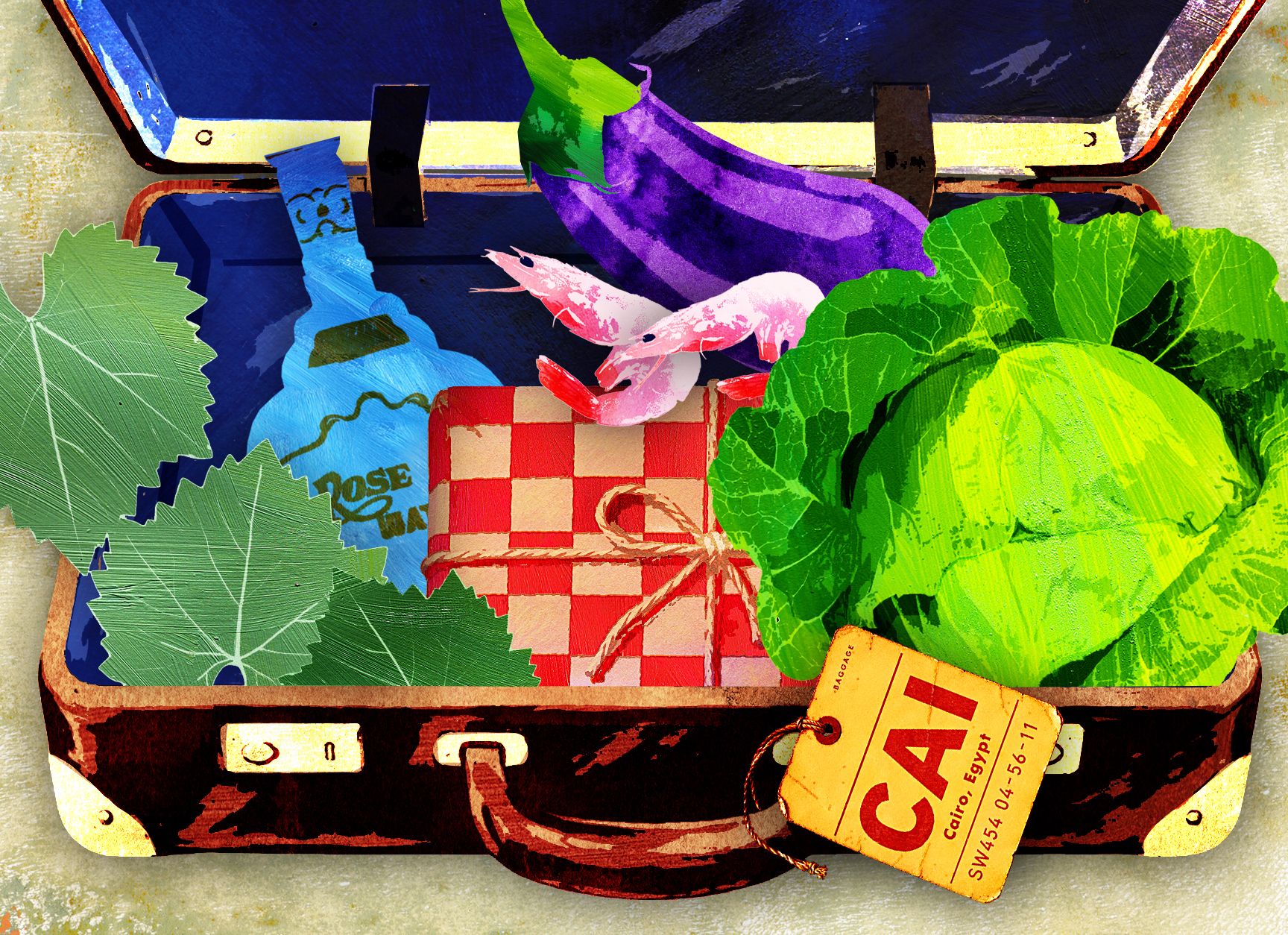
Mahshi, Arabic for “stuffed,” is a subcategory of Egyptian cuisine that involves various vegetables, cored and filled, often with rice, meat and spices. Preparing and cooking mahshi, a delicate process that can easily end in disaster (especially if one accidentally pierces the vegetable from the inside and, with it, one’s culinary ego), should be among UNESCO’s examples of intangible cultural heritage, if only for the comfort the dish brings to one’s palate and soul. There are stuffed grape leaves, which have a more textured wrapping, thanks to their viney origins, and carry a more zesty kick. There’s stuffed zucchini, which serves as a thicker coating to the stuffing, giving the vegetable a softer texture to bite into, yet a stronger overall taste. There’s stuffed cabbage, which is harder to roll because the leaves are rubbery and slippery when boiled (a necessary step before stuffing). But that very detail is also what makes it more satisfying to chew into, hours after admiring the perfect rolls you’ve made, referring to them as “cigars,” just like your mom did before you. There’s stuffed eggplant, which, much like stuffed grape leaves, also has a zesty overall taste — but, because of its stronger outer skin, feels meatier than other vegetables. Those are the main ones, but there are also stuffed tomatoes, stuffed onions, stuffed bell peppers. Basically, any vegetable that you can core and cook can also be stuffed.
I once asked my mom how she gets the cabbage slightly sweet, and she let me in on the secret: She adds a pinch of sugar in the final hour of cooking. After boiling the cabbage slightly, enough to soften the leaves so that you can peel the layers one at a time, working hard not to burn your hand in the process, you need to become a mathematician to cut the leaves to the perfect size: not so small that they won’t hold enough stuffing, and not so large that they would need too much. After the leaves are stuffed with a mix of rice, tomatoes and herbs, they are densely arranged, in alternating rows, in a pot, then covered in a saucy broth mix and left to cook.
Mahshi, in other words, is a laborious dish. I grew up watching my mom spend days preparing it, often on special occasions or for Ramadan iftar meals. The sight forever ingrained in me the knowledge that mahshi, as its name implies, is a loaded project. My mother never complained about it out loud, of course, but the pained “aaakh” she’d let out when trying to slowly stand up and straighten her back, after hours of sitting hunched over the stuffing pot she had resting on her lap, made clear how difficult the task was. Still, with pins and needles from sitting, she limped to the stove, carrying stuffed vegetables and moving to the next step, always working as fast as she could to avoid having to listen to everyone’s moaning about a long wait.
Before all of that, though, there is the quest to find the right vegetables for perfect coring and stuffing. Eggplant is often too stubby and round, or too large and long, in stores in the West. The zucchini is left to grow too large before being picked and sold in markets. The cabbage is not always easy to find, and when you do find it, it’s often too round, like a head of iceberg lettuce — not like the flat variety that supplies just the right size of leaves for wrapping. As for the vine leaves, they’re often sold in jars imported from other countries, and are seldom fresh.
That’s why, when we moved to the United Kingdom when I was 4 months old, my mom turned our backyard into an impressive vegetable patch. Of course, I was too young to form memories of the scene, but the pictures I saw when I was older, with my mother proudly photographed next to her produce, served as a reminder that not only did I not become a doctor like my mother, I also failed to inherit her glorious green thumb. There were heads of cabbage, along with carrots, tomatoes, zucchini — and lots of herbs.
Once I was old enough to help my mom in the kitchen and backyard, at the age of 10, we moved further east of London, to Sittingbourne. Sadly, cabbage kept failing to grow, so my mom grew grapes instead, to use the leaves for stuffing. One spring, after planting a vine, she went out every few days to check on it and help wrap it around a wooden structure she had erected to keep the leaves off the ground. Once the grapes started sprouting, we discovered that the birds were competing for them. That was fine by us, because it was the leaves we cared about more.
My mom began experimenting with more crops, including pumpkins in the greenhouse, which she used to make pies in the fall, and mulberries, the leaves of which fed the silkworms we had as pets. She taught me the habit of keeping the seeds of the fruits that tasted good and planting them anywhere possible. And then there were potatoes, which were initially my favorite vegetable to harvest as a child, digging through the soil to find them, as if looking for hidden treasure. That lasted until, one time, I dug out a snake. Suddenly, potato-digging was no longer a summer highlight for me. Eventually, I managed to overcome my fears, but I still preferred to collect the ripe tomatoes from the vines. As I write this, I can still smell their leaves, which were always the first thing I smelled once I entered the greenhouse.
Even when we moved back to the Arab world, where vegetables for stuffing were abundant, I would not ask her for mahshi. I never told her that the request felt too selfish, having spent years with her in the kitchen and seeing the exhaustion she’d mask at the table when serving us dinner. Yet somehow she knew, and never waited for me to ask.
Before I called her mama, her family nicknamed her Mimi. Mimi was born in Menouf, the Delta town that was the birthplace of several Egyptian politicians, but where most people grew up on farms. Its people are famously stereotyped as being stingy. That might be true: My mom has always been stingy with herself, if it meant she could give more to others.
Her own family had people working on the farm all year, growing seasonal crops throughout. They had jasmine shrubs growing half the year around their home. Before her father would wake up, she and her siblings would race to them to see who could collect the most for him. He died before I was born, and one of the handful of things I know about him is that he loved the smell of jasmine.
She and her family eventually moved to Cairo, as her dad was a graduate of Al-Azhar University and a judge during the Gamal Abdel Nasser era. It was there that she was forced to grow up too fast. At 10, she lost the sibling who was closest to her, both in age and in friendship, when a tank hit her sister Lubna on her way home from school. When the sun set and she still wasn’t home, her worried father roamed the streets in search of her. He didn’t need to go far; at the corner of their street, he found the aftermath of what would be his tragedy. A tank had driven off the road and over the pavement, hitting 11-year-old Lubna. She was pronounced dead on the spot, and no one was held accountable for her death. The last time my mom saw her was the day before, when Lubna threw her a surprise birthday party. Even though my mom is excellent at masking her discomfort from her children, the memory of her sister’s passing still brings sadness to her face.
After Lubna passed, Mimi grew up among eight siblings. The exact number is still unclear to me. I know that three other siblings of hers passed away from sickness, but I’m not sure when, and I can’t bring myself to trigger my mom’s traumatic memories just to feed my curiosity. Losing multiple children led my grandmother to do something that she herself wasn’t convinced of, and which certainly would not have been approved of by my grandfather. She had ink tapped on the back of her hands, a process known as “dak,” which literally means to tap. She was told that this centuries-old method of warding off evil would help protect her remaining children — a pagan practice of tattooing that endures alongside Abrahamic religions, finding a home in hearts that have taken on more grief than they can endure.
Each sibling had a chore to take care of in the house. There was cleaning, polishing, sweeping, dusting, washing, folding and cooking. Mimi was the best cook. At 10, she would prepare meals for the whole house from scratch. Her mother trusted her to always get the seasoning just right. Never a grain of salt less or more than needed.
One day, when in my teens, I was helping her in the kitchen, showing signs of my restlessness, when she told me: “My mom would say, ‘Your ability to cook is more important than your medical degree.’” I would have been horrified to be told something similar by my own mother. Yet young Mimi took it as a lesson, not as an offense. Where was her sense of women’s empowerment? Where were her women’s rights? It would take me years to finally understand that a woman’s fight in life predates these concepts. My mom didn’t expect the same from me — for the very same reason that it was OK in her time for her mom to tell her that — although now I wish she had. She would often not call me to help her in the kitchen if she knew I had schoolwork to do or an exam to prepare for, even if she really needed help.
It’s sad that it would take me being a mother to finally see how she sacrificed much of her adulthood to grant me a childhood. And in adulthood, she still managed to grant me space to remember what being a child feels like — even if it is just bringing me food when I didn’t ask for it, a slice of home while living in the diaspora as an immigrant.
My mom’s childhood was starkly different from mine. She went to school when military training was mandatory for all students, boys and girls. The school uniform was combat attire and boots. She was the best archer in her year, I’d find out.
She later went to medical school and became a doctor of internal medicine. She was part of the first generation of women in her family to get a university degree. Her mother did not study beyond elementary school because her stepmom denied her the right to an education. Despite this, she would teach herself reading and writing. “My mom was very smart,” my mom would often tell me, to remind me of my grandmother, as she died when I was young.
Unsurprisingly, the few memories I hold of my grandmother involve food — but alive, not dead. There was never a time when I did not dread going to the bathroom at her home in Giza. I knew that I would be sharing it with a bird of some sort. Which kind of bird was always a surprise. Sometimes it was a goose. Sometimes it was a pigeon. Most of the time, it was a chicken. It was always a different bird, one that would usually end up becoming dinner a few days later, after its feeding was altered to change its stomach contents before butchering. I didn’t make the connection between the chicken in the bathroom and the molokhia and chicken we would have later that week until many years later. All I remember is the perpetual fear I endured every time the bird looked at me as I would try to walk past it to reach the toilet.
After graduation, Mimi moved to Itay Al Barud, a province between Cairo and Alexandria where she did her medical internship. As her rotation there was ending, she was visited by a fellow doctor, known as Dr. M, also in his internship year. He would be taking over her role as she moved on to the next town.
The two met in a conference room. Dr. M was a green-eyed doctor, with brown hair and large aviator glasses, from Alexandria. And my mom was a woman with sharp cheekbones, soft, beautiful features and perfectly layered, blow-dried hair. They looked perfect for each other, but neither cared for the other at that point. It was only once my mother left and the nurses began crying over her departure that Dr. M took notice. He was surprised: Nurses didn’t often show such sadness at the departure of resident doctors, who were often mean to them. He probed them to see what it was that made them miss her. They explained to him that she was kind to them and, they added, cooked amazing food for them.
Dr. M would find reason to meet Mimi and, eventually, would experience what the nurses spoke of, both in kindness and food. There were three dishes Mimi shared with Dr. M at work: a kabab halla sandwich, a sort of brisket sub with thick sauce; orange cake; and a pickled eggplant sandwich. I don’t know if Dr. M fell in love first with Mimi’s “nafas,” the “breath” a chef brings to their cooking, or with something else. Either way, Dr. M would become my Baba.
Of course, when my mother called me, she knew she was bringing me eggplants. “You don’t have the same eggplants like here,” she said. Her mind was clearly made up. I wanted to say she was wrong, but she wasn’t.
“Wait, vegetables aren’t allowed by the TSA,” I said, thinking that by invoking the Transportation Security Administration I had found a way to stop her.
“They are if they are cooked,” she replied. “I will buy them, wash them, soften them, core them, boil them, freeze them and pack them. What else do they want? The only thing that would be left would be for me to eat them. But I’m sure, if they’re cooked, and they will be, I will be on the safe side.”
I let out a sigh. “Mama, you really don’t need to bring anything with you. We’re just so happy to see you and Dad,” I told her, in a final attempt to get her to abandon her eggplant plan.
“Why? I can bring three suitcases, and Dad can bring three more! We have room,” she boasted. “Just tell me what you want me to bring you, and I will.” I tried, TSA. Really, I tried.
It had been years since she last made the more than 16-hour flight from the Middle East to visit me or, more accurately, her grandchildren. The decision to make a journey so taxing on the body and humiliating when it comes to security was as significant as deciding what dishes the kitchen would smell of each day. That, perhaps, is why the TSA has adorable beagles trained to sniff out Egyptians at the airport, where they are the main culprits of cross-border food smuggling.
In October, an official government body in Michigan put out a video of a beagle jumping around a suitcase that belonged to an Egyptian passenger. They opened it to find large ripe yellow mangoes, fresh molokhia leaves and about a dozen slaughtered pigeons. The video served as a cautionary tale to any Egyptian trying to pull off a similar stunt when visiting America. Of course it went viral, with every Egyptian commentator finding it more funny than scary, and a bit disappointed that the poor pigeons weren’t even given the dignity of being frozen before being packed.
“That’s silly — you cannot bring fresh molokhia leaves. They have to be frozen, minced and packed, and you cannot bring meat to America,” my mom said in response. “I read what is allowed on the TSA website. They should have done the same.”
She did. Mom is an avid reader of the TSA website. For instance, you can bring in cheese, but not soft cheese. You can bring fish or shrimp, but no meat. You cannot bring seeds or anything that can be planted in the U.S. You cannot bring fruit. And you cannot bring vegetables unless they are cooked. Meanwhile, you can bring vegetables to the U.K., but not cheese. And up to 20 kilograms (44 pounds) of fish. I only know all this because she told me, reciting it as if she were at a verbal examination. I can’t lie: It’s impressive the lengths she went to, just to know how to bring me food.
This was also a discussion she had with other Egyptians living abroad. Her friends would sometimes tell her they managed to bring meat to the U.K. from Egypt. She would tell them it was likely that they were just not caught, but that it wasn’t allowed.
Even though she was proficient in food crossing, she was still pulled into secondary checks on her last visit to me a few years ago, at Washington Dulles International Airport, where each one of her suitcases was inspected.
She was carrying kaak, cookies stuffed with date paste and covered in powdered sugar once out of the oven, often served on Eid. The agent broke one in half to see what was inside. Safe. Then he found qatayef, a kind of folded pancake stuffed and served with syrup. He squeezed one inside the bag to reveal the stuffing mix of nuts and shredded coconut. “No meat?” he asked my mom. “No,” she replied. Safe. He then found the frozen fish and shrimp. I don’t even like fish and shrimp, but that, of course, never stopped my mom from telling me I needed it for omega-3. Safe. Bread. Nuts. Fteer bread. And then garlic. The agent pulled out the garlic, thinking he had gotten my mom this time. But then he found each one peeled and smoothed, like buttercream. All perfect. He looked at my mom. “This is the best way to bring garlic,” he said. My mom finally had her moment to boast. She had done her homework. “Yes, I only brought what is allowed.” He closed the suitcases and let her and Dad go.
“Do you not remember what they told me at TSA? The agent told me, ‘This is the best way.’ I am telling you, don’t worry — I know what I can bring and what I cannot,” my mom said. “Do you want me to bring you garlic again?”
The way she phrased the question made it seem like I asked her for garlic last time. I didn’t.
“No, we have garlic here! I have a lot!” I said.
“Ok. If you remember anything else, tell me,” she said.
The next day she called and told me the eggplant plan was in motion. She had bought them, washed them, squeezed them, and cored them. “I just need to boil them now,” she said, more to remind herself of her to-do list than to assure me the eggplants were coming.
The next day she texted me photos of chocolate chip cookies she prepared for my kids. Every day there was a new food-related image. I have to admit, I grew more excited with every picture.
It was now the day before my mom would arrive. I FaceTimed her. “Aloo,” she replied, in that same voice, but this time with the TV turned down. I told her I couldn’t believe I would be seeing her after just two more sleeps. She smiled and asked if we remembered anything else for her to bring. I told her, “Nothing.” She paused and told me to prepare the powdered sugar. She had made kaak, and to avoid the same inspection she had undergone last time, when she attempted to bring the clear plastic bag of white powder with her, she had conceded that it was best for me to buy it locally. And then she told me to get sesame seeds for the falafel she was bringing, too. I didn’t ask her why. I just nodded.
If only the TSA knew what I know: that the olive oil parents bring their children carries the taste of a land that would otherwise be out of reach, that the honey comes from a beekeeper the family knows, that the dates could only grow under a more intense sun, that in the overstuffed, unaesthetic suitcases, double-wrapped in newspapers and shopping bags, are ingredients with value no stranger can see.
“It will all be here when you arrive,” I told her. “I have everything here, even your grandkids. That’s why you should move here and live with us.”
Her reply this time didn’t offer me the quick relief I had been accustomed to at the start of our calls.
“My siblings all died at 80 — I only have a few years left. It’s my turn next,” she said. “We have been in the diaspora all our life, working. I want to spend my final years at home. I need to go back to Egypt.”
I instinctively interrupted her. “I remembered something I want you to get that I miss,” I said.
Her face lit up. “Tell me, we only have today; we’re running out of time!” she said.
“Can you bring me rose water and rose syrup? I want you to show me how to make sharbat. I miss it so much,” I told her, referring to the rose-flavored drink served at Egyptian celebrations. “Of course!” she said.
Once we hung up, I walked to the kitchen and opened the cabinet where I had half a bottle of rose syrup. I moved it to the back of another cabinet that’s less frequented so she wouldn’t see it. Now there’s room for my mom to show me love the way she grew up knowing how. And the only way I still remember the flavors of home.
Become a member today to receive access to all our paywalled essays and the best of New Lines delivered to your inbox through our newsletters.