


When I was a boy in Syria in the early 1990s, I spent my summer breaks going to work with my father. I rode out with him to the farm and helped him run it. We lived in Ashrafiyat al-Wadi, a few miles northwest of the capital, and my father owned farmland in nearby Jamraya and a small business in the adjacent al-Hameh. These three small towns on the outskirts of Damascus sit next to vast stretches of agricultural land.
I remember one discussion in particular that my father and the neighbors often had. They would sit in circles, and each farmer would vent his resentment at how much farmland the Hafez al-Assad regime had taken from them in 1983, when I was 1 year old, under a law that allowed the state to seize private land for public projects — a law that the new authorities in Damascus continue to uphold today, despite street protests against it.
That law is now the new government’s problem, amid growing popular frustration. In the nearly two years since the Bashar al-Assad regime fell, the interim authorities have signed two large real estate deals with Saudi developers on land in the western suburbs of Damascus that the old regime took from farmers in the 1970s and 1980s: Abyat Hills in Qudsaya and Sham View between Qudsaya and Dummar. In late September, the original owners marched on both sites and stopped the machinery. The government responded that the expropriations were legal and all requisite compensation had been paid.
Even for people from the area like me, the protests and the public debate since the downfall of the Assad regime have revealed the scale of the issue in ways we had not previously understood. In the towns along the Damascus-Beirut highway alone, residents count tens of thousands of acres taken for state housing under two decrees signed by Hafez al-Assad in the mid-1970s, with thousands more in Dummar.
The Assad regime used the expropriation law to build military bases, security branches and loyalist housing around the Syrian capital. Much of the land the regime took is still in the state’s hands, either fenced off or built on. The new authorities have inherited that issue, but, to the farmers of my father’s generation, they have so far shown no intention of correcting a basic injustice.
My own family, my father and his three brothers, lost about 50 acres spread across all three towns. They had bought the land with their hard-earned money while their widowed mother was alive.
My family’s land is split in half by the al-Hameh highway, which itself was built over two acres of my father’s land. The part on one side was taken by the Scientific Studies and Research Center (SSRC), the regime’s weapons complex, working with the Ministry of Defense, under older decrees that go back to Syria’s first Expropriation Law of 1946, the year of independence, originally intended for roads and public works. The part on the other side was taken under Decree No. 20 of 1983.
According to Imad Muhra, an activist and law student from Jamraya and himself one of the owners, expropriation happened in three phases: The land was first seized and cordoned off to prevent access, then an expropriation notice was placed on the title, and finally the title was transferred to the state body that took it. The first phase began even before Decree No. 20 of 1983 was issued. The title itself was transferred in 1989.
The earliest law authorizing expropriations by the regime dates back to 1946 and is known as Law No. 272. The first private land was expropriated in 1971, and the “civilian” SSRC was built on it. In 1974, Hafez al-Assad amended the law, preventing land taken for a public purpose from returning to its owners, even if the purpose no longer applied. That is the clause that allows a farm seized in 1974 to be sold to a developer in post-Assad Syria today. What is known as the Fundamental Law, Legislative Decree No. 20 of 1983, later became the core expropriation law that authorized ministries, public institutions and local administrative bodies to seize private property, built or unbuilt, for public infrastructure, such as roads, schools, hospitals and low-income housing. Decree No. 20 allowed every ministry and local council to expropriate on its own authority.
Locals see Decree No. 20 as the one that harmed them most. Muhra said this 1983 law did the most damage in Dahiyat Jamraya, because it allowed the biggest expansion. The decree allowed the government to take hundreds more acres, in the name of public benefit.
Huge parts of Jamraya and al-Hameh were expropriated under the law. The Baathist state stretched the definition of “public benefit” to cover the SSRC, its Branch 450 and other affiliated units, and the military sites around them, and to build Dahiyat Jamraya, a new complex of mixed civilian-military housing for the engineers, chemists, scientists and employees who worked at the SSRC.
In Dahiyat Jamraya, the authorities confiscated 25% of the seized properties under Article 31 of the law, the Free Quarter Rule, which applies to partial expropriations for roads, streets and squares. The regime’s justification was that the remaining 75% would gain in value from the state infrastructure. But the way the land was used created immense local grievances: Military sites were built all around it, and the entire area became a military zone. The free quarter was applied to the housing projects around the SSRC in the Jamraya and Qudsaya suburbs, and to the highway network.
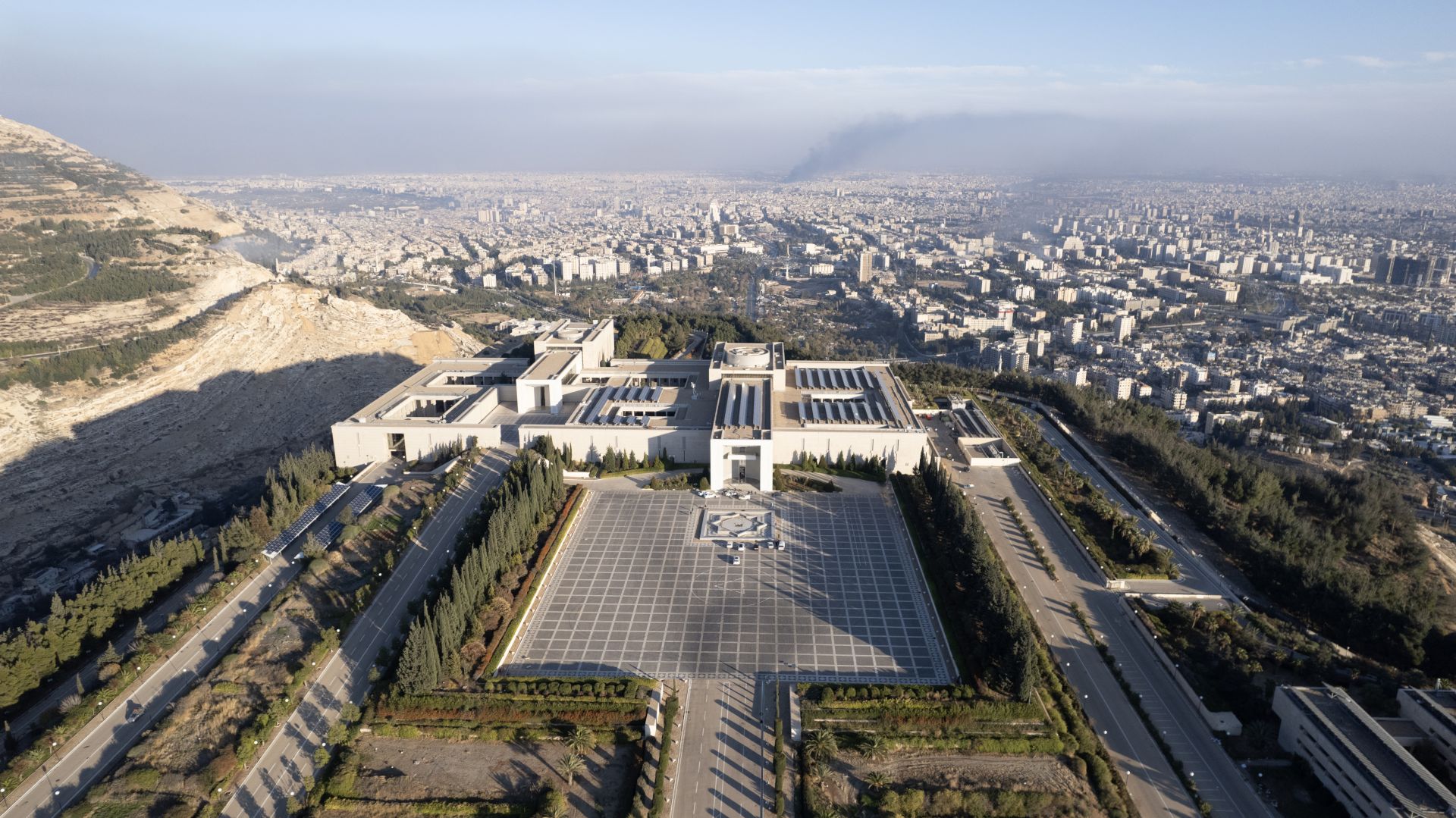
Part of my father’s seized land, about 11 acres, was allocated to the presidency of the Council of Ministers, the prime minister’s office. We still have the green title — the registered deeds that in Syria mean you own the land outright — even though the property has been taken and a lien placed on it. It is hard to estimate the total area expropriated, because real estate records are so poor, but scores of other cases resemble my father’s.
The cash compensation was negligible, delayed and imposed by force. According to Muhra, who has been working alongside activists from al-Hameh, al-Sabboura, Qudsaya, Ashrafiyat al-Wadi and other affected towns, the land was valued at rates that were extremely low and unfair. The evaluation committee paid about $640 per acre in al-Hameh and roughly $1,250 per acre in Jamraya and Ashrafiyat al-Wadi, at the official exchange rate. The committee valued the land as it stood just before the expropriation decree, and the government had five years’ grace to pay. In reality, the payments were often delayed for decades, and hyperinflation and the collapse of the Syrian pound made them worthless. By the time ownership was transferred in 1989, the land was worth more: The closest comparable sale, of a plot owned by a family from al-Hameh and sold to a private organization named “Al Qanawat” in 1992, went for 5 million pounds per dunam (approximately $400,000 per acre).
At the time, lamb cost about $2 a pound, and 21-karat gold was $15 to $19 a gram. Minimum wages in 1983 were 650 pounds ($167) a month for workers and farmers and 1,500 pounds ($385) for college graduates.
Locals were mostly farmers, but after Hafez al-Assad consolidated his rule through the Baath Party in the 1970s, many young people in the area became state employees. Al-Hameh, though, remained a hub of small carpentry and blacksmithing workshops.
The expropriation law deprived locals of their most precious asset: land. The resentment showed on every face and in every voice, mixed with the fear of protesting an injustice under the Assad regime. Assad was powerful and ruthless, and the blood he shed in Hama in 1982 was still fresh. Families had many children, and making a living was hard. Consumer goods were scarce, and people relied on state-issued ration coupons for rice, sugar, cooking oil and tea.
I was 9 when Ashrafiyat al-Wadi and the whole Wadi Barada area, including Qudsaya, al-Hameh, Jdeidat al-Sheibani, Bassimah, Ain al-Fija, Surghaya and Madaya, came under an intensive military and security crackdown, on the pretext of “unlicensed weapons and outlaws,” “combating smuggling” and “restoring public order.” The authorities raided homes and stripped residents of their personal weapons. The campaigns often coincided with further expropriation decrees and restrictions on private property in the orchards of Wadi Barada, on grounds of “building violations” or “protecting water resources” in Ain al-Fija.
This was around the time the Assad regime built military and security outposts in Damascus and then across the areas leading to it. The lands confiscated from the residents of al-Hameh, Jamraya and Ashrafiyat al-Wadi, and later used to build the SSRC and al-Firdous suburb, housed the secretive Branch 450 and affiliated units that mixed and loaded the chemical weapons, including the sarin nerve agent, that Bashar al-Assad’s forces used against civilians in Eastern Ghouta and Moadamiya in August 2013.
Until the protests erupted in Dahiyat Qudsaya in late September, I was under the impression that the expropriation law, or “istemlak” as we call it in Arabic, was something that had happened only to our villages and small towns. I was shocked to learn that land had also been seized in Qudsaya, Dummar, al-Sabboura, al-Zabadani and other towns.
The two deals, Abyat Hills and Sham View, sit on land expropriated under Legislative Decree No. 20 of 1983. Abyat Hills, launched on June 6, 2026, is a $200 million luxury residential complex of more than 2,000 units over 94 acres in the Qudsaya suburb, as one stakeholder told media outlets. Sham View, launched on Aug. 24, 2026, is a megaproject of over 440 acres between the Qudsaya and Dummar suburbs, developed by the Saudi company Thara Al Oula. The Ministry of Public Works and Housing signed both deals on the grounds that the expropriation law is “legal and legitimate” and that compensation was issued and deposited.
On Sept. 26, landowners and residents of Qudsaya, Dummar, al-Hameh, al-Bajaa and Moadamiya marched from the main square of Qudsaya to the construction sites, first Sham View and then Abyat Hills. They blocked access roads, defaced advertising boards, broke into the worksites and forced the machinery to a halt. No arrests or injuries were documented.
Officials from the Damascus Countryside Governorate responded by opening a special Office of Complaints and Disputes. On Sept. 28, the Ministry of Public Works and Housing issued a statement saying the expropriation was legal and legitimate under long-standing state decrees. Locals say that Abyat Hills threatened legal action against the protesters who had damaged its worksite.
I spoke with Loay Al Sheikh from al-Sabboura, a leading activist against the expropriation law in Damascus and its suburbs. The law cost his family of 14 some 100 acres. His father had inherited the land from his own father and bought 17 more acres — all now gone. His father died when he was 4. His mother was assigned a legal guardian and made to sign the documents, accept the cheap compensation and transfer the ownership to the General Housing Establishment. By law, only heirs over 18 can receive compensation, so as each of the 14 children turned 18, they went to the bank to withdraw their share. Thanks to bureaucracy and corruption, the payments were made around 10 years after the ownership was transferred, by which time the money had lost most of its value. Al Sheikh’s family are farmers too, and farmers, he said, do not sell their land. The law deprived his family, and hundreds like it, of their livelihoods and left them without compensation.
Al-Sabboura suffered under one of the earliest and most sweeping expropriation decrees. Decree No. 2076 of 1975 was issued mainly in favor of bodies like the General Housing Establishment, and it targeted thousands of acres of farmland and private property held under clean titles, for an alleged “public benefit,” in the western and northern countryside of Damascus: al-Sabboura, al-Bajaa, Moadamiya al-Sham, al-Dimas and others. Residents of al-Sabboura, al-Dimas, Moadamiya and Yafour, in the western Damascus countryside, estimate that nearly 15,000 acres were expropriated under Decrees 2076 of 1975 and 167 of 1976, both issued by Hafez al-Assad for the benefit of the General Housing Establishment. The land was planted with olives and grain. The compensation was about $830 an acre, a fraction of the market price.
In al-Sabboura, roughly 85% of the town’s farmland was seized for military units, training sites and military housing. These were first used by the so-called Defense Companies paramilitary force of Rifaat al-Assad, Hafez’s brother and the main figure behind the Hama Massacre of 1982. After the Defense Companies were dissolved in 1984, the sites passed to the Struggle Companies force, led by Assad’s nephew Adnan al-Assad. Later, they housed the 4th Armored Division and the Republican Guard. Since the downfall of the Assad regime on Dec. 8, 2024, the sites have been occupied by the General Security Service.
Al Sheikh told me that the expropriated land in al-Sabboura, which the Ministry of Housing used under Assad for military bases and their housing, is being rehabilitated by the new government for reuse. To the people I spoke with, the new government shows no intention of solving the issue.
The same is reported from Dahiyat Jamraya, or al-Firdous suburb, where the SSRC is being rehabilitated for reopening. The senior officials and engineers who ran the SSRC under Assad are back at work under the new government, apparently with the same privileges. Senior military officers from the Assad era still live in the area and work at the SSRC. The apartments there now list for between $65,000 and $140,000, posted by residents who wanted to leave after the regime collapsed.
I spoke with Osama Deeb Jokhadar, from Dummar, the suburb closest to central Damascus. Born in 1991, Jokhadar is a law student who lives in Germany. He said the law took thousands of acres in Dummar and the Dummar Project, and was carried out the same way as in Qudsaya, al-Sabboura, Jamraya, al-Hameh and Ashrafiyat al-Wadi: immediate seizure, then a delayed, disproportionately small payout imposed by force. In Dummar, the payouts came 20 years after the land was taken, and people accepted the meager compensation at gunpoint. Jokhadar remembers armed security personnel forcing his grandparents and other families to go to the bank and accept it. The most important property is the site of the People’s Palace, the presidential palace. His family held 600 of its 2,400 shares, as official documents I have seen show. He remembers his grandmother coming home in tears in 2004, after they were made to collect the compensation, having lost their valuable land for nothing.
Both Al Sheikh and Jokhadar said that most of those who lived in the military housing in al-Sabboura, Qudsaya, Jdeidat al-Sheibani and al-Firdous suburb were generals and soldiers of the Republican Guard, the 4th Division and the Special Forces, all predominantly from the Alawite community. The whole western side of Ashrafiyat al-Wadi was designated as training grounds for the Republican Guard. Next to them, heavily guarded housing was built for the officers. In al-Hameh, there is a well-known unregulated settlement named Jabal al-Ward, whose inhabitants migrated from Assad strongholds in the coastal region, almost all of them poorer government employees. Similar settlements existed in western Dummar. They bought or rented those units, unregulated as they were, from senior generals and officials of the regime who had used their power to build on expropriated land for their own profit. Locals in the Damascus countryside believe Assad expanded the expropriation law in 1975, 1976 and 1982 to protect his regime by embedding security branches, military units and loyalist communities in and around Damascus and its countryside. They ask whether the new authorities need to do the same.
After my conversations with Al Sheikh in al-Sabboura, Jokhadar in Dummar and Muhra in Jamraya, the same three things stood out in every town.
The first is the purpose. The seizures were supposed to be for public utility projects, and the Assad regime violated that first principle of the expropriation law. The opposite happened: In Jamraya, al-Hameh and Ashrafiyat al-Wadi, the regime built the SSRC and al-Firdous suburb, a residential complex reserved for SSRC employees. On the other side of the al-Hameh highway, itself built on our land, it put military sites and special forces’ training facilities. In Ashrafiyat al-Wadi, land was taken but never formally expropriated, yet units of the Special Forces and the so-called “Factories of Death” were set up on it. In places, they uprooted fig trees to build them. The same happened in Dummar. Locals felt that most of the projects were meant to change the demographics of the region.
The second is the cash compensation — cheap, delayed and delivered by force. The third is the absence of any actual right to object and to litigate before a fair and independent judiciary.
What locals do not understand now, and cannot justify, is the new government’s attitude toward this issue. These lands were originally expropriated for the “public interest.” How, then, they ask, did these very lands end up with wealthy investment firms building megaprojects? How can the post-Assad government legally justify handing to foreign corporate investors private property whose owners were either never compensated or were paid nominal 1980s rates that are worthless today?
The transitional government in Damascus appears overwhelmed by the weight and complexity of the legacy the former regime left behind. Nowhere is this paralysis clearer than in its failure to offer any solution for decades of predatory and unjust land expropriations. Its current handling of this highly sensitive issue remains deeply flawed. If it does not change course quickly, the property crisis will not just persist as another unresolved bureaucratic failure; it could spark a new wave of uprisings and pull the country back into the conflict it has fought so hard to escape.
Even in Ashrafiyat al-Wadi, where most of the land was never fully expropriated but is held by the Cabinet, soldiers under the authority of the new government are denying people access to their land after the liberation. The expropriating authority, in our case the presidency of the Council of Ministers, has taken possession of the land, fenced it off with barbed wire and transferred ownership to itself. It means we can’t legally use our land, build on it or sell it, even though we have titles recording ownership. For now, our property is still sealed off: Members of the General Security Service occupy the disputed area and deny us access.
Become a member today to receive access to all our paywalled essays and the best of New Lines delivered to your inbox through our newsletters.