


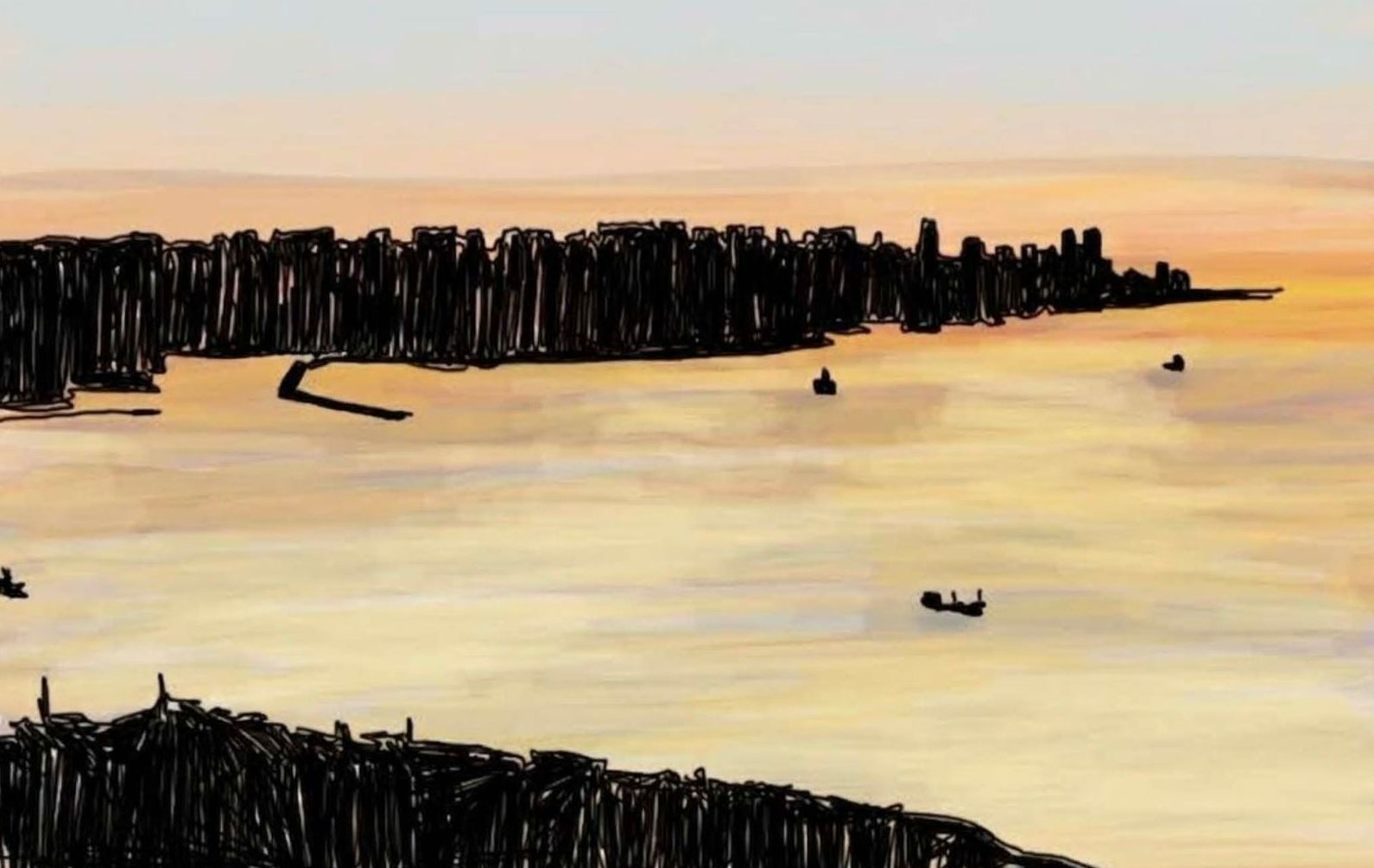
“Beirut is broken, and so is my body,” wrote my friend Nay on Aug. 5, 2020, in a diary entry that she shared on Instagram. She had just survived one of the largest nonnuclear explosions in history. The day before, in the midst of the COVID-19 pandemic, 2,750 tons of ammonium nitrate exploded at the port in the heart of the Lebanese capital. The material had been stored there since 2013, unbeknownst to most of the population and for reasons that remain unclear.
Writing these words now, and remembering the event as we approach its six-year anniversary, feels strange, because since the explosion, Lebanon has been through years of constant attacks.
Last summer, Nay was telling me that she was still processing her trauma from the blast. She did not remember any of her writing from that period — none of her diary entries sounded familiar to her anymore — but still deeply related to each of them. The shock was still extending through time, spilling into her life.
“To explain why I still feel that way, I have to go back and tell you exactly what happened to me on that day.”
She made it out unharmed, and so did her loved ones — “the best possible survival situation,” she tells me. However, like many in Beirut on that day, she came close to being killed.
On the evening of Aug. 4, 2020, Nay was in her room in her family’s Beirut apartment, having a Zoom call with her partner, then in France. At some point, she left her room and was walking toward the corridor to ask her father something. This was exactly when the explosion happened. In a matter of seconds, Nay was propelled into the corridor. Her room was destroyed. The large glass window in front of her bed had exploded, and the ceiling had fallen in. Sharp shards of glass were scattered throughout the room.
“It all just stopped in front of my feet. Nothing got to me, as if someone had shielded me. To this day, I can’t explain it.”
Nay told me that the feeling was still with her, five years on: seeing her room, and her home, absolutely shattered. Her father appeared in front of her. As he was rushing to check on her, he had walked on the shattered glass that was all over the floor, and his feet were all bloody. She vividly remembered how calm and collected he remained, until he asked if his wife was still alive; then his voice broke. There were other things she carried with her, still: the feeling of the blast and its sounds.
“I didn’t have a brain anymore.”
Several times during our conversation, she insisted that if she hadn’t stood up at that specific second, she would be dead.
Unlike my friend Nay, I experienced the Beirut explosion from the diaspora. On Aug. 4, I was sitting in the Jardin du Luxembourg in Paris, scrolling through Instagram, purposelessly jumping from one story to the next, when, there on my phone’s tiny screen, I witnessed the city where I was born exploding.
In 2020, words popped up on my screen: performances, poems, diary entries like Nay’s, angry messages, songs. Beyond the shock and grief of Aug. 4, what surprised me most was the outpouring of these raw testimonies on social media — from dream reports to drawings. In the middle of these feelings of powerlessness and grief, keeping a record gave a fragile sense of agency. I took screenshots of everything.
Mere hours after the event, I began gathering a digital archive based on these testimonies. Many of these, written in the heat of the moment — raw, unembellished — were able to say something about the specificity of the Lebanese trauma that I had never seen expressed before. Growing up in the West, representation was scarce, and sometimes the only representation you have access to is too carefully crafted, framed for a Western gaze. The outpouring of testimonies I saw here was something different.
On the night of Aug. 4, 2020, however, the disconnect between the news from Beirut and the unwitting behavior of Parisian friends had never been as openly jarring. On Instagram, I could see my French friends posting pictures of their holidays — having beers, finding a cool spot on a beach — while my Lebanese friends posted stories about the big, shattered window that had almost killed them, the glass all over their living room, and urged people to donate blood in hospitals that were already flooded with injured citizens.
Every minute, another piece of information popped up on my phone’s screen: This person is safe, that person is injured, the ammonium nitrate had been stored there since 2013. Anyone present in Beirut between 2013 and 2020 could have died at any time. My heart was aching; other people’s bodies were bleeding; 300,000 people lost their homes; the government knew about the ammonium nitrate and didn’t do anything. Seven thousand people were severely injured. The youngest victim of the explosion was 3 years old, and her name was Alexandra Naggear. We all start reposting stories, trying to “raise awareness” and raise funds.
Chloé Kattar, a historian focusing on Lebanon, also experienced the blast from abroad at the time. When we discussed it, she explained: “These are collective experiences, not things that you live on your own. The images were vivid. Even for the diaspora, it was already a collective trauma.”
“We were driving to the mountains to take shelter there, and I remember the noise of shattered glass on every street. All the cars in the whole city were simply driving over the glass. Beirut felt, smelled and looked like it was the end of the world,” Nay told me.
Meanwhile, in France, someone urged me to think about “the positive side of things” — to them, the explosion could be “the best thing that could have happened to Lebanon,” since it would put us in a good position to receive international help.
By now, we have become accustomed to witnessing some of the world’s most brutal catastrophes on our screens. But in 2020, the experience of digitally witnessing events of this magnitude was still new. Everyone in Beirut with a camera phone and social media account became a reporter of some sort. What the algorithm reshared became instant archival material, and social media was transformed, on the spot, into a new way of experiencing history.
I saw pictures of shattered belongings on the streets and on the floor: children’s drawings, cards celebrating Mother’s Day from 10 years ago, dolls and stuffed animals. Instagram was becoming more immersive, swiftly blurring the boundaries I thought existed between my two worlds.
My impulse to archive everything started on Aug. 4, 2020, born of feelings of disconnection and loneliness. It continued for years. A few weeks after the blast, I shared a public call for testimonies, and people sent me more dreams, diary entries, poems and drawings. They were sent from Australia, the United States, Beirut, France, the United Kingdom and many other places around the world.
These unknown voices moved me to my core. I had left Beirut in 2006, at 8 years old. For me, as for many others, the diasporic experience had always been a slow and pernicious process of dissonance.
In the fall of 2020, I began receiving more of these testimonies — all documenting the event. Something had shifted. I could sense it in the words of these strangers: They were expressing the fear of history repeating itself, addressing their parents’ denial and, most of all, criticizing the government’s inaction and complicity.
In the diary entries she sent me at the time, the photographer Myriam Boulos had written, “I wonder, if I don’t look at these emotions, will they disappear?”
I have often wondered whether my desire to archive came from a similar impulse, born of the dissonance I felt between the magnitude of the event and the uncanny indifference of the Western world, alongside the Lebanese government’s failings. There was a need to record things before they were suppressed, forgotten, buried or appropriated.
In Lebanon, history textbooks stop in 1943, with Lebanese independence. Our parents’ generation, who had survived the civil war, tended to address it with a mixture of denial and silence. I grew up with no accessible archives of what had happened in 2006 — only childhood memories of evacuation and uprooting.
This is how, in the middle of a gray, tepid Parisian COVID-19 lockdown, I immersed myself in their words and spaces. I started experiencing Beirut through Tara’s eyes. I didn’t know her, yet she had sent me dozens of journal entries.
A few months before the blast, she said in her diary, she had met another girl at a party, and the two of them began a romantic relationship right before the March 2020 lockdown. In Tara’s journal, I discovered another city: a place where a stranger fell in love and then experienced a deadly, apocalyptic catastrophe.
Following the explosion, Tara began sharing her desire to move away from Lebanon; that same urge was shared by most of her friends. On the day after the explosion, some were still trapped under the rubble, and the smoke was still lingering in the air. Yet in her diary, Tara describes the evening of Aug. 5 as “a normal Wednesday night,” on which she and her friends discussed “the best way to kill politicians and how to leave the country.”
I dove into Tara’s diary and into her daily life: the morning coffee she drank with her mother, trying yoga during lockdown, maintaining a romantic relationship in a world decimated by the explosion and one of the worst economic crises in the world.
Tara’s apocalyptic, tender and funny descriptions overlapped with the dreamy, blurry memories that I had of the place I left as a child.
Tara met her partner at the time in a building that was destroyed by the explosion. In her journal, she glued two pictures: the place before and after the explosion.
One sentence struck me in particular: “The place where we made memories, they are destroyed, but I will continue to make memories with you in every city that I can, until they destroy them all.”
Unsurprisingly, perhaps, writings coming from the Lebanese diaspora are driven by a different dynamic. Diasporic writing often carries fantasies of returning to the ancestral land, and the relationship with space feels different — perhaps less embodied, more metaphorical.
Around the same time as I was discovering Tara’s journal, I started to become more familiar with the artistic universe of “Antigone Beyrouthine” — the Beiruti Antigone — an Instagram account whose drawings became widely shared online. The artist’s name is Marie; she lives in Paris too. I am fascinated by Marie’s representation of space. In her way of expressing her trauma, she is challenging the Western canon and reinventing it.
Marie and I started to chat a little on Instagram during the COVID-19 lockdowns, and we met for the first time in 2021. “I always identified with the figure of Antigone,” she told me, referring to the ultimate clash between personal conscience and state authority in Greek mythology. Antigone, a Theban princess, defies the king’s law to bury her brother and dies for her act.
“When I saw everything that was going on — the thawra [revolution], the protests, the government’s repression — I was struck by its resonance with social justice, and by how it could mean something not only at the scale of one character, but of a whole people.”
Marie’s work is inspired by Jean Anouilh’s rewriting of Antigone, which was first staged in Paris in 1942, during the Nazi occupation. The play already carried a strong message of resistance, subtle enough to evade Vichy censorship and be performed in front of the Nazis, who didn’t suspect a thing. Marie, who had already been compelled by the play’s story, felt its deep resonance in the aftermath of the explosion. She decided to rewrite the play, but this time through a Lebanese lens.
At the time, rewriting Anouilh’s play was also a way to reconcile both of her hyphenated identities — her father is French and her mother Lebanese — in a period when she felt that her French environment met her grief with utter incomprehension.
Through my work on the explosion, I gradually felt more connected to the concept of “postmemory,” coined by Marianne Hirsch.
A child of Holocaust survivors, Hirsch argues that “to grow up with overwhelming inherited memories, to be dominated by narratives that preceded one’s birth, is to risk having one’s own life stories displaced, even evacuated, by our ancestors.” Inherited memories can be passed down, invisibly but so strongly, she states, that they can be “remembered” more vividly than our own — despite silences. In her book “The Generation of Postmemory,” she also argues that these effects are most visible in the cultural productions of “the generation that came after.”
But what happens when it is not only memory that we inherit, but also the same politicians, similar catastrophes and the narratives of a war that should have ended decades ago? How do we think about postmemory in our region, and about a past that has become recurrent? On Aug. 4, whether we were in Lebanon or in the diaspora, amid our grief, we all noticed our parents’ deep denial — and the impression that history was repeating itself, this time with us there to witness it.
This has influenced Marie’s work as an artist, and Nay’s research as a doctoral student in history. Marie’s mother speaks very little about her experiences in Lebanon, but the attacks on Nov. 13, 2015, in Paris, when 132 people were killed in one night, violently triggered her memories of the civil war. Nay grew up struck by her parents’ defense mechanisms. “When the explosion happened, once they checked that everyone was alive, they went straight into ‘reconstruction mode.’” Her father got ready to go check on his colleagues while his mom was helping him; they were acting as if nothing big had happened. “You could tell that this is how they learned to get through the war.”
This takes me back to the nightmare Nay shared on social media very soon after the explosion. In the dream, she is with a childhood friend in a big old house. They see a missile; there is a big explosion, and “the sound is HUGE.” While, in her dream, Nay asks everyone to stay in the hallway, she only finds her father, who says he didn’t hear anything, won’t move and needs a nap.
Similarly, Marie told me that her uncle had “mad laughter” when he learned about the explosion. This echoes what the illustrator Lamia Ziadé described in her book “My Port of Beirut,” which came out in 2021: A few hours after the blast, after rushing to shelter in the mountains, they found their father seemingly indifferent to the catastrophe. Unbothered, he simply started to watch a documentary on Russia, as he had planned to do days earlier.
How can we remember the Beirut explosion, all these years later, I wondered, amid all the pain and trauma going on in the region? After all that Lebanon itself has been through? In the summer of 2025, I reconnected with Marie, Nay and Tara.
Nay has had nightmares every single night since surviving the explosion, she told me. The explosion was one of the triggers that pushed her to leave her country and pursue a doctorate in the U.S. in 2021.
A few weeks before she left, she had explained how the explosion had changed her relationship with space and shattered her sense of safety: “If this can happen and remain unpunished, anything else could happen to us. We’re not respected; we’re not considered. We’re seen as ants, not people.” Here too, even back in 2021, there was an anticipatory logic. And those of us who keep anticipating the next trauma have not been proven wrong by history.
Nay visited Lebanon for the last time in 2025. Even if she wasn’t physically present in Beirut during the subsequent bombardment of southern Lebanon and parts of the capital, the sense of insecurity rooted in the explosion persists. In North Carolina, where she lives now, there are many thunderstorms. That summer, when we talked, she told me that she stayed away from windows “as if they could explode at any time.” It is as if she carries what happened in Beirut with her, across oceans and through the years.
After the explosion, the shock to her body was so profound that she needed physiotherapy for several months. When she talked about the aftermath, five years later, she used the word “humiliation” several times — humiliation at the hands of a government that was able to destroy a city and traumatize, maim and kill its own citizens.
But also humiliation through the gaze of others. “Once, during one of my first semesters studying in the U.S., there was a huge sound in class — a slamming door. I had an extremely violent reaction, so everyone turned to me. And I could feel their pity in their eyes. And I felt humiliated.” Tara, too, was obsessed with leaving and went abroad for a while. Yet she came back to Beirut.
She told me that, after the explosion, she had absorbed many of the feelings of her partner at the time, who had come very close to being killed on Aug. 4. The memories of the explosion became tied to the relationship. “I think there is something about cities and relationships — they’re linked,” she said. “You have to go on. You have to. You make new memories, with new partners.” Now, however, whenever she passes through Beirut’s suburbs, she wonders whether the destruction will ever stop.
I recall the sentence she wrote in 2020 about making memories in every possible city “until they destroy them all.” At the time, I was struck by the anticipatory logic of a war that seemed unavoidable in Tara’s words, moving from Beirut to the whole world. When I asked her about that sentence in 2025, she had completely forgotten about it, but it still felt deeply and sharply relevant to her.
Its accuracy was unsettling then and still feels very much so today. In her book “For the War Yet To Come,” Hiba Bou Akar argued that post-civil-war Beirut had been rebuilt in a space of in-betweenness, according to sectarian logic and in anticipation of “a war yet to come.” I am left wondering whether, like our city, our notions of memory and healing, as Lebanese people, are also structured by the idea of “the war yet to come.”
Marie, who has visited Beirut a couple of times since 2020, has found the city unrecognizable each time. “My cousin and I stayed in an Airbnb in Gemmayze. I feel that the neighborhood has lost its soul. You can still see traces of the explosion — missing windows and inhabited buildings that remain damaged.” It is a “ghost neighbourhood,” she told me, filled with Airbnbs but emptied of its own people. Her sensory experience of Beirut has also changed, she said. As a little girl, Marie and her sister used to count the silences between the car horns when they were in Beirut. In her childhood memories, Beirut was overwhelming in its smells and sounds. Now, they count the car horns between the silences.
Marie, Tara and Nay all agree that we aren’t talking enough about the Beirut blast. Tara describes the monthly protests at the port, mostly attended by victims’ relatives, who continue to demand justice. “But the crowd is getting smaller and smaller.” In her journal in 2020, life seemed to pass very slowly, as if time itself were diluted. The future seemed very far away. Now, she tells me, things move far too quickly, and there is no time to process or remember — she doesn’t have time to write anymore.
Marie, similarly, told me that she stopped working on Antigone for a while, but a few events have made her consider returning to the project. One factor was our conversation in the summer of 2025, which prompted her to think about the concept again. She also told me that one of her friends, a literature teacher, had her students study the draft of her graphic novel in progress on Antigone. The next day, Marie’s friend arrived in class to find that the blackboard was filled with drawings and comments about the Beirut explosion, along with the exact time of the blast: 6:07 p.m. This encouraged Marie to continue raising awareness through her work and to embrace her dual cultural identity rather than allowing it to limit her.
There was another sign: In the summer of 2021, she returned to Beirut to work with a Lebanese nongovernmental organization. She and other volunteers worked on construction sites near the port, helping to clear debris and remnants from buildings and homes. Several months later, beneath the rubble, one of her NGO friends found, among bills and administrative documents, a first edition of Anouilh’s “Antigone” — unharmed. She sent it to Marie, telling her that she should keep it and see it not only as a symbol of resistance, but also as a sign to continue her work.
Marie and I found, once again, that we had so much in common. Through her work, she wanted to counter both the oblivion of her French environment — on Aug. 4, she learned about the explosion when a co-worker had insensitively informed her that “it looked like her country was blowing up” — and the silence within her own family. One of her uncles, upon learning about her work on Beirut, said that it was “not her story to tell,” since she hadn’t experienced the civil war, like he did. That, too, is what Marie continues to resist.
As the sun set on the terrace of the bar where we met in Paris in August, sipping cocktails made with pomegranate flower, cardamom bourbon, pear, zaatar and tequila, Marie told me that reading the archive I had gathered gave her a sense of hope and community. “All these women who wrote after the explosion, who survived — they are all Antigones of a sort.” It inspired her deeply and made her think about her project in a more grounded way.
“Maybe,” she suggested, “we could do this together, you writing about these women and me illustrating their work.”
“It is Beirut, all over again,” wrote the Lebanese poet Etel Adnan in 1990, as she witnessed the civil war in El Salvador unfolding on her TV screen in her home in San Francisco. Instantly, by seeing the disturbing similarities of civilians caught between different political factions, she was reminded of Lebanon, and reminded that the civil war and its horror kept existing, somewhere else, in another form. Six years on, we have no justice and might never know what and who caused the port explosion in 2020. Yet, Adnan tells us, the very root of imperialism, the quest for power and domination, remains the same, and our different struggles are intertwined:
But Beirut will not sleep
until El Salvador sleeps
and San Francisco will
not eat until Eritrea eats
and El Salvador
will not die
In 2021, in the aftermath of the explosion and the economic crisis, the scholar Maya Mikdashi stumbled upon this Adnan poem, and had already noted the sharp echoes between the past and the present: “The Lebanon of 1990 was divided, full of rubble, garbage, fuel and bread lines and people with guns. Thirty years later, Lebanon is divided, full of rubble, garbage, fuel and bread lines and people with guns.”
The experience of Beirut itself is torn with “doubleness” and divisions, whether it is a diasporic experience or not. It is anchored in different temporalities, all at once, as if the memories of the past and generational suffering were contaminating the future. I remember my conversation with Kattar, around the same time. She didn’t like to talk about a “cyclical history” back then, but understood Lebanese history as a sequence of events linked by a cause-and-effect relationship. To her, it all dated to the 1989 Taef Agreement, which ended the civil war, and an amnesty law passed in 1991, which forgave all war crimes, plunging the country into amnesia. “After the war, we kept using war policies, in a time of peace. With time, this led to a regime based on impunity.”
From Paris, Marie tells me that she cannot believe it has been six years already since the Beirut explosion. It feels, to her, that much more time has passed. In retrospect, 2020 felt to her like “only the beginning of the apocalypse.” Since then, she explains, “I wake up exhausted, look at my phone, check the news, check if my family is alive.”
It is Beirut all over again: buildings disappearing in seconds. Marie tells me the impulse to draw is still here, that drawing is saving her. In 2020, it helped her so much that people had written to thank her for her art. She uses clay now — maybe, she says, in reaction to all this destruction. The Antigone project is still dear to her heart. Documenting, to her, is more important than ever. “I don’t even know what I am grieving now. It feels like I am grieving so many things at once,” she tells me.
I think of the world that opened inside my phone, six years ago. Out of suffering, it became a space of conversations, community and new words. Words of strangers alleviating decades-old pain, and healing. Ours, of course, but also the pain that has been inflicted on those before us. Adnan writes:
it is Beirut, all over again,
because poets die
rather than surrender
…
because poets refuse to die,
and carry hope on their
backs, and go from door
to door
…
to leave messages of defiance
in the
people’s hearts.
Become a member today to receive access to all our paywalled essays and the best of New Lines delivered to your inbox through our newsletters.