

In the summer of 2021, I set out to walk the 15 minutes from my apartment to Hamra Street, and turned back after two blocks. I have been explaining that to myself ever since.
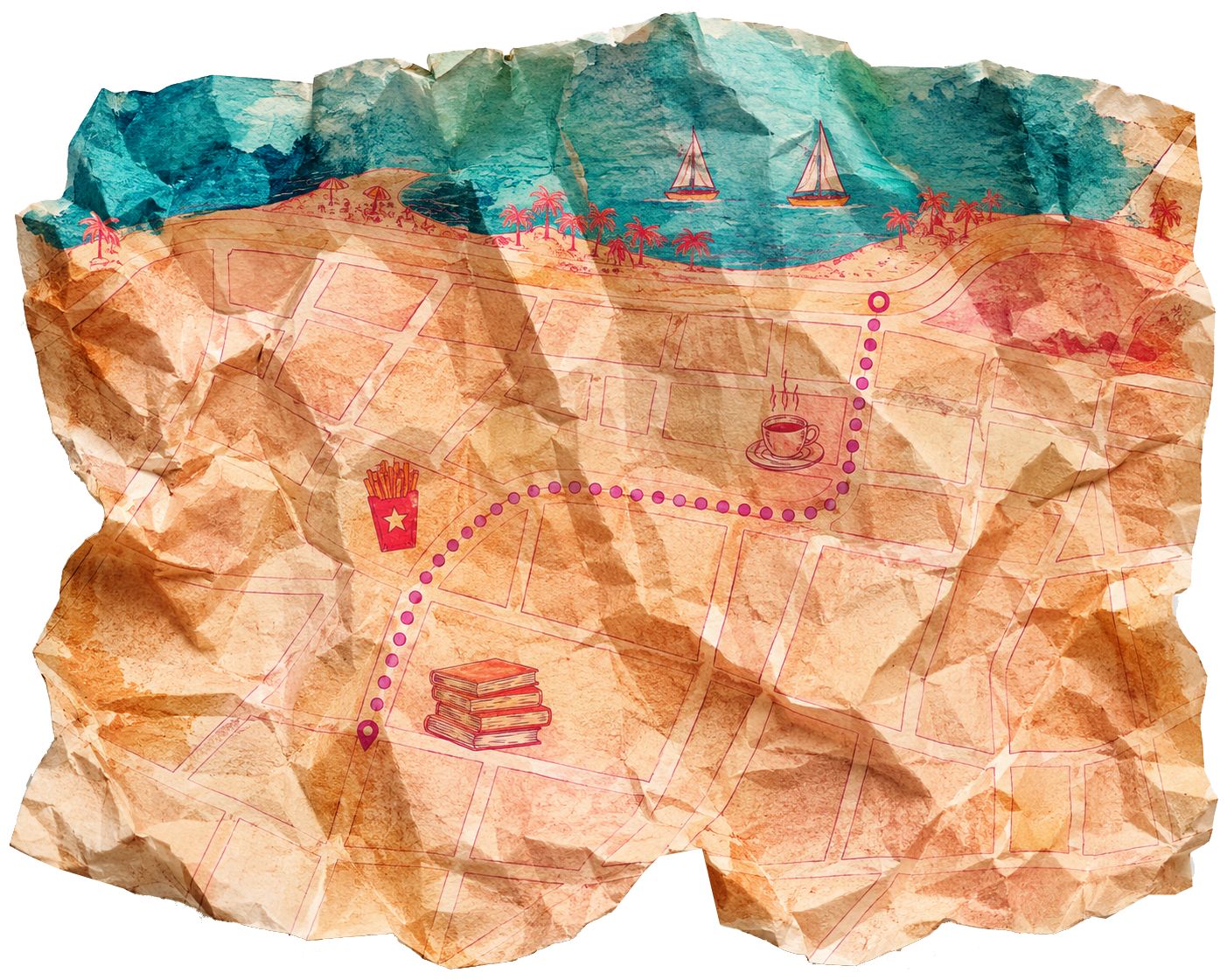
The walk begins in Ain al-Mreisseh, with the Mediterranean at your back, and climbs toward Hamra. I made it for years without thinking about it: to class, to the cafes, the bookshops, the stores; to Malak Al Batata, a sandwich shop that made the best french fries. It became more of a habit of the body than merely a route. With the sea behind you, the city rises ahead, leading to a street at the top that believed, more than any other in Beirut, that it was the center of the world.
I had been away the summer before, kept out by the COVID-19 pandemic, and by then the city I was returning to had been through the 2019 economic crash, the explosion at the port and the fuel crisis that switched off its lights. Most streets went dark at night. Light became a currency, and you could read the city’s class divide from a rooftop.
I was homesick for something I could reach on foot, and Hamra was a few minutes away. So I went.
I understood my mistake immediately. There was a Hamra I was walking toward, and it existed mainly in my memory. The street in front of me had stopped resembling it years earlier and I had watched it happen, summer by summer. In the course of a decade, the street had come to look more like its namesake in the Syrian capital than its original self, as refugees fleeing the violence next door settled in Lebanon, bringing their businesses with them.
I had known all this. But that summer, after the crash and the explosion and the dark, the knowing had slipped. Homesickness had restored the older street, and I walked out the door toward a Hamra that no longer existed. I was approached for money before the first corner, and again before the second. I cut the walk short and went home, and for five years I did not set foot on Hamra Street again.
Soon, and without deciding to, I began keeping a private map of Beirut in mind. It contained the places that still looked like themselves, and the places I no longer recognized. I came back every summer and every winter break and moved through the city the way you move through a house where someone has died, keeping to the rooms that hurt less. Gemmayzeh, where the buildings still match my memory of them. Beirut Souks, once they reopened. A short list of streets and cafes and facades that could be relied on. Everything else I crossed out and the city became smaller, more defined and a lot more manageable. This way, I could keep loving it — or pretend to anyway.
This summer, I decided to stop. I made a list of the neighborhoods I had been avoiding, the ones that had changed the most and the ones I had loved the most, and it turned out to be the same list. Then, one morning, I walked them in a line, starting in Ain al-Mreisseh, where I lived for 12 years. From there, up to Hamra. South to Verdun. Northeast to Downtown. Then across the old green line, the imaginary border that once split the city between a Christian East and Muslim West, to Gemmayzeh, where I live when I am here now.
Ain al-Mreisseh takes its name from water, “the spring of the small anchorage.” Fresh water once met the sea here, and boats moored where the two touched. The old fishers’ port still exists, tucked beneath the seafront boulevard like something the city forgot to demolish. On the corniche above it, the mornings have not changed: the joggers, the men with fishing rods, the men with thermoses of coffee, the men with shishas, the men versed in catcalling and the sea doing what the sea does. A mosque from 1887 keeps the neighborhood’s oldest date. Everything else keeps newer ones.
I moved here in 2010, with my late husband and my infant son, to an apartment on John Kennedy Street, a few feet away from the American University of Beirut. The neighborhood was still, in the word I used then without examining it, authentic, with its handful of red-roofed houses from the 1920s and ’30s wedged between the towers. In a building near ours lived an artist, in the same apartment where he was born. He kept a studio on the ground floor, where he painted old Lebanese houses and made custom frames to supplement his income. For years, he was a fixture in the neighborhood and his presence was part of what gave the street its character.
The towers had been rising over those houses for decades by then, glass and seafront-priced, bought as investments by people who lived elsewhere. At night, the old houses glowed a low yellow while the towers remained dark for months at a time, whole floors of them owned and empty. The neighborhood was already two neighborhoods on top of each other, and the one with the lights on was the one being slowly squeezed out of existence.
The painter left in the late 2010s. The studio went first — the arithmetic of the street no longer had room for a ground floor that produced paintings and custom frames — followed by the apartment he had lived in since childhood. He moved east. The last time I saw him, he told me he had come to feel like a stranger in his own neighborhood. I have thought about that sentence for years, because he said it while the street, from my balcony, still looked like itself. The neighborhood was losing its people before it lost its appearance. That is how it happens, and now I know. The facades hold even when the lives behind them are already gone.
I left in 2022.
Last week, I started the walk where my old building stands. The neighborhood has received the recent war with Israel the way it once received investment money: as a force from elsewhere, redrawing it.
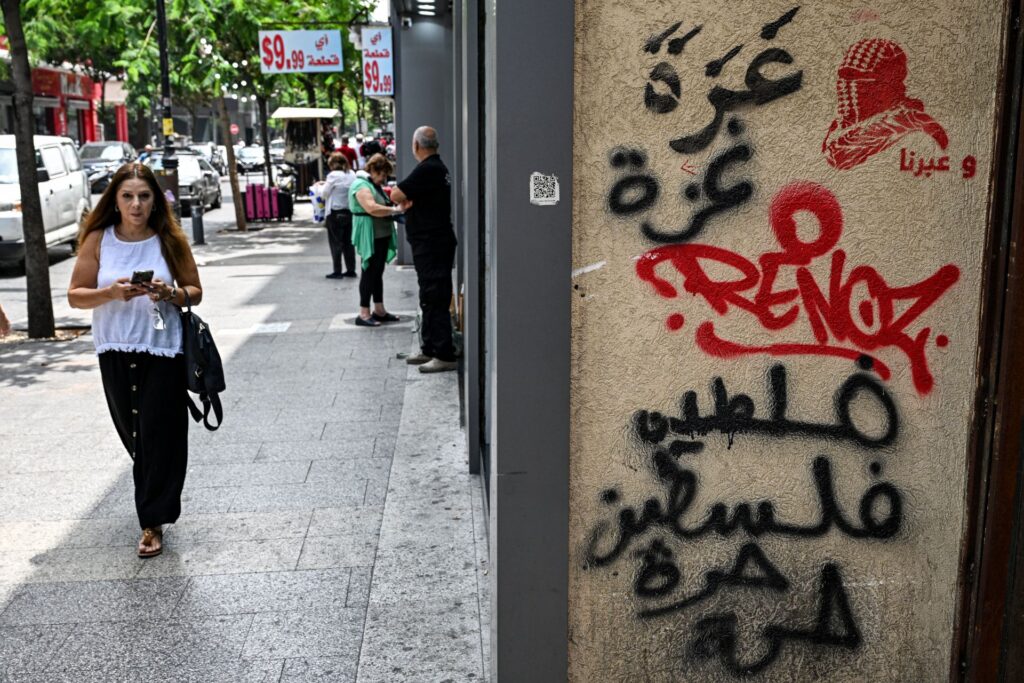
Families displaced from southern Lebanon have filled the blocks, even moving into abandoned buildings, including the dilapidated ones. On the walls, I saw the same graffiti I lived beside for 12 years: “Amal,” the political party, hand-painted in Arabic, the logo, the green. I never read it as anything, it was always part of the street, like the wiring and the Mediterranean. Walking past it now, I understood that the neighborhood had changed to match its walls, not the other way around. The writing had been there all along and I had lived in a sentence without understanding it.
From the sea, the walk climbs.
Hamra is the street the walk was always about. For a stretch of the 1960s and ’70s, this one avenue, a few hundred yards of cafes, cinemas and bookshops, had a serious claim to being the intellectual capital of the Arab world. The universities explain part of it, as it runs between the American University of Beirut on one end and the Lebanese American University on the other. The rest was the era. Arab writers, journalists and political dissidents who could not publish at home published here. Exiles from every failed revolution took tables at the sidewalk cafes, arguing and opining. The street had movie houses showing films the rest of the region banned, and it had money.
By the time the street was mine, in the late 1990s, the golden age was already a story told about it. But the shape of that age was still there. I was a student at LAU, up the hill, and Hamra was where we went between classes and instead of them. Walking it was the entire activity, because the street itself was the destination. My cafe was Modca, a sidewalk institution of the old kind, where you could hold a table for an afternoon over one coffee. There were the stores I went to as a child with my mother (and later shopped at for my son). When Starbucks opened across from Modca, in the early 2000s, everyone understood it as an omen, and I have never quite agreed. An American chain, yes, but people came and stayed for hours, and the sidewalk stayed a sidewalk. It kept the street’s oldest habit. Not everything foreign that arrives on this street arrives as a conquest, and it matters to say that now, before I list the rest.
Because the rest of Hamra’s history is a list of arrivals, and the street records them like strata. The civil war ended its golden age and the cafes of the Arab left soon emptied as the militias carved up the city. In the summer of 1982, Israel invaded Lebanon and besieged Beirut. That September, its soldiers did what no Arab capital had seen: They walked down the street itself. It was at a cafe here — the Wimpy, a hamburger franchise, of all things — that a young man named Khalid Alwan stood up and shot at Israeli soldiers, then disappeared into the side streets. The operation became one of the founding acts of what Lebanese would come to call the resistance. I walk past where the Wimpy stood and think about how that word in its many Arabic iterations (muqawama, thawra, nidal, kifah, haraka watania) began on this street, local, secular, aimed at an occupier, and what has been done to it since. But that is for later in this walk.
In the 2010s came the arrival I watched most closely. Damascus has a central shopping street named Hamra. For 30 years, Syria ruled Lebanon in all but name, after its army entered in 1976, a year into the civil war, and stayed until 2005. When the war broke out in Syria in 2011, its Hamra came to ours, with the lingerie shops and the nut roasters, the window displays arranged exactly as they are in Damascus, the cafes converting one by one to cater to a different clientele. For 30 years, Syria sent Lebanon its rulers. Then it fell apart and sent us its ruined. I found the resemblance disorienting in a way I am not proud of; it took me years to understand what I was looking at, which was not my street being taken but another country’s collapse being unpacked onto it.
Then the economic collapse of 2019 stripped whatever was left.
Last week, I finished the walk I abandoned in 2021, and took the inventory. A bank stands where Modca stood. The Piccadilly Theater — a grand cinema where Fairuz once sang — burned in 2000 and has sat sealed ever since, a hollowed shell from the street’s golden age that no era since has had the money or the confidence to reopen. The Commodore, the hotel where the world’s war correspondents drank and filed through the civil war, closed this past January. And Tosca, a record shop that has been on the street since 1958, is open. I cannot explain how or why history takes a cafe and spares a record shop and no one keeps those accounts.
From Hamra, I turned toward Verdun.
You know whose neighborhood Verdun is before anything tells you. That is the point of it. In Ain al-Mreisseh, the claim on the street is hand-painted with green graffiti, a logo, and a single Arabic word. Elsewhere in Beirut, the claims are printed and hung like party flags on lampposts, posters of martyrs and faces of leaders looking down at traffic. Verdun does not have that, but the way its streets behave explains it all. There are barriers, armed police and traffic diverted around a compound. Behavior, in this city, is the highest form of writing. Graffiti asserts a claim, and a flag maintains one. But silence, on the other hand, means the claim is settled.
The word on my old street’s walls has a name and an owner. Amal began in 1974 as the movement of Musa al-Sadr, the Iranian-born cleric who organized Lebanon’s Shiite poor — the neglected south, the Bekaa, the migrants filling Beirut’s suburbs — into a political force, and then vanished on a trip to Libya in 1978. The movement he left behind became a militia in the civil war, and the militia became the property of Nabih Berri, a lawyer who has led the party since 1980 and has been the speaker of Lebanon’s parliament since 1992 (making him the longest-serving head of any legislature worldwide). His residence and headquarters, the Ain al-Tineh palace, sits on Verdun’s coastal edge. For three decades, the country’s crises have gone there to be brokered. And the neighborhood was arranged around that fact.
It was not always anyone’s fortress. In the early 1970s, Verdun was one of Beirut’s elite quarters, where families of every confession who could afford the address lived. The war unsorted it the way it did everything else: Christian residents fled West Beirut, and money displaced from the south — families who had the means to skip the crowded suburbs — bought in. By the time I knew Verdun, in the 1990s and early 2000s, it had become a shopping destination. With the old downtown still in ruins, Verdun became where the city went to shop, to the movies and to dine. The palace was there then, but it never felt like a political place.
Nothing in this city, it seems, is allowed to stay that way.
Two things ended Verdun’s reign, and neither was a war. The first was business with new commercial developments in other parts of the city, and the second was the perimeter. Somewhere in those same years, and I cannot date it, because it happened the way security always happens here, one barrier at a time, the blocks around Ain al-Tineh hardened into a zone. One day, I found myself maneuvering through concrete barriers, checkpoints and police officers’ passive-aggressive attitude that tells you to turn around.
Last week, I walked instead of driving. On foot, Verdun feels like a gated community built inside a war zone; the nearest thing I know to it is the Green Zone, the fortified enclave the American occupation walled off in the middle of Baghdad. The comparison arrived on its own and I could not talk myself out of it. The neighborhood I loved for being the least political in Beirut is now the most secured.
I turned east, toward the center of the city.
Before the war, this area was accessible to everyone. The Bourj, Martyrs’ Square and the districts around it, held the souks, the cinemas, the newspaper offices, the bus station. Every sect passed through it because everything ran through it. And perhaps that is why the war chose it, snaking its imaginary green line straight across its square. For 15 years, the shared center of the city was its front, repeatedly shelled, sniped and emptied.
What replaced it was the most ambitious act of remaking in the city’s history, and the most contested. After the war, Rafiq al-Hariri, who had made his fortune in Saudi construction before becoming Lebanon’s prime minister, created Solidere, a private company that took possession of the entire ruined center. Property owners and tenants received shares in the company in exchange for their claims, at valuations many never accepted; the banner “Stop Solidere” on the Saint Georges Hotel and Yacht Club is the last loud survivor of that fight.
What Solidere built with Gulf money was a district of restored Ottoman and French mandate-style buildings and cobblestone alleys, more intact than the center had ever actually been, a memory of the city retouched by a developer. People called it Hariri’s showcase, and it was the argument he made, in limestone, that Lebanon’s future would be commerce, tourism and a Saudi-anchored peace. I will not pretend I stood apart from it. The center was open to us, and I did not much care to interrogate on whose terms. Even the criticism people made at the time, about a city bought from its owners, I heard and set aside, because it was beautiful, ours again, and I was young in a country that appeared, briefly, to be going somewhere.
The appearance ended in stages. Hariri’s assassination in 2005 brought a million people into that square and forced Syria’s army out of the country; for a moment the center did what centers do. The crowd had a word, and the word was “sovereignty,” a demand that Lebanon’s decisions be made by Lebanon. Half the country took it as a banner, the way the other half had taken “resistance.”
Then the rival camp answered. On Dec. 1, 2006, Hezbollah, the party born in the wake of Israel’s 1982 invasion, armed and financed ever since by Iran, and by then the most powerful military force in the country, occupied downtown, together with Amal. Their tent city stood in the squares for a year and a half, a siege of the government laid across the district’s commerce.
The tents eventually left, but the customers never returned. The state then finished what the sit-in began, sealing the blocks around parliament into a security zone of barriers and permissions, and the district settled into emptied alleys, deserted stores and more security forces than were needed to guard an area that hadn’t seen traffic in years. Built by one patron’s money, it was killed by another’s proxy, then fortified by the state against its own people. For a few weeks starting October 2019, a popular uprising filled its accessible parts again, every sect at once. It was the only crowd I ever believed in, and when that subsided, the barriers grew back thicker.
Standing in the district, you can read the whole record at once, and it is older than any of its entries. Ghassan Tueni, the publisher of Annahar, this country’s once-great newspaper, gave the civil war its most famous description when he called it “other people’s war fought on Lebanon’s land.” Half of that is true. The other half is that, since 1975, Lebanese factions have also used foreigners, their armies, money and moral alibis, in the name of resistance, sovereignty, protection and realism.
The war of others in Lebanon has always also been the war of Lebanese through others.
This year, both renamings collapsed. When Israel killed Iran’s supreme leader, Hezbollah answered from Lebanon, firing on Israel to avenge him, tying the south, with its villages, its dead and its future, to the outcome of another country’s war. Israel’s campaign has since killed more than 4,000 people and left its army occupying a fifth of the country. Whatever the word resistance still meant, that act by Hezbollah on March 2 emptied it. The distance from Khalid Alwan’s cafe table on Hamra Street to a barrage fired for a foreign leader’s grief is the distance the word resistance has traveled in my lifetime.
On June 26, the state emptied the rival word “sovereignty” when it signed a U.S.-brokered framework agreement trading Hezbollah’s disarmament for an Israeli redeployment on terms Lebanon does not control. Sovereignty negotiated under occupation and imposed through outside pressure is sovereignty that is already compromised. Each side now accuses the other of selling the country, and each is right about the other’s dependency.
Lebanon is no longer divided between those who want resistance and those who want sovereignty. It is divided between rival forms of dependency, each claiming to be a national project.
People call this a stalemate, but stalemate suggests paralysis, and Lebanon’s condition is too active for that because it produces dependency, feeds on it and has done so for 50 years. The country has not counted its population since 1932 — a census is the one document the sectarian arrangement could not survive — so the streets keep the records instead. Green paint on a seaside wall. Flags where a claim is being maintained. Silence where it is settled. A walk is how you read the national registry.
Two parts of the rebuilt center are busy today. Beirut Souks, which was wrecked in the port explosion and reopened this year, is looking exactly like itself again. The second is the newer, seaside corner of Downtown, a neighborhood of towering glass facades and tree-lined streets, accessible only to a few.
I was glad some parts recovered, but it also felt bittersweet. Of everything the center once was — the square, the papers, the crowds, the public markets — only an upscale shopping and dining experience remains.
I crossed the old line as the light went, toward home.
Gemmayzeh begins where the rebuilt center ends, and it is everything Solidere’s district is not. Its streets are narrow, stepped and lived-in. Its Ottoman and French-mandate buildings lean over streets that were never planned by anyone. This is the old east, the Christian quarter that faced the Muslim West across the line for 15 years. Its second life began in the mid-2000s as the city’s nightlife district, when a strip of bars, restaurants and cafes moved into the ground floors of heritage houses.
My Gemmayzeh begins in 2004. I was a reporter at The Daily Star, the English-language newspaper whose offices stood on this street. There was Paul, the French cafe where we stopped for coffee in the morning; Le Rouge, where we had dinner; and two bars, Torino and Dragonfly, where the night ended. I have measured every year since against that street, and here is the strange thing: It still measures up. The buildings match my memory of them. The businesses turn over, as businesses often do, but the constants hold. Torino is Torino. Dragonfly is Dragonfly. Paul is Paul. Of every street on this walk, only this one resembles itself and its character the most.
I know now to ask why. On Aug. 4, 2020, the port, which sits directly below this neighborhood, exploded when 2,700 tons of ammonium nitrate, stored for years in a warehouse, detonated. More than 200 people were killed across the city, and Gemmayzeh was shattered.
It resembles itself now because it was made to, but it did not escape the ledger. It survived through a different kind of patronage: of volunteers, heritage groups, embassies, local and international nongovernmental organizations and owners restoring buildings one by one. I am grateful for every stone of it. I also know what the gratitude means. Even the street that kept faith with my memory did so with help from elsewhere.
By the time I got here, it was already night, and the street was doing what it does every night. People were barhopping, traffic was at a standstill and valet attendants frantically jumped from car to car to clear the street.
An hour’s drive south, the villages remain empty and a foreign army decides who visits them. One part of this country mourns while another orders a second round, and the sentence is not an accusation, because I have a table, too. I live here. I chose this street because it still looks like itself, and I sat in it while the rest of the walk settled in my body: the graffiti, the perimeter, the banner on the ruined hotel and the square you can no longer stand in. Every stop on the walk is somebody’s compartment. This one is mine.
I woke up the next morning expecting to feel differently about the city. I did not. Nothing had changed. The south is still occupied, and the Lebanese-Israeli talks are still ongoing. The graffiti in Ain al-Mreisseh will outlast the paint it was made with. Even though the map I carried all these years is still in me, I walked through every place I had crossed out, and the city did not finish me off. I did not get the Beirut of my memory back. But it was OK.
For years, I treated each collapse here as a detour — the wars, the assassinations, the explosion, the crash — and waited for the country to return to itself. Now I know better, and I want to be precise about what that means. The crisis is one of the forms Lebanese life has taken. This is a description and is not meant to excuse anything. To accept the country as-is means to stop lying to oneself, and to keep demanding better with both eyes open, because the redrawing will continue for as long as every faction in this country believes the way out runs through a foreign capital. Nothing I passed on my walk suggests that belief is dying. The streets will keep the registry. Someone will keep painting, someone will keep hanging flags, and the most settled claims will keep their silence.
My son is 16 this year. He has his own map of this city, short still, made of other addresses. Some summer I will walk this line with him and say little, and let him take his own inventory. He will have to decide, as everyone raised by this country does, what terms to set with it.
I wanted Beirut to look like my memory so I could keep loving it. But memory is not a city, and love cannot live only in recognition.
Become a member today to receive access to all our paywalled essays and the best of New Lines delivered to your inbox through our newsletters.