

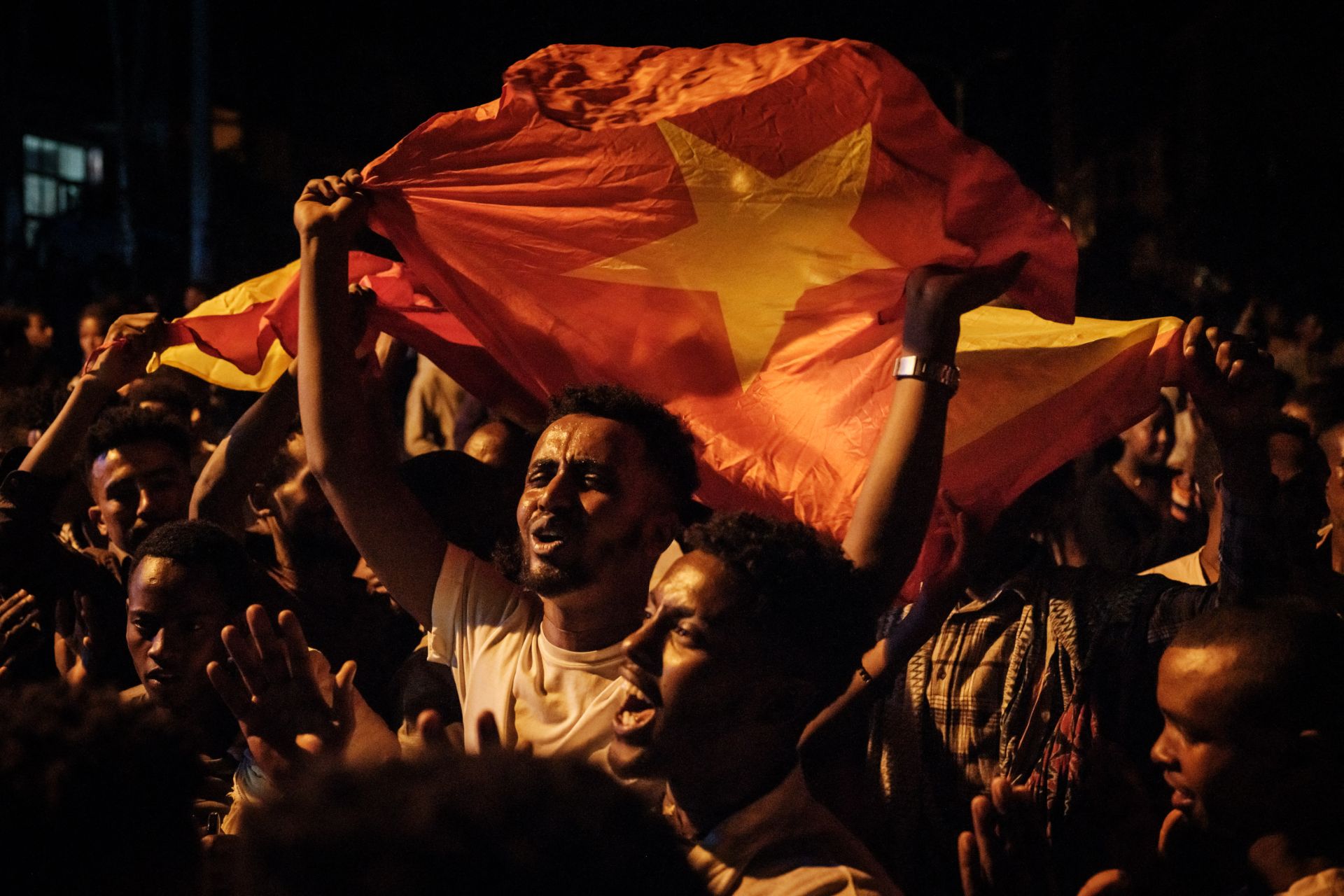
Like many Tigrayans, I live in exile from my homeland, Ethiopia’s northernmost region, bordering Eritrea. We are a people scattered by war. And like other such peoples, we know the pain of exile: the nostalgia, the heartache and the dread. Since mid-August, we have been hearing about bombs falling on Tigray, attacks carried out on a near-daily basis by Ethiopian fighter jets and drones. And since Sept. 23, ground battles have been raging in the region, which is sliding into war yet again.
Those of us who are lucky enough to live outside can only hope that our families and friends are safe. But it is hard to know for sure, since telecommunications have been shut down. I try to comfort myself by listening to music from the past. I keep returning to Mulat Hayelom’s “Selam Tigray” (“Peace to Tigray”), an old song that for me remains timeless and transcendental, even through the tinny speakers of my phone. “If your land is at peace, my homeland, you are desirable,” Mulat sings. “But in July and August bombs fell on your land instead of rain. Those who decided on war for you, my country, may they lose their eyes.”
Which leaders, I ask myself, deserve to be eyeless? Because someone keeps deciding on war for Tigray, time after time. My grandfather used to tell me stories of the 1930s, when Ethiopia was invaded by Mussolini’s fascist army, and Tigray was bombed with mustard gas. My father lived through the horrors of the long war against the Derg, a brutal military dictatorship that seized power in Ethiopia in 1974. In 1991, the Derg was overthrown by the Tigray People’s Liberation Front (TPLF), a grassroots rebel movement with mass popular support. You will not find a single family in Tigray that did not lose someone during those 17 years of armed struggle. The TPLF’s victory was supposed to usher in a new era of peace and development. But in 1998 it led Ethiopia into a devastating border war against Eritrea. My uncle fought and died in that conflict, one death among tens of thousands on both sides.
My turn came in 2020. That year Ethiopia’s federal government — led by an upstart prime minister named Abiy Ahmed — joined forces with Eritrea and militias from the Amhara region to wage war on Tigray. The conflict was merciless from the start. Civilians were rounded up and massacred. Women were corralled and methodically raped. In Western Tigray, nearly a million Tigrayans were expelled from their land by the Amhara militias, whose leaders openly declared their intention to ethnically cleanse the area. “We will erase you from this land,” the militia members told Tigrayans, according to Human Rights Watch, as they slaughtered people by the hundred and razed villages to the ground. I joined the resistance, which the TPLF led, after the Ethiopian army burned my village in southern Tigray and killed dozens of my childhood friends.
We fought for two years until the TPLF signed a peace agreement with Abiy’s government in Pretoria, South Africa, in November 2022. By then, more than half a million people had been killed. But we were full of hope for the future, believing that our darkest hour had passed. I remember vividly the day, nearly four years ago, when we heard that the peace agreement had been signed. People ran shouting through the streets, delirious and half-doubting whether the news was real. Parents who had recently sent their children for military training broke down in tears of relief. Everyone waited eagerly for a return to normal life, when peasants would be able to farm without fear of bullets, when students would attend class without fear of air raids and women would walk freely without fear of rape.
Now Tigray has been plunged into yet another war. Tensions between Abiy and the TPLF have been brewing for more than a year. The TPLF accuses Abiy’s federal government of failing to implement the Pretoria peace agreement, by refusing to cede control of Western Tigray and obstructing the return of the hundreds of thousands of Tigrayan internally displaced persons (IDPs) expelled from the area during the war. The federal government, for its part, says the TPLF is working with Ethiopia’s enemies to destabilize the country. It is particularly concerned about what its propagandists describe as an “unholy alliance” between the TPLF and Eritrea. Fierce clashes between the TPLF and the Ethiopian army broke out on Sept. 23, after the TPLF seized control of three airports in Tigray. Fighting is ongoing on several fronts.
The leaders in whom we once placed our trust have betrayed us and our sacrifices. During the last war, the TPLF told us that we had to unite to secure our survival. But today, after years of bickering among themselves, its leaders have split into two factions. Both are conspiring with the same enemies who sought to destroy us in the previous war. And both have played their part in bringing about a disastrous sequel to that conflict. No one knows how long this second war will last, or who will eventually win. What is certain is that ordinary people will lose — and that none of the leaders on any of the sides in this conflict can claim not to have blood on their hands.
It is impossible to make sense of this new war without first understanding the last. Back in 2018, mass protests in Oromia, Ethiopia’s most populous region, had forced the TPLF to cede power to Abiy, who became the first leader in modern Ethiopian history to identify as an Oromo, the country’s largest ethnic group. But the TPLF retained considerable influence, particularly over Tigray. Abiy, who has said publicly that he regards himself as Ethiopia’s “seventh king,” anointed by God to rule over the country, could not accept any checks on his power. Having chafed for years at his status as a subordinate in the TPLF-led order, he was determined to bring his former bosses to heel.
Abiy found plenty of willing partners in his war against Tigray. The most important was Isaias Afwerki, Eritrea’s totalitarian ruler since 1991. Eritrea had been defeated by a TPLF-led Ethiopian army at the end of the border war in 2000. Despite its military success, the Ethiopian government yielded to international pressure and signed a ceasefire agreement instead of marching on the Eritrean capital. Isaias would never forget his humiliation at the hands of the TPLF. When Abiy rose to power, he saw his chance to take revenge.
Others were out for blood, too. Abiy and Isaias were joined by a disorderly confederation of militias that had taken up arms in Amhara, Ethiopia’s second-most populous region. The Amhara elites behind these militias resented the power their Tigrayan rivals had accumulated since the 1990s. Their forebears had dominated Ethiopian politics during the imperial era, which ended with the fall of Emperor Haile Selassie in 1974. They now claimed that Welkait, an area of exceptionally fertile land also known as Western Tigray, had been stolen from the Amhara by the TPLF. That rhetoric prepared the ground for a ruthless campaign of ethnic cleansing, one of the most brutal subplots of an atrocity-filled war.
Abiy and his allies all said their goal was to destroy the TPLF. In reality, every Tigrayan was a target. We were “weeds,” the prime minister told Ethiopians during the war, a “cancer” that had to be uprooted. Long before the fighting began, he had described us as “daytime hyenas.” People across Ethiopia, following Abiy’s lead, took to calling us the “junta”: a vicious minority — just 6% of the population — that oppressed the masses through the power of the gun. The junta was suffocating Ethiopia, Abiy’s acolytes hissed, stealing the nation’s wealth and holding back its development. “They should be erased and disappeared from historical records,” said Daniel Kibret, a close adviser to the prime minister. “A person who wants to study them should find nothing about them. Maybe he can find out about them by digging in the ground.”
If someone had told me, when the last war ended, that in a few short years the TPLF would be working with Eritrea, I would have called them mad. Eritrean soldiers had been responsible for some of the war’s worst atrocities. In Maryam Dengelat, they slaughtered dozens of worshippers in a church on a holy day. In Axum, they killed hundreds of civilians and left their corpses lying in the street for days, shooting at anyone who tried to bury their relatives. Throughout Tigray, they systematically abused women. In numerous cases, Eritrean soldiers inserted rusty screws and other metal objects into the wombs of women they had raped, along with handwritten notes in which they gloated about how this would prevent Tigrayans from bearing children. Previously, the TPLF called this violence genocidal. Now they are working with the perpetrators.
Soon after the Pretoria agreement was signed, Abiy parted ways with Isaias, his chief wartime ally. Since 2023, he has been threatening to invade Eritrea in order to annex the port of Assab. Isaias has concluded, not unreasonably, that Abiy is a dangerous irredentist. To contain the threat, he has provided military support to an array of Ethiopian rebel groups fighting to overthrow Abiy — including his old enemy, the TPLF. “We have access to Eritrea,” a TPLF official told The Economist in June. “Coordination is going to be automatic.”
The decision to form an alliance with Isaias, however, led to a schism within the TPLF. In March 2025, the group’s hard-liners carried out a coup against Getachew Reda, Tigray’s president at the time, whom Abiy and the TPLF had jointly agreed to install as the head of the postwar regional administration. Established under the Pretoria agreement, this administration was supposed to govern Tigray on a temporary basis, until an election process acceptable to both Abiy and the TPLF could be organized. Getachew — a hard-drinking former law professor, famously prolific both in reading and womanizing — was until recently one of the TPLF’s most senior leaders. During the war, he was one of Abiy’s sharpest-tongued critics, once ridiculing the prime minister as a “political dwarf.”
Yet by the beginning of 2025, as hostility between Ethiopia and Eritrea deepened, the TPLF had begun to claim that Getachew and his allies had turned traitor after the Pretoria agreement, selling themselves out to become lackeys of Abiy. Shortly after the coup in March of that year, Getachew joined Abiy’s Cabinet as an adviser to the prime minister. In May of this year, he called for the TPLF’s leaders — his former comrades — to be “eliminated” by targeted drone strikes.
Since then, all hope for a peaceful future has evaporated. A few months ago, before the war restarted, I called Medhin, a friend from Mekelle, Tigray’s capital. We have known each other since before the war, when we were both students at Mekelle University in happier times. “Mekelle is not the vibrant city we used to know,” Medhin told me. “You can’t see happy faces, faces full of hope. All you see are exhausted faces.”
In the last war, the people of Tigray rallied around the TPLF. We felt we had no choice but to remain united and to fight, if we were to save ourselves from enemies who had vowed to eliminate us. This time, things will be different. No one that I know wants to fight in another war. They cannot see the reason, and we do not have a cause. Tens of thousands of people, especially the young, are fleeing Tigray. I myself left months ago. But I worry about friends and family who lack the means to escape.
They have been living in fear for months. In June, the TPLF issued an ominous proclamation, authorizing the forcible mass conscription of Tigrayan youth, criminalizing attempts to evade the draft and, in effect, outlawing all criticism of the party and its policies. Since the proclamation was unveiled, critics of the TPLF have spoken darkly about the “Eritreanization of Tigray.” They allege that the TPLF’s authoritarian turn has been inspired by the example of its newfound ally, Isaias, who has for decades maintained a draconian system of open-ended military service in Eritrea, which the U.N. has described as akin to mass enslavement. Kindeya Gebrehiwot, a close ally of Getachew, said “the Eritrean model of forced conscription is being replicated across Tigray” by the TPLF. Human Rights Watch wrote that the TPLF’s conscription drive “bears similarities to Eritrea’s abusive national service system.”
When I was young, I heard about people being rounded up and press-ganged into the army in Eritrea. It was impossible to imagine such things happening in Tigray. But the other day my brother called me from Mekelle to tell me that he had gone into hiding. “Soldiers came to our place, but my friends and I ran away from them,” he said. “Brother, I’m worried. I don’t know what to do. If my phone doesn’t work for two days, it means I’m conscripted.”
Other friends have told me similar stories. “I’m hiding with relatives,” said one from Shire, in northwestern Tigray. “The soldiers are searching from house to house.” Another, from Axum, told me: “In our village almost all the men are hiding in the hills to escape conscription. Only the wives and children are sowing,” adding that, “At this time [sowing season] we are supposed to be worrying about rain and fertilizer. Instead we are running from cave to cave.”
The TPLF’s leaders say we must be ready to fight to liberate Western Tigray, to reclaim our “sovereign territories” and allow our IDPs to go home. I share these goals, but I do not think the TPLF leadership truly cares about the IDPs, nor even about the people of Tigray in general. Since the end of the war, Tigray’s politicians and the generals have focused most of their energies on illegal gold mining. They have been lining their pockets while the IDPs starve. In the year to July 2025 alone, nearly $2 billion worth of Tigrayan gold was sold to Ethiopia’s national bank, extracted from the toxic, unregulated mines that have sprouted like poisonous mushrooms across the region in recent years. Large quantities of gold have also been smuggled out of Tigray through Eritrea. Many poor people, including IDPs from Western Tigray, have been displaced by the military commanders who control Tigray’s mining industry. In one IDP camp located in a gold-mining area, more than 300 people have died from hunger and lack of medicine since last year.
I have come to believe that the TPLF wants to reclaim Western Tigray not for the benefit of the people, but to expand their access to resources and consolidate their power. To do this, they are asking other people’s children to die for them. During the last war, Tigrayan mothers willingly sent their children to fight. My own mother told me to “face the enemy with honor and never turn your back,” reciting the words of a common saying that originated during the struggle against the Derg. Today there are reports of the TPLF arresting elderly women whose sons were martyred in the previous war, in order to punish their remaining children who are hiding from the draft.
The sad reality is that the TPLF, once idolized as a movement of freedom fighters, is now hated by the public. The Tigray Defence Forces (TDF), the people’s army for which I once fought, has become the militia of a single party. The TDF arose during the previous war to defend the Tigrayan people against the threat of genocide. Today it serves no nobler purpose than to protect the power and wealth of the TPLF’s leaders.
And yet, for all the TPLF’s misdeeds, I cannot agree with those who say they are the only ones at fault. Others have done just as much to bring about the disaster we are currently facing. Just consider Abiy’s role. During the last war, Abiy’s forces, like those of Isaias, raped and killed civilians. Abiy also armed, encouraged, aided and abetted the sadistic militias that ethnically cleansed Western Tigray. He continues to provide them with military backing to this day.
I am no apologist for the TPLF. But it should be clear to anyone with eyes to see that Abiy’s actions have backed the party into a corner, cementing a conviction among its leaders that they have no option but to fight. The prime minister has refused to end the unjust and illegal occupation of Western Tigray, knowing full well that leaving the territorial dispute to fester raised the risk of a return to conflict. His reckless warmongering against Eritrea, meanwhile, drove the TPLF into the arms of Isaias. Their improbable alliance could only have been forged in extremis, when any enemy of your enemy automatically becomes your friend. Significantly, last year Abiy stripped the TPLF of its formal status as a political party under Ethiopian law. From the TPLF’s perspective, the implication was clear: Abiy is not interested in dialogue. How can you negotiate, after all, with an entity that doesn’t exist?
Over the past year, Abiy has imposed a de facto siege on Tigray. He has blocked the transport of fuel and medicine, crippling essential services like healthcare. He has also suspended budgetary transfers to Tigray’s regional government, as well as cash deliveries to banks. The Ethiopian army has been deployed in massive force along Tigray’s borders since February. Long before the TPLF’s conscription drive, people were already fleeing in huge numbers out of fear that Abiy’s forces were poised to invade once again.
Getachew and his allies castigate the TPLF for working with the Eritreans after the atrocities they committed. Yet Getachew has himself visited occupied Western Tigray and publicly shaken hands with the leaders of the militias there, who are no less guilty than the Eritreans. And Getachew’s humiliating overture has brought the IDPs no closer to going home. Abiy continues to provide arms and training to the militias, which continue to abuse Tigrayans still trapped in the areas under their control. Ample evidence gathered by journalists and independent researchers has documented how the militias in control of Western Tigray have systematically taken Tigrayan women as sexual slaves. Tigrayans are also forced to work on the occupier’s farms without payment. Torture and extrajudicial killings are routine.
Far from giving Tigrayans a voice in the federal government and extracting concessions from it, Getachew and his allies are ultimately little more than proxies and propaganda tools for Abiy. Through their mouths, he is spinning a narrative that whitewashes his crimes in Tigray, laying the blame for all the brutalities of the previous war at the feet of Eritrea. Talking up his “partnership” with Getachew also allows Abiy to present himself as a peacemaker, and to cast the TPLF as a vengeful clique of warmongers with whom he cannot be expected to negotiate.
In these dark times, I fall back on nostalgia. Often I think of mornings on the winding road to Adigrat, where we would travel every September for the Orthodox festival of Meskel, and of how the city seems to rise up out of the clouds in the distance, like a magic kingdom floating in the cold mountain air. It is one of many recurring memories linked to religious holidays. Another is the burst of activity in my village every April, when people scrub their houses clean and paint them white ahead of Easter. I can see their spotless walls in front of me now, white as newborn lambs.
Living far away from home is strange. I feel like a car with a fault in its engine, like I cannot move without a rattle or a wheeze. I miss rambling as a child in fields of sorghum, chewing idly on the sweet stems. I miss the sound of thunder and the voices of the boys herding, singing to their cattle as they greet the first drops of rain. Some of the songs are clever and poetic; others are funny and crude. Many are about love, and especially heartbreak, with endless variations on that changeless theme. “Your teeth are whiter than popcorn,” one goes. “Your clothes are sleeker than the barrel of a gun. The day you love me as I love you, grass will sprout in the dry season.”
I will not be at home to hear their songs this year. The rains, in any case, have failed, and bombs are falling instead. So instead I sit in exile, rattling and wheezing, wondering who is to blame. Is it the feckless TPLF, or Getachew and his fellow defectors? Is it Abiy, or is it Isaias? Or is it all the work of grasping, invisible hands — of the Saudis and the Emiratis, the Egyptians and the Turks — who have flooded our region with guns and bullets and drones, so that the warlords can lay waste to as many cities as they please?
I do not know how to answer these questions. But I know what it means to be at war. To watch your mangled comrades die in agony. To see villages destroyed. To go for days without food, drinking filthy water that poisons your stomach and voids your bowels. The politicians and the generals will find ways to protect themselves. They will keep their eyes, but so will the rest of us.
Become a member today to receive access to all our paywalled essays and the best of New Lines delivered to your inbox through our newsletters.