


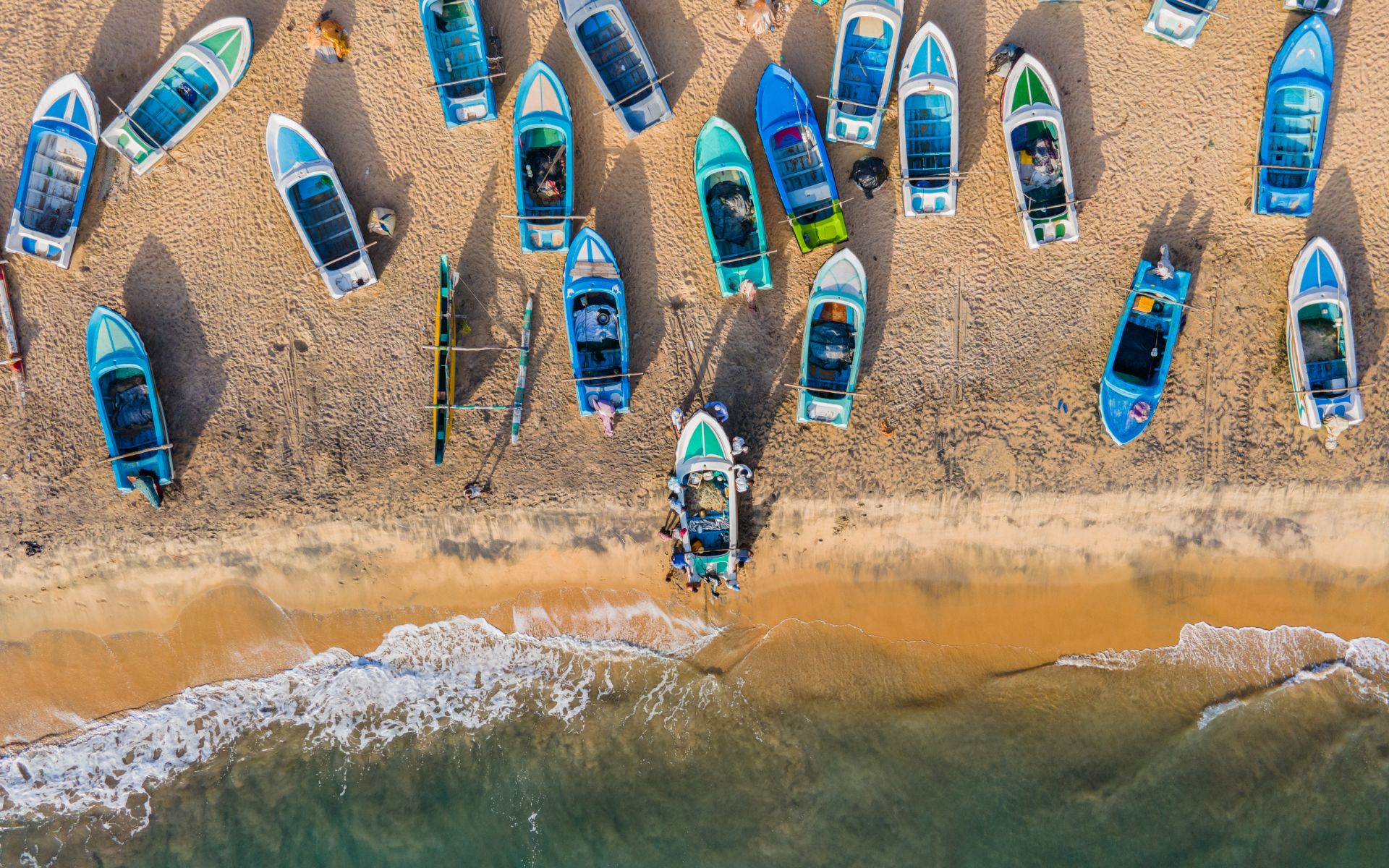
In Arugam Bay, the fishing village turned surf town on Sri Lanka’s east coast, 22-year-old Hameed, a Sri Lankan whose name has been changed at his request, was setting up his brother’s hopper stand for the evening at the tail end of the surf season. The mile-long stretch running parallel to the beach is lined with hotels, restaurants, cafes, roti stands and boutiques that stay open well into the night between May and September, but, by October, are all but abandoned. The stand is popular with tourists, Hameed told me, pointing to posters, menus and graphics around the seating area, none of which I could read because they were all in Hebrew. “99% of our customers are Israeli,” he said. “They keep coming back here. They prefer Arugam Bay over the south and the west [of the island] because the people here get along with them.”
Hameed’s eldest brother, who owns the stand, was given a Hebrew name by his Israeli patrons, which he uses instead of his given Muslim name. The two brothers, who hail from the nearby town of Pottuvil, are their family’s breadwinners. Hameed got into university to study management, but did not go. “It would have taken too much time,” he said. His middle brother, a graduate, cannot find work now.
So the family relies on their earnings from selling hoppers — crispy fermented pancakes with sweet and savory fillings — during Arugam Bay’s five-month surf season. Over the past decade, the area has become something of an Israeli enclave, with Israeli-owned hotels and restaurants opening at an increasing rate to cater to large groups of young Israeli tourists who, after completing mandatory service in the Israeli military, spend weeks, sometimes months, surfing and partying by the beach. Many fund their trip with savings or discharge benefits, such as a one-time release grant, and travel on a budget, staying in cheap hostels. “Some of them come here with mental issues like PTSD. They don’t want to talk about the war; they only want to relax,” a cafe worker told me.
Arugam Bay and Pottuvil are majority Muslim, yet Hameed insisted the Israeli presence causes no friction, despite Israel’s ongoing aggression in Gaza and the assumption that Muslims globally stand with the Palestinian cause. “Pottuvil is 80% Muslim, but we get along well with Israelis. Any issues between Israelis and Muslims are created by social media, which is misleading people. Social media is full of lies about Israelis,” he said. After a moment, he reconsidered. “Out of 100 of them who come [to the stand], maybe one will have a problem with us, will say they don’t like Muslims. What can you do? Not all the fingers on your hand are the same.”
While working-class locals are grateful for the business Israeli tourism offers, transplants who also run businesses in the area are less welcoming. They tend to be middle class and are usually from Colombo, the capital. Kalini (name changed), who owns a business in Arugam Bay, does not accept Israelis as clients. “Not everybody is an asshole; there are some nice people who just come and surf, and I don’t know what their stance is [on the war],” she said. “But I’m sure they’re still [supportive of] their government, because it’s very rare that you find an Israeli that is against what is happening in Gaza.”
Devin (name changed), who runs a surf camp, had only one Israeli customer all of last year. “Myself and my father are known in the community for being very much against them,” he said. While conceding that he can’t afford to turn away any business, Israeli or otherwise, he was unwilling to serve them. “They think they deserve a lot more for less money,” he said. And out in the surf, “they generally believe that they are entitled to, like, the entire ocean.”
Israeli tourists have built a marked presence across South and Southeast Asia in recent years, including Thailand, the Philippines and India, where backpacker hubs such as Koh Phangan, Siargao Island and Kasol have earned nicknames like “second Tel Aviv” and “mini Israel.” In Thailand and the Philippines, locals have protested against Israelis illegally running businesses and religious establishments, and accused them of cultural insensitivity, misconduct and aggression toward local communities. They have also complained of noise and environmental damage. In September, Thailand’s foreign minister warned Israel’s ambassador that the misconduct of Israeli tourists could harm relations between the two countries. The Thai Tourism Authority even launched a campaign featuring satirist Dan Pundak, familiar to many Israelis, aimed at acculturating Israeli visitors to local sensibilities. “A table for two refers to people, not nipples,” he quips in the ad.
In Sri Lanka, Israelis have become more visible over the past decade for much of the same behavior. But with the country only just emerging from an economic crisis, and parts of it still contending with the long-term effects of the civil war, local communities are divided between those who can and cannot afford to say no to Israeli tourism. The Sri Lankan government faces a version of the same bind. President Anura Kumara Dissanayake reaffirmed Sri Lanka’s support for Palestinian statehood and a two-state solution at the U.N. General Assembly last year, yet his government has kept sending thousands of workers to Israel through a bilateral program. Israel is among the main sources of remittances that have become Sri Lanka’s largest foreign-exchange earner, reaching a record $8.07 billion last year, more than double what the country earned from tourism.
“There was a good chunk of time in Arugam Bay and the south when a lot of locals weren’t distinguishing between Israelis and other tourists. They were all just tourists,” Jeana De Zoysa, a Colombo-based political organizer and environmental activist, told me. “But over time we have seen a shift where locals feel a bit more reluctant toward them, not because of what is happening in Palestine or globally but more so because they’re really shit tourists. They try to negotiate over everything, even stuff with fixed prices, like menu items and room rates,” she said. She added that once Israeli and Israeli-partnered businesses began popping up, they started supporting each other.
Sumi (name changed), a Sri Lankan recreational surfer who has returned to Arugam Bay several times in recent years, first saw the scale of the Israeli presence when an Israeli man she was dating, who lived in Sri Lanka, invited her there. “I was really amazed when I went and stayed with him for four days because the place we stayed at was owned by Israelis, every single restaurant we went to was Israeli,” she said. She recalled patronizing mostly local Muslim businesses on earlier trips. “And all of a sudden, I was only experiencing Israeli [businesses], and that’s when I realized what a strong presence they have,” she said.
Israelis have made national headlines for their behavior several times in recent years. In January 2025, Prime Minister Harini Amarasuriya told Parliament that the government would crack down on illegal activities by Israeli tourists, and that no authority had granted permission for them to build religious establishments or places of worship in the country. Later that year, two Israeli men were arrested for attacking a local surfer and his girlfriend. Earlier this year, authorities in Arugam Bay shut down the local Chabad House, a Jewish center for travelers, run by the Orthodox Chabad movement, that hosts Shabbat meals and prayers. Kalini said the center, like the one in Colombo, had Sri Lankan armed police guarding it around the clock. “It was down a small lane, in a Muslim neighborhood. And for the people who have been living here for so long, it’s like, what is this?” In August, residents in Hiriketiya, on the south coast, also protested against the recently established Chabad House there, which they said had been set up without the necessary government permits or the consent of the local community. And earlier this month, a video of Israeli tourists pushing their Sri Lankan boat operator into the sea also went viral. Facing a backlash online, the tourists said that it was a joke and the operator was in on it.
Complaints against Israeli tourists go beyond illegal business activity and unlicensed Chabad Houses. Kalini said their presence in large numbers comes with a blatant disregard for the communities whose homes they holiday in. “We have just had very unruly behavior. They don’t care about the environment; they come here to party,” she said. On the weekend I spent in Arugam Bay, the raves kicked off at 7 p.m., the whole bay pulsating with music so loud that the street dogs gathered as far from the beach as they could get for some quiet. “I know for a fact that when peak season is happening, a lot of European travelers won’t come to Arugam Bay because of the Israelis, and that’s not a good thing,” Kalini said.
Conflict between Israelis and locals has only become more likely in light of Israel’s ongoing genocide in Palestine. This past summer, Sumi got into a heated confrontation with two Israeli families after she wore a keffiyeh by a hotel pool in Arugam Bay. She had just seen “The Voice of Hind Rajab,” Kaouther Ben Hania’s 2025 film about the 6-year-old Palestinian girl killed by the Israeli military in Gaza while trapped in a car with the bodies of her relatives. “That little girl lives with me, you know?” she said.
When the tourists spotted her keffiyeh, they started shouting at her to leave. “When they started coming at me, I just stood my ground. I was like, you guys are f—— telling me to f—— leave, this is my f—— country, you child killers,” she said. The police were called to diffuse the situation, and Sumi stayed elsewhere that night.
Foreign-run businesses operating illegally have been a point of contention in Sri Lanka for years; the law does not allow foreigners to run businesses on tourist visas. Last year, 75 foreign nationals were arrested and 15 deported for running illegal tourism businesses such as hostels, wellness retreats and surf schools, and authorities have pledged more than 80 new or restructured tourism police units to maintain strict vigilance. However, when foreigners partner with local businesses to run retreats and camps, Devin explained, locals cannot afford to turn down the income. “With the surf camp scene, I believe a lot of money is going straight into Israeli accounts. The only money going to locals would be the room accommodation and food, none of the actual services. So it’s not [bringing any foreign income] to the government, not at all,” he said.
Sri Lanka relies on tourism as its third-largest source of foreign exchange, an industry worth $3.2 billion in 2025. The government has pushed to grow the industry after years of instability: the 2019 Easter bombings, the COVID-19 pandemic, economic crisis and the 2022 Aragalaya protest movement. Last year, the country welcomed a record 2.36 million visitors, surpassing prepandemic levels for the first time. Yet tourism earnings grew by only 1.6%, and spending per tourist fell by 12%. Business owners in Arugam Bay see the same pattern. “They come here in groups and, of course, they hire some locals to cover their asses, but the majority of the money doesn’t come back here. It’s very short-term money that’s coming in; it’s not thought through,” Kalini said.
Arugam Bay’s local working-class community has been hit the hardest. Saman, a Sri Lankan from the south who moved to the area over three decades ago, runs a hostel and restaurant called Hummus Bay. It was earlier named Ruwangie Place, after his daughter, but he changed it to capitalize on the influx of Israeli tourism. The restaurant is most popular for hosting Friday-night Shabbat dinners, which draw upward of a hundred Israelis a week during peak season.
Still, Saman said, they are not reliable customers. “Some of them, when they come on their religious day, say they can’t touch money. So they say they will bring it and come tomorrow. About a quarter of those who say they will pay me the next day abscond without paying. We can’t find them because we don’t know where they are staying, and they come in big groups, so you can’t keep track,” he said.
Israeli tourists are also known for driving down the price of surf lessons across the south and east of the island, forcing local surf schools to charge less in order to stay in business. “I’ve spoken to instructors who say it’s better to give Israelis cheaper lessons because they will tell their friends and then you will get loads of bookings,” Devin said. Surf coaching is a very young market, he explained, and it pays more for far less time and effort than fishing, the main alternative for young men in the area. “But the people willing to [bring their prices down] are generally unqualified to teach those lessons,” he said. “There are a lot more costs that go in when you do things legitimately.”
Several business owners describe Israeli tourists’ disregard for the local environment and wildlife, in particular setting off fireworks during beach raves. “They have changed the balance of who comes here and who is prepared to stick around and put up with what they choose to do, because they do what they do and we’ve been on the brunt end of that for many years now,” Dee (name changed), a local business owner based in Arugam Bay for more than 20 years, told me.
Pottuvil, the nearest town to Arugam Bay, has a population of roughly 43,000 and is home to many of the young men who work there as tuk-tuk drivers, chefs or surf coaches. Muslims make up about 10% of Sri Lanka’s population, but in Pottuvil, they are about 80%, alongside Hindu, Christian and small Buddhist minorities. When I asked Ahamed Lebbe Irshad, imam of the Pottuvil Grand Mosque, about the Israeli presence, he was reluctant to comment. “People talk amongst themselves,” he said. “But we don’t talk about war or politics in our sermons; we only talk about religious matters. We are not taking sides. We are just common people who mind our own business.”
Eastern and northern Sri Lanka were hit hardest by the civil war between the government and the Tamil Tigers, which lasted from 1983 until 2009. Nearly two decades later, both regions’ economies and infrastructure still lag far behind the south, west and center of the island, and their minority communities, including Muslims, are in a markedly different position from those elsewhere. “The east has been pummeled by violence in a way that the south really has not,” said Farzana Haniffa, a professor of sociology at the University of Colombo. “Even if there are particular communities in the south, among Muslims, who were affected, for instance, by Sinhalese nationalist anti-Muslim sentiment, the economies of those places are different, and the possibility of their [recovery] as a result of having stronger economies is different than it is in the east, where there is just nothing happening.”
This socioeconomic divide helps to explain the relative lack of friction between Arugam Bay’s Muslims and the Israeli tourists, whose five months of patronage each year underpins their livelihoods. It also helps to explain why transplants from the south are more likely to take a stand against Israeli tourism on political and humanitarian grounds, because they can afford to. “We mostly think about our job and our livelihoods,” Irfan, a tuk-tuk driver, told me. “We don’t like or dislike them [Israelis]. We do what we have to do, and they do whatever they do.”
The Sri Lankan government, too, it seems, cannot afford to take a stand. “The government’s overarching position is, ‘free Palestine,’ but they’re very happy to send people to Israel to work,” Haniffa said. “What I understand from people in government is that there is a real push to not disturb that economic activity at that level from their constituents.”
In the first half of this year, 2,500 Sri Lankan workers were sent to work in construction in Israel, with another 7,500 due to follow by the end of the year. A further 1,000 are due to take up home-based caregiving jobs, joining a growing number of Sri Lankans caring for elderly Israelis. One of them, Anula Ratnayake, was killed in a Hamas attack on Oct. 7, 2023, after a decade working as a caregiver in Israel. As the war enters its fourth year, the Sri Lankan government has maintained its economic ties with Israel and has announced intentions to strengthen them.
“As a whole, Sri Lankans are not so engaged with this issue, and as a whole even Muslims here are not that engaged with it — that’s personally how I feel,” added De Zoysa, who has been organizing for Palestine in Sri Lanka for several years. “And because of the economic crisis, all the remnant trauma from the war, the Easter bombings and the [subsequent] Islamophobic sentiments that are very much still present, I feel like most Muslims are a little more cautious when it comes to any protesting.”
Many of the people she organizes with are Muslim, and have faced disproportionate Islamophobic online abuse and intimidation from authorities, including being reported to the Terrorism Investigation Department for Islamist terrorism. “I think some Muslims are very wary to join this because they don’t want to be painted in that light,” she said. “I don’t think they are making a religious connection [with Palestine] at all. I think they have gone through a lot of hardship, so I guess income and business are the priority, and I wouldn’t blame them for that.”
This may be true for Hameed, whose hopper stand will see meager business until next year’s surf season begins. “If the government stops spending money on other things and spends on tourism instead, they could get this country out of debt in 10 years,” he said. When we returned to the subject of Israeli tourists, he repeated that he had no issues with them. “With the war there, there are faults on both sides. It’s all political, all because of America. I hope the war ends soon, and Israelis tell me they want the war to end.”
Become a member today to receive access to all our paywalled essays and the best of New Lines delivered to your inbox through our newsletters.