

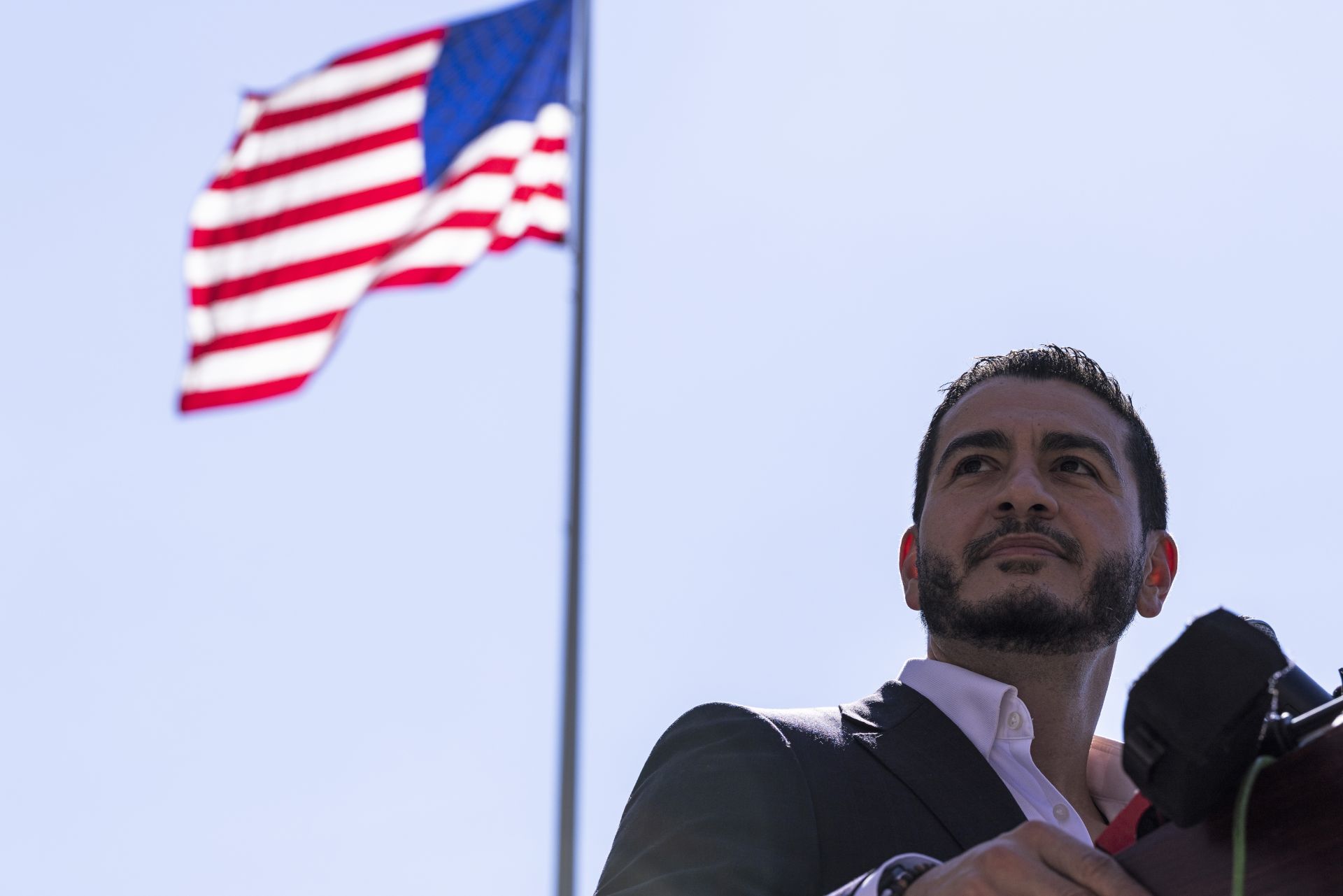
Michigan’s airwaves have been flooded with attack ads targeting Abdul El-Sayed’s religious and racial identity in the final stretch of the state’s hotly contested U.S. Senate race — one that could determine the balance of power in the upper chamber of Congress. While the Democratic nominee has sought to keep the campaign focused on kitchen table issues, his Republican opponent Mike Rogers and some Democrats have turned El-Sayed’s candidacy into a test of Islamophobia’s influence in U.S. elections.
“They will point to my name and my faith because they think that they can distract you from paying attention to the issues in your life — the price of gas, the price of groceries, the fact that too few people can see a doctor,” El-Sayed said on Friday in a fluorescent-lit United Auto Workers Local 600 hall in Dearborn, Michigan. The late-afternoon rally four days before the election drew dozens of white, Black and brown Michiganders to the union hall, one of about 700 events he has held since launching his campaign 18 months ago.
El-Sayed, an American Muslim of Egyptian descent, born and raised in Michigan, has faced an avalanche of anti-Muslim attack ads from the Republican Party and Rogers, who is endorsed by President Donald Trump. The ads accuse El-Sayed of having ties to terrorist groups and the Muslim Brotherhood and supporting Sharia, or Islamic law.
If elected Tuesday, El-Sayed would be the first Muslim ever to hold a U.S. Senate seat. Yet El-Sayed has declined to campaign on his religious identity and dismisses the notion that Michiganders will reject him because of it.
“Michiganders are good people. Big-hearted, open-minded, gritty and earnest. We expect the best, and we give the best. And we’re willing to work hard; we just don’t want to be exploited by a billionaire from New York or a millionaire from Florida,” El-Sayed said at the UAW hall. And when traveling across the state, he added, people don’t ask him how he prays but what he prays for. “Turns out we pray for the same things, we hope for the same things.”
Dave Groenenboom, sitting in the back of the hall before the event, told New Lines that he’s been backing El-Sayed since the primary, even though he has typically voted for more centrist Democrats.
“I’ve never voted for a progressive in my life, but things are so backwards now that this politics as usual just isn’t gonna do it,” Groenenboom, a retired teacher in Detroit, said.
Groenenboom said he was impressed by El-Sayed’s intelligence, pointing to his education from the University of Oxford and the University of Michigan. “He’s a little bit of a smartass, which I kind of like too,” Groenenboom said. “The Muslim thing doesn’t fizz on me at all.”
Instead, Groenenboom said the attack ads on El-Sayed’s identity show that Rogers and his allies “don’t have anything else to say. They gotta scare people.”
One ad from the Rogers campaign featured a young Iranian-American man who calls El-Sayed a “real threat to our national security and our values.” The ad then claims he is funded by “dangerous people who financed terrorist networks.” Another ad funded by the Senate Leadership Fund (SLF PAC), a Republican super PAC, said: “The Sharia law-compliant way. Abdul El-Sayed’s way.” One mailer read, “ABDUL EL-SAYED’S Sharia-compliant way: The wrong way for Michigan.” And in press releases, debates and social media posts, Rogers has repeatedly insinuated that El-Sayed has ties to the Muslim Brotherhood. Trump has gone even further, saying on Sunday: “If you vote for this jihadist lunatic that wants to destroy you, you’re crazy.” When Trump campaigned for Rogers in Michigan late last month, he said El-Sayed would “have to go through a metal detector before he’s allowed to go into the Senate.”
Alyssa Brouillet, the communications director for the Rogers campaign, referred New Lines to Rogers’ previous statements when asked about the Islamophobic rhetoric.
“What I say to the [Muslims] who are calling our campaign every day and saying this worries us: Remember, the Muslim Brotherhood is banned in five Muslim countries. This is not about Islam. It’s not about how he prays. It is about his adherence to this radical Islamic agenda,” Rogers said on NBC’s “Meet the Press.”
Dana Mohammad, who’s running for a seat on the City Charter Commission in Dearborn Heights (a neighboring town to Dearborn) and has cross-endorsed El-Sayed, said Rogers’ framing of his attacks as concerns about national security were offensive and “obviously a lie.”
“I think that our national security is threatened when we start flaming Islamophobia and anti-Arab rhetoric, and making targets out of everyday American citizens,” Mohammad told New Lines at Qamaria Coffee in Dearborn, where she was getting ready for a canvassing event for her and El-Sayed’s campaign on Sunday morning.
The messaging in the Senate race, against a candidate whose faith she shares, has been disheartening to watch, she said. Mohammad said that while door-knocking for her own campaign the last few months, she often saw attack ads against El-Sayed running on TV in the background as residents opened their doors. Mohammad said that she’s privileged to live in an area with large Arab and Muslim communities, and doesn’t feel she’ll be directly harmed by the rhetoric.
“But I do feel deeply sorry for young kids across the country that heard their president make fun of a name that matters to them,” she said, referring to the Prophet Muhammad. Trump has pointedly invoked El-Sayed’s full name — Abdulrahman Mohamed El-Sayed — echoing his former references to “Barack Hussein Obama.”
“That’s not just an attack on a name, but it’s also an attack on our faith,” she said. But she added that she’s heartened to see strong turnout at early voting sites in Dearborn Heights from people who are casting a ballot for the first time because they’re excited to vote for El-Sayed.
Seated next to Groenenboom at the UAW hall, Michael Krystyniak, a fellow Detroiter and retired educator, said Israel was one of the biggest issues he was watching in the primary and one of the main reasons he backed El-Sayed.
“I believe Israel has a right to exist. I believe we should support them in defending themselves, but beyond that, they’re out of control,” Krystyniak told New Lines. “For me, in the primary, that was the main issue because the traditional Democrats were not willing to go down that road at all. They were 100% lockstep in support of Israel as much as Trump and the Republicans were.”
Mohamed Gula, CEO of Emgage and Emgage Action, a coalition focused on Muslim civic engagement, said the growing awareness among Americans about Israel’s genocide in Gaza has humanized Palestinians and perhaps weakened the effectiveness of Islamophobic campaigning.
“People are seeing our babies being seen as their babies and their babies being seen as our babies,” Gula told New Lines.
He also said that El-Sayed and other populist Muslim candidates have spurred healing and conversation around the lingering fears that some Americans have carried about Muslims since 9/11, pointing to New York City Mayor Zohran Mamdani’s victory last November and Adam Hamawy’s primary win in New Jersey’s 12th District this year.
For Muslims, meanwhile, the Islamophobic rhetoric has prompted one of two reactions: Either they have further embraced their Muslim identity, or it has stirred fear for their safety and planted doubt about whether Muslim Americans have a seat at the table.
But the anti-Muslim sentiment has not been as effective as Republicans might have hoped. A recent New York Times/Siena survey found that El-Sayed had the highest favorability of a Democratic Senate nominee in a battleground state, including 93% favorability among Black voters, a key voting bloc in Michigan.
Still, Islamophobia has played a role in how voters view El-Sayed. A recent poll by Michigan State University’s Institute for Public Policy and Social Research found that Jocelyn Benson, Michigan’s Democratic nominee for governor, has a larger lead over her Republican opponent than El-Sayed does in his race against Rogers. Matt Grossmann, director of the institute and a professor of political science at Michigan State, notes that El-Sayed’s smaller lead compared to Benson is fueled in part by voters who express negative sentiments toward Muslims as a whole. Nearly 40% of voters say they would be less likely to support a Muslim candidate — which they were not willing to say directly about other identities, such as women or African Americans.
Grossmann also points to a white candidate parallel to El-Sayed in Will Lawrence, a former DSA member attempting to unseat Republican Rep. Tom Barrett in what has become the most expensive U.S. House race in the country. The Mid-Michigan Democratic nominee has cross-endorsed El-Sayed and is also running on a progressive platform.
“You can observe the differences in the negative campaigns,” Grossmann said of Lawrence and El-Sayed. Both candidates face traditional Republican lines of attack, including that they are “soft on crime” and support “open borders.” But the messaging diverges there, as attack ads on Lawrence focus on socialism, whereas El-Sayed faces false accusations of ties to extremism and foreign groups. Grossmann said the Rogers campaign has been able to fuse traditional lines of attack with identity politics — using both traditional detriments such as criticisms of progressive policies and El-Sayed’s lack of experience in elected office, along with anti-Muslim attitudes.
Emily Stocker, a Detroit resident who works part time for a group called The People for Bernie Sanders and has been campaigning for El-Sayed since before the primary, said she hasn’t encountered racism about El-Sayed when she’s doorknocking or phonebanking. But texting, “where they’re hidden behind a screen, is where the racism comes out.” Stocker, who was getting ready to canvass for El-Sayed just outside of Detroit’s historic Eastern Market, told New Lines that several respondents have directed slurs at El-Sayed or invoked concerns about Sharia.
“What’s scary is how much they’re absorbed and that people believe them,” Stocker, 48, said of the ads about El-Sayed’s identity. “The amount of racism is so scary to me.”
But kitchen table issues still dominate conversations on the campaign trail, she said, including concerns about gas prices, data centers and healthcare.
Just around the corner from Stocker, Austin Petersen was holding a poster board that read: “Free speech use it or lose it!” in all caps. Petersen, a conservative political YouTuber based in Missouri, said he supports Rogers over El-Sayed, citing his concerns about the Democratic nominee’s “potential connections to the Muslim Brotherhood.”
Petersen, who was the runner-up for the Libertarian Party’s 2016 presidential nomination, said Rogers is not his perfect candidate, but he has concerns about “the rise of political Islam in the United States, because I’m very much opposed to theocracy,” while citing the “mass migration” in Europe.
Petersen said it’s not about El-Sayed’s identity. “You could be an Arab Muslim, and if you still believe that the U.S. Constitution must be respected, and you accept the values of individual liberty, then, yeah, that’s fine.”
Tuqa Nusairat, the executive director of the Institute for Social Policy and Understanding (ISPU), a nonprofit organization based in Dearborn, said that as long as Islamophobia is a successful campaign tactic for some people, politicians will continue to use it. She also noted that the media bears responsibility for failing to call out anti-Muslim hate with the same ferocity as anti-Black racism or antisemitism. In some instances, the press has even legitimized Islamophobic rhetoric against El-Sayed, including claims that he has ties to the Muslim Brotherhood.
ISPU began measuring anti-Muslim animus in 2018 by measuring public opinion on five common tropes: that Muslims are violent, discriminate against women, are hostile to the U.S., less civilized and partially responsible for violence by other Muslims. Rogers and his allies have campaigned on virtually every sentiment measured in that index.
But on Sunday morning, some of the pretense dropped for El-Sayed’s former primary opponent Rep. Haley Stevens, who withdrew her tepid endorsement of El-Sayed and endorsed Rogers, a candidate who has campaigned on Islamophobic sentiment. Rogers has been supported by Jake Lang, a white supremacist and Jan. 6 insurrectionist (although the Republican nominee’s campaign said last month it disavows Lang). Lorenzo Sewell, a Detroit pastor who joined Lang in an anti-Muslim demonstration in August, is part of Rogers’ campaign. And Rogers is endorsed by Trump, who has expressed some of the most virulent anti-Muslim bigotry.
Stevens drew widespread and fierce condemnation from Democratic Party leaders over her surprise announcement, which came shortly after she appeared at a Black church in Detroit with Rogers. Stevens’ fiance, Jason Turkish, had said on “Fox and Friends” the night before that he was voting for Rogers. Stevens also claimed after endorsing Rogers that El-Sayed was “getting angrier and angrier,” which appeared to hearken back to tropes about “Muslim rage.”
Former Rep. Jamaal Bowman, who lost his reelection bid in 2024 after funding from the American Israel Public Affairs Committee (AIPAC) flooded his primary race, harshly criticized Stevens’ endorsement as “traitorous behavior.” “Democracy is hanging by a thread, so to support Mike Rogers, who supports Donald Trump, is a complete disgrace to our Constitution and democracy,” Bowman told New Lines.
Bowman also accused Stevens of leveraging divisions between Arab and Black Americans in her primary campaign. “Historically, there’s been misunderstanding, there’s been trauma, there’s been incidents, and those incidents have led to generalizations as opposed to reconciliation. So that’s a real thing,” he told New Lines. “What Haley Stevens did in her campaign in the primary was she took advantage of those divisions that were already there.”
Bowman pointed to the outside groups backing Stevens, the largest of which was AIPAC’s super PAC, United Democracy Project. UDP ran ads that appeared to suggest Stevens was endorsed by former President Obama, and others purported that El-Sayed was sexist and had disrespected former first lady Michelle Obama.
Especially since 9/11, nearly every supervillain in movies is brown, Arab or Muslim, Bowman said. “A lot of Islamophobia is rooted in ignorance and racism,” he said. “But it’s also rooted in the fact that they can’t win on their ideas. … When they start losing, they turn to hate.”
Some ads in the primary also criticized El-Sayed for his support of the “uncommitted” protest vote over Gaza in the 2024 presidential primary, when then-President Joe Biden was running largely uncontested (before then-Vice President Kamala Harris replaced him). Stevens and her allies had used El-Sayed’s support as evidence for their claim that he did not back the party. But her surprise endorsement of Rogers three days before the general election, with control of Congress in the balance, has drawn condemnation of her disloyalty to the party. Trump, meanwhile, has praised Stevens and said he hopes she joins the Republican Party.
But the endorsement may have inadvertently benefited El-Sayed. The campaign said it raised $2.4 million on Sunday, in its biggest fundraising day yet.
“If anything, I think it’s going to backfire from the intended actions because I’ve heard from a lot of people who have texted me or slid into my DMs today that said how much this pissed them off,” state Sen. Mallory McMorrow said on Sunday. McMorrow had campaigned for the U.S. Senate Democratic nomination before withdrawing her candidacy ahead of the primary.
In Detroit’s bustling Eastern Market on Saturday, Yvette Baburam, a technical consultant in Southfield, Michigan, told New Lines that she voted for Stevens in the primary but is supporting El-Sayed in the general election because she wants to see Democrats take back the Senate and believes Rogers would be a rubber stamp for Trump.
Baburam said she voted for Stevens in the primary because she has more experience and appeared to communicate with both sides of the aisle. But she said she’s not upset about El-Sayed winning and is focused on getting Democrats control of the House. (The interview was Saturday, before Stevens’ bombshell endorsement of Rogers.)
“The crazy thing about the ads — none of them are talking about policy. They’re all fear tactics, and I’m not sure who that’s working on. I hope people can see behind that,” she said. “Anytime they’re trying to control you based on fear, I don’t give a whole lot of credence to that.”
Become a member today to receive access to all our paywalled essays and the best of New Lines delivered to your inbox through our newsletters.