


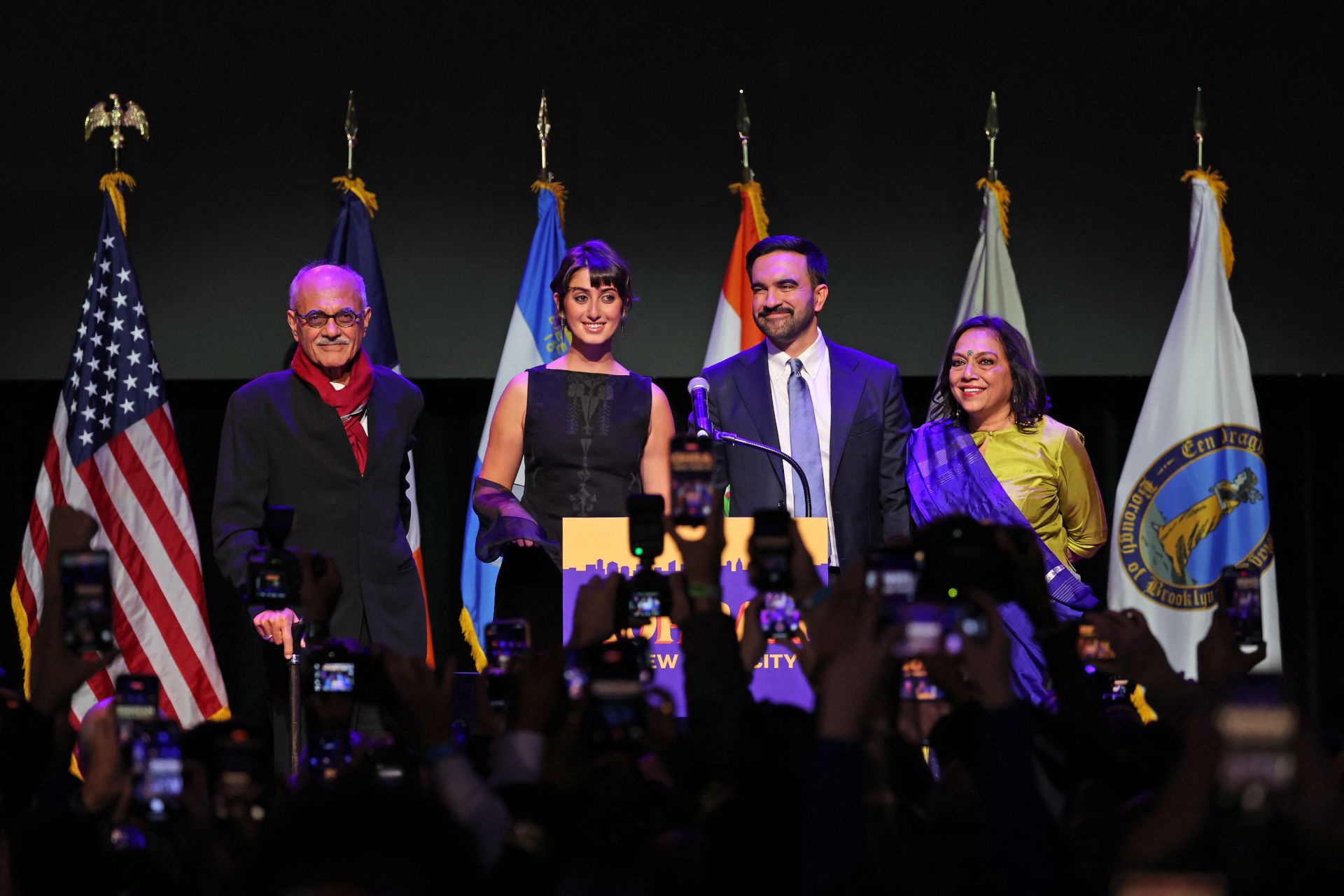
A day before Zohran Mamdani won the general election and became the first Muslim and first South Asian mayor of New York, the city felt alive in ways it had not for a long time. New Yorkers everywhere were already calling him their mayor. At a campaign event where Mamdani had met with night-shift workers at LaGuardia Airport and traveled to Jackson Heights to serve them food, an editor of a Bangla-language newspaper presented him with an edition to be published the following week, announcing Mamdani as the first Muslim mayor of New York. A day earlier, Mamdani had visited the same street on Fordham Road in the Bronx where he had done his now-famous interview asking people why they had voted for Donald Trump a year ago. Unlike then, when many ignored him or simply walked away, this time Mamdani was swarmed by a crowd, many declaring him “our mayor.” On election night, at a corner of Midwood in Brooklyn, Pakistani New Yorkers who had canvassed for Mamdani began celebrations with “dhol” (the double-headed South Asian drum) beats and dancing before the polls had even closed at 9 p.m.
In the week before the election, Mamdani met with voters at the East Asian grocery store H Mart in Long Island City, attended a South Asian-majority rally with Democratic Rep. Ro Khanna in Jamaica, Queens, and watched a Buffalo Bills game with New York’s Gov. Kathy Hochul in Astoria. He also distributed Halloween candy at Park Slope, practiced Tai Chi with seniors on the Lower East Side and visited several queer and Black- and Latino-majority nightclubs on the weekend before the election. Mamdani requested a track by trans pop star Kim Petras at a queer Latino party hosted at the popular electronic music venue Elsewhere and vibed to Kendrick Lamar’s “Not Like Us” at the Afro-Caribbean spot Damballa from behind the DJ booth. At every event, people jostled to talk to Mamdani and take photos (at the Jamaica Queens rally, some attendees came close to tripping as the mass of people lurched forward after his speech).
The excitement around Mamdani in New York had been palpable (local New York City publication Hell Gate recently compared it to Beatlemania), fueled by his skyrocketing popularity, viral debate performances and multiple sightings across town. Mamdani sightings had become so ubiquitous that it led many online to wonder if they were the only ones left who hadn’t met him in person yet. Mamdani also seems to have unlocked a unique kind of celebrity, whereby his access and ubiquity further fuel the frenzy. In videos from clubgoers who witnessed Mamdani’s drop-ins on Saturday night, each of his appearances is met with wild cheers and enthusiasm.
Mamdani’s win comes at a particularly dark time in the city, when Supplemental Nutrition Assistance Program (SNAP) food benefits for millions of New Yorkers have been paused because of the government shutdown, and many others are set to deal with prohibitive health care costs as a result of the Trump administration’s legislation. Yet Mamdani’s centering of working-class concerns and laser-sharp focus on affordability also give many New Yorkers hope. They see him as a champion to take on the policies of Trump, who endorsed Mamdani’s main opponent, the Democrat and former Gov. Andrew Cuomo (he ran as an independent), on the eve of the election, while threatening to block funds to New York if Mamdani were elected. Notably, Trump did not endorse the Republican nominee Curtis Sliwa and said that “a vote for Curtis Sliwa is a vote for Mamdani.” Mamdani has repeatedly talked about being open to working with Trump if he were to “talk about his promised agenda of lowering the cost of living,” but “not at the expense of New Yorkers,” in an evident dig at former Mayor Eric Adams, who allowed Immigration and Customs Enforcement (ICE) to arrest New York residents while failing to implement the city’s sanctuary policies.
In his victory speech from the Brooklyn Paramount theater, Mamdani directly addressed Trump, saying, “So, Donald Trump, since I know you’re watching, I have four words for you: Turn the volume up.” In his recent interviews, Mamdani had consistently talked about “utilizing the power” he would have as mayor, comparing it to how Republicans often wield their authority in public office. In his speech, Mamdani told working-class New Yorkers that “this city is your city, and this democracy is yours too,” and declared that he fully understood the extent of the power he now held and was not afraid to use it. With over 50% of the total votes cast in his favor, Mamdani has a decisive mandate to implement his core agenda of affordability.
Mamdani’s win in the general election is historic in ways that go beyond his identity as New York’s first Muslim and South Asian mayor — he is a generational candidate who has managed to draw New Yorkers out of political apathy in the wake of Trump’s win and suffuse the city with a kind of energy that feels both collective and kinetic. Through an army of more than 100,000 volunteers, Mamdani’s campaign urged New Yorkers — who famously don’t talk to their neighbors — to enter their homes and convince them to vote for him. Knowing that he was making a massive ask from the canvassers, who were working round the clock with phone banking and door knocking, Mamdani urged them to “give more” and “drink Adeni chai,” creating a rare sense of community and ownership around the campaign that could possibly shore up support as Mamdani looks to implement his agenda in the coming months.
As someone who emerged from a background of canvassing and organizing, Mamdani also made sure to recognize the time and effort of his campaign volunteers, often giving them special access to rallies and merch, and posing with them for exclusive photos alongside progressive figures like Sen. Bernie Sanders and Rep. Alexandria Ocasio-Cortez, both of whom lent significant support to Mamdani’s campaign.
Even though Mamdani is yet to take office (which will happen in January), his campaign seems to have already transformed the city’s political establishment. Over 2 million votes were cast — a turnout the likes of which haven’t been seen in New York since 1969, when incumbent Mayor John Lindsay, sort of a folk hero, won an election that drew more than 2.4 million voters to the polls. South Asian and Muslim voters, who were among the majority of first-time voters added to the electorate as a result of Mamdani’s primary campaign, also became a prominent part of New York City’s polling infrastructure — a significant departure from previous elections. But among the biggest changes wrought by Mamdani’s campaign is the direct and central focus on the concerns of working-class New Yorkers.
At one of his first rallies in May, titled “A City We Can Afford,” Mamdani spoke about the “aspirations” of working-class New Yorkers and challenged what he called a “myth” about the city. “It is the lie that life has to be hard in New York … the lie that only the rich or the lucky get to live a good life here,” he said. While his general election campaign later extended his umbrella of affordability to include “all New Yorkers” struggling with rising costs, working-class voters have remained at the heart of his message. Through collaborations with organizations that focus on working-class South Asian and East Asian communities, Mamdani positioned these New Yorkers as central to the city’s story and future.
This contrasted sharply with Cuomo’s campaign. Hell Gate reported that pro-Cuomo groups and super PACs, funded by billionaire donors like Michael Bloomberg, Bill Ackman and casino magnate Steve Wynn, spent close to $19 million on ads targeting Mamdani in October alone. Another report from Dropsite News said that a massive sum of $56 million was spent by pro-Cuomo groups in ads over the course of the campaign (his supporters had initially threatened to spend over $100 million).
Mamdani’s historic win over Cuomo (who was often labeled “Status Cuo-mo” by the new mayor’s supporters) signals an era of political change in New York. Mamdani’s policies, if implemented, might even stop the bleeding of working-class New Yorkers from the city. (At a weekend rally before the election, New Lines spoke to a New Yorker who had left the city for Miami due to rising costs but was hoping to move back if Mamdani won the election.)
Yet perhaps the most palpable change that the Mamdani campaign has realized is one in the relationship between the city and its residents. New York, a famously difficult city to live in, has become even more challenging with high inflation and unaffordability, especially for its longtime residents. One of the Mamdani campaign’s early videos featured a Harlem resident who had lived in New York for decades but no longer seemed to recognize it. “I used to love New York City. Now I just live here,” she told Mamdani in a video that became a maxim of sorts for the campaign (a line that Mamdani evoked in his victory speech).
Over the course of last year, along with his promise of affordability through universal child care, fast and free buses and a rent freeze proposal, Mamdani’s love for the city emerged as the fourth and perhaps the most important yet understated aspect of his campaign. While it shouldn’t be surprising that a candidate running to be its mayor carries a torch for the city, few local politicians have embraced and highlighted the broad contours of New York like Mamdani. He held his rallies and events over the Brooklyn Bridge (which Mamdani walked at 6 a.m. one day before the election, greeting city officials Brad Lander and Letitia James on the other side), in Washington Heights in uptown Manhattan, in Jamaica and Jackson Heights in Queens, in Co-op City in the Bronx, and Kensington and Coney Island in Brooklyn, drawing reporters and New Yorkers into areas that are not typically the center of press attention.
Compared to Cuomo, who more or less avoided large gatherings, Mamdani made it his mission to interact with as many New Yorkers in as many different neighborhoods as possible (he famously walked the length of Manhattan on the Friday before the primary). While many online wondered about his sleep schedule before the election, given his ability to hit the clubs at 2 a.m. and attend the Sunday Church service next day, Mamdani and his campaign conscientiously worked to position him as “New York’s Mayor,” who is quite literally “one of us,” showing up everywhere from a livestream of a popular online music creator to cheering from the sidelines of the New York City marathon.
And, in many ways, he is — Mamdani, New York’s youngest mayor-elect in over a century, met his wife Rama Duwaji on Hinge, which is among the most popular dating apps used by New Yorkers. Mamdani’s ease at traversing both “Starbucks Brooklyn and jerk chicken Brooklyn” — a distinction made by House Minority Leader Hakeem Jeffries, who held his endorsement for Mamdani until the day before early voting — stems from both his South Asian background and his evident love for his city.
Mamdani can rattle off his favorite brunch spots with ease (often upsetting his Astoria neighbors, who worry about their local joints getting “too popular”), has a native New Yorker-approved sandwich order (egg and cheese on a roll with jalapenos), effortlessly sings along to dancehall hits like “Gyal Your Party Animal” and can even pull off a good whine, like he did at the West Indian Day Parade in September. For several born and raised New Yorkers, particularly in Black and Latin American communities, there is no bigger sign that, while being of South Asian origin, Mamdani is also one of their own.
Moving deftly between different New York neighborhoods (he could be in the Hasidic Williamsburg at noon and the Arab-majority Bay Ridge a few hours later), Mamdani showed incredible versatility and perceptiveness, recalibrating his responses to suit varied sensibilities. Yet it was during his campaign for the general election, which differed from the one that Mamdani ran during the primary, that these qualities stood out the most. Taking lessons from the candidacy of Buffalo’s Democratic nominee for mayor in 2021, India Walton — who beat the establishment candidate, Byron Brown, in the primary, only to lose to him in the general — Mamdani astutely adapted his campaign to ensure its success.
While maintaining until the end that “billionaires should not exist,” Mamdani effortlessly found his way into closed-door meetings with the city’s business elite, often leaving many there convinced of his agenda. Several business leaders, including some who supported Cuomo, talked about his “charm” and his ability to “genuinely listen” to their concerns.
Even though the weeks before his primary win were marred by claims of Mamdani being “antisemitic” (based on his pro-Palestinian views and initial refusal to condemn the slogan “Globalize the intifada”) and “anti-Hindu” (at a mayoral forum in June, Mamdani had called Indian Prime Minister Narendra Modi a “war criminal” for his role in the 2002 Gujarat riots), Mamdani was able to effectively defuse both charges. With help from allies like Lander, a prominent Jewish politician, and campaign support groups like “Jews for Zohran” and “Hindus for Zohran,” Mamdani ultimately secured a coveted endorsement from the influential Orthodox Jewish leader Rabbi Moshe Indig over the election weekend (he had also been endorsed by several other Jewish leaders) and visited a string of Hindu temples on the festival of Diwali.
Even the most vulnerable aspects of Mamdani’s campaign, like the lack of support from the Democratic establishment and previous comments about defunding the police, failed to alter his trajectory. Mamdani’s alignment with the Bangladeshi Police Association after the killing of officer Didarul Islam, his apology for having once called the New York Police Department “racist” and “anti-queer” and his retention of establishment-favored police chief Jessica Tisch left Cuomo’s attacks looking feeble. While the eventual support of prominent Democrats, most significantly Gov. Hochul, lent heft to Mamdani’s campaign, they also signaled to other Democrats to fall in line. (Just days before the election, former President Barack Obama offered to be a “sounding board” for Mamdani.)
Although Senate Minority Leader Chuck Schumer never endorsed him and Jeffries recently refused to call him the future of the Democratic Party, Mamdani’s blazing win as New York’s mayor has made him a Democratic star across the country. Politicians, in both New York and the rest of the U.S., have already begun to emulate his social media strategy in an effort to reach out to younger voters, while voters from around the country often leave comments like “I am not from New York, but I support him as mayor” and “New York don’t fumble him as mayor” on Mamdani’s social media posts. Mamdani’s successful campaign has animated the left, not just in the U.S. but also in Europe. The British left-wing politician Jeremy Corbyn manned the phones to canvass for Mamdani days before the election, while French and German left leaders like Manon Aubry and Ines Schwerdtner arrived in New York the week before to meet with Mamdani’s team and absorb the lessons from his campaign.
During the course of that campaign, Mamdani often talked about having a “big tent” that offered space to anyone who was open to supporting his agenda, regardless of their alignment with his policies as a democratic socialist. Yet, remarkably for an openly left-leaning politician, Mamdani was able to do that without alienating his constituency of democratic socialists, who have been instrumental in organizing his canvassing operations. Even as Mamdani repeatedly detailed his policies as separate from those of the Democratic Socialists of America (DSA), the organization’s leadership decided to ease the pressure over his more moderate stances and instead focus on electing more socialists to office.
Before election day, Mamdani’s campaign indeed looked like a massive tent with enough polarities to generate its own magnetic field. Yet it was his ability to get ahead of the media narratives that ultimately got him to the finish line, as he preempted attacks and used media savvy to outline his own agenda, using social media to speak directly to his voters. While Mamdani’s campaign did rely on traditional media, it also became the first major campaign to collaborate with “new and digital media,” which included online content creators from platforms like Twitch, Substack, YouTube, Instagram, X and various podcasts, whom he invited to an exclusive press conference and gave separate access to his rallies. (Since the loss in the presidential election, Democrats have attempted to penetrate the podcast “brosphere” that helped elect Trump, which Mamdani did effortlessly during his run.) Despite running an incredibly hectic campaign, Mamdani made time to appear in videos of various popular as well as niche influencers in the run-up to election day, plastering certain sections of social media with wall-to-wall Mamdani mentions on election day.
Mamdani’s ascent to the mayoralty, given his democratic socialist values and steadfast support for Palestine, would have seemed unthinkable just a year ago, when Kamala Harris’ election loss was squarely blamed on “leftists” and “pro-Palestine supporters.” Yet, against all odds, Mamdani — through his gifted political acumen, a brilliant team of 30-something managers, and his exceptional hold over his own narrative and messaging — carved his own space in the political mainstream while the establishment was intent on not giving him an inch.
“Being right in and of itself is meaningless. … We have to win,” Mamdani had said in an interview before the election. Despite overwhelming support from working-class South Asian and Muslim New Yorkers, Mamdani’s monumental primary win was dismissed by Cuomo and Adams as not reflecting the opinions of real city residents, while Mamdani was labeled a candidate for “rich transplants” by Cuomo supporters, in a dig at younger New Yorkers who had canvassed and voted for him in massive numbers.
Mamdani has generated an extraordinary playbook on how to run a principled campaign while consistently turning foes into allies. On the campaign trail, he liberally quoted former New York Mayor Fiorello La Guardia and the architect of the New Deal, President Franklin D. Roosevelt. Leading a campaign of hope and positivity of a kind not seen since the days of Obama — as he bounced between concert appearances, food distribution drives and soccer matches, often in a single day — Mamdani never let his seemingly permanent smile fade or showed any signs of exhaustion.
For many New Yorkers of varied ethnicities and incomes, Mamdani’s run represented a return of optimism and joy — a direct result of his unique engagement with the city’s residents — that some hadn’t experienced since “pre-Covid” times. Yet this win didn’t come without extracting its bloody pound of flesh. In the days leading up to the election, Cuomo’s campaign, with the help of super PACs like “Fix the City” and “Defend NYC,” ran eye-wateringly racist and Islamophobic messaging that, according to Mamdani’s supporters, attempted to bring back the Islamophobia seen in the aftermath of 9/11.
Cuomo seemingly agreed with right-wing radio hosts who claimed that Mamdani would celebrate another 9/11-like attack and ran AI-generated ads labeling Mamdani’s supporters as “criminals.” Adams, the former mayoral candidate turned Cuomo supporter, compared Mamdani to “violent extremists burning churches in Nigeria,” while the Republican nominee Sliwa (who, thanks to his quotable one-liners, had emerged as a surprise contender in the race) said on the debate stage that Mamdani supported “global jihad.” Super PACs labelled Mamdani a “terrorist” and promoted political cartoons showing a plane hurtling toward the World Trade Center as an outcome of a Mamdani mayoralty. Islamophobic threats of violence and harm after his primary win forced Mamdani to hire multiple security personnel for his safety, and in a recent interview with MSNBC, Mamdani off-handedly mentioned listening to “Many Men” by 50 Cent “every time” he received a death threat — highlighting their routine pervasiveness in his public life.
While right-wing media outlets and conservatives pushed to revoke Mamdani’s citizenship and deport him, in a deeply moving speech that he delivered days before the election, Mamdani tearfully acknowledged the cost of being Muslim in public office and “leaving his faith in the shadows.” Standing outside a mosque in New York, Mamdani, whose politics have coexisted with his Muslim identity during his time as a public official, declared: “To be Muslim in New York is to expect indignity. … For too long, we have been told to be satisfied with whatever little we receive. … No more.” As he talked about saying “goodbye” to the anti-Muslim sentiment that has grown “so endemic in the city” 10 days before election day, Mamdani had already turned the page on a new chapter in New York. Now the city has its first Muslim, South Asian mayor-elect, who is also an immigrant and unapologetic about all of it, and the book of a new New York is waiting to be written.
Become a member today to receive access to all our paywalled essays and the best of New Lines delivered to your inbox through our newsletters.