


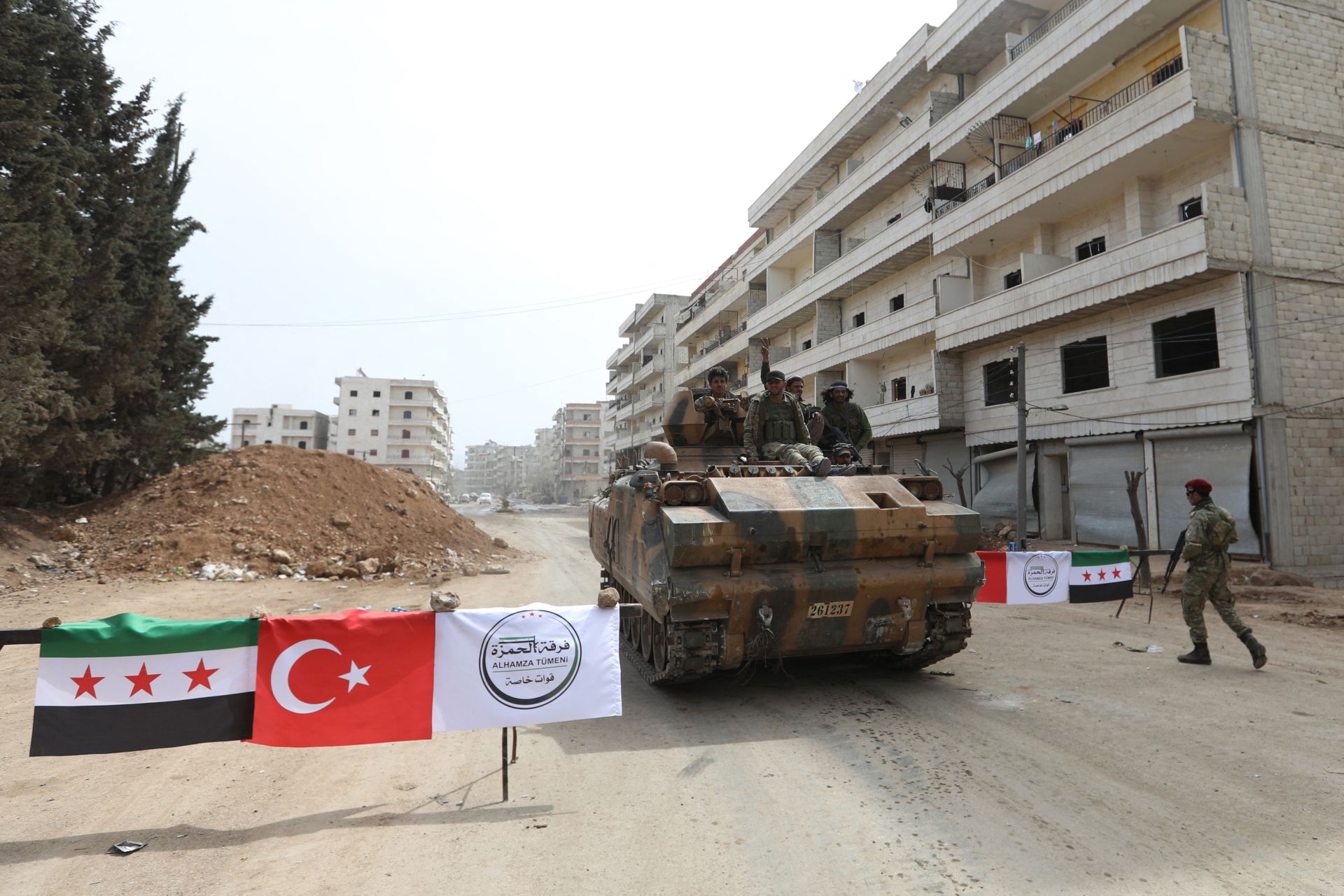
Turkey’s relationship with Syria’s new leadership has undergone a startling evolution. What began, prior to the fall of Bashar al-Assad, as an uneasy partnership of necessity, fraught with mutual distrust, has matured into a formal alliance. Yet it remains a bond defined more by friction than unison. This is not a relationship of subservience, but a partnership defined by mutual dependence, whereby an increasingly assertive Damascus frequently charts its own course — at times in direct defiance of Ankara. Yet Syria’s efforts to broaden its alliances and increase its room for maneuver, and thus its independence, are consistently met by a hard reality: The new Syrian regime remains tethered to Turkish support. Ultimately, Ankara’s role in the security sector remains the essential guarantor of Syria’s stability. The following analysis is based on exclusive interviews with senior Syrian government officials, military and intelligence officers, and key international actors engaging the leaderships of both countries.
The relationship between Syria’s current rulers and Ankara started with deep distrust on both sides. But “Turkey needed a reliable local partner to deal with the proliferation of jihadist groups in Idlib, as it did not want to fight them directly,” said an independent mediator who has engaged the Turkish government. According to this source, there was initially a great deal of discomfort within the Turkish security establishment about dealing with the jihadist faction then led by Syria’s current transitional president, Ahmad al-Sharaa. Yet Hayat Tahrir al-Sham (HTS), as the faction was known, proved to be a useful partner against the Islamic State group. It was also an organized force that could maintain order in the border province of Idlib, housing 3 million Syrians, whom — crucially for Ankara — it could prevent from crossing into Turkey in large numbers. For HTS, the partnership with secular Turkey that it accepted from 2018 onward was deeply contentious, leading to splits within the ranks and among commanders. Repeated defeats of Syria’s rebels, however, led HTS to recognize that it simply could not defend Idlib on its own. The relationship expanded after Turkey’s direct intervention in Idlib in early 2020 to halt an offensive by the Assad regime, Iranian-backed militias and the Russian air force. Thus, an uneasy partnership emerged.
The period between 2020 and the toppling of Assad in December 2024 was nevertheless marked by disagreement. Assad’s survival at the helm appeared guaranteed to the wider world, and Arab regimes began to normalize relations with the regime. Turkey attempted to explore this path, too, triggering dismay and anxiety among Syria’s opposition factions, as well as the residents of those areas in northern Syria that remained outside the Assad regime’s control owing to Turkish protection. Despite multiple public statements from Turkish officials, including President Recep Tayyip Erdoğan, about meeting with Assad, Damascus rebuffed these messages until the last months of Assad’s rule, demanding that Turkey first withdraw its forces from northern Syria.
Another source of tension between HTS and Turkey was the former’s incessant drive to grow its power and influence. Not strong enough to push into Assad regime areas, HTS chose to expand to northern Aleppo, an area under direct Turkish control, cooperating with proxy factions Turkey had established, unified under the umbrella of the so-called Syrian National Army (SNA). Turkey originally created this umbrella of former rebel factions in 2016, using it to fight the Syrian Democratic Forces (SDF), whose Syrian Kurdish leadership is organically linked to the Kurdistan Workers’ Party (PKK), a Kurdish militant group that has waged an insurgency against Turkey since the 1980s. On June 20, 2022, hundreds of HTS fighters encroached into Afrin and captured Jindires, a small town held by the SNA, seeking not only to expand their territory but also to capture checkpoints established between HTS-ruled Idlib and SNA-occupied territory, which represented a source of revenue via taxing passing vehicles. HTS was forced to withdraw three days later, owing to Turkish threats. As documented by Patrick Haenni and Jerome Drevon in their book “Transformed by the People: Hayat Tahrir al-Sham’s Road to Power in Syria,” the move strained HTS’ relations with Ankara. Ignoring Turkey’s policy in northern Syria, which sought to maintain full control over areas governed by the SNA, al-Sharaa, who was then the leader of HTS, ordered a second incursion in October 2022, overriding voices within HTS’ leadership who wanted to give up on the expansionist ambitions in the face of Turkish opprobrium. This time, a U.S. official told me, Turkey threatened airstrikes against HTS, leading to another pullout.
Further conflict erupted between Turkey and HTS in late 2023, when Abu Ahmad Zakkour, in charge of managing HTS’ financial interests and outreach to tribes, defected and fled to the Turkish-controlled areas in northern Aleppo. HTS sent armed men after him, attempting to capture him in Azaz. After HTS threatened to blow up the house in which he was sheltering, Zakkour surrendered, but as HTS was transferring him to Idlib, Turkey intercepted the convoy, liberated him and moved him to a safe location. According to members of the Sultan Murad SNA faction, which protected Zakkour during his refuge in northern Aleppo, he provided extensive information through them to Turkey about the inner dynamics within HTS. Following the fall of the Assad regime, Zakkour reconciled with the group and now oversees the outreach of the Syrian government to tribes.
Unable to normalize relations with the Assad regime, Turkey preferred to maintain the status quo ante in Idlib. There was constant shelling of areas opposite the front lines by regime forces, causing them to become depopulated. This prompted HTS to plan an operation to push the front lines further south and allow the displaced to return — Operation Deterring Aggression, which would finally result in Assad’s fall. According to U.S., Syrian government and SNA sources, as well as independent mediators with direct contact with the Turkish and HTS leaderships, Ankara opposed this plan. Since 2016, owing to Russia’s intervention in Syria, all major battles against the Assad regime had brought mass destruction, displacement and, sometimes, loss of territory for the rebels. Turkey feared that continued violence would mean more flows of displaced persons toward its border. A Syrian Ministry of Foreign Affairs official told me: “The Turks didn’t want the Assad regime, but they felt the offensive is not worth a fight. The Turks were right to say that this will boomerang on us,” meaning they feared that refugees would flee to Turkey. According to two Syrian government officials, Ankara made its opposition to the offensive clear to Asaad al-Shaibani, then in charge of HTS’ foreign relations, and now Syria’s foreign minister.
HTS decided to launch the operation regardless. Initially relying on just 10,000 fighters, with quite limited goals, the operation turned into a rapid march through the country, culminating in the capture of Damascus, owing to the catastrophic weakness of Assad’s army and the feeble foreign support from Iranian-backed militias and Russia. According to multiple SNA commanders, instructions came to them on the second day of the offensive from Turkish intelligence, telling them to abstain from participating. However, fighters and commanders within the SNA were eager to participate, leading the senior commanders of SNA factions to inform the Turks that they had lost control over some of their units.
All Syrian and U.S. sources to whom I spoke, as well as independent mediators, agreed that the Turkish position changed quickly. As a Syrian official put it to me: “Once Turkey got the slightest impression that it would be different this time, the Turks said, ‘We’re with you, go all in.’” Even then, however, Turkey did not wish its proxies to join the battle to liberate Damascus. According to several SNA commanders, after the capture of Hama on Dec. 5, 2024, Turkey ordered the factions to mobilize their forces toward the Tishreen Dam and take it from the Kurdish-led SDF. That is, even after changing its position and supporting the battle to take Damascus, Turkey tried to use its proxies for its top national security priority: combating the PKK-influenced SDF, which had exploited the collapse of Assad’s forces to expand westward.
Fighters and commanders of the SNA did not want to fight Turkey’s battles against the SDF at this point, but to join the rapidly advancing offensive toward Damascus. According to several sources from Jaysh al-Islam, one of the SNA factions, its leadership informed the Turks that there was a state of rebellion among its fighters, and its chief of staff, known as Abu Maarouf, left with the majority of the fighters. Abu Maarouf and Jaysh al‑Islam were among the first opposition fighters to arrive in Damascus, taking the desert route.
HTS brought down the Assad regime without direct Turkish support, but it cannot maintain security in post-Assad Syria without Turkish help. Ankara is the preeminent military and security guarantor of Damascus, owing to its direct intervention in northern Syria and military capabilities. This intervention, which significantly expanded in early 2020, put Turkish soldiers alongside fighters of HTS and fellow Idlib-based groups, such as Ahrar al-Sham and Faylaq al-Sham. Both sides worked together to halt the Assad regime’s advance on Idlib, and it was Turkey’s heavy use of attack drones that stopped that offensive in its tracks. The war room run by HTS at the time, called al-Fath al-Mubin, received Turkish armaments and equipment after Turkey trained HTS-allied groups (but not HTS itself) on how to use them.
Damascus and Ankara also share clear mutual interests: ensuring Syria’s stability and the achievement of control over all the country’s territory. But despite these shared concerns, Damascus’ desire to maintain its independence has resulted in disagreements with Ankara. Upon seizing power, for example, Syria’s new leadership sought to expand its alliances beyond Turkey and Qatar, with whom it had preexisting relationships. Three weeks after Assad fled, al-Sharaa gave his first interview to an Arabic-language TV channel. The decision to grant it to Al Arabiya, a channel run by Saudi Arabia, was intentional, according to a Syrian official, as was the decision to conduct the first foreign trip to Saudi Arabia, according to multiple informed sources.
This drive to diversify Syria’s alliances stemmed from several factors. The first was simply to have more leverage and independence by decreasing the dependence on a single ally. A senior Syrian official told me that “al-Sharaa wants to balance between Turkey and Qatar versus Saudi Arabia.” The second reason was the desire to avoid antagonizing anti-Islamist powers such as Saudi Arabia, the United Arab Emirates, Egypt, Jordan and Israel. Those Arab countries have banned the Muslim Brotherhood, perceived as a potential challenge to their rule, and they use their educational systems and media to lambast these groups. By contrast, Turkey and Qatar have advanced their regional positions through the adoption of populist Islamist rhetoric and the promotion of Muslim Brotherhood groups. As the senior Syrian official explained to me: “Syria wants to be more in the embrace of the Saudis as opposed to Turkey, which causes sensitivities with Israel and the region.”
Another influential factor driving the outreach to oil-rich Saudi Arabia and the UAE is Turkey’s limited ability to invest in or donate to Syria. Even the salaries of its proxy militias before 2025 were underwritten by Qatar. A final reason, according to mediators who have engaged Syria’s new leadership, is the nature of the Turkish partnership, which they characterized as more paternalistic, conditional and interventionist, compared to newer allies of Damascus. There is Turkish unease about Damascus’ expanding alliances. According to a senior Syrian official, “The Turks realize that Damascus is seeking to broaden its alliances, so they keep coming back, keep asking for more.”
On the ground in Syria, Turkey has lost many of the assets it had prior to Assad’s fall — Syrians operating under its command — but it still plays an important support and advisory role to the Syrian army and intelligence. Thus, the nature of Turkey’s influence has adapted to the new realities of cooperating with a state rather than a rebel militia. According to a senior Syrian government official and several former SNA commanders, who are now Syrian army officers, Turkey used to run an intelligence unit in Afrin under the direct command of a senior Turkish National Intelligence Organization (MIT) officer. Turkey wanted this unit staffed with highly skilled Syrian officers, these sources explained, to serve as the cornerstone of Syria’s intelligence service post-Assad. Instead, Damascus set up its own intelligence service, and the members of the former Turkish-run unit ended up being absorbed into it, under Syrian command.
Other assets Turkey previously possessed included dozens of proxy militias operating in northern Syria, whose leaders were all granted Turkish citizenship. These SNA factions operated under direct Turkish command, and dispatched mercenaries to Libya, Azerbaijan (in the war against Armenia) and Niger, projecting Turkish power at minimal cost for Turkey. As reported by Syria Direct, Turkey tried to ensure that these commanders would obtain senior positions in the new Syrian army. Ankara also asked that SNA fighters make up half of the armed forces. Damascus fulfilled both requests only partially. According to a senior Syrian government official and senior Syrian army officers, following the incorporation of these factions into the Syrian army, HTS officials made clear to the commanders of these former proxies that their previous regular communication with their Turkish superiors was no longer acceptable.
Alongside losing those assets, Turkey has made some gains. Damascus lacks the intelligence and military capabilities required of a state, and Turkey is partially filling this void. Ankara also plays an outsize role in providing intelligence to the Syrian leadership and army, according to Syrian intelligence officers. This cooperation on intelligence has significantly expanded since Assad’s fall. According to Syrian army sources who spoke to New Lines, Turkish drones were used on the coast in March 2025, providing them with live intelligence when Syrian security services fended off attacks by hundreds of Alawite insurgents. (These forces, along with armed Sunni civilians, then engaged in widespread massacres against Alawite civilians.) Turkish drones were again hovering overhead and providing intelligence in the blitz campaign against the SDF in January 2026 in eastern Syria.
Turkey is also the preeminent partner of the Syrian army and police, providing training to thousands of fighters, as well as weapons, and playing an advisory role on an ongoing basis, according to Syrian army sources. Turkish officers sat in the operations rooms in Aleppo and in newly established headquarters, overseeing the offensive against the SDF. Yet they served in an advisory capacity and as suppliers of intelligence, unlike prior offensives against the SDF by Turkish proxies, which Ankara commanded.
Turkey also maintains influence through over 100 military outposts it established during the civil war across northern Syria. According to Syrian army sources speaking to New Lines, Turkey has evacuated only a few of these bases since Assad’s fall, and insists on maintaining its presence until the PKK threat is dealt with in Syria. PKK members, mostly Syrians, operate within the ranks of the SDF, but many of them are far removed from Turkish bases, making the continued Turkish presence in Idlib difficult to explain. A senior Syrian Ministry of Foreign Affairs official speaking to New Lines said that “the question of having foreign bases is not related only to Turkey, but also the U.S. and Russia and Israel. This issue was not a priority until now, because we have many other security issues to deal with and the matter of sanctions removal.” However, a request by the Turkish government to establish a military presence in the strategic T4 base in the Homs desert is “off the table,” according to an American official, due to Israeli opposition (and Israeli airstrikes, following attempts by the Turkish military to scout for basing locations).
There are more disturbing manifestations of the ongoing Turkish influence. Turkish intelligence continues to operate a prison, holding Syrian inmates, at the Hawar Kilis crossing separating southern Turkey from Aleppo province. According to survivors of detention in the prison and SNA sources who spoke to New Lines, the prison holds detainees who are considered to pose a threat to Turkish national security, and includes individuals suspected of belonging to the Islamic State, the SDF and the latter’s civilian administration, and political detainees opposed to Turkey’s policies in Syria. The prison is notorious for its inhumane conditions and the use of torture. According to Syrian army sources, in mid-2025, several of the detainees were transferred to the custody of the Syrian state and moved to the al-Rai prison in northern Syria, while others suspected of belonging to the PKK were taken into Turkey itself.
Since Assad’s fall, Damascus and the SDF have engaged in several rounds of negotiations concerning the integration of the SDF into the Syrian army and the absorption of Syria’s SDF-controlled northeast into the territory ruled by Damascus. These negotiations saw a breakthrough only after Damascus launched a blitz offensive on Arab-majority eastern Syria in mid-January 2026, capturing Deir ez-Zor, Raqqa and the Arab-majority areas of Hasakah. The SDF ended up accepting a significantly worse deal than the one Damascus had offered in early January 2026, due to its battlefield losses. The prolonged talks prior to the blitz demonstrated the complicated nature of the relationship between Damascus and Ankara, since Turkey was involved in the negotiations, seeing the SDF as a threat to its national security.
While Ankara supports the end goal of Damascus regaining control over eastern Syria and the SDF, it has occasionally disagreed on the best path to achieve it. According to multiple sources involved in the negotiations or informed of them by participants, in all of those moments of disagreement, Damascus was the one to chart the path forward.
The fact that Damascus was driving negotiations was not always clear to the Kurdish negotiators. According to a U.S. diplomat involved in the negotiations, “sometimes Damascus is hiding it is in the driver seat, and claiming that Turkey is opposed to this or that to threaten the SDF. If they got pushback on some issue, they would say Turkey has a problem with it. In reality, all along this was a master game from al-Jolani [al-Sharaa] and Shaibani. They have dealt enough with militias to know how to dismantle them.”
Turkey wanted the offensive against the SDF to continue, even after Assad’s fall, according to former SNA commanders and an independent mediator engaging both Damascus and Turkey. But they would not get their way. The new rulers of Damascus informed Ankara they opposed any such offensive, and sent HTS-turned-Syrian army forces to the front lines of Deir Hafer, an area the SDF captured during the regime’s rapid withdrawal, to ensure no more action took place.
The Syrian state is weak, unable to control even its own territory, and faces the threat of three different insurgencies on the coast, in the desert and in the east, not to mention the occupation of swaths of southern Syria by Israel. Damascus therefore needs reliable security partners to counter the existing security vacuum. Turkey, due to historic ties to the Syrian armed opposition in general and HTS in particular, is the prime partner for Damascus.
Yet despite this clear reliance on Ankara, Damascus is seeking to maintain its independence. The jihadist faction established by al-Sharaa, known as Jabhat al-Nusra, evolved from a small cell made up of about 20 members in late 2011 to become the ruling power of Syria through the relentless and, at times, ruthless pursuit of greater influence and control by its top leadership. Individuals who endure danger and take on major risks to achieve power are generally not willing, once they achieve that power, to be the puppets of any state.
From its inception, the uneasy HTS-Turkish partnership survived due to the interests binding the two sides. HTS always had significant leverage and influence because it was a relationship of mutual dependence. Since Assad’s fall, this partnership has evolved into an alliance, and because it remains underpinned by mutual interests, Damascus’ increasing assertiveness has not diminished the strength of the relationship.
Become a member today to receive access to all our paywalled essays and the best of New Lines delivered to your inbox through our newsletters.