


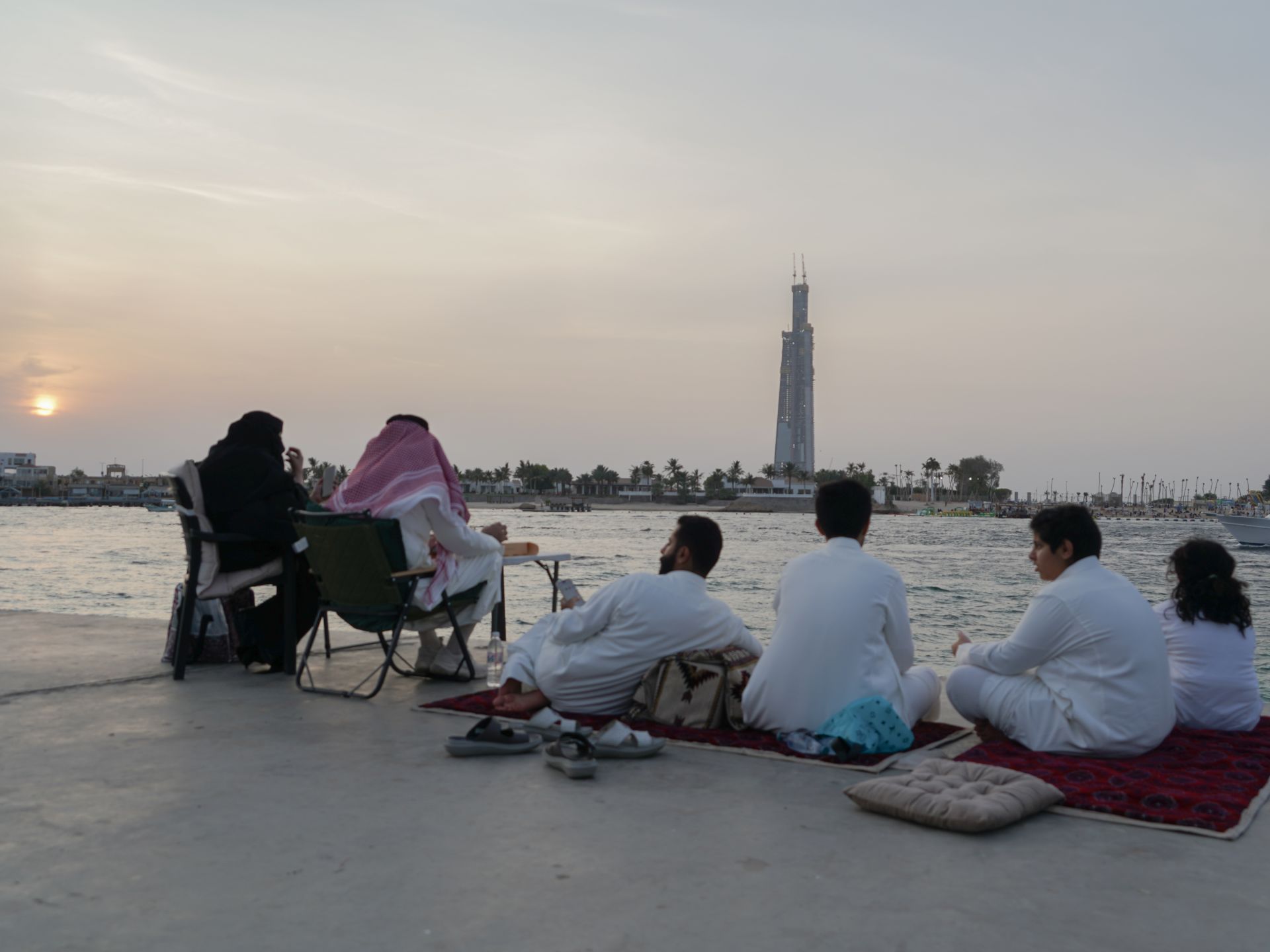
In 35 years at the helm of the Saudi Maritime Company, the kingdom’s oldest shipping firm, Syed Ahmed thought he had weathered every storm the Middle East could throw at him: the Gulf wars, Somali piracy, a container ship blocking the Suez Canal in 2021 and, more recently, the Houthi campaign against Israel-linked shipping. The latest regional war, sparked by U.S. and Israeli strikes on Iran in February, even proved initially good for business.
“Once the Strait of Hormuz was closed, Gulf countries rerouted their food imports through the Red Sea,” Ahmed told me from his glass-walled office overlooking the port of Jeddah, Saudi Arabia’s commercial capital. “The containers are unloaded here and trucked across the peninsula. Our ports are overflowing. Freight rates have tripled. People in our industry are making money hand over fist.” He paused, glancing toward a giant digital map tracking some 30 company vessels. Nearly two-thirds sat at anchor, waiting for a berth. Some had been stranded there since mid-June.
The boom came to an abrupt end on July 20.
That morning, Ahmed received an email from the Houthis. From now on, it read, no merchant vessel would be allowed to enter or leave Saudi ports without risking attack. Within days, two Saudi-linked oil tankers were struck in the Red Sea. The Bab al-Mandeb, the kingdom’s last remaining maritime gateway to the Indian Ocean after the closure of Hormuz, has effectively been sealed off.
For Saudi Arabia, the shock is unprecedented. For the first time in its history, the Arab world’s largest economy finds itself under what amounts to a maritime siege. Only one route remains: north through the Suez Canal, adding roughly 9,000 miles to the journey toward Asia, the kingdom’s most important export market for crude oil.
“In practice, the Houthis are still allowing vessels carrying anything other than oil to pass,” Ahmed said. “Grain, metals, container traffic: All still move through Bab al-Mandeb. Some Saudi shipping companies have turned back, but most continue to transit the strait.”
“As long as they limit the blockade to oil tankers, Saudi Arabia can stay out of the war,” he said. “The day they begin threatening our food supply, that changes everything. But we’re not there yet.”
For now, the Saudi government appears to agree. Since the blockade began, Riyadh has responded with carefully calibrated force. Saudi aircraft struck Houthi positions on July 24. Four days later, the kingdom targeted Iranian-backed militias in Iraq alongside U.S. forces, after drones were launched toward Saudi oil facilities.
Each military response, however, has been accompanied by an equally visible effort to prevent the conflict from spiraling further. After a phone call with President Donald Trump on Aug. 2, Crown Prince Mohammed bin Salman issued an unusually conciliatory statement urging all parties to “contain the escalation” and pursue “diplomatic solutions.” Saudi officials are reportedly seeking to reopen channels with the Houthis while simultaneously announcing a 14-nation maritime coalition to protect Red Sea shipping.
Whether that coalition ever leaves port is another question. “The announcement was aimed less at the Houthis than at Tehran,” said the Saudi journalist Badr Alqahtani. “It was a way of signaling who still stands with Saudi Arabia in the region.”
Alqahtani, who is close to Saudi policy circles, argues that the kingdom’s restraint is not simply a response to the current crisis. It reflects a broader shift in Saudi strategy.
“For years now, Saudi Arabia has pursued what you might call a ‘zero-problems’ policy with its neighbors,” he said. “Mohammed bin Salman wants to turn the Middle East into what he calls ‘a new Europe,’ where economic prosperity replaces proxy wars. Toppling the Iranian regime is not his objective. Look at Iraq. Look at Syria. Look at Libya. Once a regime collapses, nobody knows what comes next.”
How long can Saudi Arabia sustain this strategy of restraint? Part of the answer lies 200 miles north of Jeddah, in the port city of Yanbu.
Wedged between the ocher mountains of western Arabia and the Red Sea, the sleepy town where T.E. Lawrence once established his headquarters during the Great Arab Revolt has suddenly become the kingdom’s economic lifeline.
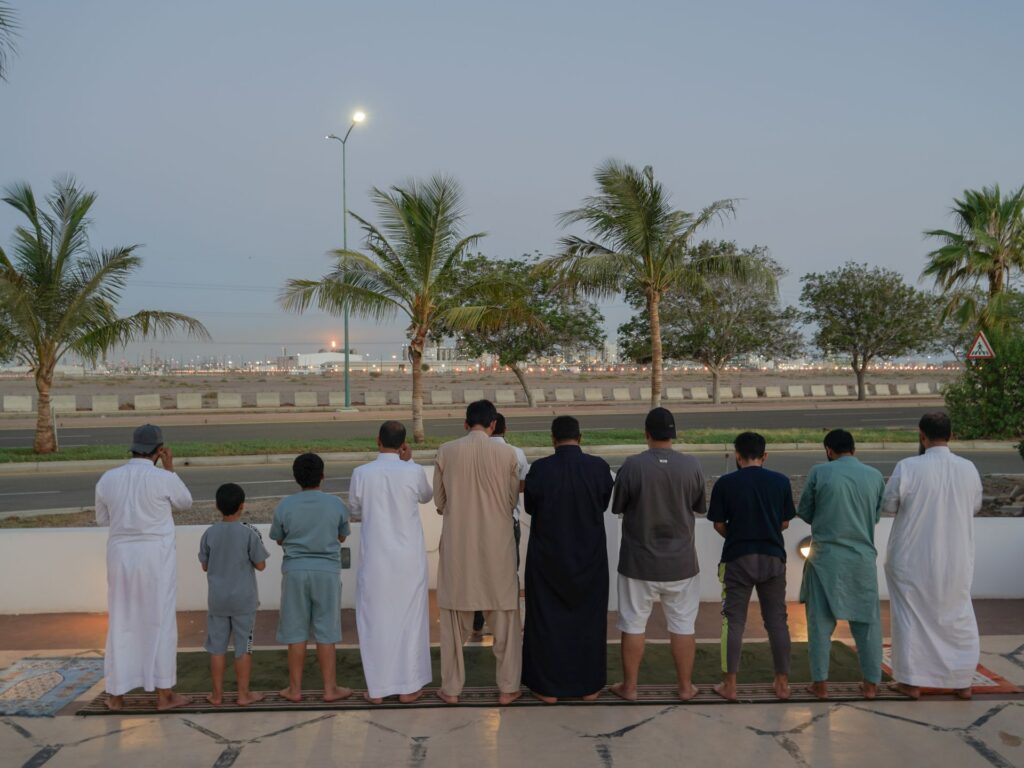
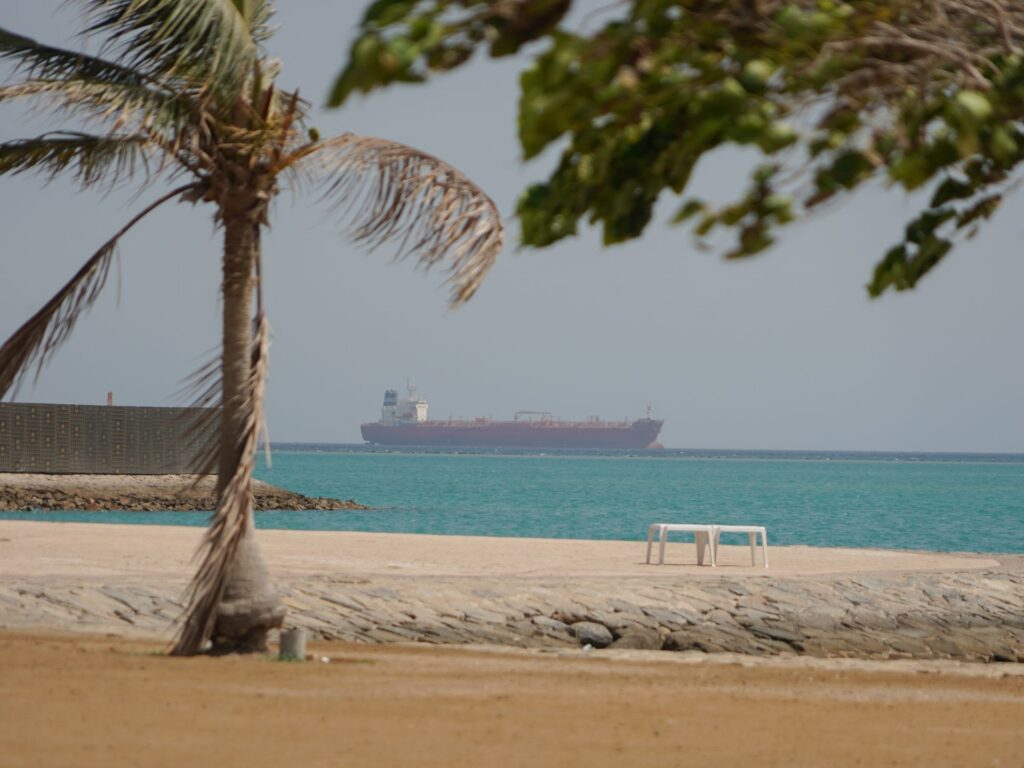
Its rise was decades in the making. In the aftermath of the Iran-Iraq War of the 1980s, when both sides targeted oil tankers in what became known as the “Tanker War,” Saudi planners decided they could no longer afford to rely solely on the Strait of Hormuz. They built the East-West Pipeline, linking the oil fields of the Eastern Province to the Red Sea, with Yanbu as its western terminus.
For years, the pipeline was little more than an expensive insurance policy. This year, it became indispensable.
“Before Hormuz closed, Yanbu exported barely 1 million barrels of oil a day,” said Yasser Ali, Yanbu’s chief administrator. “Now we’re approaching 5 million.”
Dressed in a red-and-white ghutra, Ali has spent the past several months managing what amounts to a logistical wartime mobilization. Roughly three-quarters of Saudi crude exports now pass through Yanbu. South of the city, the refinery operates around the clock. Yellow plumes rise from a maze of smokestacks and flares, hanging over the desert horizon. Offshore, an almost uninterrupted procession of supertankers heads north toward the Suez Canal, bypassing the Houthi blockade farther south.
“The whole world suddenly knows where Yanbu is,” Ali said with a smile.
So do the Houthis. On Aug. 5, the group claimed it had fired missiles at an oil tanker off Yanbu’s coast. Days earlier, it announced another strike, this time involving what it described as “multiple drones” targeting the Yanbu refinery. Saudi authorities have neither confirmed nor denied that the attack reached its target.
Yanbu residents, however, believe they already know the answer.
“It was around 5:30 in the morning,” said Talal, a 27-year-old employee at the neighboring industrial zone. “Our phones started buzzing with emergency alerts. Then we heard three explosions coming from the direction of the refinery. The following day, every road leading to the petrochemical complex was closed.” Since then, police patrols have multiplied around the site. Cars are no longer allowed to stop nearby. Photography is strictly forbidden. Officers scan the area for suspected spies.
Saudi Arabia has spent tens of billions of dollars on air defense systems. Yet it still struggles to shield its most critical infrastructure from relatively inexpensive drones and missiles. The trauma of the 2019 attack on the Abqaiq and Khurais oil processing facilities still hangs over the kingdom. In a matter of hours, a swarm of Iranian-made cruise missiles and drones temporarily knocked out half of Saudi oil production, exposing the limits of one of the world’s most sophisticated air defense networks. The Houthis claimed responsibility, while U.S. and Saudi officials blamed Iran, which denied any involvement.
“The Gulf states never truly adapted to these new aerial threats,” said Bilal Saab, a former Pentagon adviser on the Middle East. “Now it is hitting them in the face.”
The problem may soon become even more acute. According to recent U.S. media reports, Washington has already depleted roughly 80% of its stockpile of Terminal High Altitude Area Defense (THAAD) interceptors and nearly half of its Patriot missiles during the past six months of regional fighting. If those figures are accurate, American allies could wait years before replenishing their own missile defense inventories.
For Riyadh, the implications are sobering. Russia’s experience offers a warning of what might come. Despite having one of the world’s largest militaries, Moscow has struggled for more than two years to prevent Ukrainian drones from repeatedly striking oil refineries hundreds of miles into Russian territory.
Saudi officials fear a similar future. “The Houthis can threaten the kingdom’s western export terminals while Iranian-backed militias in Iraq pressure the oil infrastructure in the Eastern Province,” said Andreas Krieg of King’s College London. “For the first time, both ends of Saudi Arabia’s energy system can be held at risk simultaneously. That vulnerability is one of the main reasons Riyadh is so determined to avoid direct escalation with Iran.”
The consequences of that strategy are visible even in the narrow alleys of Yanbu’s old town. Under the blistering summer heat, some residents openly question the government’s restraint. “I don’t understand why we don’t hit back harder against Iran and its proxies,” one businessperson told me, insisting that his name be withheld for fear of what he called the kingdom’s “secret police.”
Nearby, 20-year-old Malik wandered through the city’s aging fish market, a crumbling concrete building overrun by stray cats. “Yanbu has become indispensable,” he said. “But it’s also become much more dangerous. I just hope these attacks don’t derail the region’s development.”
Above the fish stalls, strings of faded green flags fluttered lazily in the hot air. Each carried the smiling face of the crown prince. Beneath it, in bold letters, are the words “Vision 2030.”
Vision 2030, launched in 2016, is the cornerstone of Bin Salman’s rule. Its first pillar was social reform. Over the past decade, women have gained the right to drive, travel without a male guardian and enter professions once closed to them. Their participation in the workforce has risen from around 20% to nearly 35%.
“For us, Vision 2030 means an aunt who can now go to court on her own, start a business or travel without a male guardian,” Alqahtani told me. “It’s as much about transforming Saudi society as it is about transforming the economy.”
The second pillar is economic. Saudi Arabia still derives roughly half of its economy from oil, and Vision 2030 was designed to change that. The projects unveiled over the last decade were breathtaking in scale: The Line, a futuristic city stretching 100 miles across the desert; Trojena, a luxury ski resort in the mountains of the northwest; The Mukaab, a cube nearly 20 times the volume of the Empire State Building; and the Red Sea Project, an ultraluxury tourism development expected to feature around 50 hotels and 10,000 rooms.
A decade later, reality has caught up with many of those ambitions. Rising construction costs, hesitant foreign investors and the global race for artificial intelligence have forced Riyadh to rethink its priorities. Several flagship projects have been scaled back dramatically or quietly postponed.
One, however, has survived.
Approximately 120 miles north of Yanbu, tens of thousands of workers from India, Pakistan and Bangladesh are racing to transform an archipelago of 92 islands into what Saudi officials hope will become the Riviera of the Middle East. Rising above the turquoise coastline and sea turtles are construction cranes, luxury villas and the logos of the world’s biggest hotel brands: Four Seasons, St. Regis, Ritz-Carlton.
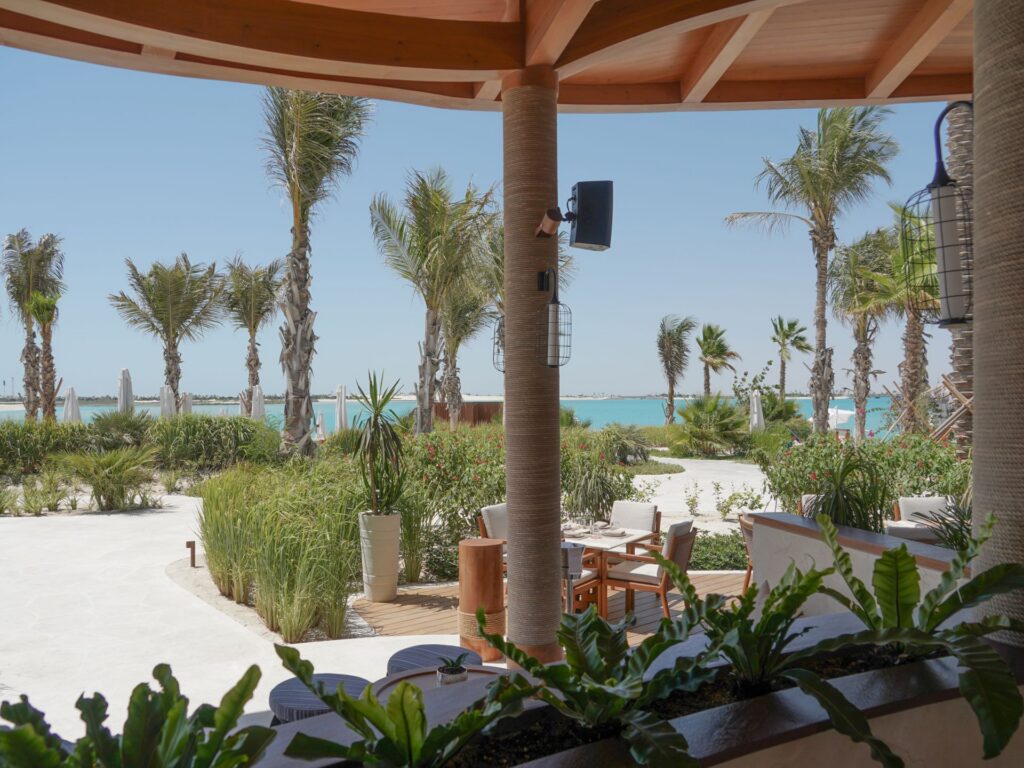
Visitors arriving at the project’s new international airport are whisked away in luxury sedans driven by uniformed chauffeurs. They glide past translucent lagoons and immaculate golf courses before arriving at private beachfront villas designed by some of the world’s leading architects.
“The goal is simple,” a Four Seasons employee told me over lunch at the resort’s waterfront Italian restaurant. “We want to compete with the Maldives and the Seychelles. We’re half the flying time from Europe.”
Winning over Western tourists may prove harder than building the resorts themselves. For many in the U.S. and Europe, Saudi Arabia still evokes the murder of Jamal Khashoggi, restrictions on civil liberties, and religious conservatism. A YouGov survey conducted in late 2024 found that only 12% of Americans could imagine visiting the kingdom.
“It will take at least five years to build the Red Sea’s brand,” the hotel employee said. “And that’s assuming nothing goes wrong. If the first tourists arrive to find Houthi drones overhead, we’re back to square one.”
That, analysts say, is precisely Iran’s leverage. “The real danger isn’t that every drone gets through,” Krieg told me. “It’s that some do.”
A single successful strike near one of the Red Sea resorts, he argued, could send insurance premiums soaring, frighten investors and shatter the carefully cultivated image of stability on which Vision 2030 depends. “Iran and its partners do not need to destroy these projects to undermine that confidence,” Krieg said.
Not every Saudi megaproject has met the same fate. About 60 miles north of Jeddah lies King Abdullah Economic City, known as KAEC, the kingdom’s first great attempt at reinventing itself.
Launched in 2005 under the late King Abdullah, the project was envisioned as one of six new economic cities that would transform Saudi Arabia into a global industrial and logistics hub linking Europe and Asia. A deep-water port was carved out of the Red Sea. A high-speed railway connected the site to Jeddah. Planners expected the city to be home to 2 million residents by 2035.
The reality is strikingly different. Twenty years later, the city feels almost abandoned.
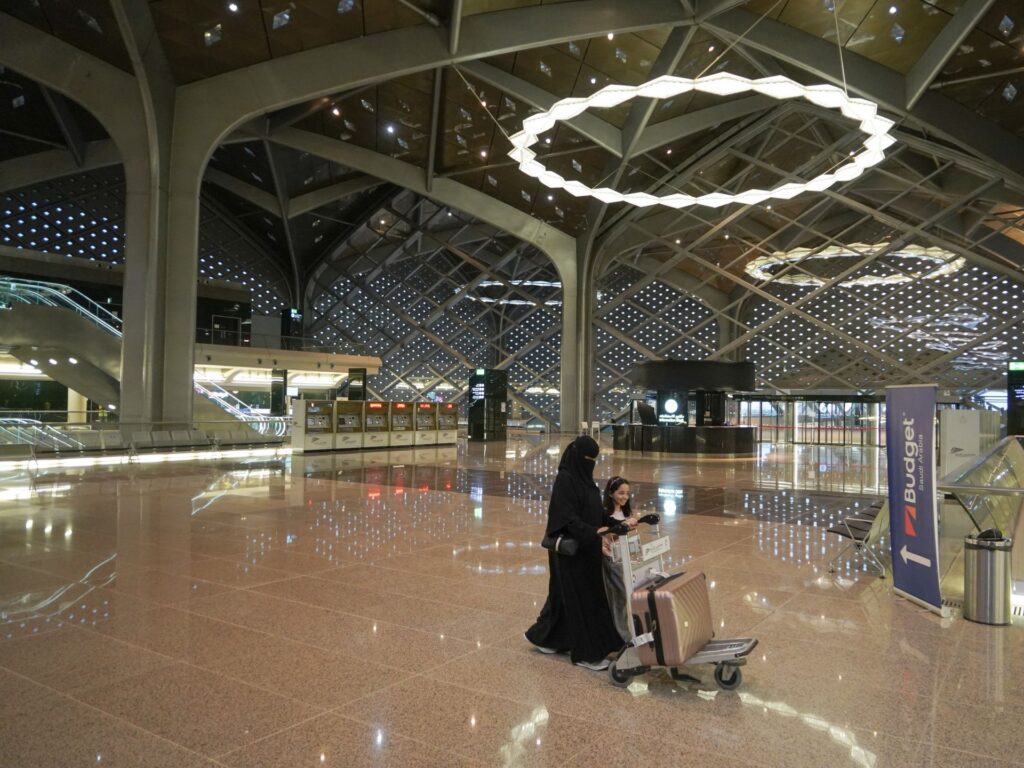
Barely 7,000 people live here. Entire streets have been paved, but the houses they were meant to serve were never built. The roof of the sports complex has collapsed. Only two multinational companies, Pfizer and Mars, ever established factories in the industrial zone. The high-speed rail station, vast enough to resemble a major North American or European terminal, sees only a trickle of passengers each day.
“People simply never wanted to move here,” said Yasmine, a French expatriate whose Saudi husband invested heavily in the project. “There’s nothing to do. People get bored.” Their last hope is the 2034 FIFA World Cup. Perhaps, they believe, millions of soccer fans will finally bring to life what two decades of planning could not.
Saudi Arabia now finds itself caught between two ambitions that are increasingly difficult to reconcile. On one side lies Iran and its network of regional proxies. On the other is Bin Salman’s vision of transforming the kingdom into a global business hub.
For today’s Saudi leadership, peace has become the prerequisite for an entire economic and social project. The question now is whether those ambitions can survive while an adversary retains the ability to reignite conflict at almost any moment.
The equation has been made even more complicated by Washington’s growing unpredictability. In late July, after months of negotiations, the White House abruptly conditioned a landmark civilian nuclear agreement on Saudi Arabia’s formal recognition of Israel, a reminder that Riyadh’s most important security partner can no longer be taken for granted.
Mahmoud Shehrah, a former Yemeni diplomat now at Chatham House, believes the kingdom will probably succeed in defusing the current crisis. But he doubts it can live indefinitely under what he describes as the permanent threat posed by Iran’s regional network.
“This is a sword of Damocles hanging over Saudi Arabia’s development,” he told me. “The Houthis are deepening their ties with al-Shabab jihadists in Somalia, with the long-term ambition of projecting influence across both shores of the Gulf of Aden. Sooner or later, Riyadh will have little choice but to support another ground offensive by Yemen’s internationally recognized government. Another war is only a matter of time.”
Not everyone agrees. For Krieg, another large-scale military intervention would risk dragging Saudi Arabia back into the strategic dead end of the 2010s: a war that failed to dislodge the Houthis despite years of fighting and one of the world’s worst humanitarian catastrophes.
“The real choice isn’t between defeating the Houthis and recognizing them,” he said. “It’s between learning how to contain them or accepting that they will remain a permanent weapon against Saudi Arabia’s economic transformation.”
That may be the defining paradox of Mohammed bin Salman’s Saudi Arabia. The kingdom’s future depends on convincing the world that it has become a place of stability. Iran and its proxies only have to make investors doubt that the future is as stable as Riyadh promises.
“Spotlight” is a newsletter about underreported cultural trends and news from around the world, emailed to subscribers twice a week. Sign up here.