


The first time I told my wife, who is from Aleppo, that I loved her, I was in the throes of a half-coma prompted by eating unnecessarily large quantities of kebab karaz (small meatballs cooked in a sour cherry and pomegranate molasses reduction) and kibbeh labaniyeh (meat dumplings cooked in a yoghurt stew). It was probably the closest I’ve ever come to accepting my own inherent mortality and the peace that comes with knowing that one can be ready to let go — the belly is saturated and the mind is in a stupor, but there is little you want to do to remedy the situation, and the world will take care of itself when you’re gone. Snooze gently into that good night.
I started with this anecdote to ameliorate the impact of my next statement: We don’t talk enough about how great Egyptian cuisine is, and I dare say so as an Egyptian.
In the past week, social media has been awash with discussion of the merits and shortfalls of the Mother of the World’s cuisine, with much pearl-clutching that evokes Robert Pattinson’s “somebody get these beggars out of here!” line in “The Odyssey,” caused by the whispered suggestion that humble grain-based Egyptian food might actually hold up favorably in comparison to Levantine aristocratic flamboyance, Lebanese mezzes and Syrian kibbeh.
As far as I can tell, the latest salvo of the food wars was prompted by a screenshot of a poll in which Egypt trailed Turkey, Lebanon and Iran on the question of which Middle Eastern country had the best food, and subsequent social media posts about how Egyptian food was subpar. Georgetown Islamic civilization professor Jonathan Brown bucked the trend of bashing Egyptian food that usually ensues, by saying that the past 10 years had seen massive improvement in the country’s food scene, likely due to several factors — Gulf investment in restaurants, the presence of Syrian chefs who had fled the war in their country, etc.
I grew up between the Gulf and Egypt in a largely Egyptian milieu of extended family and friends, so my experience of Egyptian food was largely centered around home-cooked meals made by my mom, aunts, grandmothers and other Egyptian women in our social circle, particularly during Ramadan, when iftar invitations were frequent. Many of these meals included variations of Egyptian staple dishes (though not koshary, which we’ll come to later, given its history as a working-class dish, making it inappropriate when you invite people over). If the meal wasn’t seafood-focused, it usually involved various combinations of “mahshy” or stuffed dishes (vine leaves, cabbage, zucchini, bell peppers, eggplants — all filled with rice and herbs) alongside various meat dishes, which could be chicken, duck, lamb, quail or pigeons stuffed with rice and spices, the various combinations a particular form of art. Sometimes there was Egyptian goulash (a phyllo pie crust stuffed with ground beef), macarona bel bashamel (a casserole with beef, penne pasta and bechamel sauce), molokhia, or Egyptian fatta (layers of crispy bread and rice topped with tomato sauce and vinegar). Sometimes the rice dish was ruz muammar, which was baked in a clay pot with milk and cream. Sometimes it was a seafood meal with about six or seven variations of fish. Sometimes it was kawareh, slow-cooked cow trotters, a dish my father loved but that I found so vile I ordered takeout on the days it made an appearance. Or, when I’d visit my grandmother, it was a bunch of rice pudding and Umm Ali (bread pudding) dishes she’d prepared for the occasion.
Those were halcyon days, when the extended family existed for me, and ten times out of ten I’d have picked any of those dishes before any of the Levantine, Turkish, Persian, Indian, North African or European dishes I’ve gotten the opportunity to experience during my travels (except perhaps for kebab karaz).
I was therefore surprised when I began traveling more and came up against the spurious allegation that Egyptian cuisine, to put it in scientific terms, sucks.
This was news to me, but I quickly realized that those who had succumbed to the propaganda of the Lebanese restaurant military-industrial complex of the Arab diaspora had had little opportunity to experience my grandma’s very specific method of making molokhia in farm-fresh duck stock, or the exact millimeter length of her vine leaf mahshy rolls. The few Egyptian restaurants that did exist in Europe or North America, and they were vanishingly rare, were simply not as good at making the main dishes and augmented their menus with grilled meats that were Egyptian in the sense that they were meat made by Egyptians, but were so ubiquitous and generic that one could say they’re as characteristic of Egypt as the Empire State Building. The more interesting Egyptian food experiments I have come across in Montreal, where I live now, were mostly private caterers or places that experimented with street food, like a deli that makes spicy ful (fava bean) sandwiches, hawawshi (spicy minced meat pies) and a croque monsieur made with pastirma. Another spot makes a mean Alexandria-style liver sandwich.
This is not to say that some Egyptian restaurant food doesn’t excel over its lauded Levantine counterparts in certain departments. This is the point where I may lose some of you, but I do hope that as you close down this tab, you will leave safe in the knowledge that you are objectively wrong.
First, the Egyptian variant of falafel, known as tamiyya, is simply superior to the Levantine version. Some pedants will point to the fact that Levantine falafel is made with ground chickpeas instead of the fava beans and herbs that characterize the more moist and flavorful Egyptian version, so they are essentially different foods. To which I would say they are technically correct, but their point doesn’t suit my narrative, so it will be ignored. In addition, they are served in rather similar settings — on-the-go bites or sandwiches, usually at breakfast. Check and mate.
The argument holds a bit more water in the contentious space of who makes the best molokhia. Levantines (with a few exceptions) usually make it with whole or chopped molokhia leaves somewhat similar in texture to spinach, whereas Egyptians chop the leaves finely and make a soup in which we usually cook chicken, rabbit or duck. Critics have uncharitably described the texture of soup molokhia as slimy or mucus-like, which is defamatory. Mixed evenly with rice, it is an excellent meal, but the preparation method and mode of consumption are different enough that we can agree to disagree.
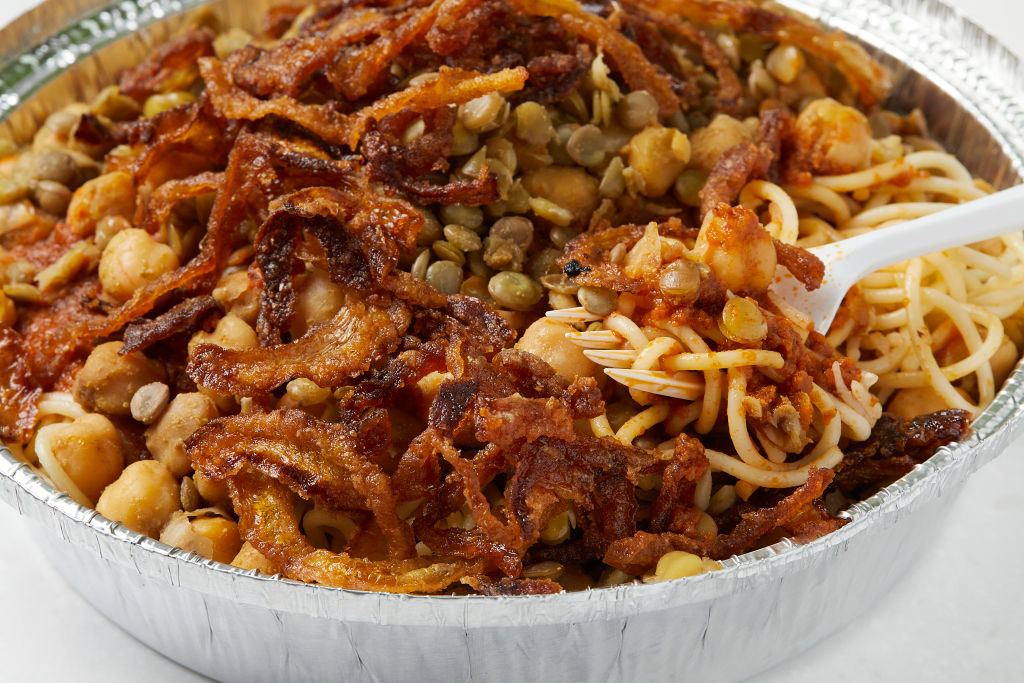
Third, koshary is unparalleled. Even the staunchest Levantine revanchists will acknowledge, through gritted teeth, that koshary is a valuable regional addition to the carb-overload working-class dish space, and that equivalent dishes like the lentil and grain mujaddara don’t really hold up as competition (as a side note, however, I am an absolute sucker for burghul bel banadora, a tomato and bulgur dish that embodies the comfort food moniker). Koshary, which is essentially a mix of various carbs and legumes like lentils, macaroni, rice, and chickpeas, topped with fried onions, a garlic and vinegar mix, and tomato sauce of varying degrees of spice, is restaurant-friendly and recognizable, and is therefore communal (the best version I had was with my uncle in an open-air eatery in the town of Tanta, 58 miles north of Cairo).
Over time I developed my own pseudoscientific beliefs around regional cuisine, undeterred by the need for scientific analysis to prove my hypotheses, or anything other than my own lived experience of eating my way through the region (my experience is mostly deficient in the Iraqi food space, however, and for that I apologize).
Some of these beliefs include the following: Jordanian, Palestinian and Aleppo zaatar are superior to all other variations; Syrians dominate all other cuisines when meat is the star of the table and are endlessly creative with it (they also generally, and perhaps rightly, believe nobody else has lamb as good as theirs); the Lebanese have perfected mezze and appetizers; few environs are as conducive to merry food and drink consumption as the Turkish meyhane; the Syrian chefs displaced by the war have transformed the region’s culinary scene; the ancient Persian who invented the pomegranate and walnut-laced chicken dish known as fesenjoon should be fast-tracked to a life of luxury in Paradise eternal; and Egypt does grain-based dishes, from mahshy to koshary and feteer meshaltet (layers of dough and ghee that date back to ancient Egypt), like nobody else.
So the next time the nostalgia or falafel craving hits you, and you long for the warm spice palate of the Middle East, and you fire up Fairuz on Spotify to inspire you in the kitchen, consider experimenting with an Egyptian recipe. Or better yet, call your Egyptian friend (we all have one) and invite yourself over to their home for a meal.