


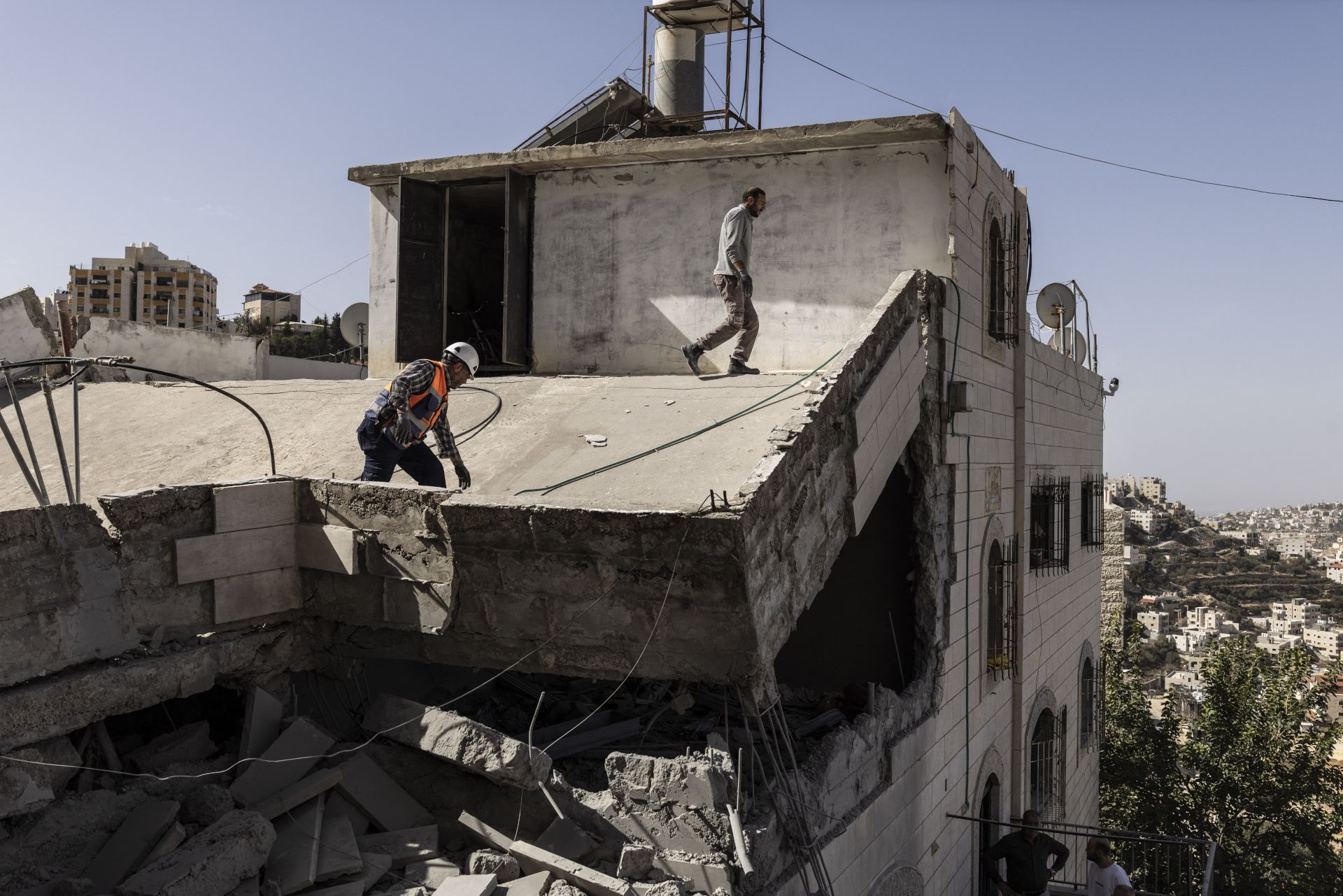
Shereen Al-Jaaba’s oldest son was killed on Oct. 23, and her life will never be the same. Ahmed Al-Jaaba, 23, was one of two Palestinians suspected of opening fire on Farsh al-Hawa checkpoint on the outskirts of Hebron in the occupied West Bank earlier that day. The shooting was followed by an intense 20-minute firefight that left three Israeli soldiers wounded and two soldiers dead, in addition to the two Palestinians.
The incident was the catalyst for something much bigger for residents of Hebron, home to more than 200,000 people. Israeli forces descended with fury on the two Al-Jaaba family homes in Ain Deir Bahha.
“They acted with such brutality. It was beyond anything normal,” Shereen told New Lines.
“They immediately began tearing the place apart, smashing the interior of the house. They were incredibly savage, to a degree that’s truly indescribable,” she continued, adding that the soldiers ordered her family out into the street in the early hours of the morning.
“They didn’t even tell us what was happening; we thought we were just stepping outside for a few minutes, that perhaps they wanted to bring us in for questioning. So, we didn’t take a single thing, nothing at all, from the house,” she continued. Shereen didn’t know it then, but that was the last time she would see her house standing.
Neighborhoods known as Al-Jalada and Ein Deir Bahha were largely emptied during the Israeli military incursion. Homes were ransacked, doors were damaged, and locals’ testimonies claim belongings and money were looted. The area remains marked by signs of destruction: Several buildings were leveled.
When Al-Jaaba spoke to New Lines more than a week after this incident, she sat in a family member’s home shared with some 25 other people, many of whom were now permanently displaced. Her husband was still in hospital as a result of abuse perpetrated by Israeli soldiers at the time of the raid, and a day earlier she’d watched a video of the Israeli military blowing up her family home.
“This home held both sadness and joy; it was a place for family gatherings and togetherness. To lose this home, and all those memories, right before your eyes is an indescribable feeling,” she said. “I knew it was going to happen, but seeing it unfold in real-time, right there on your phone … it’s overwhelming.”
“Why are these people, the last remaining members of these families, being subjected to such suffering and torture? What have they done?” Shereen asked, as she held back tears.
International humanitarian law is clear that people living under military occupation cannot be punished for an offense they’ve not personally committed. The events that unfolded across Hebron following the shooting would bring this topic, and Israel’s actions, into a much sharper focus.
“Everywhere else in the world, torture is reserved for those who commit acts of oppression or wrongdoing,” Shereen added. “But here, why is an entire family being treated this way?”
Just days before Israel’s national election on Oct. 27, Prime Minister Benjamin Netanyahu vowed to shut down the West Bank in response to the shooting, saying: “We will act to destroy this place, to change it completely.” The prime minister also proposed a strategy new to Hebron: “We are going to implement the successful and aggressive model we used in the refugee camps.”
“It wasn’t just one house; the situation escalated from a single home to the entire town,” Shereen said. “Why are other families being dragged into this?”
Palestinian teenagers Amira and Aya Natsheh had almost no time to pack a small bag when Israeli soldiers came to their family’s door in the early hours of Saturday morning, as the neighborhood filled with military trucks. They had no connection to the events at the checkpoint; they just happened to live in the same area.
“We tried as much as we could to stay really quiet,” said 16-year-old Amira, describing how her nervous family watched events unfold outside as their neighbors were evicted one by one. “We didn’t put any lights on. We didn’t make any noise. We just waited to see what would happen.”
Eventually it was their turn. For the first time in their lives, the teenagers had to evacuate the home they grew up in. “I took clothes and whatever important items I saw, like my camera,” Amira explained. “I was afraid they would break it if I left it there.” Their father, Osama, gathered his four children and helped his pregnant wife out into the cool Hebron night with what little they could carry, before trying to get as far away as possible.
“The good thing here in Hebron: We have social solidarity, so you’ll never find someone in a hotel or a dorm or something like that,” Osama explained, but their home was left at the mercy of occupiers seemingly intent on teaching the city a lesson. “Whenever the Israeli army asks you to leave your house, it’s better to keep your doors open, not shut,” he added. “Otherwise, they will explode the doors.”
The Natsheh family were among 4,969 Palestinian men, women and children forcibly displaced from their homes as Israeli forces swiftly brought down siege-like conditions on vast areas of the West Bank city’s Al-Jalada and Ein Deir Bahha neighborhoods. Schools were closed, shops were shuttered and Israeli forces started the engines of demolition bulldozers.
Standing on the opposite hillside, overlooking his family home while the evacuation orders remained in place, Dr. Bashir Salah pulled out his phone to watch the live camera still recording his front door. Looking across the valley, several buildings had been marked with a black “X,” which they thought signaled they’d been searched and cleared. Salah, who holds German citizenship and teaches in Saudi Arabia, just happened to be home visiting his wife and four children when the evictions began; he was forced, like many others, to leave the lights on and his doors open, his electricity bills still ticking up day by day. He watched the CCTV as armed soldiers calmly walked in and out of his property, sipping Coca-Cola.
“The most painful [thing] is that you are looking at your home, [knowing] you couldn’t reach your home,” he says. “No one will have this feeling unless they live this feeling. … I can assure you, no one in this neighborhood has participated in what is happening. We are not guilty.”
Dr. Khaled Fahd Al-Qawasmi, the city’s deputy mayor, was doing what he could to support the displaced families impacted by the eviction orders. He met with New Lines a week after the shooting, standing beside the Hebron checkpoint where the Oct. 23 attack unfolded, a short drive from the evicted neighborhoods. He’s clearly busy; his phone rings constantly as he recounts the situation facing Hebron, explaining that even filing a petition to Israel’s Supreme Court hadn’t stopped the soldiers from proceeding.
Behind him, a chaotic scene was playing out: A sprawling ceramic showroom had received demolition orders that morning. They had less than 24 hours to evacuate; trucks whizzed into the parking lot to load whatever supplies they could. Along with the eviction of families, Israeli soldiers had already demolished most structures surrounding the checkpoint. The showroom’s owner, Issam al-Qawasmi, said, “Words don’t explain what we live here,” before quickly getting back to loading the trucks. The surrounding destruction may foreshadow what lies ahead for the family-run business.
“All of this area was a place for cars and everything. All of the people have evacuated their things from this area up to that tower,” the deputy mayor explained as he motioned toward a sea of rubble and bent metal. Soldiers claimed they were clearing anything they deemed a security risk.
“The Israelis are angry; they are not satisfied with the usual punishment they are making for the Palestinians. They want to increase it,” he continued. “We are afraid that this is going to be their new policy. They will do that in all other areas. It’s very tough procedures. It’s very inhumane, very unnecessary.”
Netanyahu intended to “do something that has not been done until now,” as he said. He seemed to take pride in imposing a widespread Hebron siege that mirrors similar events that played out in Palestinian refugee camps across the West Bank, perhaps also signaling an escalation in military strategies. Many displaced residents expressed concerns about the scale of retribution in Hebron, but felt helpless in the face of it.
“All this suffering [is] because of the policy of collective punishment,” Osama added. “I don’t know what their leaders are thinking, because this won’t lead to anything. This is useless. If you put more pressure in a boiling pot, it won’t make the thing easier. It would be more complicated.”
Itamar Mann, professor of international law at the University of Haifa Faculty of Law, is currently a fellow at Humboldt University of Berlin. He explained that while collective punishment is prohibited under international humanitarian law, it’s a “traditional practice,” carried out in Israel under Regulation 119, which authorizes the confiscation and demolition of Palestinian homes under certain circumstances, often following attacks. The action in Hebron, however, is “very, very different because it takes a much wider scope,” he said.
“I think the prohibition of displacement, which we’ve seen violated systematically in Gaza, and also violated in the West Bank over the last three years in numbers that are unprecedented, may also be implicated in this case in Hebron,” he told New Lines.
Whether this signals a systemic shift toward broader collective punishment strategies across the West Bank may hinge on the next Israeli government. Gadi Eisenkot, a former chief of staff who heads Yashar, the opposition bloc’s largest party, is currently tasked with forming a new government after a tense, inconclusive election. But there’s still no guarantee that he will secure the necessary majority.
“We hope that the new government might be smarter,” Osama explained. “They wouldn’t adopt the same policies of collective punishment, as these policies wouldn’t lead to a solution, [they] might be complicating the whole situation.”
But should the coalition negotiations result in another far-right government, Mann suggested, “this will be the pattern.”
“The pattern will be biting away chunks of the Palestinian population and pushing them to population centers and also pushing them abroad. This is very clearly the political program of the current government still in office.” Regardless of which way Israel’s political pendulum swings, however, many international experts agree on what played out in Hebron.
“We have evidence that the chief of the military suggested that there is not a real military purpose [in Hebron],” Mann continued. “I don’t think we need much more than that to say that there is at least a very valid suspicion that what we are seeing here is a collective punishment on a broad scope.”
After almost 11 days, on Nov. 2, the Israeli military lifted its siege of Hebron and withdrew, finally allowing thousands of Palestinian families to flood back to their homes, unsure of what they would find. Local reports said 15 homes and facilities were destroyed during the incursion, while many others sustained damage and graffiti. There were also reports of looting.
The Natsheh family told New Lines they were lucky: Although some of their things were scattered, their home was still standing. “There is no big damage, just two internal doors that we forgot [were] closed,” Osama said. “They broke the two doors.” For many families experiencing displacement for the first time, however, the mental burden of the ordeal may take longer to process. “It was a strange experience and mixed feelings when we came back,” Osama added. There’s also mounting uncertainty over what this means for the future.
“People are very afraid,” said Hebron’s deputy mayor, referring to warnings from Defense Minister Israel Katz that this could happen again on an even bigger scale.
“He said that if something similar happens in Hebron, the operation will be wider and longer. We think that probably such a sentence could happen at any time, and this means that the Israeli army has a plan to enlarge the evacuation,” the deputy mayor continued. The municipality is already preparing for such a scenario, working with international organizations in case something similar plays out.
Thousands of Hebron residents now attempt to return to normal life, but others have nothing to return to. Al-Jaaba said, “I have nowhere else to stay.”
As is routinely the case, Israel is currently holding the bodies of the two Palestinian suspects linked to the checkpoint attack, meaning Shereen has been unable to bury her son. For now, the family remains in limbo, without a home and unsure whether there will be further repercussions.
“Anything could happen against the family,” Al-Jaaba added. “We don’t rule anything out; we remain vigilant at every moment.”
For many across the city, the latest escalation has only deepened a pervasive sense of insecurity felt in every corner of the West Bank. “I don’t know how the Israelis are thinking,” the deputy mayor said, “but [they are] not a people, not an army, not a state that is looking to live in peace near another people.”
Become a member today to receive access to all our paywalled essays and the best of New Lines delivered to your inbox through our newsletters.