


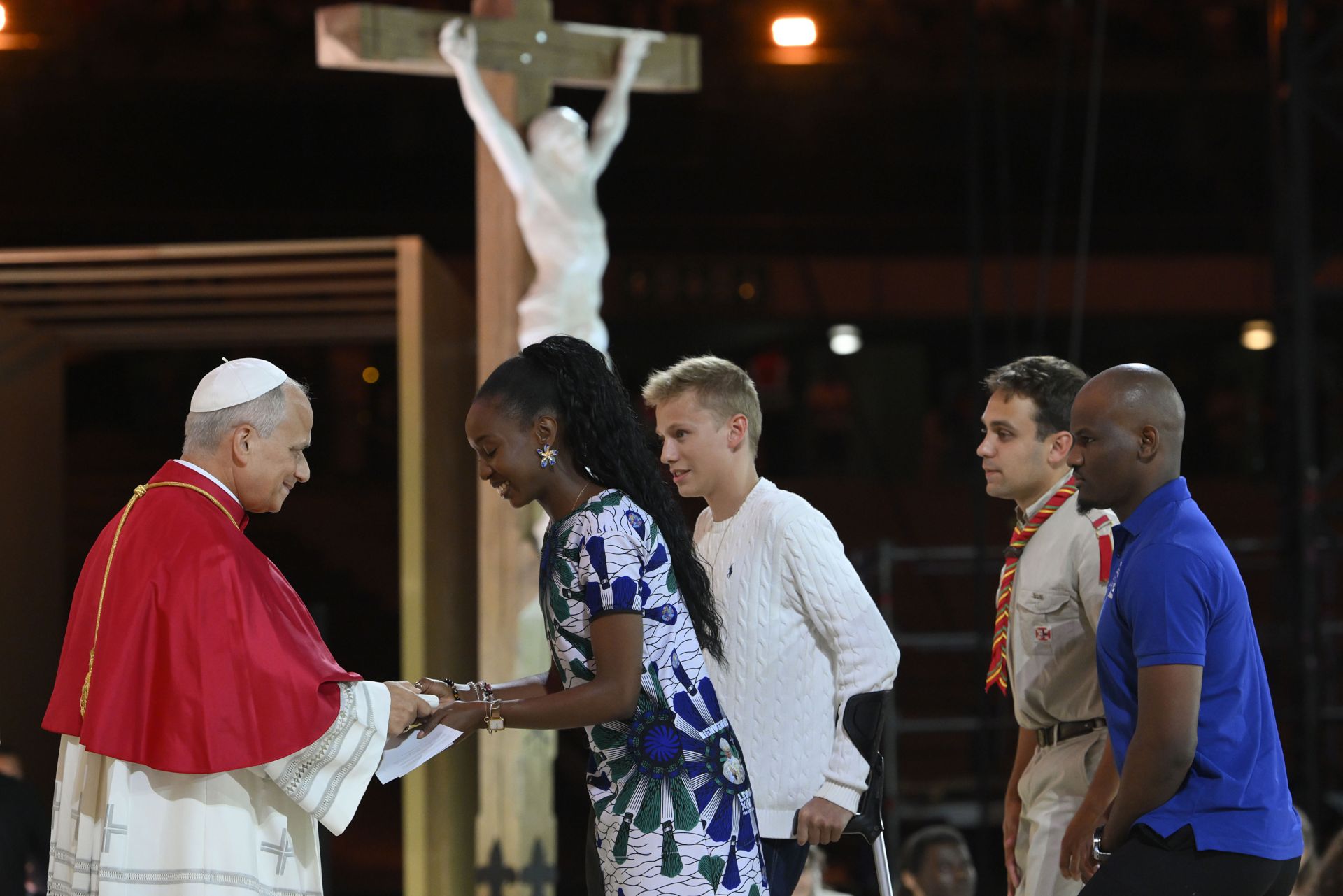
Chants of “Léon, Léon” rang out as Pope Leo XIV walked onto the stage of the Stade de France in Seine-Saint-Denis on Friday. This, said Monseigneur Etienne Guillet, bishop of Seine-Saint-Denis, was the “stadium of all France,” highlighting the cosmopolitan, multiethnic and multicultural character of his diocese just northeast of Paris — and of the 80,000 young people gathered there.
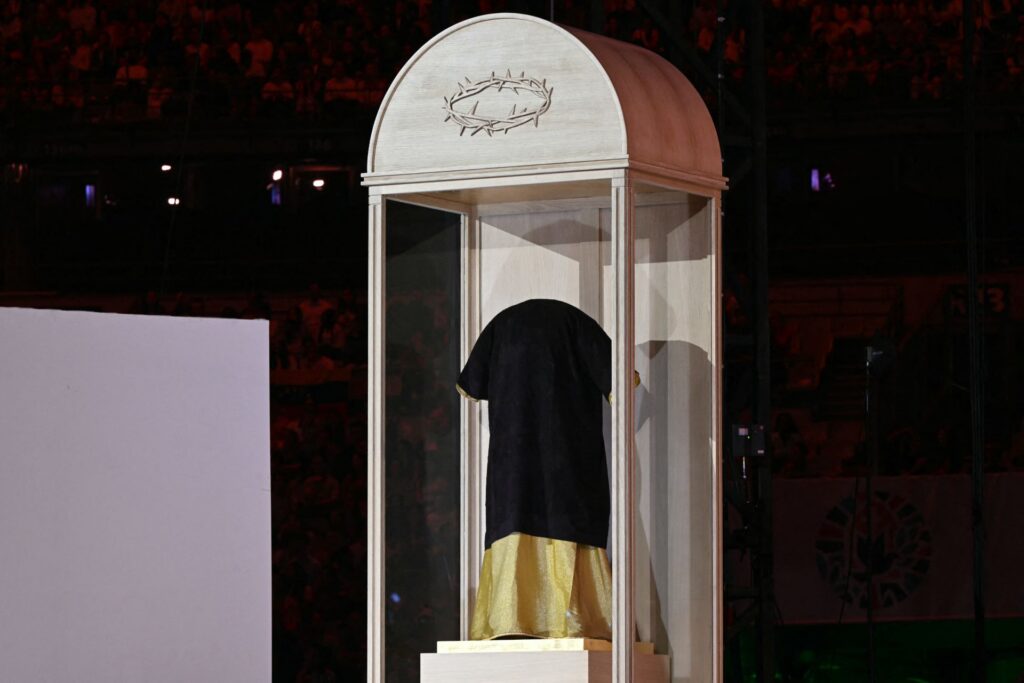
Behind Leo stood a giant cross, and, nearby, the Holy Tunic of Argenteuil, said to be stained with the blood of Christ. “Let us look at the two relics before us,” the pontiff said, inviting France’s Catholic youth to meditate on the Passion, a message of divine love, hope and grace.
But to those who knew to look for it, the two emblems on the stage of the Stade de France carried another message — this one not addressed by Leo but planted there by followers of France’s version of Christian nationalism, known as identitarians, who treat Christianity as a badge of ethnic and cultural belonging in their supposed battle for the preservation of white European identity.
The giant cross that stood behind Leo during the Stade de France vigil was provided by SOS Calvaires, an association that restores roadside crucifixes, or calvaries. But behind their heritage work is a decidedly identitarian project. In 2022, the investigative outlet StreetPress revealed that among other far-right ties, one of SOS Calvaires’s early funders was Pierre-Édouard Stérin, the far-right billionaire hoping to use his financial firepower to remold French politics in line with his conservative ideals. “A calvary is a banner,” the group’s chairperson said, “It’s a flag you plant.” Questioned about the controversial cross, the vigil’s producer said the Vatican had found the original cross too small, and that SOS Calvaires simply happened to have another.
The tunic, kept in a basilica in the Paris suburb of Argenteuil, has very little historical grounding; scientific analysis dates its cloth to the Merovingian era, centuries after Christ. Still, its restoration was funded by conservative billionaire Vincent Bolloré, whose media empire, notably his CNews channel (often compared to Fox News), dragged France’s far right from the margins to primetime, and by his friend, Trump ally and Europe’s richest man Bernard Arnault. Arnault, head of the LVMH luxury group, recently had dinner with Marine Le Pen and is now said to be “preparing for the far right’s rise to power.”
The cross and the tunic were just two Easter eggs among many planted throughout Leo’s visit by what reads like a who’s who of France’s identitarian figureheads. Seven months before France’s presidential election, they used the first papal visit to the country since 2008 to showcase their power, reach and influence.
In the U.S., people speak about “Christian nationalism”; in France, we use the word “identitarian” to describe something similar. The movement is not a party or a church but a current, whose members treat Christianity less as a faith than as a marker of ethnic and cultural identity, a heritage to be defended against immigration, Islam and what the French like to call “le wokisme.” This French cousin of Christian nationalism has roots in the ideas of Charles Maurras, the early-20th-century nationalist who prized the church as a pillar of social order rather than a source of faith. Or, as far-right pundit and presidential hopeful Éric Zemmour put it in 2018: “I am for the church and against Christ.”
Identitarianism runs from boardroom to street. At the top sit billionaires like Stérin and Bolloré, who, according to reporting by French business weekly Challenges, likes to tell his friends: “I use my media to wage my civilizational battle.” In politics, from Zemmour’s party to the mainstream right, identitarian figures want France’s “Christian roots” written into the constitution. In popular culture, the movement’s emblem is the Puy du Fou, the hugely popular historical theme park founded by far-right politician Philippe de Villiers, where an eternal Catholic France is staged in giant spectacles complete with horses, fireworks and costumed volunteers. On the street, it is embodied by groups like the pan-European anti-immigration movement Generation Identitaire, dissolved by the French state in 2021.
Seine-Saint-Denis, where the pope held a vigil on Friday, is one of the most frequent targets of this identitarian current. One of France’s poorest and most diverse departments, with residents hailing from locales as far-flung as Sri Lanka, Algeria, Romania and Mali, it is often described by identitarians as a “foreign enclave” fallen victim to “colonization” — in short, an emblem of the “Great Replacement” supposedly at work on the outskirts of Paris.
Bishop Guillet conceded to the French daily Le Nouvel Obs that, while “it is not always easy being a young Christian” in his diocese, many of the young men and women who signed up to meet the pope also invited their unbaptized friends — atheists, Jews, Muslims, Sikhs, Buddhists — because these are people who “live together all year round” in France’s youngest department. Some 1,500 of them attended the vigil Friday.
The official website for Leo’s visit insisted that he would “come and meet all French people,” baptized or not: That was the church Leo traveled to France to greet.
Since his election in May 2025, Leo has fought the identitarian current inside Catholicism. In July, he excommunicated the four bishops ordained by the ultratraditionalist Society of Saint Pius X in defiance of Rome. On Friday, at the Elysee Palace and in an apparent rebuke to the anti-immigrant platform of Marine Le Pen’s National Rally, he praised France’s “rich and varied social fabric” and its “sensitivity to diversity.”
Church officials said Leo wanted a “pacified” visit — but popes don’t run their own trips; hosts do. And though the identitarians weren’t handed the reins of his visit, per se, they certainly had a hand in steering it.
Leo’s visit was a “windfall” for traditionalists, one of the top organizers of the Paris leg told French daily L’Express. “Since June,” the source said, “they have been attempting to infiltrate the visit from within.”
Though no individual donor was solicited to help fund the event, which cost some $22 million for the Paris leg alone, there has been plenty of implication in the French press about who might have generously contributed to the tour. LVMH’s Arnault, who helped fund the restoration of Notre-Dame Cathedral to the tune of $225 million, and his wife were invited to meet Pope Leo in a private audience this summer, and offered reserved seats to the papal events in Paris.
When the diocese of Paris asked for 12,000 volunteers, traditionalist groups urged their members to sign up en masse. Notre-Dame de Chretiente — the traditionalist group that organizes the yearly Pentecost pilgrimage between Paris and Chartres, featuring the very Tridentine Masses restricted by Pope Francis in 2021 and attended, among others, by far-right politician Marion Maréchal, Le Pen’s niece — reportedly sent some 2,000 members to welcome the American pope.
But the hunt for identitarian Easter eggs began before Leo had even set foot in Paris.
On Thursday night, on the eve of his visit, some 2,000 young Catholics attended a vigil featuring about 10 content creators, among them two controversial Catholic influencers known as Father Matthieu Raffray and Brother Paul-Adrien.
Raffray, with 200,000 Instagram followers, is a regular on far-right-leaning news channels. The priest, who says his mission is to “evangelize identitarian and nationalist circles,” delivers frequent online sermons in which he calls on women to be stay-at-home moms and fearmongers over civilizational war. During the 2022 presidential elections, he called Zemmour the candidate “most compatible” with the Catholic faith. When National Front founder Jean-Marie Le Pen died in 2025, Raffray hailed him as an “oft-misunderstood prophet.” As for Brother Paul-Adrien, the Dominican priest with 680,000 YouTube followers, he famously vowed, after the 2024 Olympics’ alleged Last Supper parody, that his was a “generation of Christians that won’t let itself be spat at in the face.”
The vigil, though not technically part of the pope’s apostolic visit, was set in Saint-Sulpice — the biggest church in Paris — and opened by Bishop Bruno Valentin, head of the French Bishops’ Communications Council, who addressed the crowd “on behalf of the church in France.”
In the columns of Le Monde, progressive Catholics called Raffray’s vision of the faith “incompatible with the message of Christ.”
The next day, in Seine-Saint-Denis, those two opposing branches of the French church shared a stadium. “You could tell they’d attempted to put something in for everyone,” Ombline Damy, a 28-year-old doctoral student in literature, told New Lines. There were speeches from refugees and MMA fighters alike, the young progressive Catholic explained. “But as soon as the show started,” she added, “I knew something had gone wrong.”
She explained: “I felt like I’d landed in the Puy du Fou.”
And for good reason: The show was produced by artistic director Jean-Baptiste Darantière, who happens to be the son of Notre-Dame de Chretiente’s president. He made his name directing “cinéscénies,” outdoor spectacles inspired by Le Puy du Fou and showcasing a supposed “eternal France” by glorifying its history and, above all, its catholicism: the perfect counter to the “blasphemous” 2024 Olympic opening ceremony.
Friday’s spectacle, costumes and all, had “France’s Christian era” beginning in the first century, with the arrival of Lazarus and Mary Magdalene in Provence. But, lest we forget, there was no “France” in 44 CE: the Gauls still belonged to the same empire as the inhabitants of modern-day Egypt and Tunisia. “As for Louis IX ,” Damy recalled, the 13th-century French king who was later canonized was portrayed as a “kind idealist,” with no mention being made of his role in the Inquisition, the Crusades or the persecution of Jews.
When asked about the giant cross set up by SOS Calvaire, Ombline lamented that “images of Leo next to this cross give visibility to this fringe group, and might legitimize their political goals.”
Call it a Trojan Cross.
The final nail, as it were, came when Leo celebrated Mass before some 800,000 people on the Place de la Concorde, the spot where Louis XVI was guillotined. It was a strange choice, made stranger when it was revealed that the location was selected by Albéric Dumont, a veteran of La Manif Pour Tous, the movement against same-sex marriage, who also runs the security firm that protected far-right presidential candidate Éric Zemmour in 2022.
The selection of this particular spot raised a lot of eyebrows among the French left, especially given the strong counterrevolutionary current within identitarian Catholicism. Might this be read as the republic’s willingness to finally provide some “atonement” for the horrors and martyrs of the French Revolution?
Bolloré’s media outlets were well placed to supply that reading.
Each Easter egg, taken alone, has an innocent explanation: The Vatican found the first cross too small, and SOS Calvaires happened to have another; volunteers are volunteers; the Place de la Concorde was simply the biggest stage available. But taken together, they form a pattern.
The hijacking of Pope Leo’s Paris trip offered a rare look at how Europe’s identitarian Catholic movement builds influence: reaching young people through mainstream religious events, and borrowing Leo’s “pope star” image, as the French call it, to push a political and cultural narrative of its own. With a presidential election seven months away and the far right poised to win it, that narrative is working on a deadline.
“Spotlight” is a newsletter about underreported cultural trends and news from around the world, emailed to subscribers twice a week. Sign up here.