

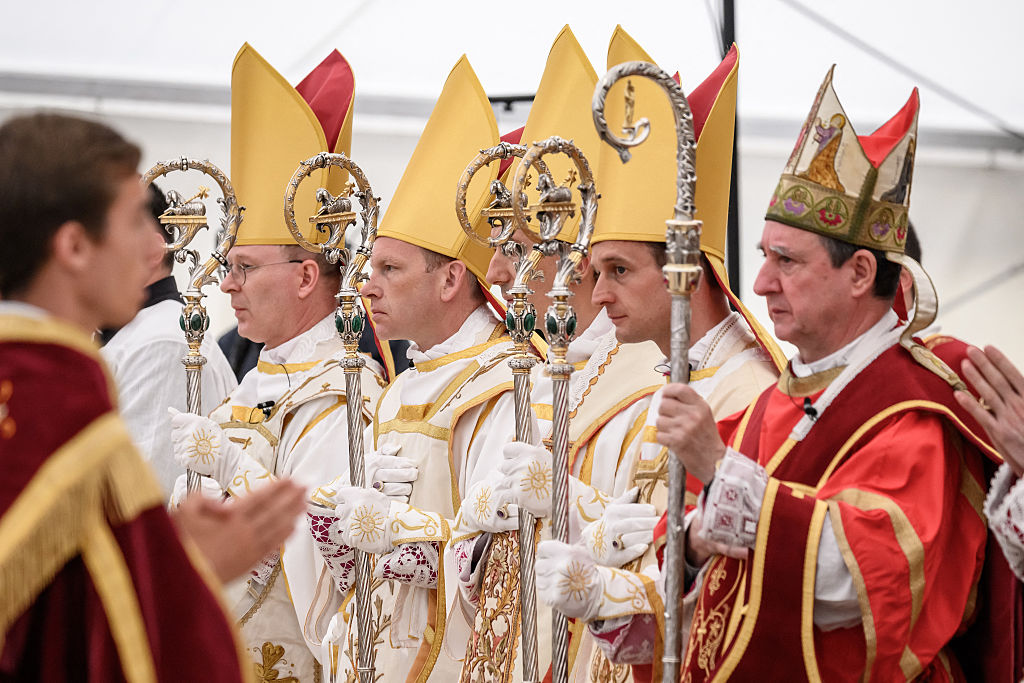
On Wednesday, under a rain-soaked tent in a field in Econe, Switzerland, bells tolled, hundreds of Catholic priests processed to an altar and some 15,000 faithful watched four men become bishops in open defiance of Pope Leo XIV — an act that triggers automatic excommunication and, under canon law, schism.
The Society of Saint Pius X (SSPX) livestreamed the ceremony on its YouTube channel in multiple languages. The highly publicized extravaganza had the air of a festival: Girl Scouts handing out water bottles, baseball caps stamped “Écône2026,” even a commemorative wine box with bishop-themed labels retailing for 75 Swiss francs ($93).
The ceremony fell exactly 38 years after July 1, 1988, when SSPX’s founder, Archbishop Marcel Lefebvre (1905-1991), was excommunicated for consecrating four bishops without Rome’s approval. Founded in 1970, the SSPX stood in opposition to the modernizing reforms of the Catholic Church in the 1962-1965 Second Vatican Council (or Vatican II). The group opposed the Vatican’s liturgical reforms and its switch to vernacular Mass, as well as its redefinition of the church’s relationship with other religions, which Lefebvre said “encouraged false religions to pray to their false gods.”
In much of the American coverage, Wednesday’s ordinations were treated as pageantry: nostalgic Catholics in lace, attached to their Latin and incense, tweaking the nose of a reformist pope. Headlines presented the movement as a “rebel,” “breakaway,” “schismatic” or, most often, “traditionalist” Catholic group.
From a French perspective, that framing doesn’t hold. We are all too familiar with the group, not only because the overwhelming majority of SSPX clergy preach from France, but because we see its history as inseparable from our country’s: We see Vichy, collaboration and the Catholic right’s entanglement with antisemitism.
The grievance at the heart of the SSPX schism has a prehistory, and it is not a flattering one.
Lefebvre was a fervent supporter of Marshal Philippe Pétain, who, as head of the collaborationist Vichy regime under the Nazi occupation, contributed to the deportation of some 75,000 Jews from France to Auschwitz and other death camps. Of the liberation of France, Lefebvre wrote, “we witnessed the victory of Freemasonry against Pétain’s Catholic order” — a reference to a long-standing far-right conspiracy theory that casts secular republicanism, liberalism and Jewish influence as part of a Masonic plot against the Catholic Church.
Decades on, he was still leading pilgrimages to Pétain’s grave, declaring that the man convicted of treason for collaborating with Nazi Germany had “restored [France] spiritually and morally” and telling followers he believed Pétain was in heaven. “Long live Marshal Pétain!” he concluded. “Long live France!”
Then there is Paul Touvier. A Vichy militia chief convicted for ordering the 1944 execution of seven Jewish hostages, Touvier spent 16 years hidden in SSPX priories before his 1989 arrest in Nice. The society’s explanation for sheltering a man who murdered Jews on Nazi orders was that it had acted out of “charity to a homeless man.” When Touvier, sentenced to life imprisonment, died in 1996, an SSPX priest performed the funeral rites.
In 1991, Lefebvre himself was convicted of fostering race hatred for declaring that Muslims “cannot be truly French” and asserting that, as a result of migration, “your daughters, your wives, your children will be kidnapped and taken to segregated neighborhoods like those that exist in Casablanca.”
Then there is the question of Holocaust denial — not a rogue element but a recurring feature of the SSPX. In 1989, Bishop Richard Williamson, one of Lefebvre’s original four and then rector of the SSPX’s main North American seminary in Wisconsin, claimed that no more than 300,000 Jews died in concentration camps, and declared that “there was not one Jew killed in the gas chambers. It was all lies, lies, lies.”
He was expelled from the SSPX in 2012, ostensibly for lacking “respect and obedience.” Williamson went on to found the breakaway SSPX Resistance. In a 2020 sermon, he blamed Jewish people for the COVID-19 pandemic and accused them of manipulating the stock market in an effort to spark a war, calling them “master servants of the devil.”
Williamson was not alone: Bernard Tissier de Mallerais, a fellow 1988 bishop, wrote in 1997 that Jews were “the most active partisans for the coming of the Antichrist.” The group’s leaders called all this a distortion of the SSPX’s true position, even as its own archived publications trafficked in the same material for years, quietly scrubbed only after journalists started asking questions.
Lefebvre would go on to endorse the far-right National Front’s Jean-Marie Le Pen, and maintained vocal admiration for authoritarian regimes from Franco’s Spain (which he called “the ideal of the state”) to Pinochet’s Chile, lamenting that “as soon as a man rises up to save his country from communism and restores Christian order, everything is done to discredit him.”
In France, the SSPX’s political bloodline runs, to this day, through Civitas, a group that embraces integralism — the belief that Catholic values should guide government policies. Dissolved by the French state in 2023 on account of its antisemitism, the organization was steeped in the same pro-Vichy thinking that shaped Lefebvre in the first place.
None of this makes the SSPX unique among Europe’s reactionary Catholic currents. What makes it especially legible, to French eyes, is its specific genealogy. Americans watched the wine and the baseball caps and saw nostalgia. In France, our history won’t let us call it merely traditionalist. We know exactly what to call it.