

Fearing Iran, Saudi Arabia Looks To Draw Turkey and Nuclear-Armed Pakistan Closer
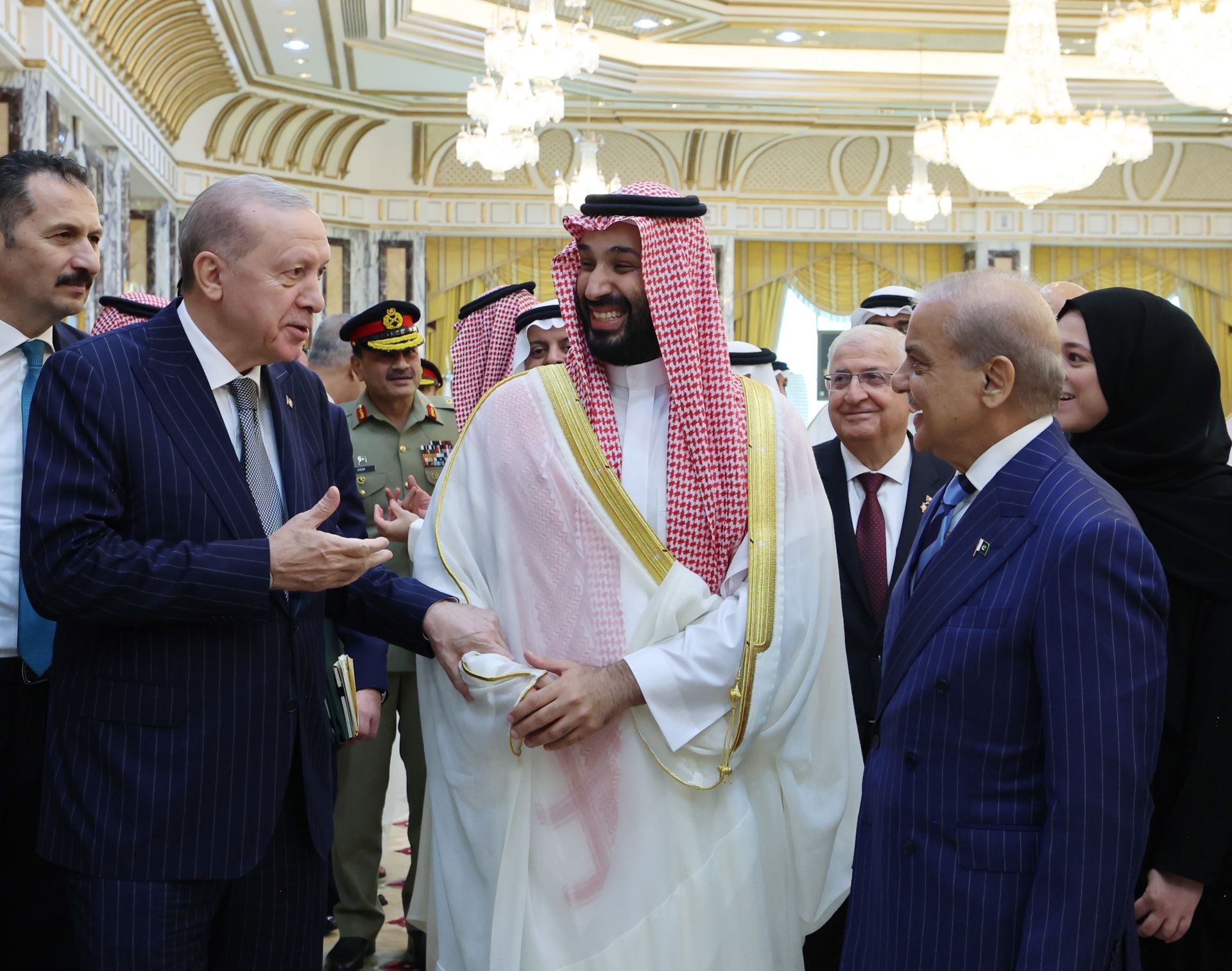
Last Friday, Saudi Crown Prince Mohammed bin Salman, Turkish President Recep Tayyip Erdoğan and Pakistani Prime Minister Shehbaz Sharif signed a joint defense agreement in Mecca. Commentary has split over whether it represents a serious military commitment or a mere symbolic gesture. The short answer is: It is more serious than many think, for the coming months at least, but unlikely to harden into a durable NATO-like alliance.
The context of the signing suggests that Saudi Arabia needs this agreement more than its two partners. Turkey is a NATO member and Pakistan is a nuclear state. Saudi Arabia is neither. More importantly, Riyadh is caught in the unintended consequences of a war on Iran initiated by its traditional security partner, the United States. Since the war began, the kingdom has come under nonstop attack from Iran, pro-Iranian militias in Iraq and, most recently, Yemen’s Houthis. With the Strait of Hormuz closed, Saudi oil exports depend on the Red Sea route through the Bab al-Mandeb; this is the artery the Houthis have declared closed, amounting to a naval blockade of the kingdom. Friday’s agreement in Mecca came just days after Riyadh announced a military alliance to protect navigation in the Red Sea, and one day after a Saudi official publicly warned, citing intelligence, of an imminent coordinated attack by the Houthis and Iraqi militias.
Alliance agreements are basically commitments. With no superior authority to enforce them, any party to a treaty can renege. Since states live effectively under political anarchy, then it is reasonable for a country like Iran to be skeptical that such treaties would actually compel a state to come to an ally’s defense. Indeed, Ebrahim Rezaei, a member of the Iranian parliament’s national security committee, has already dismissed the Mecca pact as a “paper agreement” that will bring the Saudis no security.
Rezaei’s bravado aside, we know from the academic literature that political leaders normally resort to two main mechanisms to make their commitments credible. The first is raising the cost to themselves of backing down later. When Saudi Arabia, the United Arab Emirates, Egypt and Bahrain announced their boycott of Qatar in 2017, for example, Turkey rushed additional troops to its base in Doha within days. This made any attack on Qatar an attack on Turkish forces as well, and any Turkish retreat from their commitment to defend Qatar far costlier.
The second mechanism is paying real costs up front that an uncommitted state would never pay. For example, one day after the Hamas attacks in October 2023 that started the Gaza war, the Joe Biden administration demonstrated that it would stand with Israel against Iran and its proxies by ordering the USS Gerald R. Ford carrier strike group to the eastern Mediterranean.
The Mecca agreement falls under the first category, but what is fascinating about it is how Mecca itself was used to manufacture the audience cost of reneging. The three leaders all face weak domestic audiences at home, which blunts the standard mechanism by which democratic publics punish leaders who back down. To engineer an audience large and powerful enough to make retreat costly, the Saudi crown prince staged the signing in the holiest place in Islam, on the holiest day of the Muslim week. In this way, he was able to bind the commitment not before voters, but before the Muslim “ummah” (“nation”).
Yet the binding force of such commitments erodes over time. Leaders change, regional circumstances shift and interests are recalculated. The mechanism also carries its own danger: Precisely because it locks leaders in, it raises the risk of war if deterrence fails. Commitments that adversaries doubt invite testing. The most dangerous period for the Mecca agreement is therefore its first months, when Iran and its allies have every incentive to probe whether the paper means what it says.