

Fear and Unity Fueled a Historic Turnout Among Israel’s Palestinian Voters
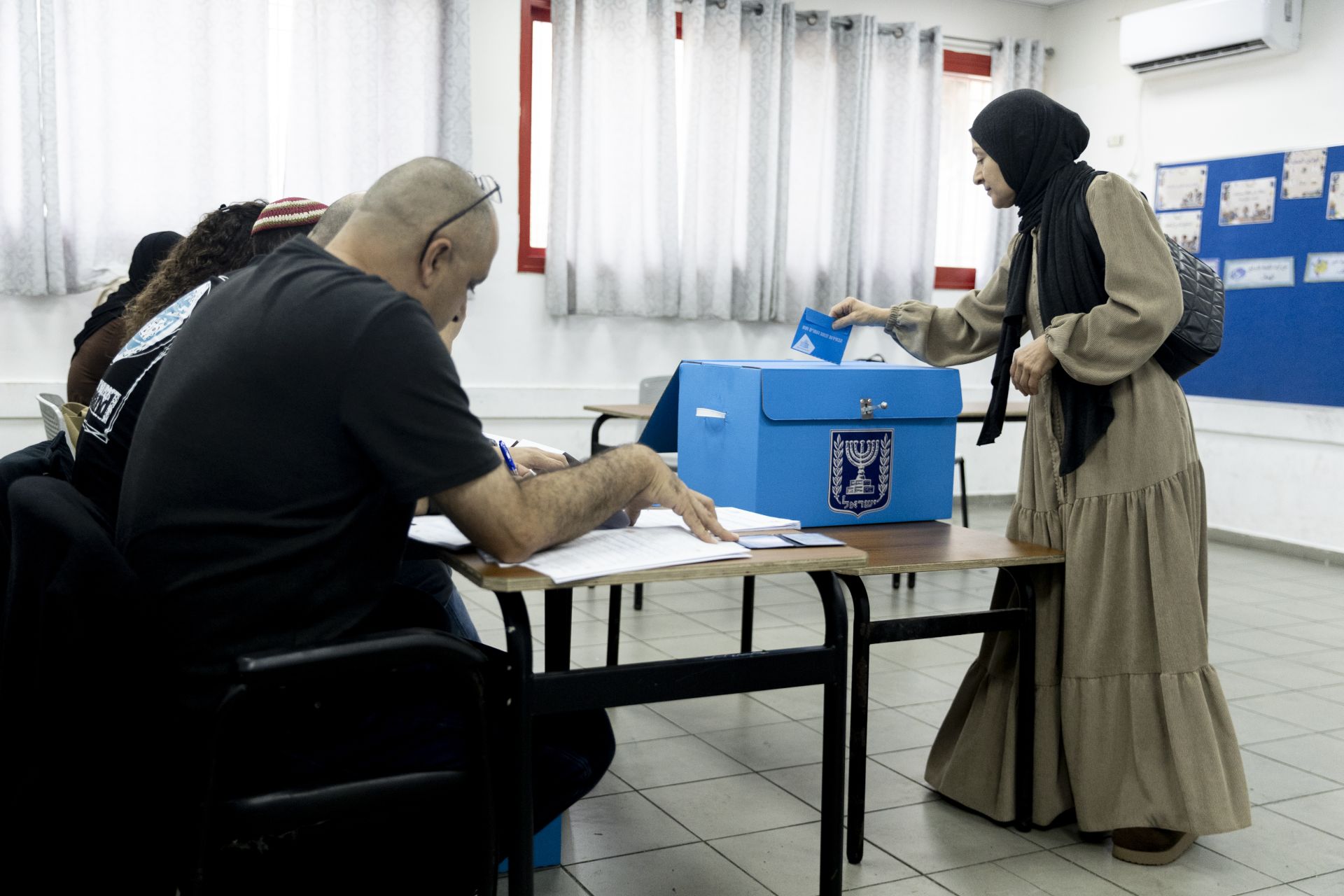
On election day in 2015, Israeli Prime Minister Benjamin Netanyahu exhorted his followers to go to the polling stations and vote for him, “because the Arabs are going to the ballot boxes in droves.” Yesterday, “the Arabs,” Palestinian citizens of Israel, did indeed come out to vote. Voter turnout in the “Arab sector” reached a record high, and the result was a historic victory. The so-called Arab parties, which represent the interests of Palestinian citizens of Israel, collectively won 19 mandates. They shattered their 2020 high of 15 seats.
The latest data indicates that the anti-Netanyahu bloc of parties secured a decisive 66 of the 120 seats in the Knesset, Israel’s parliament — if one includes the Arab parties. Without the Arab parties, the Zionist opposition parties collectively won 49 seats. This is well short of the 61-seat majority needed to form a government. Without the Arab parties, the Zionist opposition parties cannot form a government.
Likud, headed by Prime Minister Benjamin Netanyahu, won 27 seats, which means it will retain its status as the Knesset’s largest party. His main opponent, Gadi Eisenkot, head of the Yashar party, is on track to secure 22 seats.
The spotlight is on Eisenkot and his fragmented bloc, which includes right-wing parties with leaders who have voiced overt racism toward Palestinians and who have said explicitly, on more than one occasion, that they would not be willing to sit in an Arab-backed government. The Palestinian surge makes their path to power significantly more complex.
Unless someone in the Zionist opposition caves and breaks their campaign commitment to reject an Arab-backed government, further rounds of elections are likely. Mansour Abbas’ United Arab list is the more amenable of the two Palestinian parties to such a coalition. Abbas divested his party manifesto of Palestinian national aspirations, said that he accepted Israel as a Jewish state, and recruited a Jewish Zionist former chief of police to his party, which is now projected to win six seats. This is not enough to make up the shortfall in the Zionist opposition party’s seats. If they want to form a government, they will be forced to court the non-Zionist Joint List, with its Palestinian nationalists and communists, which is projected to win 11 seats.
Yesterday’s turnout of Palestinian voters was truly historic. Preelection polls hinted at an increased turnout, but those expectations were far exceeded on election day.
Since 2015, a clear pattern has emerged among Palestinians citizens of Israel: They reward unity with high voter turnout rates, and punish disunity by staying at home. When the Joint List was established in 2015, uniting all four predominantly Palestinian parties under one umbrella, the public responded with a 63.5% turnout rate, up from 56.5% in 2013. The Joint List won 13 seats. But when the list disbanded ahead of the 2019 elections, the Palestinian public punished it with a turnout rate of 49% — a historic low.
This pattern continued to hold in the following elections. Unity was rewarded; disunity was punished. Earlier this year, with elections on the horizon, the Palestinian grassroots placed considerable pressure on the parties to unite. At a large demonstration against rising crime rates in the Palestinian city of Sakhnin, participants literally forced party leaders to shake hands and commit verbally to reestablishing the Joint List.
Mansour Abbas insisted on pursuing a separate path by breaking away from the Joint List to stand as an independent party. This stoked fears of low voter turnout. The parties’ late, sluggish, and somewhat vague campaign in the months leading up to the elections did not bode well, either.
Yet the numbers started to shift in the weeks leading up to the elections. Public opinion polls indicated an uptick in anticipated voter turnout rates, culminating in yesterday’s surge.
The catalyst for this massive voter turnout can be summarized in one word: fear.
Israel’s Palestinian citizens have navigated an impossible political reality since Oct. 7, 2023. They have lived in the shadow of genocide in Gaza, while many Jewish Israelis, often their colleagues at work or their neighbors, were cheering it on. They have faced overt racism in daily life, deepening institutional neglect, government-initiated home demolition campaigns and systemic political repression.
Palestinian citizens were arrested for posting simple sentiments of sympathy for Gaza’s victims on their social media accounts, while rabidly racist politicians like Finance Minister Bezalel Smotrich threatened openly to expel them from their towns and villages. Certainly, Palestinian life inside Israel was far from rosy before the Oct. 7 attacks and the Gaza war; racism, unchecked organized crime and systemic discrimination were rampant. But these trends accelerated until they were out of control. All of this contributed to a “do or die” mentality that was palpable yesterday among Palestinian citizens of Israel.
The Israeli Supreme Court’s decision to uphold the disqualification of Sami Abu Shehadeh, a prominent Palestinian politician in the Joint List, added a final spark of urgency. Shehadeh’s disqualification, on the basis of a single published opinion piece that he later disavowed, was backed by the entire range of Zionist parties, including the liberal Democrats party. This resonated deeply among Palestinian citizens, mirroring the ways in which their own speech was policed by their Jewish-Israeli peers and their loyalties questioned by Jewish colleagues in their places of work.
Over the past decade, a considerable share of the Palestinian public — between 35% and 55% — has abstained from voting. Some boycotted the Knesset for ideological reasons, viewing it as an illegitimate, Zionist institution. Others were disillusioned, fed up with seeing their leaders consistently excluded from Israel’s political game. Yesterday, they got out the vote. The full picture is still emerging, but we can already say that in some notable Palestinian towns — in Tayibe, Kafr Qasim, and Rahat — turnout rates exceeded 75%. The turnout happened because of an organic, grassroots effort by Palestinians to force their way onto Israel’s political playing field.
Counterintuitively, the existence of two parallel tactical streams within the Palestinian community may have raised turnout rates. Pragmatic voters, prioritizing political access, felt reassured that a vote for Mansour Abbas would not be wasted. On the other hand, members of the parallel constituency, those who espouse Palestinian nationalist positions, could cast their ballots without feeling they had compromised their core demands — chief among them, ending the occupation.
The concept of “sumud,” meaning “steadfastness,” is often romanticized by observers. It describes the ability to endure hardship while holding fast to land and principle — a “stiff upper lip.” This concept can sometimes set an impossibly high bar for communities struggling under the weight of apartheid. Palestinian citizens of Israel are worn out and tired. Many speak of emigration, though most will never have the opportunity. But as yesterday’s results demonstrated, they remain steadfast.
Nineteen seats may not be enough to compel the Zionist parties to accept a Palestinian-backed government. But the Palestinian voters of Israel have sent a clear signal: We are on the playing field, and we are here to stay.