

If the polls are correct, Israel’s longest-serving prime minister, Benjamin Netanyahu, will lose the national election on Oct. 27. His coalition of five parties is falling short of the necessary 61-seat majority in Israel’s 120-seat parliament, the Knesset. But the opposition bloc, an odd amalgam of parties that represent far-right settlers, secular centrists, religious Zionists and Tel Aviv hipsters, is also polling several seats short of the minimum number necessary to form a coalition. The only way for the opposition to guarantee a majority is by aligning with one or more of the parties that represent Palestinian citizens of Israel. But so far it appears that the parties in the opposition bloc have only two things in common, which may very well be at odds. On the one hand, they share a burning desire to oust Netanyahu; on the other, they are adamantly opposed to including the so-called Arab parties in a governing coalition.
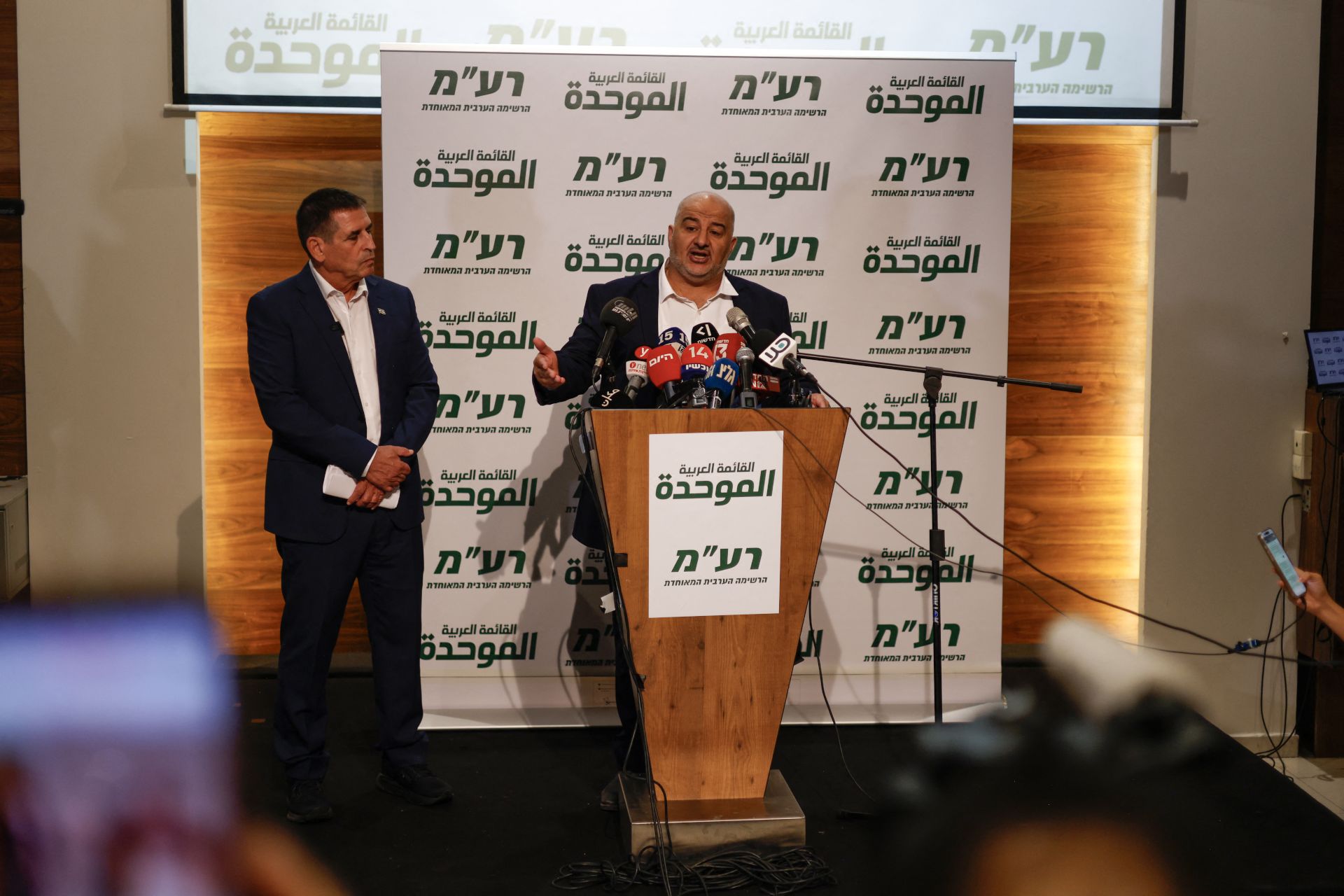
All eyes are on Mansour Abbas, an Islamist politician aiming to break through the opposition’s Arab boycott. In 2020, he broke ranks with the rest of the Arab leadership when he declared his willingness to enter any government, including one led by Netanyahu. He has publicly divested his party’s manifesto of Palestinian national aspirations and recognized Israel as a Jewish state. At the end of August, Abbas announced that Yoav Segalovitz, an experienced politician who is Israel’s former chief of police, would join his party. Currently, Abbas’ party, the United Arab List (UAL), is polling at five seats. Given that the opposition parties are collectively polling a few seats short of the necessary 61-seat majority, Abbas could provide the mandate needed to form a government.
How did a Palestinian politician become Israel’s kingmaker? And what is a secular, Ashkenazi former police commander doing in an Islamist party?
Abbas comes from the mixed Druze-Christian-Muslim town of Maghar, just a few miles northeast of the Sea of Galilee. A conservative Muslim, he began giving Friday sermons at the local mosque when he was 17 years old, attracting the attention of Abdullah Nimar Darwish, the founder of the Islamic Movement in Israel. Darwish started off as an Islamist hard-liner, but later became a moderate integrationist, advocating change from within Israel’s political institutions. Abbas became a close disciple of Darwish while studying dentistry at the Hebrew University in Jerusalem, a profession he quickly abandoned for politics.
Abbas has a history of breaking precedents. After splitting from the rest of the Arab leadership, the UAL became the first Arab party to join a governing coalition in 2021, as part of the short-lived “government of change” formed by Naftali Bennett and Yair Lapid. His decision to bring a Zionist former police commander into the UAL is equally unprecedented.
As a police officer, Segalovitz commanded Lahav 433, Israel’s top investigative and anti-corruption unit. He entered politics in 2016, joining Lapid’s center-left Yesh Atid party, and in 2021 was appointed deputy minister of national security in the Bennett-Lapid Cabinet. Many Palestinian citizens credit him with effectively addressing rising crime during his tenure; Abbas hopes to capitalize on that legacy, positioning Segalovitz as the UAL’s candidate to replace Itamar Ben-Gvir, a rabid racist who heads the far-right Jewish Power party, as the minister of national security.
In a social media post announcing the move, Segalovitz defined himself as “Jewish, Zionist, secular, an officer in the IDF, and a superintendent of the Israel Police.” He insisted that, despite their differences, despite Abbas being an “Arab, religious, conservative Muslim,” and despite a “complicated history between Arabs and Jews,” the moment has come to build “political bridges.” He seemed to promise a historic new beginning.
But beneath the flowery, self-congratulatory rhetoric lie cold political calculations. Segalovitz’s inclusion was primarily designed to break the Jewish-Zionist parties’ boycott of the Arab parties in the Knesset. In 2021, in what turned out to be a brief interregnum, the opposition ousted Netanyahu and formed a coalition with Abbas. This move caused enormous controversy because it broke the taboo on inviting Arab parties into the government, but Abbas was a popular legislator, and the partnership was a success. In Israel’s post-Oct. 7 atmosphere, however, with the entire political spectrum shifted rightward, allying with an Arab is a much harder sell. Both Bennett and Lapid, who jointly lead the second-largest party in the opposition, have said that they would not agree to form a government with “non-Zionist” (read: Arab) parties. Recruiting Segalovitz was clearly meant to make the Islamist party much more palatable to Israel’s increasingly right-wing Jewish mainstream.
But Abbas’ move is also aimed at Palestinian voters. Homicides within the Palestinian communities inside Israel have skyrocketed in the past two decades but accelerated over the last four years, since Ben-Gvir was appointed minister of national security. The minister has neglected the issue, diverting police resources away from the Palestinian community, while also securitizing it by handing cases to the Shin Bet, Israel’s domestic security agency.
As of Sept. 3, Haaretz recorded 201 homicides in Israel in 2026, including both Jewish and Arab citizens. Most of these were a result of gang violence, and at least 157 of the victims were Arab citizens, though these make up less than 20% of Israel’s population. According to a May 2026 poll, “violence and crime” is, by far, the top concern among Palestinian citizens of Israel: 71% said it was “the most important issue” facing the community today. “Settling the Palestinian issue” ranked a distant second at 8%. Members of persecuted minorities sometimes hesitate to express critical or nationalistic views, fearing surveillance, so there is some reason to believe that national issues are more important to Palestinians than they acknowledge to pollsters. Still, Palestinian citizens are clearly deeply concerned by the violence and crime in their community. Segalovitz is a tough-on-crime, establishment politician with good credentials and a reasonable chance of replacing Ben-Gvir, all of which is sure to attract new and undecided Arab voters.
Abbas’ trajectory parallels his former peers, with Ayman Odeh, former leader of the Joint List, the most notable example. Founded in 2015 as a union of Israel’s four predominantly Palestinian parties (including Abbas’ UAL), the Joint List was originally conceived as a pragmatic response to legislation that raised the electoral threshold, the minimum number of votes necessary to take a seat in the Knesset, from 2% to 3.25%. Under the leadership of Odeh, then head of the Democratic Front for Peace and Equality (DFPE), an Arab-Jewish, socialist, non-Zionist party, the Joint List aimed to increase Palestinian representation in the Knesset. Its 2015 election campaign was centered on the premise of strength through unity and the idea that the Israeli political establishment could no longer afford to ignore a large, consolidated Palestinian bloc in the Knesset. The message resonated powerfully among Palestinian voters: the Joint List secured 13 seats, surpassing the combined total of 11 won by Palestinian-led parties in 2013.
Abbas’ recent moves echo Odeh’s approach. In 2019, Odeh downplayed Palestinian national aspirations; instead, he emphasized issues like the need to fight organized crime and secure infrastructure funding for Palestinian communities in Israel. After the 2019 election, the Joint List recommended Benny Gantz, Netanyahu’s chief rival at the time, as prime minister. (In Israel, the mandate to form a government is traditionally given to the candidate most endorsed by other parties and not necessarily to the leader of the largest party). Historically, Israel’s Palestinian parties refrained from submitting recommendations; the ideological gaps were too wide to bridge. But under Odeh, who was bent on replacing Netanyahu, the Joint List endorsed Gantz, a former army chief of staff who once boasted of sending Gaza “to the Stone Age.”
Gantz did not reach out to grasp the extended hand of the Arab parties. Instead, he chose to call a new election, preferring to give up the opportunity of becoming prime minister rather than head an Arab-backed government.
Similarly, the inclusion of Jewish candidates in predominantly Arab lists is not new. As a proudly binational party, the DFPE has always run Jewish members at or near the top of its list, as a matter of principle. It has also consistently advocated for a two-state solution. Under Odeh’s leadership, the Joint List actively worked to broaden its Jewish support base, especially in the lead-up to the 2020 elections, when it attracted thousands of new Jewish voters. Emphasizing Arab-Jewish partnership, the Joint List advertised widely in Jewish towns and cities, and its leaders, especially Odeh, gave talks and held town halls, in Hebrew, in the heart of Tel Aviv. That year, the Joint List reached a zenith of 15 seats.
And still, the anti-Netanyahu opposition refused to ally with Israel’s predominantly Palestinian parties. The Jewish majority’s red lines were firm. It preferred to allow Netanyahu to remain in power while nursing the hope of unseating him with an all-Zionist, all-Jewish coalition at the next election.
Enter Abbas. Pushing Odeh’s pragmatism to its logical conclusion, Abbas split from the Joint List in 2021, dramatically shifting his party’s discourse toward the Israeli Jewish mainstream. He purged the word “Palestine” from the UAL’s rhetoric, replacing it with an exclusive focus on the fight against crime, alongside budgets, infrastructure and “civic integration.”
“Israel is a Jewish state whether we like it or not,” Abbas said. He repeatedly refused to rule out any potential coalition partner, including Netanyahu, “as a matter of principle,” a stance he maintained well after Oct. 7. His strategy worked. In June 2021, just a month after an eruption of bloody and terrifying violence between Jewish and Palestinian citizens of Israel, the UAL became the first Arab party to be formally included in a governing coalition.
Abbas was well-liked among his coalition partners, in no small part because he avoided rocking the boat. He focused, as he had promised, on material improvements for “the Arab sector” while carefully maneuvering around the Israeli-Palestinian conflict. But the Bennett-Lapid government was short-lived. It collapsed in 2022, when right-wing parliamentarians defected because the government failed to renew legal protections for West Bank settlers. Netanyahu returned to power following the 2022 election, by cobbling together the most far-right government in Israel’s history. It was also one of the country’s most stable, the first since 1988 to survive a full four-year term, despite Oct. 7, and despite dragging Israel into costly wars on multiple fronts.
Netanyahu failed to keep Israel secure. The courts have yet to rule on the major corruption cases against him. He has normalized far-right politicians who, four years ago, were pariahs. His far-right government is well into its project of ending the judiciary’s independence, which half the country believes will mark the end of Israel’s democracy. And yet, despite all these failures and scandals, the polls predict a tight race on election day.
There’s no guarantee that the opposition will choose to oust Netanyahu, whom they see as deeply corrupt and antidemocratic, if the only means of doing so is to bring an Arab party into the government. Israeli society is deeply divided over Netanyahu, but it is remarkably cohesive when it comes to Arab-Israeli relations. A February 2025 survey found that 67% of Jewish Israelis oppose including Arabs in a governing coalition. For a large majority of Jewish Israelis, the political game must be played without Arabs.
Since the early 2000s, Jewish-Israeli society has veered sharply to the right, a process that has rapidly accelerated since Oct. 7. According to a 2025 Penn State survey, 82% of Jewish Israelis support forcibly expelling Gaza’s residents, while 56% back the expulsion of Israel’s own Palestinian citizens. In 2003, those figures stood at 45% and 31%, respectively. The rightward trends are particularly prominent among Israel’s youth: A survey of first-time voters, between the ages of 18 and 21, published earlier this year found that 75% of young Jewish Israelis identify as right-wing, compared to 68% of respondents 22 and older.
Israel’s Central Elections Committee has routinely disqualified Palestinian candidates from running, on grounds that they reject Israel as a Jewish state, or over allegations that they support terrorism. This year was no exception, with a slew of Palestinian politicians, along with one Jewish one, banned. The Israeli Supreme Court has always reversed these decisions, but this year, it seems likely to confirm one — the disqualification of Sami Abu Shehadeh, a prominent politician within the Joint List. Abu Shehadeh is accused of supporting terrorism over a column he published a day after the Oct. 7 attacks, in which he stated that “it is possible to prevent [Israel and its intelligence services] from infiltrating our countries, parties, and political movements … if small, besieged Gaza can do this, then others can do it more effectively and simply.”
The entire Israeli political spectrum — including Yair Golan, leader of the Democrats, Israel’s supposedly left-wing, liberal party — has backed Abu Shehadeh’s disqualification. In an interview published days after Abu Shehadeh’s disqualification, Golan said that “from an American or European perspective,” he belongs to the far right because, like the German far right, which wants to minimize Muslim immigration, he supports separating Israeli Jews from Arabs. If recent history is any indication, the Israeli opposition may well choose another roll of the dice, another round of elections, over partnering with Arabs. Even the “good Arabs,” like Mansour Abbas.
Become a member today to receive access to all our paywalled essays and the best of New Lines delivered to your inbox through our newsletters.