


“Have you heard of this novel?”
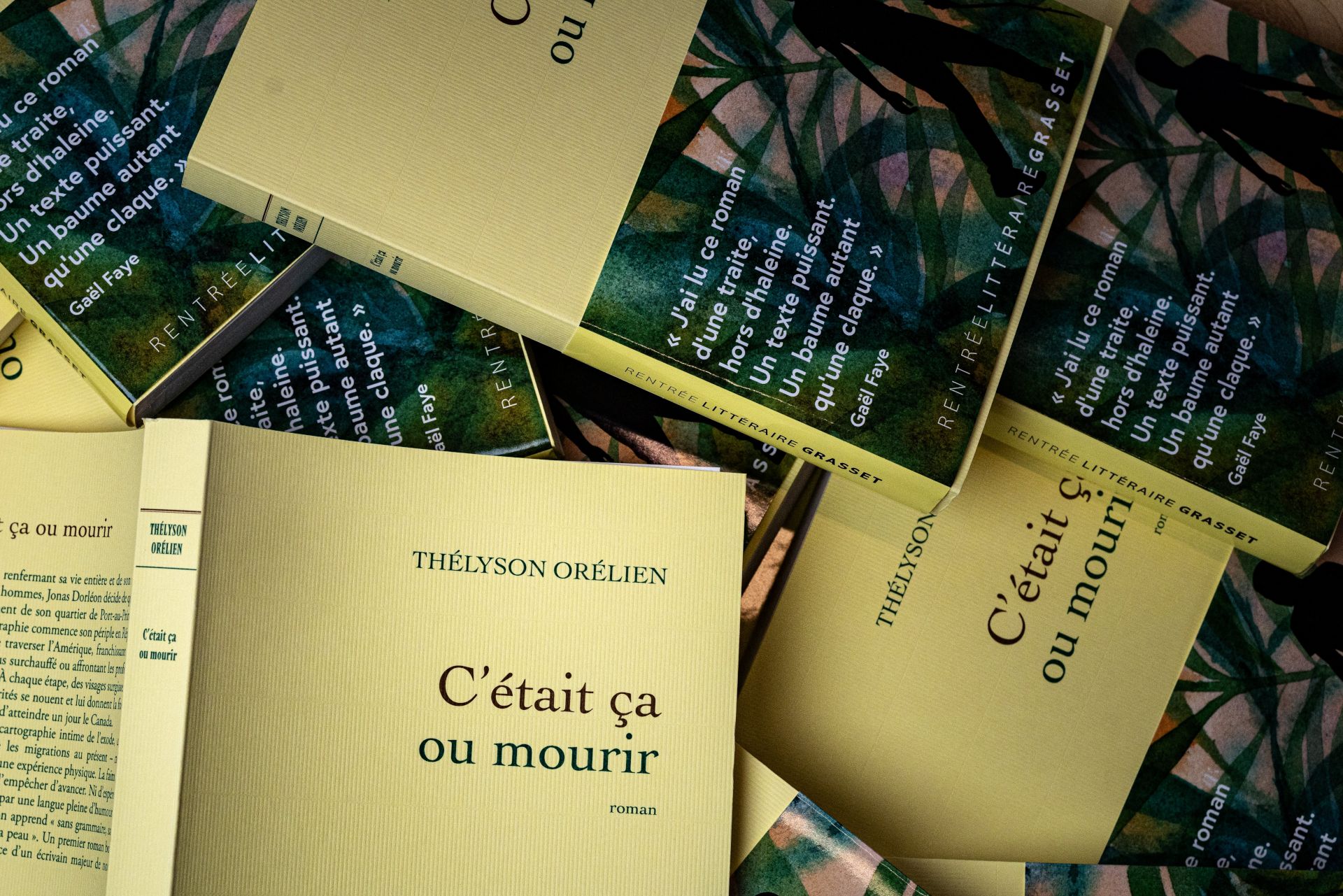
The question was posed at 4:39 p.m. on Monday, Sept. 21, by @Pangramed, an anonymous X account with just 92 followers. It was accompanied by a picture of Thélyson Orélien’s hit debut novel, “It Was Either That or Die” (“C’Était Ça ou Mourir”).
Since its French release in August, the novel and its 38-year-old Haitian-born Canadian author have taken the literary world by storm. The story of a schoolteacher who flees gang rule in Haiti and crosses 12 countries to reach Canada, the novel was the book of the “rentrée littéraire,” France’s avalanche of new fiction for the autumn literary season. It had already won two prizes, was shortlisted for the Goncourt — France’s most prestigious literary prize, awarded to the likes of Marcel Proust and Simone de Beauvoir — and had seduced legions of readers. Among them was the mayor of Beziers, Robert Ménard, who has often been accused of turning his city into a laboratory for the far right. He said it brought him to “rethink his view of migrants.”
But the X post wasn’t another glowing review from a newly converted reader. It was the undoing of a career on a meteoric rise, in a matter of 1,200 characters. The novel was, the post claimed, “written almost entirely by artificial intelligence.”
@Pangramed brought what they claimed were the receipts: screenshots from Pangram, an AI-detection program the account described as “the most reliable” on the market, suggesting that “almost 100%” of the book had been written by AI.
Newsrooms across the political spectrum fed “It Was Either That or Die” into other AI detection sites, with conflicting results. For Pangram’s false positive rates, it should be noted, are not negligible. The company estimates that its overall false positive rate is 1 in 10,000, though other factors, including the language of the text, can affect that rate.
Within days, the Goncourt Academy nonetheless struck the novel from its shortlist. The Orélien scandal, as it would come to be known, quickly took France by storm.
Mainstream coverage focused obsessively on existential questions around the future of literature, with AI-detection tools held up as the now unavoidable sentinels of the (human-)written word. As a safety measure, the other 15 books shortlisted for the Goncourt were fed into Pangram as well. According to the president of the Goncourt Academy, these novels “passed the test with flying colors, with the exception of a few ridiculous dregs” which have, unlike “It Was Either That or Die,” remained unnamed and unchallenged.
As for Orélien, he has vehemently denied the accusations. Breaking his silence last week, he described them as “slander and heresy” to Agence France-Presse. “I wrote this novel myself,” he added: “It springs from my own wounds and those of other migrants. That wound of exile from which there is no healing.”
Stephanie Lamy, a French researcher who studies online influence operations, told New Lines that she wasn’t surprised that Pangram’s first French victim was to be an immigrant, foreign-born Black man.
“We should know by now,” she added, “that the tech industry’s tools are never neutral.” These tools, Lamy argued, are funded, promoted and unevenly used by very real humans with skin — and, often, a lot of money — in the game.
The people who opened Pangram’s box have remained largely unquestioned in the media storm that followed their revelation. But they have a vested interest in the chaos they have wrought: political points for felling a Black immigrant author set to be crowned by the literary establishment for a story about migration; increased visibility for their own conservative essays and media outlets; and a new market opportunity for an AI-fix to an AI scandal manufactured to embarrass the “woke” literary establishment.
This isn’t a story of literature versus machine — at least not in the cold, techno-futuristic sense. This is rather the story of one man versus a social and political machine built on a specific vision of Europe’s future.
The people who denounced Orélien were never very well hidden.
Shortly after the X post blew up, AFP contacted 29-year-old anti-“woke” columnist Samuel Fitoussi to ask him whether he might be the man behind the account. Fitoussi repeatedly denied it. Until, that is, three days later, when the conservative daily Le Figaro — the very paper he writes for — revealed his identity in a viral expose.
Fitoussi, who is the author of a series of essays with titles including “Why Intellectuals Are Wrong” and “Woke Fiction,” told Le Figaro that he had not worked alone. He and four others, he argued, had felt moved to act because of their belief that Orélien’s readers were victims of a “ruptured moral pact” between them and the author.
Once Fitoussi’s identity had been revealed, much of the coverage stopped short of interrogating the anatomy of the scandal he had unleashed, fixating instead on the “moral pact” Orélien stood accused of rupturing. Journalists unearthed examples of plagiarism in some of Orélien’s early writing — which he has since admitted to and apologized for, calling them “youthful mistakes.” Others brought to light the racist bias behind who is suspected of fraud and who is not.
Few noted the key irony at the heart of this scandal: Fitoussi himself moonlights as an AI investor, with a stake in providing an AI-backed magic bullet to a publishing world supposedly broken by AI.
Fitoussi, New Lines can now reveal, created @Pangramed not with his personal or Figaro email address, but the one he uses at Frst (pronounced “First”), the French seed-stage venture capital firm which invests in AI and where Fitoussi works as an associate. Frst stems from the family office of billionaire Pierre-Edouard Stérin — the man who has been putting together an avowed plan to enable victory for the far right in France.
This, Lamy argued, is a classic case of “a far-right smear campaign motivated by capitalism just as much as it is motivated by white supremacy.”
Fitoussi was unmasked by his colleague Eugénie Bastié, Le Figaro’s deputy editor-in-chief. Bastié shared her revelation on X with the caption: “Samuel Fitoussi is a whistleblower, an absolutely brilliant young man with a deeply entrenched love for truth, who has long been fighting to denounce intellectual fraud. Glory to him.”
“It was like the end of a ‘Scooby-Doo’ episode,” quipped the literary critic Johan Faerber. “Le Figaro pulled off the mask and said, ‘Look, the man who broke the story was one of our own all along!’”
Faerber, who runs the cultural platform Collateral, was careful not to say Fitoussi is wrong about “It Was Either That or Die.” He himself rather disliked the novel, and was put off by its repetitive, too-perfect prose. But he took issue with the columnist’s method. A journalist with a real story to break, supported by real evidence, Faerber argued, publishes it in their own paper, and, only then, uses X as a relay. Here, Faerber pointed out, the order was inverted.
“Inversion,” the literary critic argued, “is always a form of perversion.” An anonymous post needs no editor, no vetting of its author’s impartiality, no fact-check, no right of reply. (Orélien, who has no social media presence, could not respond to these accusations until the next day.)
Le Figaro’s decision to put its seal of approval on Fitoussi’s claims, Faerber said, consequently raises a “question of journalistic ethics.”
What Fitoussi wanted, Faerber argued, was a pile-on. That, he posited, is why Fitoussi used Elon Musk’s X as his medium rather than the columns of Le Figaro. “From the start,” Faerber said, “what Samuel Fitoussi was looking for was the techno-fascist, racist cabal he ultimately got, with the masked whistleblower cast as a hero, the Black novelist as a villain, and the ‘wokists’ who had praised the book simply because it told a sad story about migration as fools.”
The account Fitoussi had created with his Frst email went live last June. Its name and handle were changed in September: The account now goes by the handle @Pangramed (as in “you got Pangramed”) and the name “Balance ton Claude.” Though the account purports to expose X users who use AI chatbots like Anthropic’s Claude in their writing, its moniker riffs on #BalanceTonPorc (“Expose Your Pig”) — the French #MeToo, used to name and shame sexual predators.
That framing should, Faerber suggested, probably have been our first clue that “these were not, in fact, serious people.”
On the day they exposed Orélien, @Pangramed had under a hundred followers — but they had a strategy. Thanks to a few choice retweets from conservative journalists and columnists, @Pangramed’s revelation soon reached some 5 million views.
From that point, Faerber pointed out, the pile-on “went gangbusters.”
For the first few days of the scandal, Fitoussi stood alone as the voice behind the @Pangramed collective. But a second member has come forward: Pierre-Thomas Eckert, another Figaro contributor. Granted an interview in the geopolitical review Le Grand Continent, Eckert, who holds a doctorate in moral philosophy, explained that he had co-founded @Pangramed to help prevent fraud in academic research.
After they had revealed themselves, the two friends wrote a joint column in France’s newspaper of record, Le Monde. Eckert and Fitoussi (who signed as an “essayist,” not an AI investor) argued that undisclosed AI use poses a “probity” challenge.
“We must,” they argued, “identify writers who lie to their readers.”
But before their identities were revealed, @Pangramed had told Radio France that theirs was a collective “without any links to the publishing world.” This, it emerged, could not be further from the truth.
Just 11 days before he anonymously denounced Orélien, Fitoussi had come out with “The Values of the Republic,” a collection of satirical columns first published in Le Figaro. Before the reveal that he was behind @Pangramed, he told his followers that, “if [they] wanted to read a book written by biological intelligence,” his latest was available for purchase. Fitoussi also sits on the editorial board of a new quarterly magazine called Civilisation, which bills itself as uniting liberals and conservatives. Its very first issue, featuring an exclusive interview with Palantir’s Peter Thiel and a piece by Fitoussi on the stakes of AI-alignment techniques, came out 10 days after his unmasking.
If other members of the @Pangramed collective exist, they have yet to be revealed. But one may perhaps look at those who boosted its denunciation early on to find leads about other possible collaborators. The first two accounts to repost the claim belong to two friends of Fitoussi, who share similar ties to the publishing world, and a vested interest in Orélien’s downfall.
Pierre Valentin and Robin Nitot, like Fitoussi, write or have written for Le Figaro. Both were named alongside Eckert in Fitoussi’s 2025 interview about the wrongheadedness of France’s liberal intellectual class as those “ready to pick up the torch” and guide France back to a more sane future.
Fitoussi, Valentin and Nitot share ties to Stérin, the billionaire who claims to want to “make France great again.” An entrepreneur and tax exile, Stérin has pledged up to $175 million to fund France’s far right through his “metapolitical” scheme called Pericles, a call back to the great Greek statesman that is also an acronym in French of far-right identifiers (it stands for: patriots, established, resistance fighters, identitarians, Christians, liberals, Europeans, sovereignists). Internal documents published by L’Humanite in 2024 revealed its core targets: To “serve and save France” by fighting “the country’s main ills,” which they identified as “socialism, wokisme, Islamism, immigration.”
Nitot, a young writer who is head of communications at the Observatoire Hexagone, a think tank financed by Stérin, was the first to repost @Pangramed’s accusation. He mocked the theory that the Haitian writer’s poor Pangram scores might be explained by “creolization” (the blending of languages into a new one). “Creolization,” Nitot wrote, “is when you’re so bad at writing that you have your book written by AI. But if you notice it’s AI, you’re racist.”
Valentin, who was the second person to repost @Pangramed’s claims, is the author of “Understanding the Woke Revolution” and runs a YouTube channel, Transmission, also financed by Pericles.
When New Lines reached Fitoussi for comment, he insisted Nitot and Valentin are not part of the @Pangramed collective.
“The racist internet cabal orchestrated against Orélien immediately reminded me of the one leveled against Jason Arday,” Lamy, who has researched information wars for the past 15 years, told New Lines.
Arday, hailed as the youngest Black professor in Cambridge University’s history in 2023, was accused of plagiarism and of fabricating his life’s story. After the accusations played out on a very public forum this summer and turned into harassment, Arday resigned, and was found dead on Aug. 14.
The two cases differ, Lamy conceded, but the playbook remains the same.
What is at play here, she argues, is part of a recurring template employed against Black public figures in which “ideological campaigns are recast as a defense of integrity, so that accusations of racism then read like a dodge.”
Anonymous denunciations, followed by drops of information, she told New Lines, “are a classic disinformation tactic of the far right.” These drops, Lamy explained, turn internet users into investigators in their own right, “all the while monopolizing their attention and diverting it toward a strategic goal.”
“The hunt for Jason Arday,” Lamy added, “traces to a network of ‘race realists’ linked to Palantir’s Peter Thiel.” The “tech right,” she noted, is just as omnipresent in the attacks against Orélien, with several of those involved linking back to Stérin. Their claims, she said, are then invariably picked up by media outlets across the political spectrum that “spread the framing imposed by the far right without ever questioning it, because it looks organic.”
Asked by French outlet 20 Minutes whether they condemned the racist attacks leveled against Orélien, the people behind @Pangramed answered: “No regret. It was impossible to publicly evoke a controversial topic without provoking hostility. As regrettable as it is, any public figure is vulnerable to relentless attacks from internet users, especially if he has lied to the whole world.”
This notion — that Orélien lied by using AI in his writing — is a theme @Pangramed would bring up time and time again in the coming days. “Lying,” wrote the collective, “is morally reprehensible.” They — somewhat ironically — stressed the importance of “authenticity,” of not “betraying” one’s reader: If you choose to use AI in your writing, they argued, your readers deserve to know.
The AI industry, as it turns out, has an app for that.
“This feels like a good time,” a still-anonymous Fitoussi told his 30,000 followers on the day Orélien was outed, “to once again share the piece in which I reiterate my prediction: Soon, no single human will write, and no single human will read.”
Fitoussi had laid out his solution in a 4,000-word X essay written two weeks prior: AI detection and watermarking.
As of Aug. 2, the transparency rules in the European Union’s AI Act require AI companies to mark AI-generated content in a way other systems can identify. Introduced by Anthropic, Google and OpenAI in the past few weeks, AI watermarks, or provenance marks, are supposed to once again make the difference between human and AI text legible. They introduce secret biases into AI-written text that survive copying and pasting and light edits, forming a signature that can be recovered by anyone holding the key. Thus far, those keys are not yet available to the public.
The AI watermarking market is projected to grow at a compound annual rate of over 24% through 2033.
“If there is, as I believe there is, a human demand for human content,” Fitoussi told Le Point in a later interview, then “we need to be able to tell the two apart.”
Fitoussi made the case for such a demand in another X essay last May. In it, he compared AI to aliens that humans struggle to understand, and wrote of an imagined startup working as a partner with both AI labs and “humanity.” “Our aim,” he wrote, “is to advance the science to study, understand, vet and align these aliens, mainly through furthering the field of interpretability.”
This startup, he concluded, doesn’t currently exist. “But we’d be willing to fund it! 1 to €5m at day 1,” he wrote, tagging Frst venture capital and adding his Frst email address.
When New Lines contacted Fitoussi about why he used his Frst email to create the @Pangramed account, he ignored this question and answered the rest. Three days later, he wrote back, calling this claim “harebrained.” As of this writing, @Pangramed is no longer linked to his Frst email address.
“This,” he concluded, “has absolutely nothing to do with my job, and I’d like to avoid embarrassing my employer. There is absolutely no connection between my employer and this account or my actions.”
Asked whether he or Frst had been investing in watermarking technology, Fitoussi wrote back: “I am simply an employee at my company, and I lead intellectual and media-related activities on the side, which far predate my being hired by this investment fund. I have not personally, nor through my employer, invested in any watermarking company, nor in Pangram, nor in any other company even remotely related to this.”
“I understand the question,” Fitoussi added, but insisted that @Pangramed was created out of “concerns about the future of literature in an era where machines write better than we do and content is indistinguishable.”
Anonymity, he explained, was necessary to the “non-partisan approach” they had hoped for, “one that wouldn’t be labeled as belonging to one side or the other.”
In their joint Le Monde column, Fitoussi and Eckert had indeed argued that, until their denunciation of Orélien, @Pangramed’s fight had been “mainly directed against right-wing content creators,” referring to the four other X accounts they have outed besides Orélien.
But Orélien’s was the first — and only — novel which they submitted to their Pangram test, and he is the only person who has suffered any actual consequences from their revelations.
The Orélien scandal, once we take the time to properly investigate its anatomy, is a stress test of a new rule: Any writer can be presumed guilty until the very machine that created this presumption declares them human.
And when the people raising the alarm are also selling the alarm system, we would do well to ask who profits from our suspicions, and who pays for them.
Become a member today to receive access to all our paywalled essays and the best of New Lines delivered to your inbox through our newsletters.