


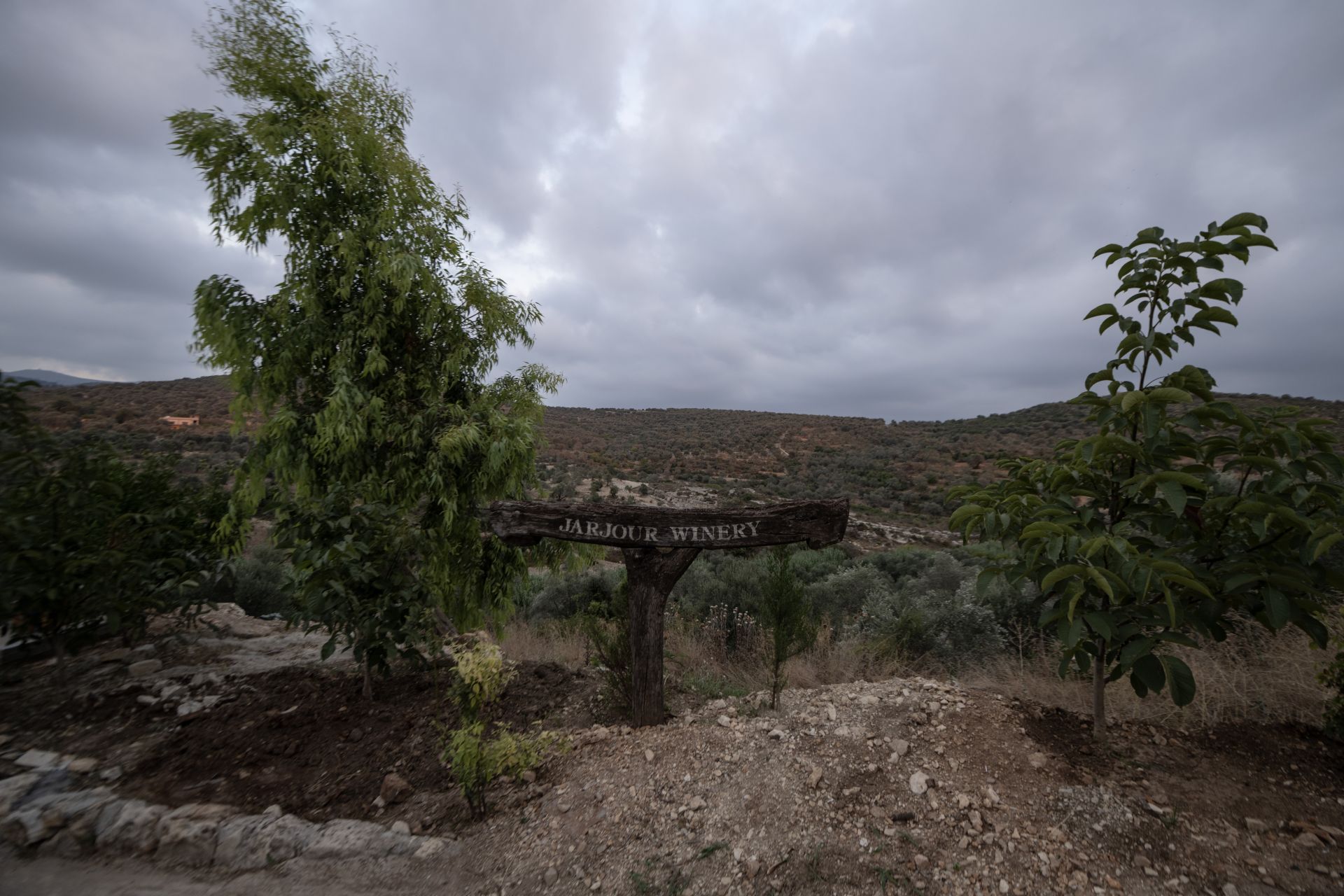
A small stone house stood among the olive groves, and the scene looked for a moment as if it was transplanted from southern Italy. But we were standing on the hillside in a Maronite Christian village in the Syrian countryside around Tartus, in the area known as Wadi al-Nasara, or the “Valley of the Christians,” which straddles the border of neighboring Homs province. We were in a village called Baait, or “God’s House” in Aramaic. A wooden sign that read “Jarjour Winery” marked the entrance, set in the middle of a field of olive trees.
It was Sept. 4, in the late afternoon, and there was a wedding. The daughter of the winery’s manager was marrying a man from the countryside of Daraa governorate. Amid singing and the sound of an iron flute, the wine flowed freely to those seated around a dish of freekeh, a traditional Syrian meal made from roasted and cracked green wheat. The red and white wines were made by Youssef, the winery’s patriarch, now in his 60s.
He started winemaking in 2004, as a hobby, but since then has refined the wine he sells under the name “Soulaf.” He began commercializing his bottles in 2008, but the civil war brought his passion to a halt. At the time, he was making his wine in Maaloula, a well-known Christian village, but in 2012 the multiplying checkpoints and security problems put his operation on hold. In 2014, he left Maaloula and moved to this land, which belonged to his mother’s family.
“It was safer here,” he said. He brought with him the equipment he had managed to salvage. Youssef was previously an artisan, working in ceramics and porcelain tableware, between Syria and Egypt. He studied oenology online for three years at a college. “There were no good wines in Syria, so I wanted to produce a good one,” he said. “We have the right temperature and environment for grapes.”
“We want to produce the same wine that was made here thousands of years ago. I was so sad to see that wine started here, in Mesopotamia, but today you can’t find good wine. So I started making wine in this part of the world.”
The origins of wine are an active research topic; the earliest clear archaeological evidence of winemaking found so far has come from the Caucasus, but the history of winemaking in the Levant also goes back millennia. Imad Bilal, a grape specialist at the Agricultural Research Center in Latakia, pointed to the ancient city of Ugarit, on Syria’s Mediterranean coast. “Ugarit used to export jars to Europe, and the first wine in the world may have been produced there,” he said. “There were varieties that existed thousands of years ago, and everything was grown here.” He said archaeological remains around Ugarit show that the area was already agricultural and that grapes were being pressed and turned into wine.
Youssef Jarjour produces up to 50,000 bottles a year, all for the local market. The winery specializes in chardonnay grapes for its white wine. For the red wine, it uses five different varieties. This year, production reached 37,000 bottles.
“Some years, we don’t have enough rain,” he said. The winery harvested more than 150,000 pounds of grapes, but was unable to press them all, so it sold some of the grapes to another winery.
An important part of its operation is welcoming tourists. Since 2022, visitors have been coming regularly, including YouTubers who showcase the unusual location on social media. China, Europe, the United States, Russia — Youssef proudly listed the countries his visitors come from. “Sometimes, it’s every day.”
But with the Iran-U.S. conflict, tourism came to a complete stop. He used the time to renovate the guest house.
For wine lovers, the winery is also about something more than production. Claudine Zaghour, 47, comes from the tourism industry and manages the boutique hotel attached to the winery, an essential part of its business.
“When you deal with wine, you deal with a soul. Everything is done by hand,” she said, comparing the wine to a child. “Wine is like a small baby. You are tired for it, you care for it, but you are happy when it succeeds in life. We receive it as grapes, and then it speaks of happiness when you see it in a bottle loved by people.”
For Zaghour, preserving wine is also a way of preserving a tradition. “For me, honestly, it is a product that we put effort into, something we have produced for thousands of years, and we are preserving this industry.”
A conversation began in the courtyard, in front of the little stone house, about alcohol sales permits. Youssef, the patriarch, said: “Exporting to other governorates, no matter how extremist the soldier is, he has to accept the orders.”
Another person added: “They are not renewing our permit now. At the checkpoints, they ask for the old permits, and it works.”
Syria’s new authorities have sought to tighten the rules governing alcohol sales, amid fears of a crackdown since Ahmad al-Sharaa became interim president. On March 16, 2026, the Damascus governorate issued a decision banning the serving of alcohol in restaurants and bars across the capital. Bar and nightclub licenses were to be converted into cafe licenses, while the sale of alcohol would be restricted to sealed bottles for takeaway in three predominantly Christian neighborhoods — Bab Touma, Qassaa and Bab Sharqi. Shops selling alcohol were required to be at least 75 meters (246 feet) from places of worship and schools, and 20 meters (65 feet) from security facilities. Businesses were given three months to comply.
The decision prompted protests in Bab Touma, one of the Christian quarters of Damascus. Hundreds of people gathered there on March 22, objecting to the restrictions and arguing that they went beyond the question of alcohol and concerned personal freedoms. The Damascus governorate subsequently issued a clarification, saying the decision was intended as an administrative regulation rather than a restriction on personal freedoms. It also apologized to residents of the Christian neighborhoods and said licensed hotels and tourist establishments were not covered by the decision, while the rules governing restaurants with a particular tourist character would be reviewed. For now, what was known as the “alcohol ban” has not been enforced.
Zaghour said she was concerned when she heard about the decision. “I was scared, but not for myself. For the industry, for the winery we have built, for the name and the legacy. It was a decision that could have affected our institution. We have put a lot of work into it. We were bothered and upset, but we thought things could go back to normal. It’s unclear what is going to happen in the future, but at the moment, it’s OK. At the same time, you never know.”
The industry remains small. Chiara Asselta, an Italian independent wine educator who visited the winery, estimated that there are only three major commercial wineries operating in Syria today: Bargylus, Jarjour and Fenikia. “I cannot give a number, but production is very modest,” she said.
Jarjour’s difficulties reflect some of the broader problems facing Syrian wine producers: water shortages, rising costs, fuel and transportation problems, as well as uncertainty over regulations and licenses. According to Asselta, transporting grapes in the heat of the day, as Jarjour Winery does, affects their quality and, ultimately, the quality of the wine. She added that producers also face high taxes, difficulties renewing licenses and limited access to international markets. “Since it’s not a well-established wine-producing country, there isn’t much support from the state,” she said.
In Damascus, concern remains among the bars in the capital that continue to serve alcohol, including wine. A bartender at one of the Old City’s emblematic bars, where alcohol is served at tables set outside, is worried. “Every establishment has six or 10 employees, so this means cutting off people’s livelihoods, not to mention the impact on restaurants, as tourism is also important for us.”
“The decision that was announced is that alcohol has to be sold by the liter rather than by the glass,” he said. “This means that only kiosks or small shops, located away from mosques and churches, would be allowed to sell it. So all the bars and restaurants would have to close. Even if you buy it by the liter, you cannot drink it in the same place, you have to take it home.”
For him, the issue goes beyond alcohol. “This isn’t just about banning alcohol; it’s about restricting your personal freedom.” He said he remained confident that the measure will not be implemented. “There have already been demonstrations, so I can’t imagine them going ahead with it,” he added. “If there was this kind of extremism, I wouldn’t be seeing the parties and social gatherings taking place in most provinces.”
On a bench in Baait on what the villagers call the “corniche,” families sat and watched the day go by. “There are 250 inhabitants now. Before the war, there were 750. Many left after 2011 to Italy, Germany, America,” said Georges Aissa, a 65-year-old man in a wheelchair, as he moved along with his wife. Around them were beautiful houses, flower-filled gardens and a huge statue of the Virgin Mary standing on a green lawn.
They all appreciate wine, they say, but obtaining it has become difficult. “After 2011, with a war economy, it’s clearly not a priority. It’s not affordable for most people,” one said. The younger generation has either left or joined military service.
As for the restrictions, one of the villagers said: “They want to put a foot on our freedom. Why are you preventing alcohol? Any law based on Sharia scares me.” For him, Jarjour Winery was also a source of employment for the village, which remains isolated.
Youssef proudly holds up a blue bottle. Blue wine is not unusual to see in Syria, although Youssef claimed to be the first person to make it in the Middle East.
He became interested in this wine about 12 years ago, after it began appearing elsewhere in the world, where it was usually made using a mix of red and white grapes. Merchants in Syria started asking him whether he had blue wine, and he called a professor in Germany who had taught him everything he knew about oenology. “No blue wine,” the professor initially told him. Fifteen days later, however, after consulting with him remotely, the professor gave him instructions.
The first season was a failure. In the second, in 2023, Youssef found his recipe.
The process is similar to making a white chardonnay, but uses red syrah grapes. The grapes have a particular color and scent. Their skins are included in the mixture, bringing both the color and the aroma. The skins contain pigments called anthocyanins, the same pigments found in eggplants and Damascus berries. The pigment contains blue and magenta tones, so he isolates the magenta.
He extracts the juice from the syrah grapes, then dries the skin in the sun, minces it and removes the seeds. He puts the skin in filters and pushes the white wine through the filters so that it takes on the color from the syrah skins.
The blue wine tastes like white wine, he said, “but a bit more foggy.” The process is extremely labor-intensive. The first batch he produced turned green and was kept for personal consumption. He eventually managed to obtain the blue color.
Twelve bottles of blue wine sell for $65, compared with $55 for the white wine. The process takes place in December.
The following day, Sept. 5, the grape harvest began. It would continue for 15 days. At 7 a.m., the car slowly made its way along a narrow road bordered by olive trees to reach the field called Ain al-Khanzir, “the spring of the pig,” a place known for wild boars.
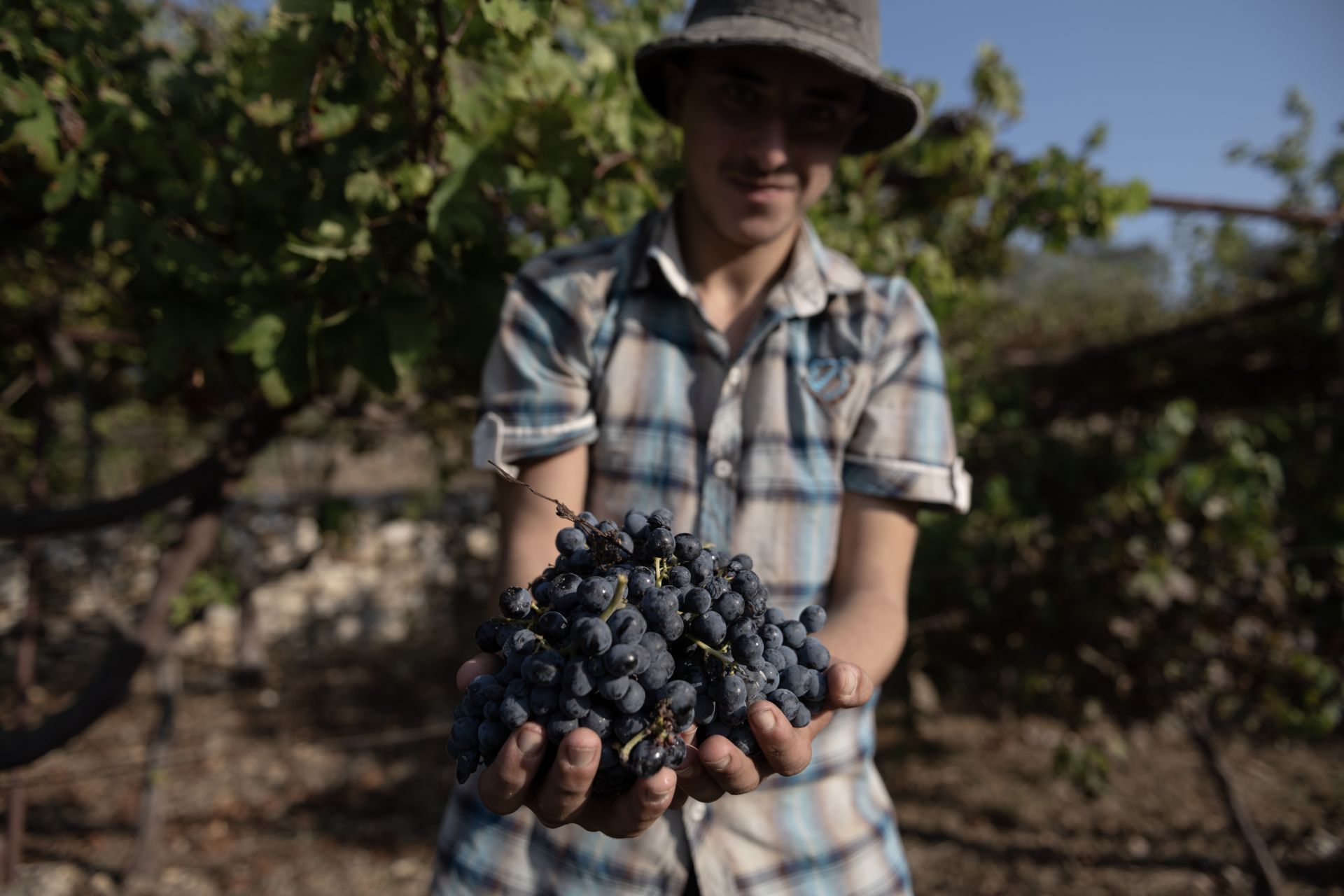
About 10 workers arrive to harvest the precious fruit, pruning shears in hand and smiles on their faces. It is a small plot. The vineyards, lit ocher by the just-risen sun, form a square in the middle of the olive groves.
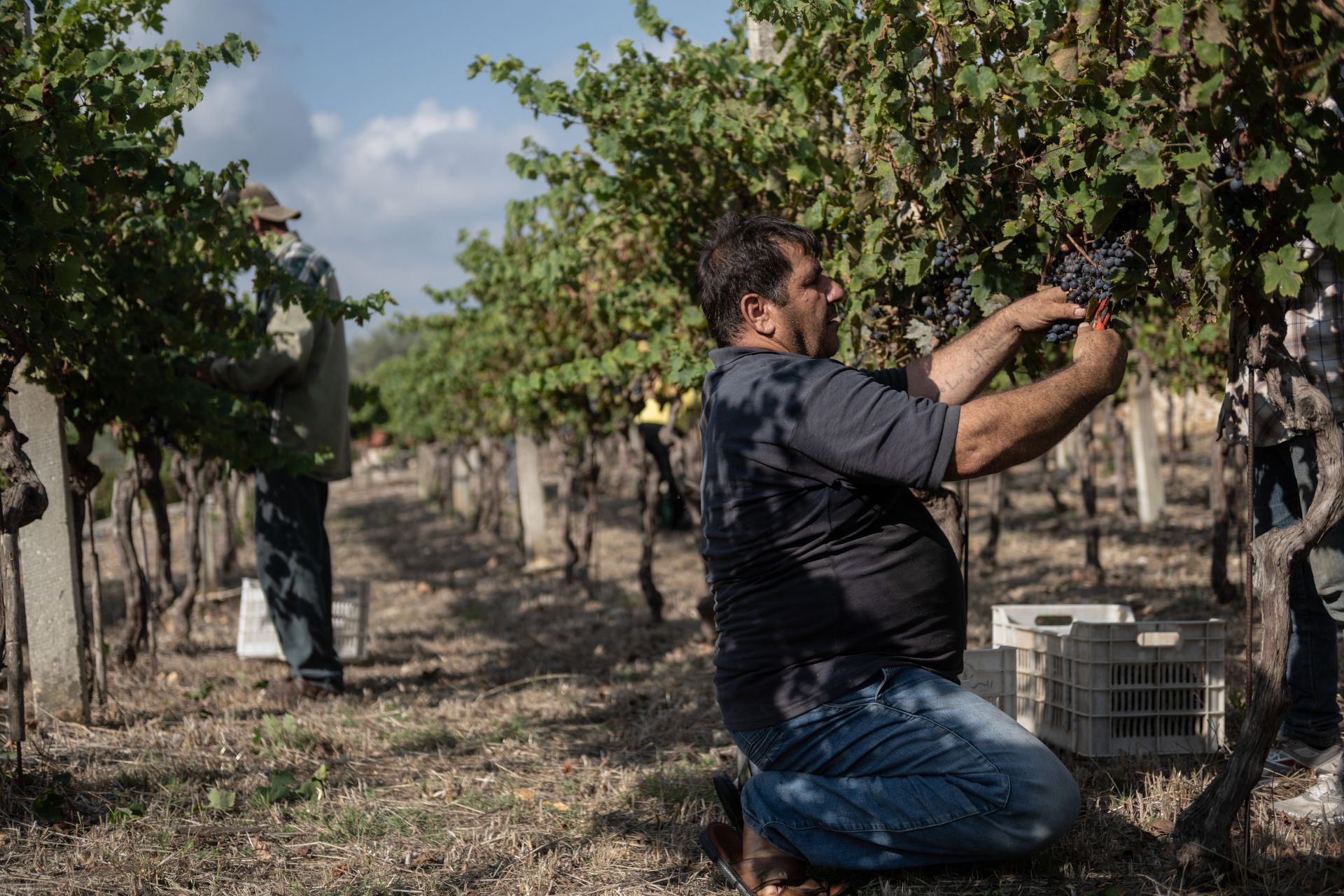
One of the workers, 58-year-old Issa Zarour, has been cultivating vines for 15 years. “I enjoy doing it. I like grapes because they become wine or arak. You feel its soul. It integrates your feelings. The land here is as if it’s ours.”
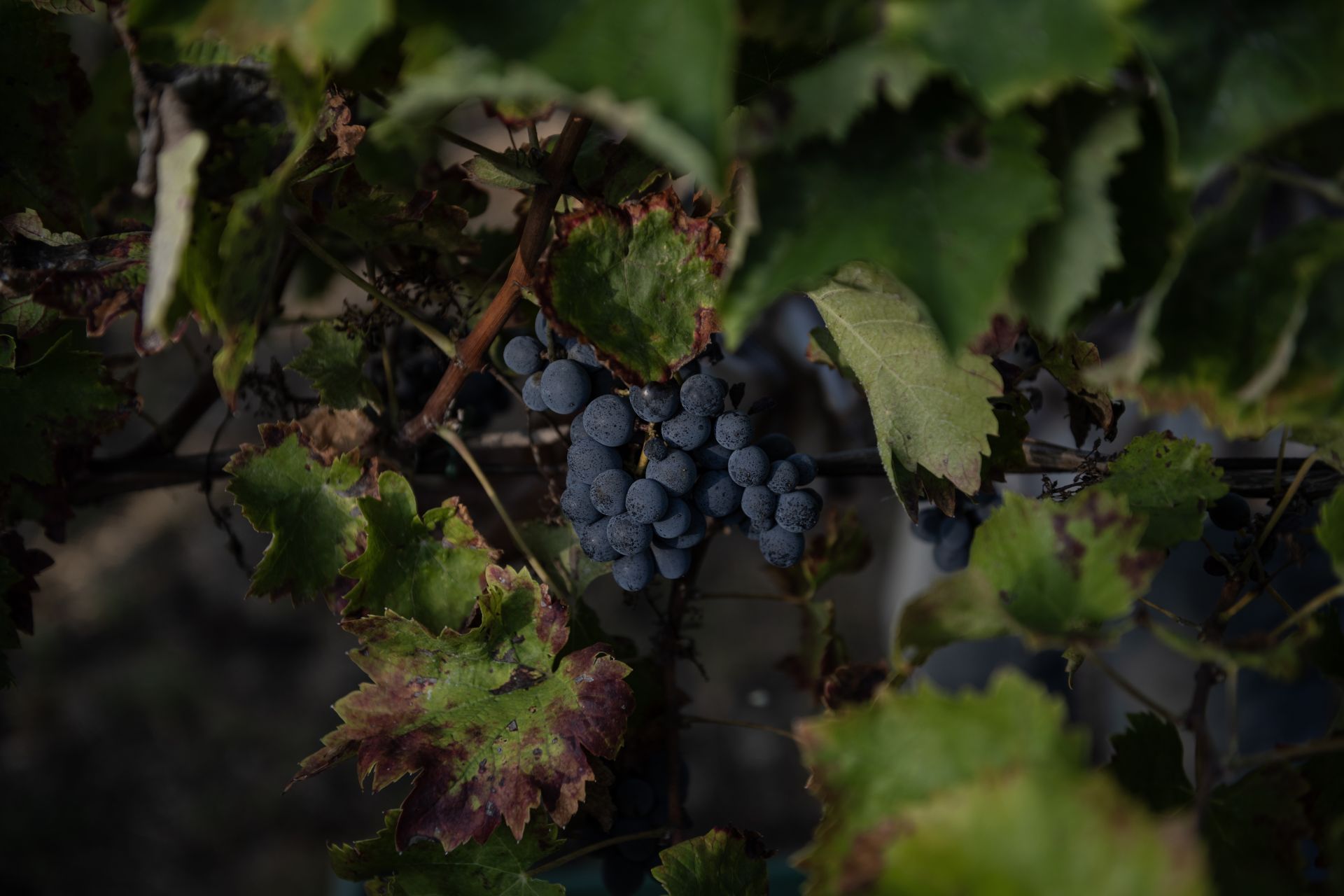
He picked a grape and handed it to me to taste. The fruit was deep purple and very sweet. A flying insect, a cicada that he called “wazwaz,” passed by, buzzing. “You see, this confirms that it’s time to harvest, when this insect arrives,” he said. “He’s not happy because we’re stealing his food.”
With 10 pairs of hands, the harvest on the modest plot concluded at noon.
In the shade of an olive tree, sitting on a plastic chair, Abu Fadi, 72, an elderly man with a prominent nose, repeatedly recited improvised poems. Facing Abu Carlos, the owner of the land, he launched into verse: “Abu Carlos has grown old, and his era has passed.”
“I disagree. Change it,” Abu Carlos interrupted. “You want me dead.”
But the elderly man continued: “Patience. His sunset is coming soon. When the grapevine grows older, it becomes more precious. The whiter the arak, the more delicious it is. The whiter your hair, the more delicious it is.”
“The darker the wine, the more delicious,” Abu Carlos corrected him.
The other man burst into laughter. Abu Carlos, 70, is a former life sciences teacher and the owner of the modest 100-acre plot. He used to grow and sell his own wine, but the economic situation became harder three years ago. Ever since, he has sold his grapes, descended from Italian-origin vines that are 20 years old, to Jarjour Winery.
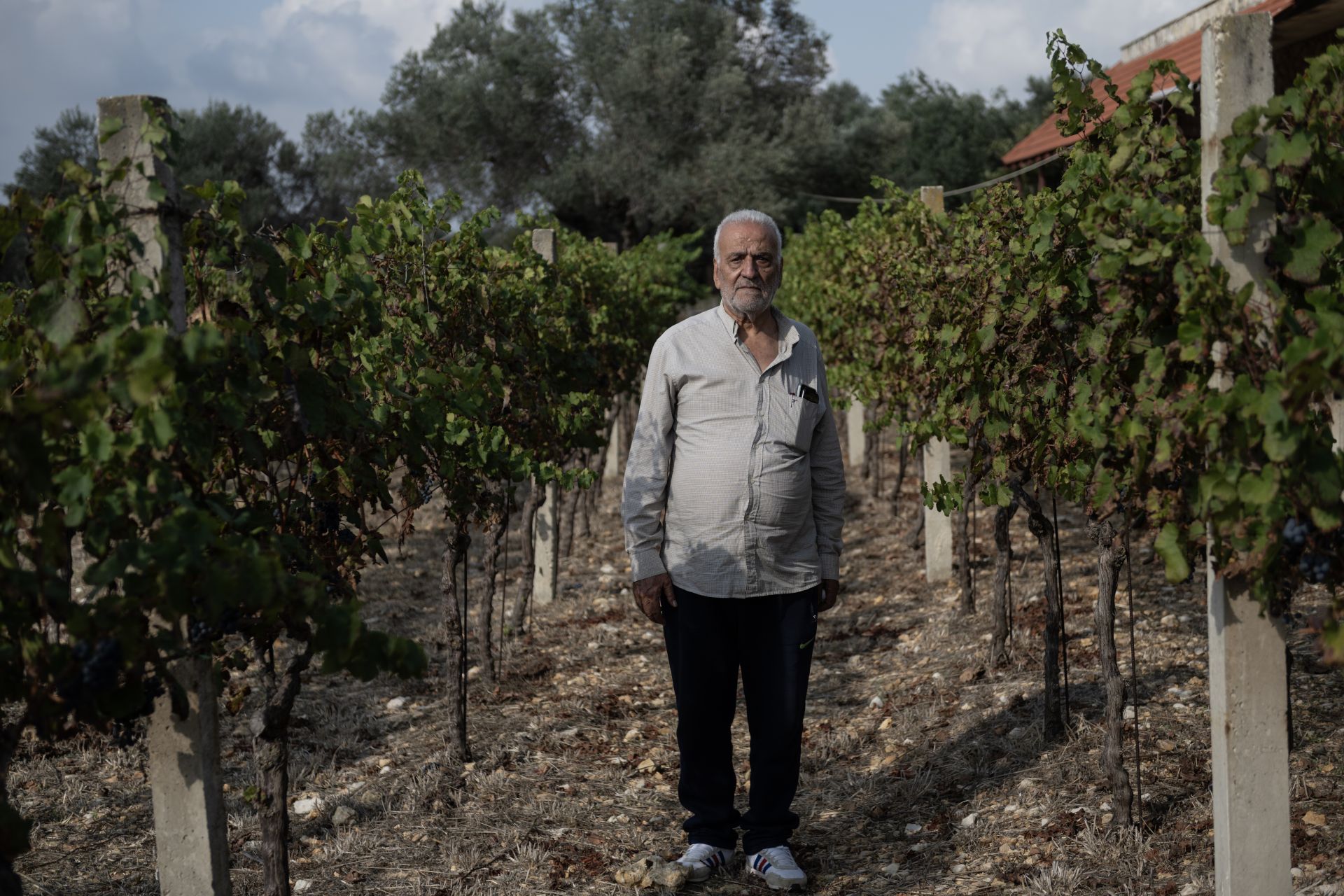
Abu Carlos does what he can. He does not grow grapes for white wine because there is no electricity on his property. “I don’t cultivate white because it needs refrigeration,” he said.
Wine remains a luxury product in Syria, and most of it is consumed domestically. Since the fall of the Assad regime, everything has become more expensive. Basic commodities take priority over drinking wine. The value of money has fallen, and people go less often to cafes and pubs. His retirement income, he said, has gone from around $700 to $90. Fuel prices have also risen. The economic situation is what prevents him from producing more wine; since the fall of the regime, he has sold only about half of what he used to sell annually.
As for the political situation, he spoke of “concerns from an Islamist perspective — nothing concrete, just psychological fear.”
“Ten thousand people can be OK, but then one encounter is not good,” he said. “It depends on luck.”
For Asselta, the obstacles facing Syrian wine are not simply agricultural. “I believe Syria has the potential to produce high-quality wine, given its varied landscape and microclimates,” she said. The coastal area and the land immediately inland, she added, offer altitude zones that can be suitable for producing quality wine at this latitude.
But the main obstacles are structural, she said, including regulation, quality controls and access to international markets. “What’s needed is less strict and burdensome regulation for alcohol producers, third-party quality controls and access to international markets.”
At around 2 p.m., the grapes arrived at Jarjour Winery in a trailer and crates. They were tipped into a large bin and fed into a machine that crushed them. Purple juice flowed out through a tube and was then stored in the winery’s cellar.
Youssef Jarjour’s favorite part of the process comes months later: tasting the results, seeing whether he has made a good wine. Six months later, the wine begins to take shape; after 12 months, it goes into storage. When the wine is not good enough, it can instead be turned into arak.
By around 4 p.m., the smell of fresh grapes filled the winery.
Additional reporting by Hadi Al-Ali.
Become a member today to receive access to all our paywalled essays and the best of New Lines delivered to your inbox through our newsletters.