

Exactly 100 years ago, a secular French school opened in Damascus with 79 students, in rented premises close to where the current parliament stands on Abid Street. The school was known then as the Laique Institute and is known today as the Al-Hurriya Institute, but is generally referred to as just Laique.
Four years later, in 1930, then-Prime Minister Taj al-Din al-Hasani, a turbaned cleric with a reformist agenda, granted the school a plot of land on Baghdad Street, to which it formally relocated in 1932. Laique quickly became one of the most prestigious institutions in Syria, celebrated for its coeducation, the quality of its faculty, and its tennis, volleyball and basketball courts. It also had an impressive library, along with a full-fledged theater that once hosted Egyptian diva Umm Kulthum in 1955. That colorful tapestry was part of a Middle East that imagined itself as part of a broader Arab world with a united identity.
Fast forward 100 years, and Laique has become a shadow of its former self. First came 61 years of Baath Party rule that imposed an indoctrinating socialist curriculum on the entire Syrian school system, along with khaki uniforms. Teachers at Laique were hired not because they were good, but because they were Baathists. Then came the 1967 nationalization that ended the school’s autonomy and distorted its institutional identity, renaming it “Mahad al-Huriyya,” or the “Institute of Freedom,” a nod to the language of Baathism, with its three ideological pillars of freedom, pan-Arabism and socialism. The fact that Hafez al-Assad chose Laique for all his children — Bashar included — only hardened the school’s Baathism. When Assad’s eldest son and chosen successor, Bassel al-Assad, died in 1994, the school was renamed after him. What did not disappear was the memory of what Laique had been, and, more importantly, its alumni network of engineers, doctors, politicians and artists who became the “who’s who” of Syrian society. For decades, “I went to Laique” functioned as a kind of passport, akin to “I went to Brummana High School” in Lebanon: a signal of academic excellence that guaranteed entry into the workforce and came with high expectations of talent and character.
A great deal of Syrian history was compressed into a single address. This was a school founded under the French mandate, legitimized by a reformist cleric premier, staffed by French and Syrian teachers, and attended by the children of the urban bourgeoisie. Within a generation, it became a kind of shorthand for a particular kind of modern Syrian identity: bilingual, cosmopolitan and proud of the mixing of boys and girls in the same classroom. That identity was also a belief about what kind of country Syria could be.
Its very name, Laique (French for ”secular”), spoke volumes about a Syrian identity built on good citizenship rather than religion. It was a school of coexistence and secularism, a fact heightened by the fact that its premises had been donated by a turbaned cleric who taught Islamic Sharia during his teens. And to make the story more extraordinary, al-Hasani himself had studied at a Christian missionary school (Lazaristes) in the Bab Touma neighborhood, despite the fact that his father, Sheikh Badr al-Din, was one of the most influential clerics of his generation. He did not merely tolerate a French secular school, but sent his son to one of them, and for his part, al-Hasani endowed another French school with real estate, bypassing Islam for the sake of “Syrianism.” Whatever his political calculations, the gesture acknowledged that modern schooling was a national asset, not a foreign intrusion to be endured.
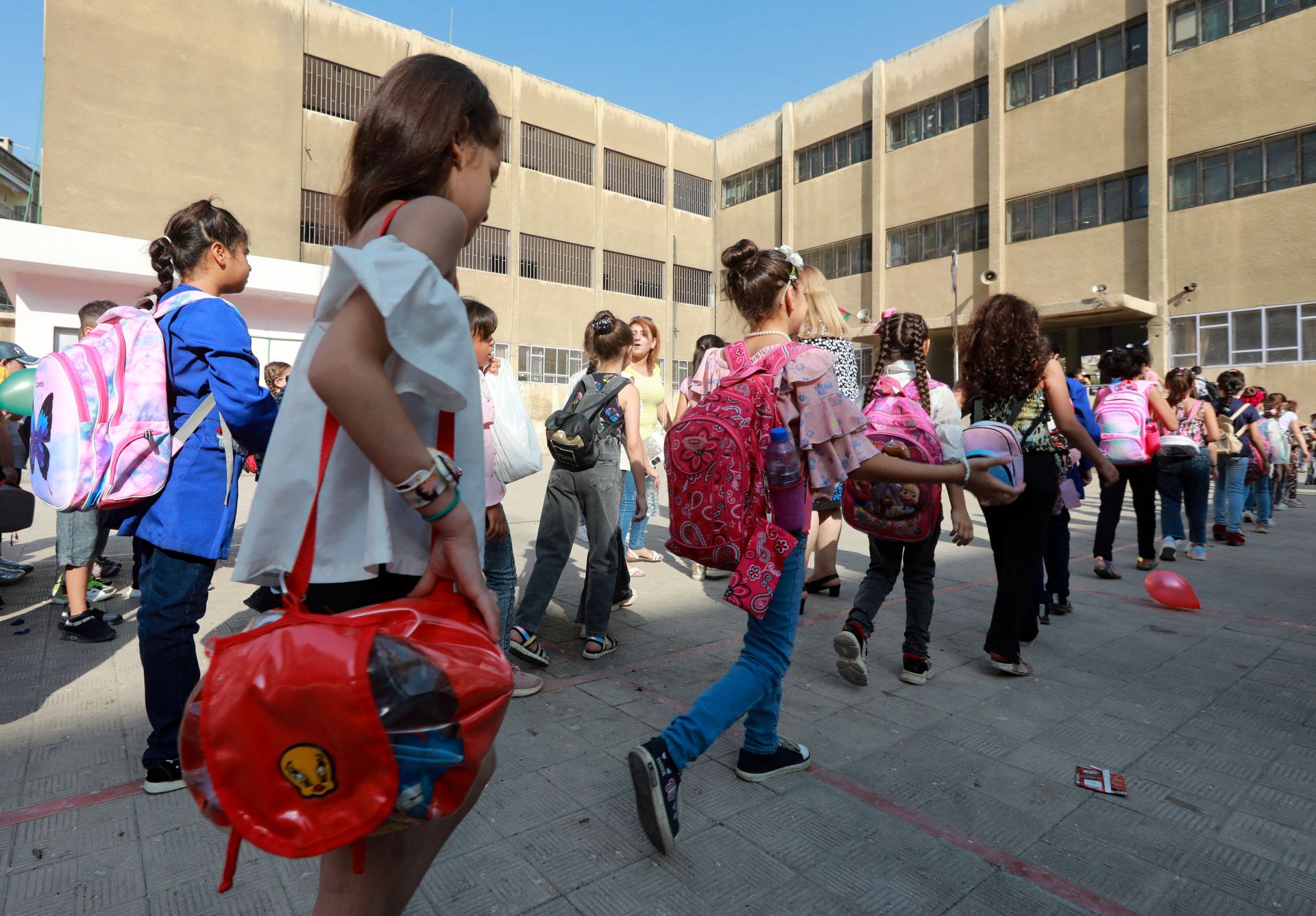
Over the course of the 20th century, Laique’s reputation, feeding on its facilities and bilingual instruction, hardened into something close to folklore. Syrian families would send their children regardless of sect or religion, mainly because Laique promised something that confessional schools did not: a Syrian identity. All of that came to a grinding halt when the school’s administration recently took the controversial decision to separate boys and girls, nearly two years into the administration of President Ahmad al-Sharaa. The change was framed as the school complying with the wishes of parents, sparking backlash from many secular voices, the Syrian intelligentsia and the school’s alumni.
To date, the Education Ministry has not intervened, but many are worried about the direction in which Syria is heading. Last year, entire chunks of Syrian history were crossed out of textbooks, including aspects of the pre-Islamic past and women pioneers. Some of the amendments were controversial but understandable, like eliminating all mention of the 1973 October War with Israel, given that it was led by Hafez al-Assad. But gender separation at a mixed school with Laique’s history takes the fears to a completely new level. Laique, after all, is not just an ordinary school but a century-old experiment in Syrian modernity, and any change to its practices will be interpreted as a verdict on that vision. The school’s founders — those French educators, the reformist premier, the elite Damascene families who enrolled their children — were all engaged in an act of imagination. They believed that Syria’s future would be built by people who had learned to think across the lines that had previously divided them. That belief is now in danger.
Become a member today to receive access to all our paywalled essays and the best of New Lines delivered to your inbox through our newsletters.