

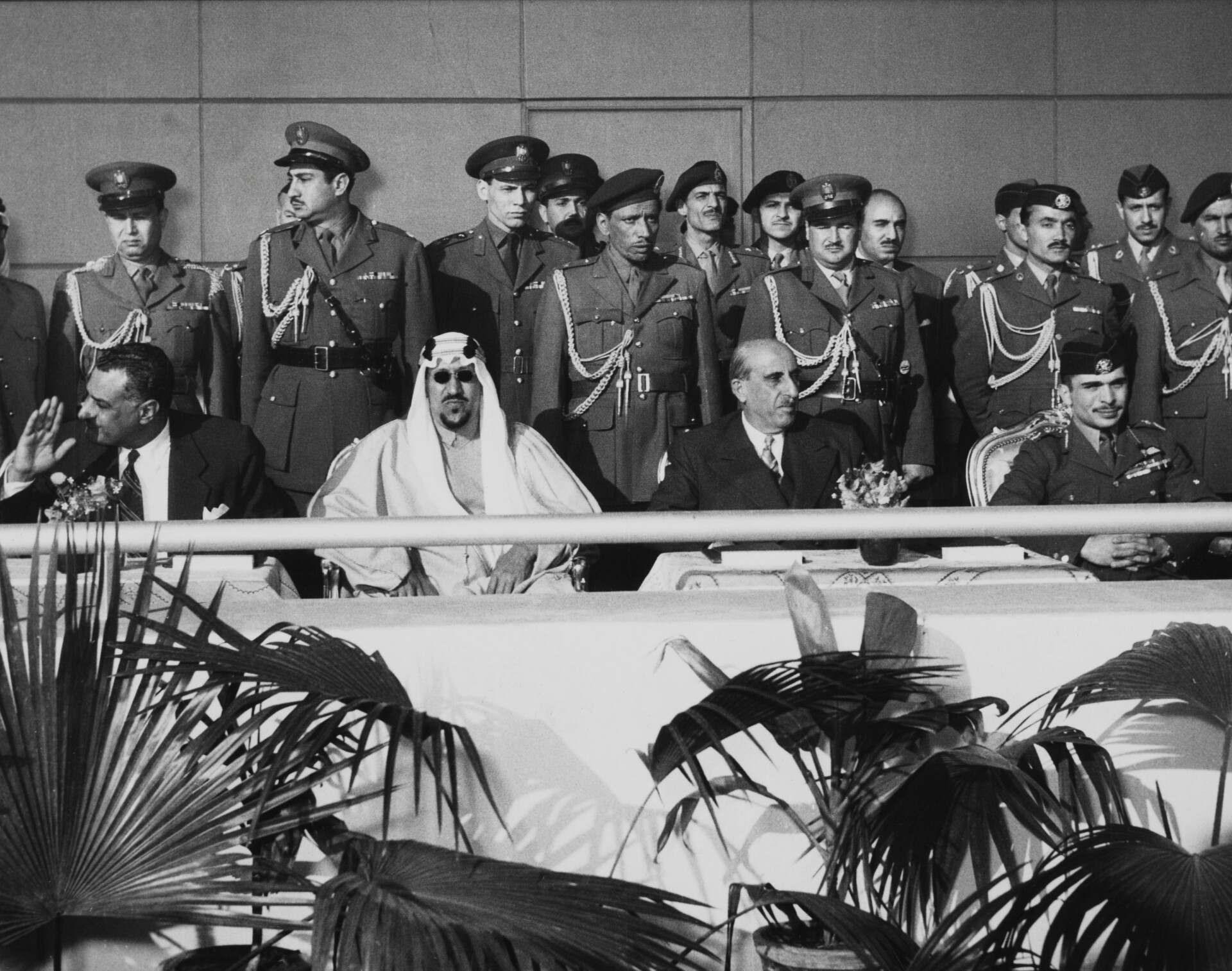
On the slopes of Mount Qasioun, overlooking the Syrian capital in the Muhajireen neighborhood, is the presidential palace of Syria, built by the Ottoman governor Nazım Pasha between 1900 and 1905. Originally a two-floor private residence, it was the seat of power in Damascus briefly, during the reign of King Faisal (1918-1920), and then again, starting with President Shukri al-Quwatli, in 1943. Hafez al-Assad continued to use it until 1978, when he moved into the more quarantined Rawda Palace, judging Muhajireen as unsafe in light of his war with the Muslim Brotherhood. The old palace was abandoned and then placed at the disposal of the Republican Guard until 2010, when it was refurbished by Asma al-Assad, wife of Bashar al-Assad. On the night of the fall of Bashar’s regime, the palace was looted, only to be revamped again by Syria’s new president Ahmad al-Sharaa. And this is where he received Hala al-Quwatli, the last surviving child of the former president, Shukri al-Quwatli, on Oct. 9, 2026.
Now in her mid-80s, Hala had not been to the palace since her father’s last term (1955-1958), and would probably never have returned if not for Assad’s ouster in December 2024. Al-Sharaa welcomed her on the second floor, facing the throne room that was created in 1920, on the occasion of the crowning of Faisal as king of Syria. She presented him with a copy of her father’s memoirs, published last April on the occasion of Syria’s 80th Independence Day celebration.
From his deathbed in 1967, Quwatli bequeathed his memoirs to his two sons and three daughters. The documents were stored in Beirut, only to be partially damaged during the 1982 Israeli invasion of Lebanon and then moved to a bank in France, where they remained until mid-2025. Weeks after the fall of the Syrian regime, the family tasked me with compiling and editing the memoirs.
The first seven chapters had already been written by his daughter Hana, who passed away in mid-2026. The rest were all recorded in Quwatli’s own voice, during his retirement between the years 1961 and 1963. They are full and complete, from his birth in 1891 until his meeting with British Prime Minister Winston Churchill in 1945, a turning point in the history of Syria that paved the way for it to join the United Nations. We then have one gap in 1946, when Syria got its independence from France, and another in 1958, when it merged with Egypt to form the United Arab Republic. Between the two gaps, we have a complete record of Quwatli’s life between 1946 and 1958 and, again, from 1961 until he stopped writing and recording in 1963.
I worked on the memoirs for a year and a half, and they were published in Arabic under the title “Hadith wa Zhikrayat” (“Conversation and Memories”) in April 2026.
These are the first memoirs of a Syrian president since the republic was created in 1932. Few other presidents had a dignified retirement in which they could write freely, and none of those did. One died in office (Taj al-Din al-Hasani in 1943), while many ended up in jail, like Nazim al-Qudsi, Amin al-Hafez and Nur al-Din al-Atassi (who was jailed for 23 years beginning in 1970). Others were killed, like Husni al-Zaim in 1949 and Adib al-Shishakli in 1964.
Quwatli takes the reader through five main eras of modern Syrian history: the final years of Ottoman rule (1916-1918), the French Mandate (1920-1946), independence (1946), the coups and countercoups (1949-1954) and, finally, the union with Egypt (1958-1961). Throughout, he provides tidbits that had been unknown to historians of modern Syria, starting with how he bought an oud and learned how to play it, pretending to be taking music lessons while actually meeting undercover with Syrian nationalists as they prepared to launch the Great Arab Revolt against the Ottomans in 1916.
Quwatli also describes how he was involved in a botched attempt at assassinating Djemal Pasha, commander of the 4th Ottoman Army in Syria during World War I, before Quwatli was arrested in 1916. His arrest has been well documented by Syrian historians, but in his memoirs, he provides a vivid description of how he tried to commit suicide while in jail, fearing that more torture would force him to reveal the names of his comrades in the Arab underground (the al-Fatat organization).
Quwatli then sheds light on his troubled relationship with King Faisal, which until today had been more or less mysterious. Faisal, who later ruled Iraq, was briefly king of Syria, and Quwatli reveals, for the first time, that he was part of a committee that decided which bureaucrats would return to their jobs despite having served under the Ottomans. He was also offered a position as head of the Royal Diwan (Court), but turned it down, wanting to distance himself from Hashemite rule, which he saw as too weak and too naive in the face of Western ambitions in the Middle East.
Quwatli says that he only heard of the Sykes-Picot Agreement of 1916 — which called for the carving out of mandates for Great Britain and France in Syria, Lebanon and Palestine — during the Faisal years. When the French Army invaded Syria and toppled Faisal in July 1920, Quwatli was sentenced to death and fled to Palestine, then to Egypt.
From Cairo, he worked hard at uniting the Syrian opposition and seeking regional support for their anti-French campaign. This came via Emir Abdulaziz al-Saud, the future founder and king of Saudi Arabia, whom he first heard of from Lebanese writer and traveler Amin al-Rihani. Quwatli made the journey to Riyadh to meet him in 1926 and became a close confidant of Abdulaziz, advising him on how to run a modern government and providing him with doctors, scribes, translators and economists from Syria.
This relationship is documented in four lengthy chapters, and it shows how Abdulaziz sought his advice on dealing with the British and offered him the post of foreign minister of Saudi Arabia. In return, Quwatli relied on him heavily to support Syrian rebels expelled to Palestine and the Emirate of Transjordan during the 1926-1927 Great Syrian Revolt. After briefly returning to Syria in 1922, he was once again blacklisted for taking part in that revolt, and as a result, the French bombed and destroyed his family home in Old Damascus. He fled back to Egypt and would remain in exile until returning in 1932 to join the National Bloc, which was the single most influential political movement of the interwar years, led by a future Syrian president, Hashem al-Atassi.
Two interesting novelties in the Quwatli memoirs are his brief stint as defense minister from 1936 until 1938, and his talks with the Jewish Agency in 1936, an organization that facilitated Jewish immigration to Palestine. He was appointed minister in December 1936, at a time when Syria had no army (its army had been disbanded after the French occupation in 1920). He drew up plans to create an army from scratch, pushed its budget in parliament, got it ratified, and began to hire former officers in the Ottoman Army. That is a detail that, until now, had been unknown, and so is his meeting with Abba Eban, the future foreign minister of Israel. It’s a known fact for Syrian historians that Quwatli and the National Bloc held talks with Zionist leaders in 1936, along with the fact that they led nowhere. All sources say that those negotiations took place at the summer resort of Bloudan, near Damascus, and were attended from the Zionist side by Damascus-born Jew Eliahu Sasson.
Quwatli, however, says that they were held with Eban, not Sasson, citing a date that is slightly different from all previous history books. He also says that Fayez al-Khoury was present on the Syrian side, rather than Lutfi al-Haffar and Fakhri al-Barudi, and that, contrary to popular belief, minutes were taken and stored at the offices of the National Bloc. Eban came seeking his assistance with the grand mufti of Jerusalem, Hajj Amin al-Husseini, trying to convince al-Husseini that the Palestinians should lay down their arms in the Great Palestinian Revolt of 1936. Quwatli refused to speak to the mufti on Eban’s behalf, saying that he was all in favor of the armed insurgency, while adding that nothing could stop it, not even an appeal from him to al-Husseini. Eban then said that he was seeking to revive the Umayyad Empire of Islam, which is dear to the heart of Damascenes like Quwatli, given that it originated and flourished from Damascus. In an empire like that, Jews and Arabs could live side by side, said Eban. Quwatli refused to take the matter seriously, and claims that it was because of this rebuttal that the Zionists pressured the prime minister of France, Léon Blum, who was himself Jewish, to back out of the Franco-Syrian Treaty of 1936. That treaty, already passed by the French Parliament, would have led to a gradual relaxation of French rule in Syria.
During World War II, Quwatli was accused of harboring Nazi sympathies by the French and fled to Saudi Arabia, returning home with British and Saudi support in 1941. He ran for the presidency and won on Aug. 17, 1943, took part in the founding of the Arab League in 1944, and then met with Winston Churchill in Egypt in February 1945. This part of the memoirs carries significant weight, given that it conflicts with everything written previously about the encounter. In their records, the British claim that Quwatli did not know he was scheduled to meet with Churchill himself, and was expecting to see British Foreign Secretary Antony Eden. Quwatli says he knew exactly whom he was meeting with, due to a formal invitation he got from 10 Downing Street. Syrian history books have often claimed that the meeting was attended by King Abdulaziz of Saudi Arabia and King Farouk of Egypt, but Quwatli says that he was the only Arab leader in the room, and that the meeting took place at a villa near the pyramids, rather than at the British Embassy, or on a British ship, as some historians have claimed.
That morning, Quwatli got a message from Damascus saying that Alawite chieftain Salman al-Murshed had called for a revolt against the government. He entered the Churchill meeting with Murshed on his mind, and it was decided that in return for inviting Syria to attend the founding conference of the United Nations in San Francisco in April 1945, Quwatli would have to declare war on the Axis Powers. (World War II was still months away from ending.) He knew that this would be a symbolic gesture, since Syria had no army to fight with and, once back in Damascus, he summoned the parliament’s speaker, Fares al-Khoury, saying, “We will be declaring war on Hitler.” Al-Khoury mocked the idea: “We are unable to defeat Salman al-Murshed, so it’s too early for us to be fighting Hitler.”
And yet he did declare war, albeit ceremonially, and Syria was invited to the U.N. and, subsequently, granted its independence with the support of Great Britain and France on April 16, 1946. Then came the 1948 war; Quwatli goes into great detail about its preparations and back-channel talks, giving, for the first time, a Syrian version of what happened in the upper echelons of power between Damascus, Cairo, Baghdad and Amman. That war led to defeat and, subsequently, the first coup that brought him down on March 29, 1949, led by the army’s chief of staff, Husni al-Zaim.
Quwatli calls Zaim “the Traitor” with due cause, given that Quwatli ended up in jail and was maltreated by Zaim’s officers. One of them, Abdul Ghani Qannut, who supervised his jail cell, would eventually become a member of the National Progressive Front that Hafez al-Assad created in 1973. And in these chapters, Quwatli expresses deep anger with many of his closest allies, accusing them of turning their back on him and supporting Zaim, including prime ministers Sabri al-Asali and Fares al-Khoury, and his own bureau chief Muhsin al-Barazi, who would serve as Zaim’s first and last prime minister in 1949.
Barazi came to jail on the day of Quwatli’s arrest, March 29, 1949, pretending that he wanted to show solidarity with his president, but he was actually spying on him. He then visited Quwatli again, offering to release him from jail and allow for a safe exile in Europe. He agreed to exile. Barazi offered to escort him to the airport, but Quwatli said no, also refusing to meet with Zaim or to be seen off by a military band, saying that this would be “more of a funeral than a farewell.” When he became too loud with Zaim’s men, his suitcases were opened at the airport and inspected in a very rude manner. Zaim had booked a one-way ticket for him to Rome on Scandinavian Airlines, with no connection to his final destination in Switzerland, causing him much discomfort. And when arriving in Geneva, he was spied upon by members of the Syrian mission, whom he had appointed to their posts.
On Aug. 14, 1949, Quwatli received a phone call from the Egyptian ambassador to Bern that Zaim had been toppled and killed, along with Barazi. King Farouk invited him to move to Egypt, which he did until he was able to return to Syria and run for the presidency again in August 1955. He would remain president until he stepped down for the sake of Gamal Abdel Nasser in March 1958. Although his relationship with Nasser remained cordial, Quwatli voices his frustration with the president of Egypt, saying that Nasser knew nothing about Arab nationalism until his first meeting with Quwatli in Egypt in 1953. He also blames him for the ill-fated collapse of the United Arab Republic, ending the memoir in 1963 with a passing mention of “the latest coup in Syria,” a reference to the botched attempt on July 18, 1963, by Nasserist officer Jassem Alwan of the Baath Party, which had come to power on March 8 of that year.