


Two years ago, South Asian political engagement in the United States underwent a seismic shift. Kamala Harris, the Indian-American and Black Democratic Presidential nominee, stepped in unopposed after Joe Biden withdrew from the race. Yet Indian Americans, long considered a reliably Democratic voting bloc and among the most visible in the South Asian diaspora, were increasingly drifting to the right. Panic buttons were being pounded and alarms sounding. Eventually, support for the Democrats within the community dropped from 68% in 2020 to 62% in 2024, while support for the Republicans rose from 22% in 2020 to 30% in 2024, as noted in a Carnegie Endowment for International Peace survey on Indian Americans. After years of trying, the Republicans seemed to have won over the community.
And for a long time, until as recently as January this year, it seemed that support might hold. Despite the steady crackdown on immigration, restrictions on H-1B visas and high tariffs on India, which have disproportionately impacted small-business owners, 25% of Indian Americans still backed the Trump administration. That changed when the heat around the 2026 midterms began to rise and South Asians — Indians in particular — emerged as an easy scapegoat on which to pin the country’s economic anxieties over inflation, unaffordability and unemployment. They seemed small enough in number to not warrant a major loss of vote share (Asian Americans make up just 6.1% of eligible voters, and South Asians are only a fraction of that), yet they are hypervisible thanks to being among the highest-earning minorities in the United States and labeled a model minority. (In the 2024 presidential race, three of the most prominent candidates — Kamala Harris, Vivek Ramaswamy and Nikki Haley — were of Indian origin.)
Anti-South Asian hate on X increased by 240% between January 2024 and June 2026, according to the Center for the Study of Organized Hate. After Harjinder Singh, a Sikh truck driver, made an illegal U-turn in Florida last year that killed three people, the Trump administration responded by pausing work visas for commercial drivers. A month later, it hiked H-1B visa fees, further fueling the xenophobic online rhetoric linked to the “great replacement” theory, with Indians accused of taking “rightful” jobs away from white Americans. Slurs like “jeet” or “pajeet” migrated from sites like 4chan and Gab to Instagram and Facebook comment sections. And within months, this vitriol turned into physical violence.
In September, a Sikh truck driver was stabbed 17 times at a Wyoming rest stop, days after the Department of Homeland Security posted a meme targeting Sikh truck drivers. “Get off our roads, you don’t know how to drive Mr. Singh,” said the post. (According to the North American Panjabi Trucking Alliance, Sikhs account for about 20% of truck drivers in the U.S.) Although the DHS was forced to take down the post after widespread backlash, the ripple effects for the community of becoming a federal target were swift and stark.
Just days later, Bo French, the Republican nominee for the Texas Railroad Commission, shared a now widely criticized photo of South Asian students cheering at a University of Texas football game as evidence that “foreigners” were replacing “Americans,” and the “problem” was “far worse than anyone imagined.” Then came October, when just a few weeks before the midterms, a mass shooter’s attempt to attack a Hindu temple in Illinois was foiled after his rifle jammed in the parking lot, inadvertently preventing a massive tragedy. Even outside these more public incidents, nearly half of South Asian adults said they experienced a hate act because of their race, ethnicity or nationality in 2025, according to a recent study by the Asian American nonprofit Stop AAPI Hate.
A year and a half of relentless negative scrutiny pushed South Asian voters to reconsider their Republican vote, and most preelection surveys pointed to their return to the Democrats. The Carnegie Endowment survey released on the eve of the midterms found Democrat support among Indian Americans rising from 57% in January to 62%, and Republican support falling from 25% to 19%. Indian American Impact, another Washington.-based political group, found similar numbers in its own poll. Republican support fell most sharply among Indian-American men over 40, halving from 32% in January to 16% in October.
Political engagement, historically low among South Asians, has also deepened. “There has been a sea change. There have been people who are now voting in primaries and voting in state and local elections, not just the federal ones. And so that’s a really great thing for South Asian communities,” Ami Haider Shah, communications director for Emgage Action, a Washington-based Muslim-focused organization, told New Lines.
But as the dust settles and the numbers get crunched, the South Asian voters who left the Democrats for the GOP may find that the party waiting on the other bank is not the one they abandoned. Many wealthy Indian Americans who enjoyed access to power in the Biden administration, and who then helped shore up the Trump presidency, might be facing a realization: Their stuffed coffers and war chests won’t protect them from the racial resentment that has undergirded the United States since its inception. The American Hindu Coalition — which endorsed Democrats like Jenifer Rajkumar — throwing a gala to celebrate President Trump on the eve of his inauguration was yet another sign of this ebullient hope, which has since thoroughly faded.
The Democratic Party looks starkly different from 2024, when Harris frequently spoke about bringing Republican voters into the fold, while refusing to describe the violence in Gaza as a genocide. Since then, Democratic Socialists, along with a reinvigorated South Asian voter base, ushered in New York’s first South Asian and first Muslim Mayor, Zohran Mamdani. Unlike Harris, Mamdani not only described the violence in Gaza as genocide but also directly held Israel and its prime minister, Benjamin Netanyahu, whom he called a war criminal, responsible for it. Beyond Mamdani, the Democratic Socialists seem poised to push the party further left. Six new DSA members head to Congress come January, joining Alexandria Ocasio-Cortez and Rashida Tlaib, along with other progressives outside the DSA, including Abdul El-Sayed and Brad Lander, who all ran on economic support for working-class Americans and on reducing or ending military aid to Israel.
The Democratic Party, which has long relied on wealthy donors to speak for the ideologically, religiously, socially and economically diverse South Asian community, may also have to reckon with a vastly different voter base: progressive, attentive and focused on issues over identity. That rift became clear earlier this year, when two stalwart Indian-American Democrats lost their races to candidates backed by progressive South Asian American organizations. In Illinois, SACRED Acts, the action arm of the Chicago-based South Asian American Coalition to Renew Democracy (SACRED), joined a “Reject Raja” campaign against Rep. Raja Krishnamoorthi, who lost the Senate primary to Lt. Gov. Juliana Stratton. In Michigan, the Democratic Socialist Donavan McKinney unseated Rep. Shri Thanedar.
“They’re maybe a very well-resourced, small, vocal minority that claims to represent our community, but does not actually represent our values,” Pushkar Sharma, founder and executive director of SACRED, told New Lines. “All three of these men from privileged backgrounds have amassed an enormous amount of wealth, all claim to be ‘Hindu’ and put forward themselves as the obvious candidate for each of these seats,” Sharma said, grouping Ramaswamy, who lost the bid for Ohio governor, with Thanedar and Krishnamoorthi. “We do not believe that having that enormous amount of wealth guarantees you, or that you should be able to buy a seat just because of the amount of money you’ve raised,” he said. He cited Thanedar and Krishnamoorthi’s willingness to accept money from ICE contractors among the group’s key reasons for opposing them.
This pattern of South Asian candidates facing opposition from desi progressive organizations was also seen in New York this June. David Orkin, a DSA-backed candidate for state assembly, received support from DRUM Beats, the political arm of Desis Rising Up and Moving, and Hindus for Human Rights Action, both of which had been instrumental in mobilizing South Asian support for Mamdani. They campaigned for Orkin over Indian American Jenifer Rajkumar, who was accused of accepting money from donors tied to the Hindu nationalist Rashtriya Swayamsevak Sangh (RSS). Notably, Hindus for Human Rights Action endorsed McKinney over Thanedar, and supported (but did not endorse) Amy Acton against Ramaswamy in Ohio.
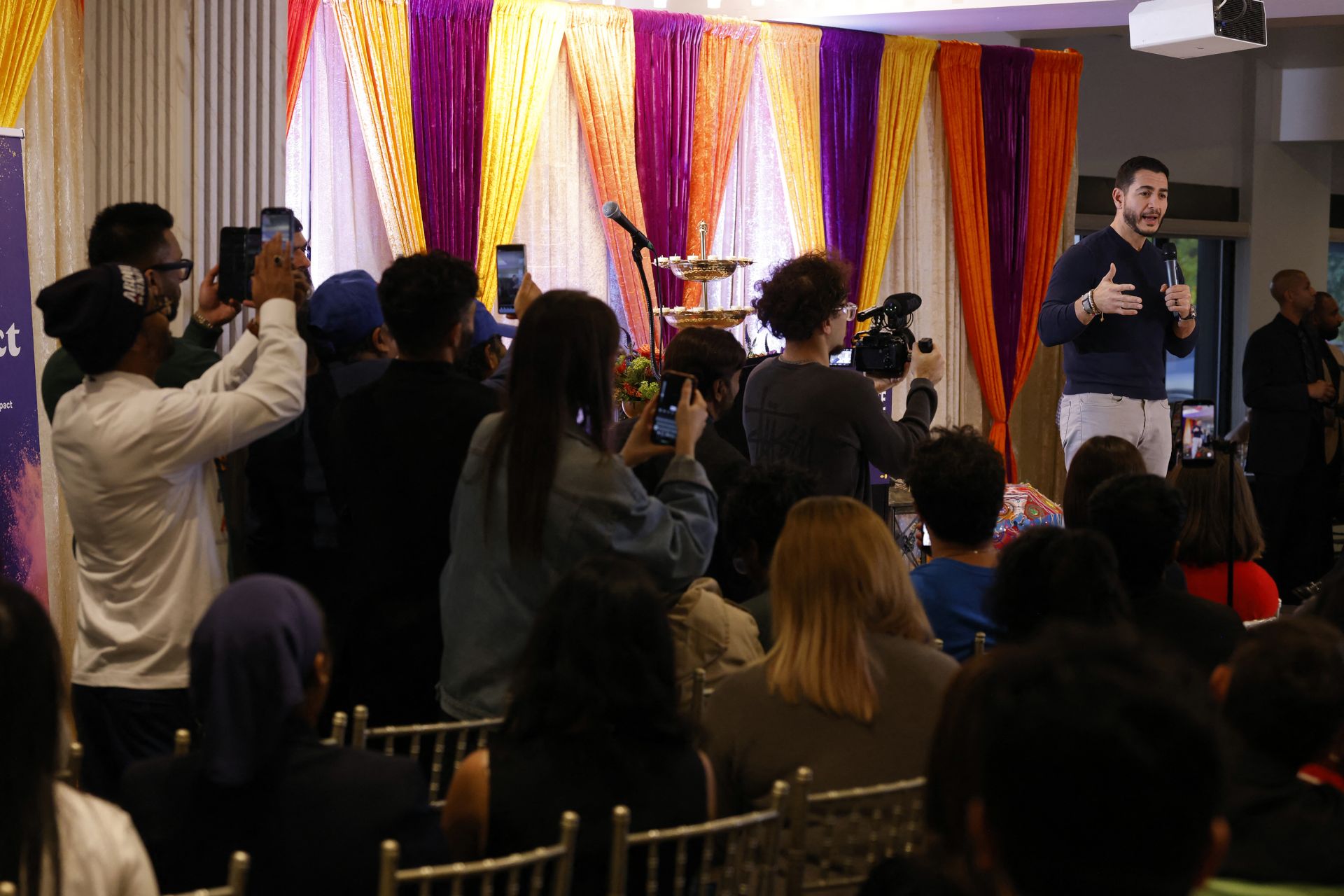
Candidates across the spectrum have recognized the power and ability of South Asian voters to bring them decisive wins, particularly in the wake of Mamdani’s New York mayoralty. In New York and beyond, candidates like Orkin and El-Sayed (whose wife, Dr. Sarah Jukaku, comes from a prominent Indian Muslim family) have made pit stops at temples and attended religious festivities and celebrations. Organizations like Hindus for Human Rights and SACRED stumped for El-Sayed and hosted campaign events, with many South Asian supporters traveling across state lines to canvas for him. (El-Sayed was on the list of 90 politicians who signed a pledge to reject any money linked to the RSS).
Texas, where the hate against Indians and South Asians spiked sharply before the elections, saw the progressive James Talarico making dosa, the classic southern Indian rice crepe, in an attempt to court the community. Before the blue wave that flipped Texas, a deep-red state, over 66% of South Asian registered voters there said they supported Talarico. Notably, Bo French, the Republican candidate whose post targeting South Asian students drew national outrage, also lost his race to Democrat Jon Rosenthal, who called the result proof that “the politics of hate no longer work.”
Despite Mamdani’s historic win in New York, buoyed in part by South Asian support, these races, along with several others across the country, point to a growing dissonance among South Asian voters who no longer feel content voting for someone just because they look alike. “Usha Vance may be Indian, but her husband is going on white nationalist rants at election rallies. And there’s a very clear one-to-one on how that affects community safety,” Ria Chakrabarty, executive director of Hindus for Human Rights Action, told New Lines. “There’s still going to be people who say, ‘Oh, well, we should support the Hindu American, the Indian American, the South Asian American,’” she added, “but I think in the way that so many people are just dissatisfied with the political status quo.”
The pull of identity can still be powerful, especially for communities, like South Asian Americans, which remain focused on representation in political spaces and beyond. “I think the community understands that when we don’t have representation, it leaves us vulnerable to policy changes that might affect our community that we have no power in stopping,” said Chintan Patel, executive director of Indian American Impact, which he described as center-left. Ultimately, he told New Lines, South Asian voters choose candidates who align with their values.
South Asians, especially Indian Americans, are known to hold different politics in the U.S. than they do toward their home countries. Even with some returning to the Democratic fold, a majority of Indian Americans support the Modi government in India. A study published this June in “Political Behavior” found that 57% of Indian Americans, including 47% Democrats, supported Indian Prime Minister Narendra Modi. (The researchers singled out Hindu Americans as exhibiting greater support for Modi and his politics, compared to Indian Muslims, who hold consistently liberal views in both American and Indian contexts.)
The campaigns of Mamdani in New York and El-Sayed in Michigan were marked by eye-watering attacks on their Muslim identity, from Republicans and Democrats alike. Their staggering wins suggest voters’ distaste for anti-Muslim rhetoric, a shift bound to register within the larger Democratic establishment. The recent widespread protests against Modi may have somewhat shifted that support. Either way, the new Democratic party is also likely to be more attentive to calling out Islamophobia, which the Modi government has normalized during its 12-year run in India and, by extension, within certain Indian-American circles in the United States.
In 2023, Thanedar launched a “dharma caucus,” which included Hindus, Buddhists, Sikhs and Jains (all major Indian religions) but pointedly left out Muslims and Christians, mirroring Indian politics within Indian-American politics. Although it was quickly denounced by South Asian civil rights groups, Thanedar’s attempt reflected the larger social trends within certain Hindu-American spaces. Thanedar, Krishnamoorthi and Rajkumar’s losses in the primary effectively signal that the widespread Biden-era reign of a certain milquetoast liberal South Asian Democrat might be over, replaced by the emerging popularity of more progressive, issue-based politicians like DSA-backed Mamdani and Los Angeles Mayor-elect Nithya Raman, along with progressive candidates like Aisha Wahab and Jyot Singh, who won their races in California and Georgia, respectively.
Consequently, for progressive South Asian organizations, this shift has provided yet another opening to muscle their way past the more centrist liberal Democrat South Asian organizations that profess Democratic values in America but shore up donations to Hindu nationalist organizations in India. After RSS chief Mohan Bhagwat’s rally at New York’s Madison Square Garden in August, Hindus for Human Rights Action and SACRED Acts announced that 90 American politicians had signed a pledge to refuse donations linked to the RSS and its affiliates.
Compared to 2023, when Modi received a roaring bipartisan welcome in the U.S. Congress, facilitated by Democrats like Ro Khanna, now among the 90 politicians on the list, the new South Asian political landscape appears more progressive and centered on fostering connections not only within the U.S., with Black, Middle Eastern, Latino and working-class communities, but also globally, “creating bridges between progressive movements around the world and in the U.S.,” added Chakrabarty. “There’s a hunger to reclaim Hindu spaces from Hindu nationalists. I know people who are my age and a little older who want to teach their kids how to be anticaste … and that makes them want to have better Hindu-American representatives,” she said. “It is an exciting time.”
After historic midterms, in which Democrats have won both the House and the Senate, flipped key states like Texas and North Carolina, and elected a string of firsts — the first Black woman governor, the first Native American woman governor, the first Muslim senator and the first openly gay man to the Senate — progressive politics in America has entered a new chapter. Yet unlike before, when checking off identity boxes seemed enough to qualify as diversity, this election result is a clear sign that America is looking for true accountability and support from its politicians. No longer can South Asians cruise through elections simply based on their background, while ignoring their base in favor of wealthy donors. South Asian progressive politics may be an idea whose time has finally come.
Become a member today to receive access to all our paywalled essays and the best of New Lines delivered to your inbox through our newsletters.